
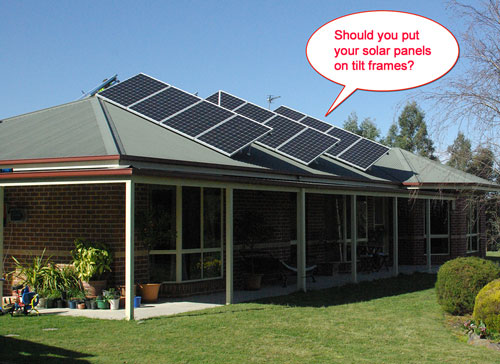
Tilt frames maximise energy yield, at a price.
Here is (another!) really common question that I get:
“I’ve got 3 quotes for solar: The first company says my roof is at the wrong pitch and wants to charge me hundreds of dollars extra to put my solar panels on tilt frames to optimize the amount of electricity I get. The second mob say it is fine to just put the panels flush on my roof and the third guy says that, yes my roof isn’t at the perfect pitch, but the best solution is to mount them flush to the roof and simply add an extra solar panel to make up for any reduced power output.
Now I’m really confused! Help!”
The problem here is that there are 2 extremes of solar installer in my experience:
At one end of the spectrum you have The Solar Purist. He is only happy if the solar panel is positioned for the absolute optimum power output – he is a perfectionist, highly technical, and has been in the industry since the dawn of solar, when solar panels cost 10 times what they do today. He thinks a few hundred dollars is a small price to pay to squeeze a bit more power out of those precious solar panels. And please, never, ever suggest to him that he uses a non-German inverter. Or feed him after midnight.
Then at the other end of the scale – you’ve got the “She’ll Be Right” Solar Installer. He just wants to get the install done. If you’ve got a roof, and it doesn’t face south and it’s not completely shaded he’ll bang the panels on, and move on to the next job.
I would argue that the best installers for your home are somewhere in the middle. i.e. ones that will give you a safe install that is not “Gold Plated” but will still maximize your return on investment.
In terms of whether to install tilt frames or not – this means that a good solar installer should show the financial consequences for each option and let you decide whether tilt frames are a good investment or not.
So let’s look at a typical scenario where tilt frames would be an option and see which of our 3 original options makes the most sense from an economic perspective:
To Tilt Or Not To Tilt
That is the question. Whether ‘tis nobler to suffer the slings and arrows of the solar purists, or just get the best ROI…
Sorry.
How to work out if tilt frames make sense or not:
Imagine you have a house in Adelaide (lucky you!) with a North facing roof that has a very shallow slope of 10° and you want to install a 3kW system.
The perfect tilt angle for solar panels is the same as the latitude of the install location. Adelaide has a latitude of 34°.
The Australian Standard for installing solar (AS5033-2014) recommend a tilt-angle within 10° of the latitude. So if we follow those guidelines, we’d have to use tilt frames for our solar panels right?
Panels at the perfect Angle:
If we crunch the numbers with my favorite free, online solar power analysis tool, PV Watts, then we can quickly work out that 3kW of north facing solar panels at the perfect angle of 34° will produce 11.9kWh per day averaged over 1 year. If we value our electricity at 25c per kWh, then that earns us $1088 per year.
Panels at 10°
If we crunch the numbers for 3kW of North facing solar panels at only 10° then we discover that we get 11.4kWh per day which makes us $1041.
How much do tilt frames cost?
Assuming our 3kW system uses 250W panels, the extra cost of tilting 12x250W panels should be around $300.
So to make an extra $47 per year, we are going to be spending $300. About a 6 year payback. Whether you think this is a good investment is completely up to you. But your solar installer should give you the numbers so you can make an informed decision!
I personally wouldn’t bother, mainly because, if you use tilt frames on your roof, you can fit fewer panels on that valuable roof space. Why? Because you need to leave extra space between the panels so that one row of panels doesn’t cast a shadow on the row behind it. I also think that tilt frames are butt-ugly. But perhaps that is just me.
What about adding an extra panel?
The third option you have – is to make up for any lost power by simply adding an extra solar panel. A few years ago, when panels were 5x the price, this would have been an insane suggestion (and some old school solar installers still think it is a terrible waste!). But in 2012 it can make a lot of sense.
The cost of one extra 250W panel will be about $400. Installed flush to our roof, this 13 panel system will generate 12.36kWh per day and make us $1128 per year. So your extra $400 investment is returning you an extra $169 per year compared to the 12 panel system at 10°. And an extra $128 compared to the 12 panel system mounted on tilt-frames at 34°.
I’d say that the extra panel is a much better investment that the racking. The third installer was right!
Note: One thing that you don’t want is completely flat panels (angle = 0°). You want them to slope at least 10° so that the rain flows down the slope and helps the panels self clean.
Are you a fan of tilt frames for solar panels? Then let rip in the comments below!
 About Finn Peacock
 RSS - Posts






My retailer has tried to charge me $800 to upgrade my smart meter to take the TFIT tariff and connect me to the grid. When I argued the cost I checked with PowerCor and they quoted $238 to change the meter and $32 to reconfigure it. I am now in my third month waiting for the upgrade and connection to the grid. The next argument will be wether I am going to be compensated for the solar credits on the meter.
I have now been charged over $450 for the meter upgrade and I have not had the meter upgrade or connection to the grid. The impersonal continual threats to disconnect me via voice actuated smsing is ridiculous.
AGL customer service is located in Malaysia or somewhere similar. The girls are nice but with the amount of problems I have had and the average call duration of one hour being passed from department to department is absolutely absurd.
find another retailer.
Should’ve refused the ‘smart meter’ in the first place. They’re bad news from ANY perspective.
Keep in mind the stand-alone option.
Sometimes you get what you pay for. Sometimes you get what you DON’T pay for.
Origin tried the same game with me long ago, and I simply informed them that I would pay my bill when they sent me an accurate ~ and verifiable ~ account, and not before.
The veiled threat to disconnect me floundered when I pointed out that I had a pair of bolt-cutters to hand and would be happy to disconnect forthwith ~ and charge them rent for storing THEIR meter on MY property. They’re well aware that in this day of VERY cheap component prices having customers go to a stand-alone system is a real risk. And contagious! Your neighbours/friends and their’s will be considering going down the same track if they see it working for you.
Anyway, it took ’em three days to solve all the ‘insurmountable’ issues AND hand me a cheque for the power racked up on the analog meter from the date of installation.
Never forget:- It’s YOUR money, Ralph…and THEY want it.
(I could never understand why cash-carrying customers agreed to ‘Terms and Conditions’ dictated by the people who wanted THEIR business [read: money!]! Remember : “He who pays the piper calls the tune”??)
Fabulous story and it does show that we as individuals need to stand up to the corporate giants and hold our ground, as you say, in the end it’s them that want our hard earned money.
After a telco’s botched install I was somehow responsible for the cost to fix it. I gave them two options, come and fix it or come and collect their ‘equipment’ from the street. They fixed it.
Excellent article and very true. However I think you under estimated the cost of tilt framing a 3.0kw system. The whole price for a decent tilt kit(one which comes with an engineering report ) would be almost $300 and then there is the extra time to install it properly. Nothing worse than seeing an ugly tilt frame system or the panels all stressed and twisted. Then thee also time for council approvals(This can be a pain in the but with some councils) Most installers would charge $800-$1000 extra to tilt frame a 3.0kw system
This extra cost for the tilt frames is more reason not to waste your money on them and go up 1.2 x inverter output (can still get stc rebate for the extra panels)with extra panels
Therefore my opinion is no to the tilt frames.
Thanks again for your comments. I just have one final question (i think). I have noticed that on cloudy days my inverter is producing lets say 1.5kW. When the sun comes out, this will increase rapidly to approx 3.5kW. If the sun stays out, the production will slowly reduce and settle around 3.1kW. can you tell me why this happens?
yes – solar panel efficiency decreases with temperature:
http://www.solarquotes.com.au/blog/the-truth-about-solar-panel-performance-and-temperature/
Hi Finn,
Your articles and commentary on solar panel efficiency are very enlightening and your web site is a great resource for solar panellists.
I had 16 x 245W rated panels installed in July 2012. they are arranged in a straight line across a northern roof at about 25 deg pitch in Brisbane. The output should be up to 3920W but I have seen the output beyond that ‘maximum’ and over 4100W.
Is this due to clouds passing across the sun – cooling the panels – then moving away allowing the sun to shine on cooler panels with resulting short term spikes in output?
If this is correct, then warm days with intermittent clouds could potentially produce more power from the panels in comparison to a continuous warm and clear day. Do you have an comment re this?
Many thanks
This has a few names, Lensing, Edge effect or just cloud effect. Just the clouds reflecting more light than normal sunlight
Another factor is the focussing effect of the sunlight coming through the edges of (some kinds of) clouds. (and probably other factors). My grid-connect system has been seen to produce about25% over its rated value.
Hi, Finn. First, many thanks for an informative site. I’ve now used PVWATTS to model my potential installation options on a system yet to be installed, neither of which are north facing (due to shade issues). Noting your firm views on south angled panels, I thought I’d offer my results for interest. My roof space and shade limited options are either East azimuth at an average 30degrees (3 panels@25deg plus 4@33deg) or (horror) South azimuth at 9.5deg. PVWATTS actually generates a very similar average annual output (~2.3MWh for 1750W Pmax, in Perth WA) for both scenarios. The optimal 32 deg North az. option would yield ~2.7MWh (17% more). The East facing install is slightly better in winter and, obviously, peaks in late-morning. The South facing slightly better in summer and peaks around midday. I plan on opting for the South facing as it has the simpler install (one group of 7 panels) and minimal risk of shade developing over time as trees grow slightly. I had originally considered tilt frames on the South roof, but at $480, it was more cost effective (and prettier!) to add a $300 panel instead. Can you offer an opinion if you think I’ve overlooked some angle (sorry) on this? Thanks, Andrew
Hi Andrew,
Now solar panels are so cheap relative to a few years ago South pacing panels can make sense in Australia. Especially if you have a very small roof pitch like yours.
PVWatts is pretty accurate – and you’ve done exactly the right thing. Quantified the energy yield before deciding where to stick the panels – I wish everyone was so scientific in their approach instead of the wild assed guesses you often see.
AT the end of the day a South facing solar panel in Australia will still give you more power that a perfectly oriented panel in Germany!
Finn
Hi Finn,
Cheers for that feedback. I’ve now used your online cost calculator – very neat – and confirmed my own estimates were in the ball-park of a 5yr ROI (at 55% export) at the likely yield. Encouraging!
Other links on the site have led me to NASA’s irradiance data, and I’m pretty amazed to find we get ~950W/m2 peak in January here in Perth. As you say, wouldn’t happen in Germany! And means I won’t kill the proposed 1.5KW inverter (1800W Pin max) with 7x250W (Pmax) panels.
Once again, thanks for your comprehensive site. I don’t know where you find the time but I hope it pays you.
Cheers, Andrew (also an Engineer, which may explain the approach!)
Consider spending a couple of hundred dollars building a pergola, potting-shed, carport, etc. to EXACTLY suit the angles/etc. you need.
A frame from recycled treated-pine poles or somesuch (I’ve used 65mm gal. pipe ~ and clips ~ from some dumped scaffolding). All you need is the frame ~ the solar-panels can provide the roof.
Discarded powder-coated bed-frames (usually 2″ angle) are also most useful for this kind of exercise ~ and with a bit of imagination can be used as a base for an tilt-adjustable string of panels.
Nice site – thanks for the info!
I’ve just checked PVwatts for my house in Perth.
We’re planning a second-storey addition with a single-slope skillion roof (facing 25 degrees west of north), and I wanted to check the impact of the roof slope for future solar panels (given that increasing the slope of the roof also increases the wall area, which obviously increases the cost!) …I’m a structural engineer!
Anyway, fiddling with PVwatts, the optimal inclination (for annual power production) for solar panels on my roof would actually be 25 degrees, although the latitude is 32 degrees. (A hunch that this would be the case, due to getting more sun in summer than in winter, was why I thought I’d check it.)
For anyone planning a stand-alone system, where the winter power production might control size requirements, the June power output (lowest for the year) is maximised at an inclination of 53 degrees.
At the 15 degree slope we currently have on our plans, we would get get 98.7% of the theoretical maximum annual output (and 81% of the maximum June output) …friendlier to walk on than a steeper slope, too. I suspect we’ll stick with the 15 degree slope… 🙂
Cheers,
Liz
…I guess my main points above are that:
a) your latitude would only be your “ideal” inclination if you get even solar irradiance year-round… which would be unusual – so it’s worth checking PVwatts or something similar if you want to know the “perfect” inclination for your site, and
b) there are other (non-electrical!) factors which work against requiring builders to always set roof pitches to whatever the theoretically “perfect” angle might be, anyway 😉
Fantastic job, anyway – really appreciate all the work you’ve put into it!!! 🙂
Liz
A good article and although many of the input values may vary the underlying assumptions are very accurate. I used PVWatts to assess my install and found that the cost of an $800 tilt frame would take 10 years to recoup the while one extra panel would take 2.5 years and two would take only 2.6 years. I went for the two extra panels obviously.
The ideal fixed ‘perfect’ angle will never be perfect as it’s just a compromise between the ideal summer angle and winter angle. Wouldn’t it be nice to have an affordable three position adjustable racking system.
Hey Steve…
It’s been done ~ long ago. https://open.abc.net.au/explore/82086
Cheers
Thanks – some common sense and pragmatic info in this article. Very helpful.
Hi Finn
Thank you for all your comments for a novice they are extremely helpful. I am building a house that faces North East and has a flat roof falling away from the street (SE) at a 1.5 degree pitch. I am close to finalizing a decision I have 2 questions
1. The installer has said he would not bother with tilt frames as any loss of efficiency in winter would be made up in summer i think he quoted a figure of 8%. Does this make sense? I have no shading issues.
2. I am buying an expandable and battery ready 5kW ENphase Micro Invertor with Trina 260w PC05A P-Honey Panels less the meter box for $8000 is this a good price
1. Yes – expect to lose 8-12% averaged over the year if your panels are flat (1.5 degrees is essentially flat).
The disadvantage of flat panels are: a) they may need more cleaning – as the rain will be less effective without a decent pitch. and b) you will get a much lower winter generation – which will affect your self consumption which can affect payback as described here:
http://www.solarquotes.com.au/do-i-get-paid-for-my-solar-energy.html
2. For a well installed 5kW system with Enphase and good Tier 1 panels I’d say $8k is a fair price.
Hi Finn thank you for the information, if i can trouble you for your opinion once again
I have read that Fronius systems will only be compatible with their own batteries and possibly the power wall.
I have a choice of two systems very similar pricing
Option 1: 5.04kW Q-Cells solar system using a 5kW Fronius Symo Hybrid inverter that can be expanded up to 8kW and includes the Fronius Energy Meter and monitoring to be able to assess your energy consumption and production,
Option 2: 5.04kW Q-Cells solar system using 19 X Enphase M215 micro inverters and includes the gateway to monitor energy production.
could you give me some insight as to which you would choose or would you recommend a different set up?
Both are excellent systems. If you are looking to add a Powerwall then the Fronius is a safe bet. As you say it will also work with their proprietary batter. It should be able to work with many other new battery systems (like LG and Samsung) too with a software change (but it is not guaranteed).
The Enphase battery will work with their AC battery, due next year – although I think that will require a new comms unit that incorporates the metering required to control a battery. Also the pricing for the Enphase battery is not available yet.
If you don’t have shading issues (which microinverters handle very well) and are keen to add a battery pack later, then the Fronius is a good option.
Hello,
I will be getting an almost-flat roof—–3 degrees,and have been told already that the cost of a rack outweighs the cost of an extra panel (also that a rack of panels are likely to fly off the roof in a high wind!!!!!). But I have also heard that the panels flat on a metal roof will become overheated. Why could one not prop them up to 30 degrees (this is Sydney) on a nice wedge of polystyrene, set in and secured by a small metal frame? Is this a silly idea?
Thanks, R
HI Robyn,
They need an air gap underneath for cooling – at least 100mm is advised.
Hope That Helps,
Finn
Too simplistic! You’re using the equally out of date idea that $ averaged out over a year is the right comparison but tariffs are so low this is now nonsensical. It is much better to angle more for winter and at the same time more for mornings and afternoon, when you can USE the power. Forego some mid day mid summer efficiency to improve output and therefore usage and value for money in these other times. Now the problem is all of the modelling has not caught up to this inconvenient truth yet…
Hi Finn,
Thank you for establishing a very good community corner to exchange ideas and valuable PV watt calculator. I am planning to have 6 kW system on my 7deg. (flat) roof without any tilt(after considering your PV watt calculator). I have the solar panels and 24 Lead acid batteries(100Amph each) to power the house at day and night.
House consumes average 35kWh/day currently. I have few questions:
1. Which meter to be connected to the net meter as I have three meters for the house?
2. Can you please let me know the size of an inverter, brand etc. and battery charger for this purpose?
3. How much would be the rough installation cost for the work to connect to the meter board as meter board is closer to the Battery storage and the panels are sitting on a dwelling roof?
1. If you have 3 meters then you probably have 1 meter per phase? If so – all 3 should be replace with a single, 3-phase net meter which will make sure you are not out of pocket when calculating exports across the phases.
2. I would look at a 3 phase Frronius Symo Hybrid inverter which will also charge the batteries (although you’ll need your installer to check the specs of you batteries are compatible)
3. I really can’t say as there are a lot of variables – get 3 quotes!
I’d be interested to hear your response Finn to the comment by Michael Willicombe above. Our home is cool by design, so we are unlikely to use huge amounts of power in summer. Winter is a different story, when we need to run a central reverse cycle system during the day for heating much of the time. Would it make sense for us to tilt our panels more to optimise for winter sun?
Hi Finn,
We are about to have our hail damaged roof replaced and it seems like an ideal time to change our flat mounted panels to a decent angle (which I think is 27 deg) here in Brisbane (the face N/NE). We have had a quote of $600ish to mount our 8 panels on new racks. This now seems quite pricey. I also had not considered an engineering certification on the rack. Is this standard?
Cheers
Olly
Hello Olly, Ronald here.
A good rule of thumb is to set panels at a location’s latitude. But while this rule is good, it’s not quite perfect and the ideal tilt for Brisbane should be between 23.9 and 25.3 degrees for maximum generation. But the difference between that and 27 degrees is tiny and hardly worth worrying about. It’s about 2 kilowatt-hours per year per kilowatt of panels.
Panels at 25 degrees will only produce 8.2% more power than those at 0 degrees. Ignoring the effects of dirt, if your system is 2 kilowatts even if you have a 44 cent feed in tariff and export all the extra electricity which is unlikely, at best you will receive about an extra $100 a year in feed-in tariff.
But if you find dirt is having a major impact of your solar panel output because they are laid flat, then tilting them can allow the rain to wash them clean may result in a considerable increase in their output. It’s also better for the panels not to allow water to pool on them. A 10 degree tilt is enough for rain to clean them and, ignoring dirt, will provide more than half the increase in output from an optimal tilt of around 25 degrees.
To be sold in Australia tilt racks or any kind of solar racking has to be certified by the manufacturer.
Hi Fin _ I very much appreciate your info.I am totally into solar and have 25 panels facing north giving me a positive cash flow. (At least prior to my recent LG Chem battery installation ….) I now have 2 string capacity available on a Redback inverter but I only have a south facing roof for more panels. My installer tells me I can fit 9 panels on it but don’t yet have a quote. I feel a tilt would help and if not too expensive would not face problems from ugliness or strong winds. I live 100 kms north of Sydney. Am I kidding myself to consider these extra panels. My F.I.T. is 12.5 cents. Your comments would be much appreciated.
Hi Ted, Ronald here.
If you laid the panels flat on your south facing roof and it has a 22.5 degree tilt, then for each kilowatt of capacity they would generate an average of 2.64 kilowatt-hours a day. That is 31% less than north facing panels. So even without tilt mounts they will still generate a little over two-thirds as much electrical energy as north facing panels. If they are tilted they will perform better but that will increase the cost of installation and you may not be able to fit as many panels as if they were laid flat against the roof. So you’ll have to weigh up the cost and benefit of each approach and see which best meets your goals.
If you want to check the effect of different tilts on output you can use the PVWatts site:
https://pvwatts.nrel.gov/
Just enter Sydney for your location as I am certain that is the closest point to you it has data for.
Hi FInn
Your site is amazing and certainly helps in separating the the good from the snake oil salesman.
I do have a question as I am going through the quote process at present. MY roof faces due south on a pitch of around 20 degrees. SHould I get get tilt frames installed – some say yes and others no – so i dont know who to believe.
I live on Lake Macquarie in NSW.
Hope you can throw some light on the decision for me.
Hi Gary, Ronald here.
Solar panels in tilt frames at an optimal angle will generate around 40% more energy than if they were laid flat on a south facing roof with a slope of around 20 degrees in your location. Their output will also be more consistent through the year but if they are laid flat their output will be high in summer and very low in winter. This may make tilt frames appear to be a sensible idea, but with tilt frames you will be able to fit far fewer solar panels on your roof. So if you want a small system tilt frames could be cost effective, but if you want a large system you may have to lay them flat on the roof to fit the panels in. Because tilt frames tend to be a little pricey and because the STCs that reduce the cost of rooftop solar are based upon your panel capacity, you may find you are better off having them laid flat. But the only way to be sure is get some quotes:
https://www.solarquotes.com.au/
And see what kind of offers installers provide.
Aside from the fact that tilt frames look ugly, panels at a shalllow angle perform much better under cloudy conditions.
Nothing exasperates me more than seeing panels installed by so-called experts that have tilt frames to add a few degrees of tilt on a roof that is already tilted North at about 15 Degrees, or twisted at an angle across the roof to aim slightly more Northwards.
Don’t these “experts” understand cosine law?
Finn or anyone, is adjustable tilt frame system exist?
I am thinking it will be a good idea to tilt the panel toward the sun in winter and when summer comes, adjust the panel near flat or 10″ to maximise the output.
The only issue i can think of is that the installer may not like the idea to avoid complaint if the panel may not secured because the panel owner keep making changes to the tilt angle over time.
Any input?
Thanks & Regards,
Jackson
Hi Finn/Ronald,
Our house is located in Melbourne and the 10 degree roof pitch faces east (slopes down from west to east). The sales manager is advising tilt frames facing north, but the installer thinks it’s not worth it. The sales manager has quoted a $400-500 saving if we lie the panels flat. We’re getting a 6.6 kW (20 panels) system. There is a lot of shade on the north side of the roof, so the panels will go toward the southern side of the house and carport. There are no significant cosmetic issues.
With all the issues with tilt frames with extra spacing and shadows etc, I was thinking of going with lying them flat. The installer said we’d lose around 10 to 15% without the tilt. Also, I was thinking that the installer will save decent time without tilting, and I was wondering if this saving is part of the $400-500 saving given to us.
Thanks Scott
Hi Scott, Ronald here.
Using the PVWatts site I see that if east facing panels in Melbourne at 10 degrees are changed to north facing panels at 10 degrees, assuming identical shading conditions, they will generate 7% more. If they face north at a tilt of 30 degrees they will generate 13% more.
Normally I would expect tilt frames to add more than $400-500 to the cost of a 6.6 kilowatt system. But if that is how much extra they will cost you then they could definitely be worth it. I recommend making sure that is the actual price difference.
If you have 3 phase power a better option is likely to be to install a larger system without tilt frames. If you have single phase power and are limited to a 5 kilowatt inverter you can look into installing a larger inverter and export limiting it to 5 kilowatts. This will allow you to install over 6.6 kilowatts of panels and normal household loses very little solar production if they install say 8 kilowatts of panels.
Hi Ronald,
Thank you for replying so promptly. All good thoughts to ponder.
Much appreciated.
scott
Hi Ronald,
Just a quick question – does the length of the conduit from the panels to the inverter make any difference to the overall performance of the system? Does a longer conduit dilute or decrease overall performance?
Thanks in advance,
Scott
Longer DC cabling from the panels to the inverter will reduce performance due to a small amount of energy being lost as heat in the cabling. The greater the cable length the greater the total loss. If possible the distance should be kept short. It is usually better to keep cabling on the DC side short and make the AC side from the inverter to the grid longer.
Okay, so the inverter doesn’t need to be right next to the metre box!?
That is where it’s often located, but it doesn’t have to go there. Note that if it’s not near the meter box it can complicate the installation as DC panels have to be run from the solar panels to the inverter and then AC cable has to be run from the inverter to the meter box.
I agree that having tilt panels on a house roof is butt ugly. Also agree that the rows would need to have a gap between them to stop casting shadows. I also agree that adding an extra panel … or 2 , to a straight to the roof system is a better investment over tilt racking. So the only positive for installing tilt panels , is better air flow, as panels can get hot in our summer climate. I’m considering going with ‘sunpower’ panels . They are expensive . I also thought to add lesser expensive brands back part of roof to catch morning power. So all the sunpower panels go on the north face.
H[ Ronald
i am in the process of selecting a company to install about 19.98 kw solar system for my house at castlehill ,NSW . The system consists of 54 panels of longi 370 w( LR6-60opH,half cut and 20 kw Fronius inverter ) and the system will be installed on a metal roof with a pitch of 7 degrees towards the south . The roof is sloping from north to south . the facade of the house is facing north . I got four quotes . three want to install a tilting frame and the fourth does not . one guy said he cannot fix the total no of 54 panels and only 51 panels can be fixed .
Please advise( urgently if possible ) if tilting frame is required or a must and what will be the loss in production if panels are fixed on the roof
regards
Fathi Alaaiddin
Hi. A 19.98 kilowatt system with with panels laid flat on a 7 degree slope to the south will generate an average of around 23,550 kilowatt-hours a year in Sydney. If the panels are instead tilted at the ideal angle of 31 degrees they will generate around 28,300 kilowatt-hours a year or 20% more. Because tilt frames can add considerably more than 20% to the cost of a solar system it may be economically worthwhile to lay them flat against the roof. Also note it may be possible to fit more panels if they are laid flat, which can potentially make up for the decreased generation.
Note that, all else equal, the reduction in output caused by laying the panels flat will mostly occur in winter.
Also note that panels installed at a tilt of less than 10 degrees may not adequately self clean thanks to rain. You will need to allow for the need to occasionally clean them if they are laid flat on a roof with a 7 degree tilt. Winaico make panels with corner water drains that reduce the problem if you’re interested.
Hi , it looks like you already have over one tonne of weight on your roof. Please don’t forget you need to take wind loads, of at least 30% to 60% depending on the gusts, into account. To do so, check the structural stability of your roof I.e. how much weight it can hold.
In regards to your question, I have 10 kw on my steel roof with a 7 deg angle. A 10 deg angle is ok but there isn’t much of a gain. It’s better to keep the panels on the surface of the roof as it already has a 7 deg inclination. 10 kw power panels and storage makes a better and economically viable system.
I also recommend that you get a battery system to store the energy generated so you can power your house at night. Any extra energy generated will go to the grid where they will convert it into credits.
I’m getting no bills currently and tonnes of credits.
We are in Melbourne SE suburbs with a north-facing roof (tilt 22.5; rotate 77.5). I have 2 quotes:
1.Solis-1P5.0K-4G D MPPT Single Phase; 20 JA Solar 330W half cell JAM60S10-330/PR/100V 6.66; 1 racking system (Do we need this)?This quote also includes height safety barriers (what are they?) $2000
2. Sunpower P Series BLK SPR P19 325 BLK Monocrystalline; Inverter Fronius Primo 5.0.1 5000W $4300
My understanding is 1. is the cheaper option and 2. is better quality.
Do we need a racking system and height safety barriers?
Do you have any advice based on the above? Thank you
Jenny
Hello Jenny
Racking refers to the metal rails and clamps that hold the solar panels to the roof and is necessary. The height safety barriers are temporary height protection for the workers installing the system that add to the cost of installation.
Solis inverters and JA solar panels are lower cost solar hardware, but I consider them to be reliable and good value for money. However, I would expect the more expensive Fronius inverter to last longer while the JA panels have a 12 year product warranty compared to the 25 year product warranty of the SunPower panels. While I expect the JA panels will last a lot longer than 12 years, the longer SunPower product warranty can give more peace of mind. Whether or not this is worth the extra cost will come down to your personal preferences.
If you received these quotes through us you can be confident the are from installers who do high quality work. If you didn’t get them through us I recommend checking their online reviews to see if they do good work, paying particular attention to how they respond when people have problems.
Thank you Ronald. That is most helpful.
Jenny
I received 3 quotes from solar installers you recommended. Other than 1 who recommended me to get tilt frames, the other 2 kept convincing me that laying them flat on my 1 degree tilt flat roof has absolutely no issues.
What is your opinion on spending on more panels against getting tilt frames like in my case of flat roofs?
Hi Andrew
I am very concerned about installers saying laying panels flat has no issues. They are required to inform the homeowner in writing that panels installed at under 10 degrees are likely to need regular cleaning. Can you let me know who the installers were? If you don’t want to tell me here you can email me at:
[email protected]
HI Ronald,
I get the idea of adding more panels to offset the sub-optimal physical installation, but I understood the authorities limit the oversizing of panels to 133% of nominal inverter input, so a 5kW system can have max of 6.65kW of panels (inverter specs permitting).
So I planned on enough panels with rated total output approaching the maximum inverter input x 1.33. But they will be flat and facing West, and so never get close to maximum rated output. Am I allowed to increase the number of panels to offset the installation losses??
Hi Roy
You’re not allowed to add panels to make up for losses from less than optimal panel positioning but — depending on where you are — you may be able to install a larger than 6.6 kilowatt system provided the inverter is export limited to 5 kilowatts. If the total panel capacity is 10 kilowatts or less any losses that result from the export limit are minor.
Here are the connection rules by region, if you want to see if this option is available to you:
https://www.solarquotes.com.au/grid-connection/
Hi Roy, some extra comments on flat roof panels.
I have a concern about installing flat panels on a low pitched roof. ((8% to west)
It is on an 8.5m x 5.4 m shed with a small old array on it now. There is a large gum tree nearby, not a shading issue but a leaf drop one. In the past the panels (Kaneka?) were flat, leaves accumulated under the panels (as well as on them) and this caused the corrugated iron roof to leak. So I designed and built tilt frames and had the panels removed and replaced. Hideously expensive. I had to submit design calcs to the council of course , and tie the roof down.
We are contemplating a larger modern array, and I favour tilting it to reduce the leaf problem. Also for anyone who like me is no longer able to clean them themselves, there is a cost for cleaning to consider with flat panels., Just how frequently flat panels would need cleaning I don,t know. We also have a fairly dusty environment, (a landscape supplier across the street from us.)
.
Thanks Ronald and Kevin.
Ronald I am in the Brisbane area so should be able to oversize the inverter. However, I will probably go to a battery with at least one of my inverters, as with a battery, I can go up to about 10kW of panels with this brand of 5kW inverter (I assume the inverter limits the export in this case).
Kevin, regarding the flat panels – I agree with your concerns too. The installers so far want to put the panels flat (or flat on the roof at 2 degrees), which I don’t want to do for a few reasons. I am approaching that age where climbing on the roof is considered crazy (by others), so cleaning will be a likely additional expense for me as well. Just the sort of expense I am trying to reduce for the future.
But the issue I have at the moment is finding an approved rail attachment design for my garage “insulated panel roof”. So far I have only one design by my roof manufacturer, and it allows for tilting using standard rail systems, but it is outdated with respect to the panel dimensions now available, and they are not interested in updating their design. I’m still chasing this.
Solar Panel Tilt Frames: Are they worth it in my case…?
Our house, in Tranmere Tasmania, has north and south facing roofs pitched approx 10-15 degrees. North roof is much smaller and significantly shaded from neighbor’s roof from sunrise till approx 10-11am. South roof is never shaded and I’m yet to establish whether it’s larger size will comfortably accommodate tilted panels to avoid any shading from them on each other. Based on the above – do u think it’s logical to tilt mount panels to face north on the south roof vs flat mount on the north roof? Thanks for considering. If our address would help your advice, let me know and I’ll up it.
Hi DC
On a Hobart roof with a 15 degree tilt, south facing panels will produce around 74% as much energy as north facing ones. So their output may be similar to shaded ones on your north roof. But south facing panels will have low output in winter when electricity demand is highest, so that is a consideration.
Whether or not tilt frames on your south facing roof makes sense depends on two main things:
1. Can you fit more panels by laying them flat?
2. Is the extra cost of tilt frames worthwhile?
If you can fit more panels by laying them flat on your south roof, you are likely to be better off doing that. While the output per panel won’t be as high as if they were tilted, the greater number of panels will make up for that and you avoid the expense of tilt frames. If you could only fit the same number of panels whether they are laid flat or tilted, then tilting them will allow the panels to produce more energy and the decline in their winter output won’t be as bad.
Installing a larger system by putting panels on your north and south facing roof sections is likely to be optimal. Because Tasmanian homes are normally allowed to install up to 13.3 kilowatts of panels, most houses run out of roof space before they reach that limit.