
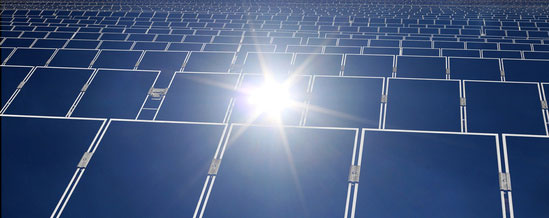
Picture: Thin Film Solar Panels on a solar farm in Germany
If you are looking to buy a solar power system and have done any kind of research on the web, then you have probably come across lots of people arguing over the pros and cons of Thin Film Solar Panels compared to the more common monocrystalline or polycrystalline solar panels. In a nutshell, there are 3 major types of solar panel technology on the market:
- MonoCrystalline,
- PolyCrystalline
- Thin-Film
It seems a lot of people are firmly in either the “Crystalline” or “Thin-Film” camp. And when discussing which panel is best, they can easily lose their objectivity with arguments along the lines of “Thin Film is the only way to go” or “Mono Crystalline and Poly Crystalline are junk!”.
I like to think I’m a bit more objective that that (although by the title of this post you can probably see that I do have an opinion!) so here is my rundown of both the pros and cons of thin film solar panels.
Problem #1 Very Low Efficiency Means You Need A Huge Roof
A thin film solar panel is typically half the efficiency of a monocrystalline or poly crystalline solar panel.
Now – if you have a north facing 35 degree roof the size of a 747 hangar – no problem!
But most people have limited space on their roofs (especially their North facing roofs), so doubling the amount of space you need for a solar system will be an issue.
And I would argue that as panel prices come down to offer cheaper electricity than the grid, that roof space is going to become an even more valuable resource. I can see a lot of people who have filled up their prime roof space with enourmous thin film solar panels having to rip them off and replace them with monocrystalline panels in a few years so that they can get enough cheap solar energy to wipe out their reliance on ever more expensive electricity from the grid (officially forecast to rise 37% by 2014).
You gotta feel for those people who were sweet talked by the Solar Shop salesperson in to filling their entire roofspace with 17 huge, square, brown Kaneka solar panels only to get a measly 1kW of power!
Problem: Thin film solar panels take up twice the roof space for the same power output.
Solution: Rent an aircraft hangar?
Problem #2 Immature Technology
I get angry emails from solar installers all the time for saying this. But the truth is that the current manufaacturing process for thin film panels has not been around for more than 10 years.
But they promise you that they will last 25 years plus.
How the @#$% can they promise that?
If you are buying thin film solar panels – please be aware that the long term performance of them is not as certain as monocrystalline or polycrystalline solar panels.
Problem: Thin film panel technology is less proven in the long term than mono or poly panels.
Solution: Get a cast iron performance guarantee from the manufacturer (Not the vendor – remember those poor Solar Shop customers…)
Problem #3 Nasty Manufacturing Process
The manufacturing process to make all solar panel types uses some pretty nasty chemicals. But thin film panels require a lot more chemicals that are a lot more nasty. And, to my knowledge, no one can guarantee that the cadmium (incredibly evil chemical) won’t leak out if a panel is cracked or damaged.
I’m a pretty pragmatic guy – but I would never collect water from a roof with thin film solar panels on it for that reason.
Problem: Evil chemicals used in the manufacturing process.
Solution 1 : Only buy solar panels from a company that get a good rap from these guys who score PV manufacturers based on how they deal with toxic waste.
Solution 2: Don’t collect water from a roof with thin film solar on it.
Problem #4 They are peddled as “shade tolerant”.
I gotta be honest with you – it is not just the smooth talking, commissioned salesmen that use the oxymoron that is “shade tolerant solar panels”. I’ve heard some guys I really respect in the solar industry come out with this bull.
A shade tolerant solar panel is kind of like a sun-tolerant ice sculpture…. No such thing my friend!
Solar needs sun. If you have shade on your solar panel, you don’t get power. If you have a location with shade issues, don’t put solar there.
I think what the guys who should know better really mean to say is that thin film have better “low light performance”. This means that their power output is slightly better when the sunlight is not 100% direct due to light cloud or haze. It does not mean that they will produce power when shaded!
Problem: People get thin film solar installed in totally inappropriate areas because they’ve been told that they are shade tolerant. The result is they are very disappointed with the power output because no sun = no power.
Solution: Get a full shade analysis done if you have any shade on your roof. And only get solar if the analysis shows it is worth it. Thin film panels are not going to help.
Problem #5 Higher Install Cost
Because thin film solar panels are so much bigger than crystalline ones for the same power, you generally are going to need many more panels on your roof. This means more work for your installers and much more mounting hardware, resulting in a much higher install cost – which usually more than makes up for the slightly chapter cost-per-watt of the thin film solar panels compared to mono crystalline.
In fact Home Power Magazine (#127) compared a 3kW install done with Kaneka Thin Film Panels, to one done with Sharp Crystalline panels. They worked out the the Kaneka install would require 345 feet of racking and 129 attachment points compared to just 102 feet and 40 attachment points for the Sharp Crystalline Panels. On top of all that extra hardware, the installation labour cost for the Kaneka thin film panels would be $4600 compared to $3,400 for the solar installation using Sharp crystalline panels.
And if you are worried about the embodied energy of your system and are considering thin film panels because they use less energy to manufacture – then please consider how much energy is needed to make all that extra aluminium and steel racking and mounting hardware!
So now I’ve given thin film solar a good beating, in the interest of balance here are the advantages of Thin Film solar:
1) Slightly better performance in low light conditions (not really relevant in most of Australia due to our super strong sun)
2) Slightly cheaper than monocrystalline solar panels per Watt (in theory). However the recent huge price drops in monocrystalline panels mean that in December 2011 this isn’t true any more.
3) Lower embodied energy per panel. They need less energy to make because they contain very little silicon (which is melted sand).
4) It has the potential to be applied to flexible surfaces and even sprayed onto walls in the future.
5) Slightly better performance in high temperatures. For example if you look at our solar panel comparison tool, and filter by panel type you can see that the best performing thin film panel (First Solar FS-272) has a performance ratio of 96.28%. The best performing mono crystalline panel (Sunpower SPR-318E-WHT-D) has a performance ratio of 92.11%. The difference is down to the temperature coefficients of the panels, so you can expect your thin film solar panels to get about 4% more power in hot Australian conditions. Does 4% more power make up for the disadvantages? Your call!
Finally there are lots of new technologies appearing in the thin film space, that have the potential to fix a lot of the disadvantages I’ve listed here. These include CIGS (Copper Indium Gallium (di)Selenide) and CdTe (Cadmium Telluride) technologies, and at the rate they are progressing may soon match crystalline solar panels for efficiency.
But, in summary I’m going to keep recommending Mono or Poly Crystalline Solar Panels for residential installs, based on the current state of solar technology.
What do you think? Am I being harsh on thin film? Have I missed a huge advantage? If so please let rip in the comments below…
 About Finn Peacock
 RSS - Posts




Hello Finn,
There may be too other benefits of thin-film panels which may have been overlooked:
1. Purportedly they don’t degrade as fast as mono or poly panels, so over the longer term the system performance should be maintained.
2. In low light conditions thin film does perform better and also, regarding shade from, for example, a nearby TV aerial will vent stack – with a thin film of panel that percentage power loss would be directly proportional to the area shaded, whereas with mono a long thin shadow over the array could cause havoc not compensated by bypass diodes – a huge disproportional power loss compared to thin-film.
I am saddened by architectural home designs of new homes which do not provide adequate space for solar PV installation, and councils allowing the largest building possible on the smallest lot allowable with inadequate shading eaves – the solution to climate control being strapping on an air-conditioner!
I have travelled the outback extensively and many a house constructed with 2 foot thick walls and extensive walls surrounding verandahs proved to be a welcome coolness in harsh outback summers.
Energy efficient home design with due reference to passive solar concepts and air-tightness of buildings is the best place to start, wouldn’t you agree?
Richard
Hi Finn,
thanks for all your info onsite – still a lot above my head (and time to research).
Can you give any knowledge on a Sandi inverter &/ eoplly brand panels.
A good deal at present 3.0kw inverter & 8x195w panels for $2491.00 – a lot cheaper than origin and big companies are offering. They used monocrystaline photovotaic panels + aluminium fittings, do all install themselves. Too good???
Thank you
Hi Nicole,
Eoplly are good budget panels. You can see their independent performance ratings here: http://squot.es/IxJDy6.
I think you might mean Samil Inverters? They are one of the better Chinese inverters: http://squot.es/win9jl
Try to get a 10 year warranty on the inverter (pay a few hundred dollars more for a warranty extension if you have to) as, although the new breed of Chinese inverters are excellent performers, in my opinion they don’t quite match the German ones for reliability …yet.
Hope That Helps,
Finn
Aloha Finn,
Thank you for your articles, they’re very informative and easy to understand. are you familiar with Solar Frontier’s CIS thin film panels? Do they have the same disadvantages that you’ve mentioned? I’m trying to decide between 19 Solarworld 255w panels with Enphase M215 inverters (4.85 kW) for $19,468 (another company quoted $28,504 for the exact system but one less panel) or 32 Solar Frontier SF155-L with 2 Power One PVI-3.0 OUTD central inverters (4.96 kW) for $26,712. The cheaper quote comes from a newer solar company and the other is an older established company with a board certified solar installer. I look forward to heard your comments!
Thank you!
DJ
Finn,
What do you think of Xunlight thin laminates. Could these replace Abound Solar in the Comparison Chart (as they are now bankrupt).
http://www.xunlight.com/
Another advantage of thin film – weight saving on roof construction that was never designed to handle. This is why Coco cola and Boeing fitted thin film to their facilities.
Hi Dave,
I’m not familiar with Xunlight panels – sorry.
Yes – one of the advantages of thin film is that if you have a large, but not-very-strong roof, they are usually lighter per square metre of roof.
Finn
Hey Finn,
Sounds like your a no bull shit type of a person, I’ve started shopping for quotes for a solar system for my home and have heard lots of stories from different installer/ suppliers about how good there systems are and how crap the competitors ones are + knowing very little about them makes it difficult to choose one. Could you please advise me on a good reliable brand that in your opinion is good quality/type and good value ie: panels + inverters, because living in country Victoria we are limited to what is locally available and every bit of information I can arm myself with may help find a suitable locally installed system and help me identify the full of it installers.
Cheers Jock Edwards.
PS Found your website by chance and am pretty impressed with what I have seen in the comments.
Good value would be Aurora Inverter and Trina panels. And they are very widely available, even in Victoria!
Thanks for the info Finn, wil look around for a local supplier of the brands that you have suggested.
Just some thoughts from a party interested in solar (but not in the industry).
Having lived 60 years in Townsville , your comment that you would need to cover your entire roof in panels to use thin film , appears that it would be a bad thing. I would being able to cover your entire roof in a shading panelset would have been desirable? I can think of a design that would space the panels away from the waterproof roof with sides raised to the level ( or slightly higher) and a space around the edged to let the hot air out, Actual roof temp would be way lower.
You could also collect water from the side NOT facing the sun.
If thin film are about half efficient compared with the other two, you only need twice as much coverage. Most PV sets I have seen on roofs cover a small fraction of roof areas.
That video was made 2 years ago. Have there been any noteable advances in any of these technologies in the interim at the commercial level?
Hi Finn
Great site you have here. I’m a novice trying to understand more about solar and it’s future for home and business use. My question is: do you have a view about the likely success or development of dye sensitised solar cell technology such as that which is being developed by the Australian company Dyesol http://www.dyesol.com/ Forgive my ignorance but is this the same as thin film? The idea of having relatively low cost integrated steel roofing panels or windows which generate electricity seems to make a lot of sense. Do you think this technology and/or company will be successful? If not, what do you see as being the issues? Many thanks for your response. Din
Yes – I do! You can read about it here:
http://solarquotes.com.au/panels/photovoltaic/dye-sensitised-cells/
I am a little shocked at information being put into the above article. Its a little outdated!
The disparity between cSi modules and CIGS thin film modules is not as large as you claim, especially regarding area required!
You are able to produce modules (flexible light weight modules) in different shapes so you can make use of roof space not covered by the standard rectangular cSi modules, so you can have a much more efficient use of roof space with flexible CIGS panels.
Dave is correct about the advantages of low light and shaded panels, they are also less affected by heat which is a significant benefit.
Silicon is also a very nasty material, the new CIGS cells begin produced by Midsummer in Sweden has 0% Cadmium.
the biggest issue is that thin film or in this case CIGS thin film cells are more expensive to produce than the cSi cells. But you can do much more with the CIGS cells than cSi cells.
Do a search for Midsummer in Sweden, there is a lot of info on this site!
Cheers,
Matthew.
I have thin film panels and wasn’t duped by Solarshop when they were installed. They offered thin film or poly for the same price and as my big roof could take the thin film I selected it for the embedded energy issue – which I think was more significant 8 years ago. Paid $19,000 for 1.5kW !! – less Johnny’s $8k rebate. Of course I’d now like to have a 5kW system up there but as we only use 4kWh/day there’s no point really. Will probably do it when the FiT runs out and batteries get cheaper.
Finn – just to clear up your claims “silicon is melted sand” – not really. Melted sand is glass. Its SiO2 and needs a lot of energy to convert to Si – just like reducing Alumina to Aluminium. We have rainwater and I’m not fussed about cadmium getting in to it – if the rainwater was penetrating the glass covers and leaching out cadmium I think I’d notice problems with the production.
Just why do people claim that thin film are shade tolerant or even better in low/diffuse light ? Why ? Whats the physical mechanism that means thin film are more efficient when the light is diffuse ? Is it that the radiation is absorbed closer to the surface of the film and so less is absorbed before it gets converted to electricity ?
Hi Alan,
Thanks for the good points – you may also enjoy this more recent post: http://www.solarquotes.com.au/blog/finn-got-hopelessly-wrong-thin-film-solar/
Finn
I already have a KANEKA system installed January 2009 by THE SOLAR SHOP who I understand are either out of business or moved to South Australia.
18 KANEKA 60w THIN Panels , with Sunny Boy 1700 Inverter.
It can be expanded by fitting another 15 panels. I would like to do this but the issue seems to be “Can I get another 15 same panels or are there panels which will do the same job & hook up to my existing inverter”. The system is working well & on the 70 cents per KWH system which expires in less than 12 months.
Think Its Jan 2017 . I am interested to find supply , get costs & instal; etc .
Please use my E MAIL for communication.
Yes I have a very large roof & can E mail pictures of the present array . John B .
Those panels are basically obsolete so it will be very difficult to expand unless you buy then second hand. My advice would be to add a second system with totally new inverter and wiring next to the existing system when the FiT ends.
Hi Fin,
This review is from 2011, have things changed since than? I live in Belgium where we have totally different weather than in Australia. There is a test setup in the Netherlands with 43 different kinds of solar panels. Last months the Solar Frontier 170 W solar Panel is always the best performing.
We just ordered an installation of 28 SolarFrontier 170W panels with an SMA inverter for the price of 7713 EUR. It has 4760 WP and would give us 4665 KWH annually. We have enough space. So under these circomstances I do think that the current CIS panels are at least something to consider.
We have one project where Five different Technologies, Poly, Mono, CIGS, CdTe and HIT are installed in same roof and all are of Same KWp rating. It is observed that on Anual performance basis, CIGS as been the best. Cost to performance of CIGS panels is much better compared to Si c Panels. We have tested CIGS panels against Poly Crystalline Panels in Several locations, Low Light, High Temp areas, always CIGS has been the winner. A tyical efficiency of 13.5% of CIGS is equivalent to 16% efficiency of Si C panels. Positive Light soaking effect of CIGS, Wide range of Spectral response, High tolerance to vibration, Lesser number of Soldered Joints, Zero content of Cadmium Foot print, Low energy and hence lower corbon foot print in manufacture of CIGS makes them stand Tall against many other technologies. We can share real time data of CIGS plants if anyone interested in India.
PHOTOvoltaic means photon – light (if your eyes get see, this mean there is light, there are photons) and volt (presens of electricity). so shade does not mean no light, but low light. I install 3,6 kw mono panel system and in extremely dense fog panels still produced more then 60 watt.
Hello Finn,
Mine is just a general question regarding panel improvements. I am a past Solar Shop bunny who has 42 Solar Frontier Hybrid panels that total 3.74k (it was originally going to be 3.3k of Kaneka panels but they claimed that they could not source them so offered a substitute. Given my lack of knowledge on the subject
and there was not much I could do about it at the time, I accepted it). I am thinking that these panels are inferior as I still pay big bills each quarter so I’m looking to improve my situation. My question is if I was to replace these panels with better quality and higher wattage panels, but still keeping to the 3.74k limit, would this generate more kw/hours or is the quality/wattage irrelevant when the limit has to stay the same? If the quality does help, can you please give me a recommendation ie Sunpower maybe? Thanks.
Hello Dean, Ronald here.
If your solar frontier panels are functioning properly then replacing them with new ones of the same total wattage will have little effect on output. While you can expect new SunPower panels to produce a few percent more electricity, you’ll be paying a lot of money for a small improvement. But if your current panels are poor shape then your choice is to find the panel or panels (usually it’s just one) which has problems and replace it, or if you are not happy with their reliability you could replace them all. Any tier one panel can be trusted to be reliable. SunPower is one of the best panels available, but it carries a considerable premium.
But first you’ll need to check if your current panels are working well or not. You can check the inverter to see how much power they are producing and you can also check your electricity bills to see how much solar electricity is being sent into the grid and providing you with a feed-in tariff. The rule of thumb is you can expect a system to generate an average of around 4 kilowatt-hours of solar electricity a day for north facing panels per kilowatt, less in Melbourne and more in particularly sunny areas. For your system you could expect roughly 15 kilowatt-hours a day if it is north facing. If you are getting around this much then your panels should be fine.
Hi Ronald, thanks for your valuable feedback. Almost three years have now passed and things have not changed much since my original post. I believe I am still receiving a pretty good feed in tariff of 58.2 cents though which I am told I will lose if I make any changes to what I have.
With regard to your comment about what my system should be generating in kilowatt hours, if it is facing north, I have been keeping records since installation in 2011 and I can tell you that I have not got close to your estimate unfortunately (ie 15 kwh per day x 90 days = 1350 kwh per quarter).
My returns have been on average 800 in summer, 650 in autumn, 350 in spring and a miserly 160 in winter. The panels direction may be an issue as they are probably split half north facing and half west facing. In total we have received rebate benefits totaling about $9,900 so the system has just about paid for itself BUT could have been much better I believe if we hadn’t been dodgied at the start when we knew nothing. When the current feed in tariff expires we might have took at upgrading/changing somehow.
Thanks again for your input.
I appreciate the update.
If you are interested in an estimate of solar output in your area you can use the PVWatts site:
https://pvwatts.nrel.gov/
To allow for the north an west facing panels you can treat them as two small separate systems and add the results together.
When you say your results are 800 in summer and only 160 in spring I’m guessing you mean the amount of solar kilowatt-hours exported for your feed-in tariff. If it’s total generation and not just exports it’s very odd to have such a large difference between summer and winter.