Is Your Roof Angle Suitable For Solar Panels?
By Finn Peacock, Chartered Electrical Engineer, Fact Checked By Ronald Brakels
The angle your solar panels are mounted at will affect how much power they generate for you.
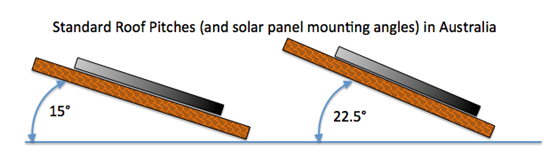
Generally speaking, (unless your roof is flat) the pitch of your home’s roof is going to be the angle your solar panels are mounted at. In Australia, common roof pitches are 15° or 22.5° – so your modules will most likely be mounted at one of those angles:
What if you have a flat roof?
If your roof is totally flat, then I strongly recommend mounting the solar panels at an angle of at least 10°. This is really important because it will allow any rain to easily run off the modules.
If the rainwater pools on the surface of the solar panel, it is more likely to eventually get through the panels’ seals and into the solar cells themselves. If this happens, it’s game over for the panel as you will experience an earth fault and need to replace the module. Many panels have a warranty condition stipulating they must be mounted at at least 10° from horizontal, so failure to do so could also void your warranty.
Ignore anyone who tells you to have the solar panels horizontal and just add a panel or two to make up for lost efficiency. Horizontal panels are asking for trouble down the line. They will also get a lot dirtier because they will have very little ability to self-clean through rain. You’ll need to manually clean them more often; which is time consuming – and time is money. Added to that, getting up and working on a roof is a safety risk.
For these reasons, if you have a flat roof, most good installers will add the option of a tilt frame to their quote.
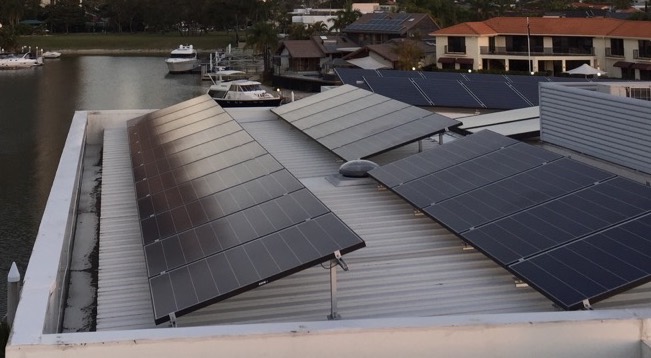
As I’ve said, tilt frames on a flat roof are a good idea. But sometimes an installer will propose tilt frames for a roof that already has a small pitch to increase the angle of the solar panels and get a little more power (for the reasons described in the next section). If your installer is proposing tilt-frames for a non-flat roof, I highly recommend that you read my blog post on the cost benefits of tilt frames before proceeding.
If you really want to lay those panels flat then there is an option: frameless solar panels.
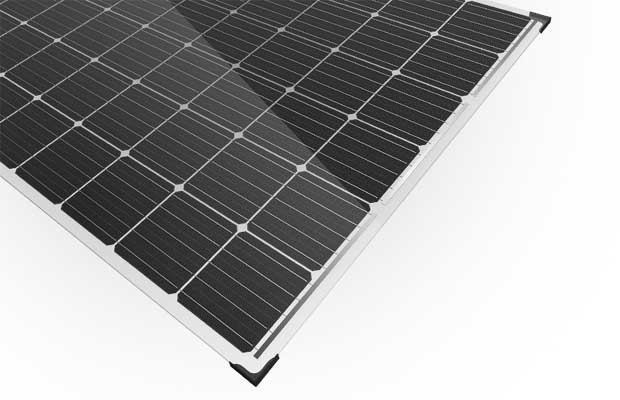
These are panels without an aluminium frame, meaning there is no ridge around the panel to collect grime and water. However, frameless panels have proven to be difficult to install given the required clamping zones, so I don’t recommend them.
Does the amount of tilt angle really matter?
Yes – the tilt of your solar panels will affect how much power they produce because the tilt will affect how much sunlight you capture.
Consider a solar panel flat on the ground that is 1m wide.
When the sun is high in the sky (e.g. at midday in summer), then a 1m wide shaft of sunlight will be completely captured by that solar panel:
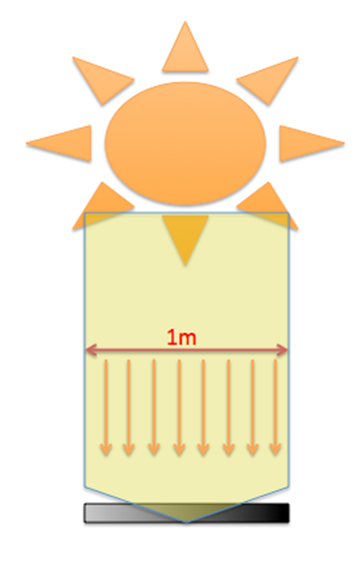
Now, if the sun is at an angle of 30° from horizontal, that same 1m wide shaft of light actually is spread out over 2m when it hits the ground:
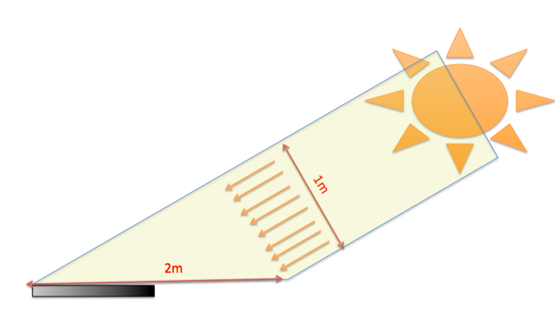
The flat solar panel in this example will only get half the sunlight, and therefore produce half the energy compared to the sun being directly overhead.
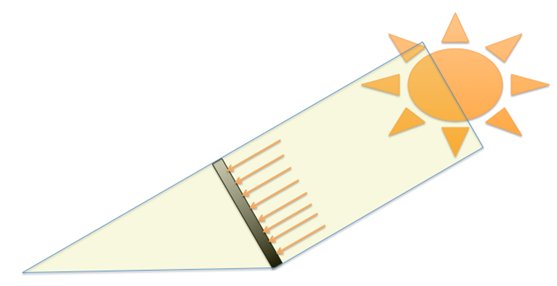
The solution in this example is, of course, to tilt the panel by 60° so that it captures all the sunlight:
So what is the best angle for a solar panel?
The angle of the sun in the sky depends on both the season and your location. In winter the sun is lower in the sky, while in summer it is higher. The closer you live to the equator (i.e. the lower your latitude), the higher the sun is in the sky all year round.
So you may think that calculating the optimum tilt for the panels on your roof is going to be really complicated…
Luckily it is actually dead simple.
An ideal angle for your solar panels (to maximize the power produced over the whole year) is simply the latitude of your location (well, fairly close to it anyway):
| City | Latitude |
| Canberra | 30° |
| Hobart | 37° |
| Darwin | 18° |
| Adelaide | 29° |
| Perth | 28° |
| Brisbane | 24° |
| Melbourne | 32° |
| Sydney | 31° |
So for my house in Adelaide, the perfect panel angle is 29° from horizontal.
Why is a great solar panel angle simply your latitude?
Because your latitude is the same as the angle of the sun in the sky halfway between midwinter and midsummer. The sun will be about 15 degrees higher in the sky in summer and 15 degrees lower in the sky in winter. So tilting your panels to the midway point will maximize the sun captured throughout the year.
How much power do you lose if your roof is at a different angle to your latitude?
In a perfect world (well my perfect world anyway) all builders would be forced to build roofs with pitches the same as the latitude of the house. However as mentioned before, most roofs in Australia are at 15° or 22.5°.
So how much solar power are you losing if your panels are not at the perfect tilt angle?
Well, it depends on your geographical location, the direction (orientation) of your roof and your roof’s pitch. If you want to calculate it yourself, then the easiest way is use our power loss table. Just pick the capital city nearest to you and find the power loss.
Let’s use my home in Adelaide as an example. The roof pitch is 15°, which is 20° lower than the ideal angle of 35°.
When you crunch the numbers, the efficiency hit is only 2% – almost nothing.
However. if my roof was flat the power hit would be 9% lower compared to having the solar panels at 35°.
So the moral of the story is: if your roof is pitched at more than 10°, your solar panels are probably not at their theoretically perfect tilt angle, but they will be close enough.
If your roof is totally flat, then I advise you mount your solar panels on tilt-frames to avoid water pooling problems and to allow for self-cleaning in the rain. And if you are getting tilt-frames, you might as well mount the solar panels at the perfect tilt angle for your latitude to maximise the power you generate over the course of a year.