1.5kW Solar System
Last Updated: 27th May 2026
The humble 1.5kW solar system was Australia’s most popular solar power system from about 2011 to 2013. It has now been well and truly overtaken in popularity by the 6.6kW system as entry level and increasingly by 10kW solar.
Why was 1.5kW so popular? Well, before Jan 1, 2013, the rebate system was skewed to max out at 1.5kW. Due to a scheme called the “solar multiplier” you used to get twice the rebate for the first 1.5kW of any system, compared to subsequent kWs. So in terms of dollars per kW, a 1.5kW system represented the best value.
However, all that has now changed. The “solar multiplier” which favoured 1.5kW solar systems is gone. But don’t panic! Australia still has a generous solar rebate program operating nationally.
How many solar panels make up a 1.5kW system?
Back when they were popular, a 1.5kW system may have had six 250W solar panels. Each was around 1.6m x 1m, so you needed at least 10m² of roof space.
To give you a feel for how big 10m² is, this picture may help:
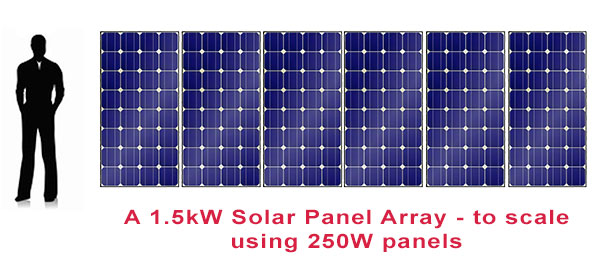
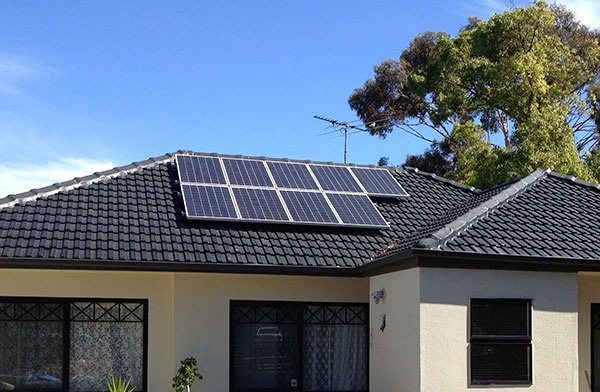
And here’s what a 1.5kW system looks like on a roof (this one is made up of 9 x 165W panels – so it’s a *really* old system):
These days, because panels are both larger and more efficient, a 1.5kW solar system only requires 3 or 4:
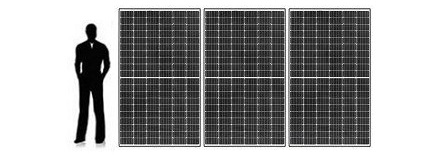
A modern 490W panel is around 2m². So three of them will give you a system just under 1.5kW that covers 6m². That’s nearly half the size of some old 1.5kW systems.
How much electricity will a 1.5kW solar system generate?
On a typical Australian roof, facing more or less north, a 1.5kW solar system will generate an average of around 6kWh per day. Unless your electricity consumption is exceptionally low or your available roofspace is extremely limited, you are going to want more solar than this.
Note: if you are serious about solar it is really important you understand the difference between a kW and a kWh. That link explains all!
How much will I self-consume with a 1.5kW solar system?
With a 1.5kW system, you can expect to self-consume a large portion of the of its generation. This means you will directly consume the electricity yourself instead of exporting it for a feed-in tariff. How much will depend on if anyone’s home during the day, but generally speaking, you can expect to self-consume around 50% or more of the electricity it produces. If you make an effort to shift electricity consumption to the day, such as by putting appliances on timers, then you can self-consume even more.
But if you have a battery, then you can expect to self-consume its entire output, as 1.5kW is a tiny solar system by today’s standards.
How much solar feed-in tariff will I get?
With 50% self-consumption, you’ll export an average of around 3kWh a day. Feed-in tariffs are not very high these days, so self-consumption will provide most of your savings. With a 5c feed-in tariff, you will bring in an average of 15c a day or around $55 a year.
But, in QLD, SA, and the ACT, some old 1.5kWh solar systems may still be receiving old premium feed-in tariffs. These systems could potentially be bringing in over $1 a day in feed-in tariff. Most of these high feed-in rates will be over by July 2028, so even if you’re currently benefit from one, you may want to plan to upgrade to a bigger and better system.
How much revenue will a 1.5kW solar system generate?
How much a 1.5kW solar system will save you on electricity bills depends on what you pay for grid electricity and how you pay.
If you pay a flat rate, then every kWh of solar electricity you consume yourself in place of grid electricity will save you that rate. If it’s 33c and you self consume 3kWh a day after the solar system produces, then you’ll save around $1 day. If you receive a 5c feed-in tariff for what you export to the grid, the savings will come to around $1.15 per day or $420 a year.
But if you have a time-of-use tariff, the savings can be very different. Many time-of-use plans now have low rates during the day, and there are plans with periods of free daytime electricity. In this case, you can expect a 1.5kW to save you less on your bills, but – unless you have a battery – you will have to pay high rates in the evening, and so may be better off on a plan with a flat tariff.
For a longer explanation of how solar saves money, you can read about the relationship between exports and payback here.
How much will a 1.5kW solar power system cost?
Compared to larger solar systems, you will pay more for a 1.5kW system, per kW of solar panel capacity. This is because installing a tiny solar system is almost as much work as a larger one, but only saves a modest amount of hardware costs. Expect to pay about $2,500 – $4,000 out of pocket, after the rebate. As mentioned, you’ll get much better bang for buck with a larger system. For example, a good quality 6.6kW system in 2026 starts at around the $5,500 mark – so you’ll get more than 4 times the capacity for only around twice the price.
How long before a 1.5kW solar power system pays for itself?
Because 1.5kW systems cost more per kW of capacity than any other system, homes with typical electricity consumption can expect a longer payback period than for larger systems. With the following assumptions…
- An installed cost of $3,000
- 6kWh average daily generation
- 50% self consumption
- A 33c flat tariff electricity plan
- A 5c feed-in tariff
…a 1.5kW solar system would have a simple payback period of around 7 years and 2 months. The easiest way to improve this is to increase self-consumption. With 60% self consumption, the simple payback period drops to 6 years and 4 months.
However, unless it’s all that will fit on your roof, it doesn’t make much sense to install a 1.5kW system these days. Outside of very unusual circumstances, you’ll be better off with a larger system. But don’t take my word for it (I wouldn’t!). Play with the numbers in my solar payback calculator and see if the return on investment makes sense for you.