The Federal Government Battery Rebate: A Complete Guide
Last Updated: 2nd Jun 2026
The Cheaper Home Batteries Program, commonly known as the federal battery rebate, provides an up-front discount on the purchase and installation of home batteries. It lowers the installed cost of a modest-sized home battery by roughly 25%.
The incentive is an expansion of the Small-scale Renewable Energy Scheme (SRES), which already provides the framework for the long-running national solar panel rebate. In addition to homes, the subsidy is also available to small businesses and community facilities. The scheme is uncapped, which means there’s no limit on the number of subsidies available. The incentive is not means tested.

How Much Is The Solar Battery Rebate Worth?
The rebate applies to the first 50 kilowatt-hour (kWh) of usable battery capacity, but can be received by batteries of up to 100 kWh. A battery system under 5 kWh can’t receive the rebate. The maximum amount of rebate that can be received per kWh of usable battery capacity is:
- First 5-14 kWh gets $271 per kWh
- From 14-28 kWh gets $162 per kWh
- From 28-50 kWh gets $40 per kWh
So the amount of battery rebate received by the following usable capacities is:
- A 10 kWh battery gets $2,720 rebate
- A 20 kWh battery gets $4,760 rebate
- A 30 kWh battery gets $6,160 rebate
- A 40 kWh battery gets $6,560 rebate
- A 50-100 kWh battery gets $6,960 rebate
When put into a graph, it looks like this:
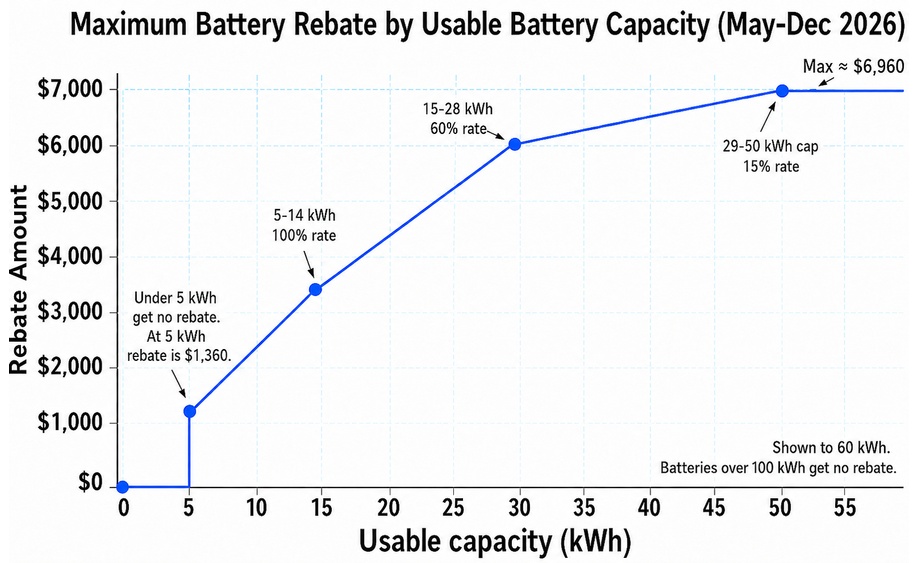
This shows batteries of 5 kWh or larger getting a rebate, but the amount per kWh declines after 14 kWh and drops dramatically after 28 kWh. But because a suitable battery size for many homes is around 16 kWh, the drop in rebate per kWh after the first 14 kWh won’t be a major problem for most households.
Your installer may offer the full rebate amount, or they may deduct a percentage to cover administration and compliance costs. But whether you’re offered the full rebate or not, the important factor is the total amount you have to pay and not the precise amount of rebate.
If you want to estimate how much you could save, try our Federal Government Solar Battery Rebate Calculator. The federal battery rebate can be combined with the WA state battery rebate.
Which Batteries Are Eligible For The Rebate?
Batteries need to meet some requirements:
- Batteries must be listed on the Clean Energy Council-approved product list (the same goes for new inverters. If you’re using an existing inverter it does not have to be on the approved list, but you do have to ensure it is not included in the product recall list);
- A solar battery system with a nominal (total) capacity of 5 kWh to 100 kWh will be eligible, but only the first 50 kWh of usable capacity is discounted;
- Existing batteries can be expanded, provided that the battery system has not already received the rebate, the additional capacity is at least 5 kWh, and the upgraded battery does not exceed 100 kWh in nominal capacity;
- Only one battery system is eligible for a property, and the rebate can only be claimed once per property. Only someone with several properties or who moves on to a new residence could potentially install or upgrade multiple batteries under the scheme;
- Batteries can be off-grid or connected to the grid, but in the case of the latter, they must also be Virtual Power Plant (VPP) capable (this doesn’t mean battery owners must actually join a VPP);
- Installers are required to be accredited for battery installation by Solar Accreditation Australia (check your preferred installer’s status here).
How Do You Claim The Battery Rebate?
Homeowners don’t actually need to do anything to claim the rebate – installers will apply for it and deduct the value from the total system price.
For installers, applications to create small-scale technology certificates (STC) for solar batteries are now available in the Renewable Energy Certificates Registry.
Does The Rebate Mean Batteries Are Worth It For Me?
The federal battery rebate means batteries are now a prudent economic choice for a much larger share of Australians. But a lot depends on your personal energy consumption (the higher your electricity use, the more likely a battery will pay off), what energy plan you are on, and where in the country you live. Read our explainers on battery costs and battery payback for more detail.
Try our “Add-a-battery” calculator to get an insight into whether adding a battery to your solar system is right for you, and if so, what size you need.
Or, if you need both solar and battery installed, try our solar & battery calculator.
Your Next Steps
Demand for subsidised batteries is still strong, but the market has settled since the initial rush. Good installers can still book out, especially in busy areas, so it’s worth comparing quotes early. Just don’t rush into a poor-quality install because an ad makes the rebate sound urgent or too good to miss.
It usually takes a few weeks between accepting a quote and having a battery installed. If you want a subsidised battery, get started by learning everything you need to know about home batteries. You can also do the following to get ahead of the pack:
- Get up to 3 quotes for a solar and/or battery system now from vetted installers;
- If you don’t yet have panels and aren’t certain you want a battery right away, get a quote now for a battery-ready solar system. This way, you’ll benefit from solar savings earlier than you otherwise would;
- Subscribe to the SolarQuotes weekly newsletter for updates on developments with the scheme.
If you want a good-quality home battery and professional installation at a reasonable price, we — of course — recommend getting quotes via SolarQuotes. We only allow verified installers into the SolarQuotes network who we know do quality work and who we would trust to install systems on our own homes. Another benefit of arranging a solar/battery installation through SolarQuotes is the peace of mind our unique Good Installer Guarantee offers.