The High Cost of Cheap Solar (And Battery) Systems
Last Updated: 16th Jun 2026
By Finn Peacock
Chartered Electrical Engineer, ex-CSIRO & Founder of SolarQuotes.com.au
The best deal is very rarely the cheapest deal. This is something we all understand intuitively.
So why are we so easily seduced by unbelievably cheap solar deals that appear so totally believable?
Let me be totally upfront with you – I did not set up this website, SolarQuotes, as a tool for people to find the absolute cheapest solar systems on the market.
If you want the cheapest solar systems on the market, just type “cheap solar” into Google and click on the Google Ad that promises a 10kW system for under $5,000 (At time of writing a quality 10kW installation should cost approx $8,000 – $11,000).
It really is that simple.
But if you use my service – backed by the SolarQuotes Good Installer Guarantee – you should still get great deals on quality hardware that *will* be installed with care.
The prices will be competitive because the installers are competing with their peers, but I want to be transparent with you: You’ll almost always be able to find a cheaper solar system elsewhere.
Many of the companies that advertise these ‘too good to be true’ deals have approached me asking to join the SolarQuotes network. I turn them down.
I don’t do this because I try to manipulate the market or keep great deals away from my visitors.
I do this because I have run SolarQuotes since 2009 with a very simple philosophy: If I would not recommend a company to my grandmother, I will not recommend them through SolarQuotes.
While the front-end purchase may be cheaper with these systems, the Chartered Electrical Engineer in me knows that the long-term consequences of buying these stupid-cheap systems are that they end up being more expensive to the buyer in the long run.
Looking to get quotes for solar from reputable installers that we’ve hand-picked?
Fill out our short form and we’ll arrange 3 free, no-obligation quotes ASAP.
While they’re being seduced by the low price, they’re getting sucker-punched because they don’t know the ramifications of choosing that cheap option – a low-quality system that will need replacement in a few years or even a few months in a worst-case scenario.
In the end, everyone loses. The consumer loses, the industry loses, and the companies with the razor-thin margins lose too – because the problem with a race to the bottom of a market is that you might just win.
So how do some companies sell systems at such jaw-droppingly low headline prices?
Here are some of the ways I’ve seen people getting burned by dodgy solar companies:
1. Bait & Switch. They use quality brands as the bait.
In their conditions of sale, they write that they reserve the right to swap out the inverter and panels for ‘equivalents’. Then, they install a really cheap inverter and panels instead.
2. Bait and Switch V2. They don’t advertise what brands they use, just a really low price.
When the customer makes an enquiry, they upsell them to better hardware, with the end result that customer pays much, much more than the price that was originally advertised.
3. Cut corners on the install. Some companies have a reputation for paying the lowest install rates in the industry. Guess what—they also have a reputation for really poor installations.
Most solar power systems operate at high voltage DC. If installed well, high-voltage DC is safe. If it is not installed well, it is very dangerous. Here’s what happens when high voltage DC goes wrong:
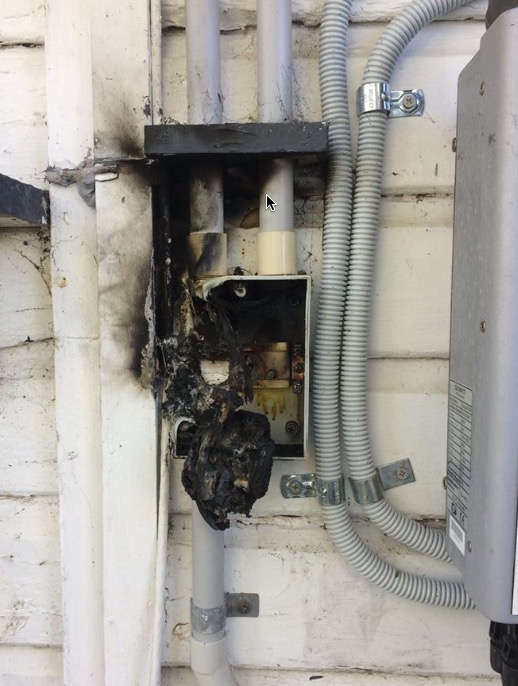
Photo: Crap Solar
4. They use a crappy solar inverter and claim it is the best quality money can buy. A really cheap inverter will be unlikely to last 3 years.
Inverters are easier to replace under warranty than panels, but some manufacturers will blame the failure on ‘grid spikes’ and you’ll either have to fight or pay $1500+ for a new inverter.
Hey, inverter manufacturers! If you want to sell into the Aussie market, then you have to cope with grid spikes because our grid voltages are all over the place!
5. They hire commission-only salespeople, treat them like crap and fire them if they don’t reach their quotas. If the salesperson you let into your home is under constant threat of being fired, do you think they might be more likely to oversell the benefits, exaggerate the quality and push for the sale there and then? Of course. These guys are under the pump.
I could go on and on – but I’m starting to get depressed!
The Same Problem Has Hit Batteries
Everything I’ve said about cheap solar panels applies to batteries too. The stakes are just higher, because a battery is a far bigger investment and harder to put right if things goes wrong.
The home battery market in Australia has gone gangbusters, driven by rising electricity prices but mainly by the federal government rebate. And wherever there’s a rush of demand fuelled by government money, the bottom-feeders follow.
Here’s how the same playbook works with batteries:
1. They quote a no-name battery at an unbelievable price. You’ll see ads for massive 50kWh battery systems at shockingly low prices compared to those of known brands.
2. They fudge the specs. A cheap battery might be advertised as “10kWh” but only deliver 8kWh of usable capacity. Or it’s rated for 6,000 cycles but starts degrading noticeably after 2,000. The headline number gets you in the door; the fine print tells a different story.
3. They skimp on the installation. Battery installations are arguably more complex than solar panel installations. They involve high-current DC connections, careful ventilation considerations, and compliance with Australian battery installation standards. Dodgy installs don’t treat these with the importance they deserve.
4. The warranty is only as good as the company behind it. I’ve seen battery “warranties” of 10 or even 15 years from companies that have been in Australia for less than two. If – or when – they pull out of the market, your warranty goes with them.
5. They pressure you with deadlines. The federal battery rebate reduces every 6 months. Some installers are using this urgency to push people into decisions they haven’t properly thought through, with hardware they haven’t properly researched.
If you want a system that is well designed for your roof and your consumption patterns;
- One that is genuinely designed to all relevant standards
- One that uses good quality panels, inverters, batteries racking, wires and isolators
- One that is installed by a trained electrician who is paid a fair wage and is given the time to do things properly
- One that will make you happy for decades to come and give you a well-optimised return on your investment
- One that will be supported into the future if there is an issue
Then please be wary of the ‘too good to be true’ offers online, in the papers and on TV.
This website provides all the information you need to make an informed choice, and you are welcome to contact me if you need any help, whether you obtained your quotes through this site or elsewhere.
If you’re considering installing solar and batteries for your home or business, SolarQuotes can help you get quotes from high-quality, pre-vetted installers quickly and easily:

About Finn Peacock
I’m a Chartered Electrical Engineer, solar and energy efficiency nut, electric car and e-bike owner, dad, and founder of SolarQuotes.com.au. My last “real job” was working for the CSIRO in their renewable energy division. Since 2009 more than one million Australians have used my site to get quotes for high quality PV systems from pre-vetted solar installers.