How Much Does It Cost To Charge An Electric Vehicle In Australia?
Last Updated: 21st Aug 2026
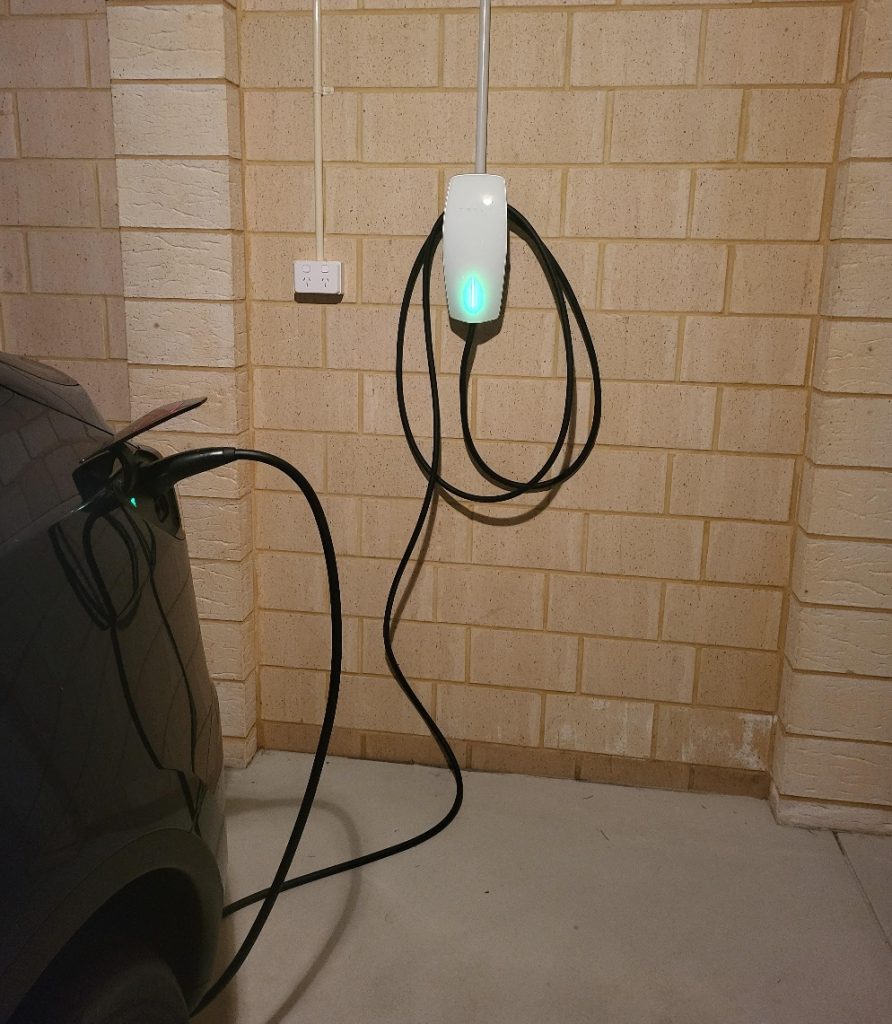
If you’re thinking about getting your first electric vehicle (EV), you’re probably wondering how much it costs to charge it. Charging an EV is usually much cheaper than filling up a petrol car for the same trip. Using solar power or an off-peak electricity plan can save you even more.
The cost depends on how you charge your EV, so let’s see where you can save money and where you might not.
Table of Contents
- EV Charging Cost Vs. Petrol, Side By Side
- What It Costs To Charge An EV At Home On A Standard Energy Plan
- Charging From Solar: One Of The Cheapest Options
- Charging Your Car On Off-Peak Rates And Free-Power Windows
- How Charging Speed Affects Cost
- Charging Away From Home: The Cost Of Public Charging
- What Changes These Numbers?
- What To Do Next
EV Charging Cost Vs. Petrol, Side By Side
Here’s a quick summary of roughly what it costs to cover 100 km of driving under each charging method, using an example 18 kWh/100km EV and an 8L/100km petrol car.
Every other row in the table below follows this exact pattern – only the rate changes.
| Charging Method | Approximate Rate | Cost per 100 km |
| Petrol | ~$2.00/L | ~$16.00 |
| Home charging, standard tariff | ~$0.30/kWh | ~$5.40 |
| Home charging, self-consumed solar | ~$0.03/kWh opportunity cost | ~$0.54 |
| Public Level 2 (AC) charging | ~$0.25-$0.45/kWh | ~$4.50-$8.10 |
| Public Level 3 (DC fast) charging | ~$0.40-$0.75/kWh | ~$7.20-$13.50 |
Let’s quickly break down a few of the numbers in this table.
For electricity: multiply your car’s energy use (18 kWh per 100 km) by the price per kWh.
An EV on a standard home tariff costs 18 kWh × $0.30/kWh = $5.40 for 100 km.
For petrol: multiply the car’s fuel use (~8 litres per 100 km) by the price per litre. So a petrol car costs 8 litres × $2.00/L = $16.00 to cover 100 km.
The numbers in the table will change based on your car’s efficiency, your electricity plan, your state, and how often you use fast charging. Still, the pattern is clear: even the most expensive way to charge an EV usually costs less per kilometre than petrol, and the cheapest ways cost much less.
Read on to learn how we came to all these figures.
Comparing Kilowatt-hours To Litres: EV Charging Cost Vs. Petrol
Petrol is sold by the litre, and your car uses a set number of litres to go 100 km. Electricity is similar, but measured in kilowatt-hours (kWh). Your EV uses a certain number of kWh to travel 100 km.
Most EVs in Australia use about 15 to 20 kWh of energy per 100 km, depending on the model. Compact EVs are closer to 13 kWh, while large SUVs can use 22 kWh or more because they’re bigger and heavier.
For the cost per 100 km, multiply a typical home electricity rate of about $0.30 per kWh by 18 kWh. It costs around $5.40 per 100 km. This is before considering solar or off-peak rates.
For comparison using the same math, a petrol car that uses 8 litres per 100 km (a common figure for a mid-size car) at $2.00 per litre costs $16.00 per 100 km because we multiply 8 litres by $2.00 per litre.
| Vehicle Type | Cost per 100 km |
| Electric Car (18 kWh) | $5.40 |
| Petrol Car (8L) | $16.00 |
It’s like comparing apples to oranges, but the cost difference is clear.
This petrol price is just an example, not an exact number. In this market, prices change quickly. Your car’s energy use may vary, so you can check the exact number for your model on the government’s Green Vehicle Guide.
What It Costs To Charge An EV At Home On A Standard Energy Plan
About 80% of EV charging in Australia happens at home, either with a dedicated charger or a regular power point.
Electricity retailers usually charge between $0.25 and $0.55 per kWh. Your own electricity bill will tell you exactly what you pay per kWh.
It’s also useful to think in terms of a full charge, since that’s how most people view fuel costs. EV batteries usually range from about 50 kWh in smaller and mid-size models to 80 kWh or more in large SUVs.
Charging from empty at home on a standard plan costs somewhere between $12 and $45, giving you several hundred kilometres of range. That’s much less than what you’d pay for petrol for the same trip.
Even with a basic home electricity plan, that’s already a big difference. It’s about a third of the cost for the same distance. And that’s before you consider solar, off-peak rates, or other options.
Charging From Solar: One Of The Cheapest Options
If you have solar panels, charging your EV during the day is one of the cheapest options. The electricity comes from your own roof, so the extra cost is almost zero. It’s not completely free, though. Any solar you use for charging is power you didn’t send to the grid for a feed-in tariff (FiT).
So we’re going to look at feed-in tariffs here. You’ll find they’re much cheaper than even the lowest grid rates.
Feed-in tariffs vary depending on your retailer, and they’ve been trending towards zero over the years.
If we use $0.03 per kWh as an example because that’s, sadly, about average for a FiT these days. That’s the cost of “free” solar charging because that’s what you would lose in the form of a feed-in tariff. It’s still much less than any grid rate, but not quite zero.
Charging our example car from solar at this rate ($0.03) multiplied by 18 kWh gives you about $0.54 per 100 km, which is about one-thirtieth of the petrol cost above.
| Charging Method | Rate | Cost per 100 km |
| Solar Without a FiT | $0.03/kWh x 18 kWh | $0.54 |
| Petrol | $2.00/L x 8L | $16.00 |
The main challenge is having enough solar capacity. Many rooftop solar systems sized for regular household use may not cover your car’s charging needs. This is especially true if you use a fast home charger for several hours.
If you want to charge mostly from solar, size your system properly from the beginning.
Charging Your Car On Off-Peak Rates And Free-Power Windows
If solar can’t cover all your charging needs, or you don’t have solar yet, your electricity plan is the next thing to look at. This can make a big difference in cost, so it’s worth checking before you settle for a standard rate.
The key is to charge during the cheaper times and avoid the expensive ones.
Off-peak and time-of-use (ToU) tariffs charge different rates depending on the time of day, instead of a single flat rate. Off-peak energy is used at nighttime while you’re sleeping. It’s a more economical rate during overnight hours, perfect for car charging.
If you’re looking for an EV-friendly tariff, compare several energy retailers. Our electricity comparison tool shows plans aimed at EV owners:
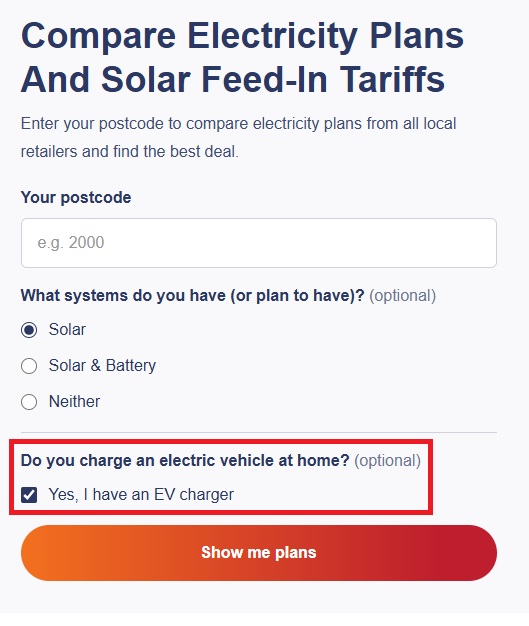
When using our electricity comparison tool, just indicate you have an EV to see EV-specific energy plans.
The list of options keeps growing, and the cheapest plan can change over time.
Government-mandated free power windows are a newer option. Since July 2026, retailers in New South Wales, Queensland and South Australia must offer at least one plan with a free three-hour block of electricity in the middle of the day, capped at a minimum of 24 kWh daily.
This scheme is called Solar Sharer, and it’s available through your retailer. It’s opt-in, and the cost is recovered elsewhere in the tariff, so it isn’t free electricity so much as electricity you’re paying for at a different time.
How Charging Speed Affects Cost
If you’re relying on one of these free-power windows, keep in mind that your charger’s speed decides how much of that cheap window you can actually use.
| Charging Type | Power | Energy Added in 3 Hours | % of 60 kWh Battery |
| Regular Power Point | 2 kW | 6 kWh | ~10% |
| Single-phase Charger | 7 kW | 21 kWh | ~35% |
| Three-phase Charger | 11 kW | *33 kWh | ~55% |
A basic charging cable, the type that gets plugged into a regular power point draws around 2 kW. Multiply that by three hours, and you get 6 kWh added to the battery. Against a typical EV battery of around 60 kWh, that’s 6 ÷ 60 – roughly 10%.
A dedicated single-phase charger is about three times as fast as power point charging. Single-phase home circuits in Australia cap out at around 7 kW. Multiply that by three hours, and you get 21 kWh added to the battery, well within the 24 kWh cap. Against that same 60 kWh battery, 21 ÷ 60 works out to roughly 35%.
A proper home charger, running on a dedicated three-phase circuit, is commonly rated at 11 kW or 22 kW, though many EVs cap their onboard AC charging at 11 kW regardless of what the circuit can supply. Let’s assume a steady charging rate of the full 11 kW on a three-phase home. Over three hours, that adds 33 kWh to the battery. That’s well over the 24 kWh cap. Please remember that once you go over that limit, you’re paying for electricity from the grid (usually shoulder rates). However, there are free power plans with a higher cap you may want to consider.
But the main point is: the faster your charger, the more you can take advantage of off-peak or free-power windows.
When you install an EV charger, most will let you schedule charging with an app or use solar-aware features, so your car charges automatically during the cheapest times.
Charging Away From Home: The Cost Of Public Charging
Most EV charging is done at home, but public charging is important for longer trips or when you need a quick top-up. Costs vary more for public charging, so it helps to know the difference between the two main types. Public EV charging is different depending on your network and hardware. Here, we’ll just focus on the costs.
Level 2 (AC) public chargers, found at places like shopping centres, libraries, and some hotels, usually cost $0.25–$0.45 per kWh. They’re good for topping up while you’re parked for a while, but they’re not fast enough for a quick stop.
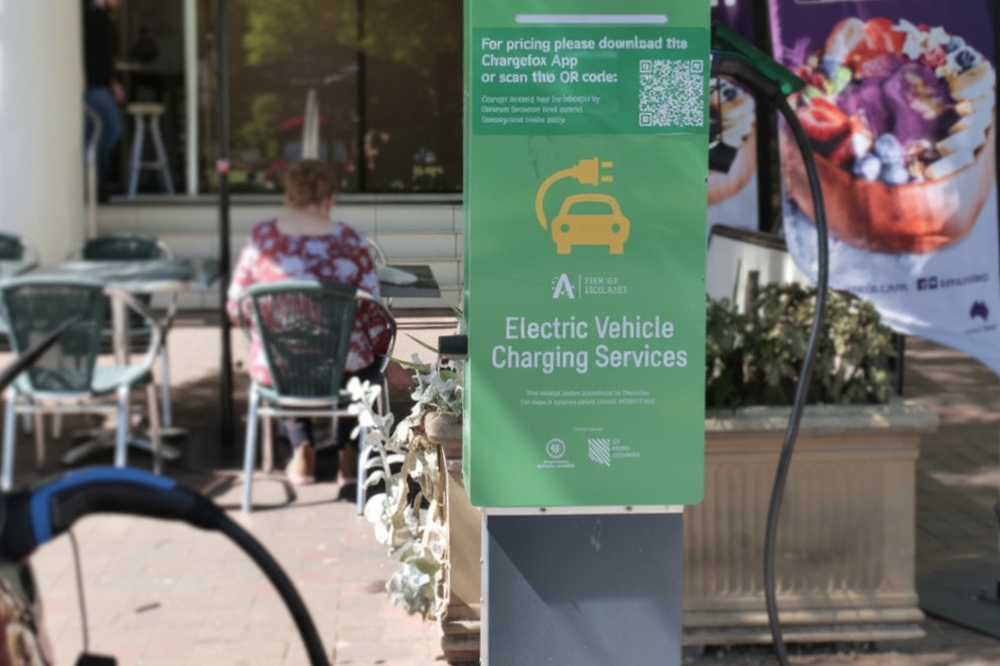
Public AC chargers usually cost between 25c and 45c per kWh.
Level 3 (DC fast) chargers, which you’ll use for road trips, cost more because the charging networks pay higher demand charges for all that power. Prices vary a lot depending on the network and charging speed.
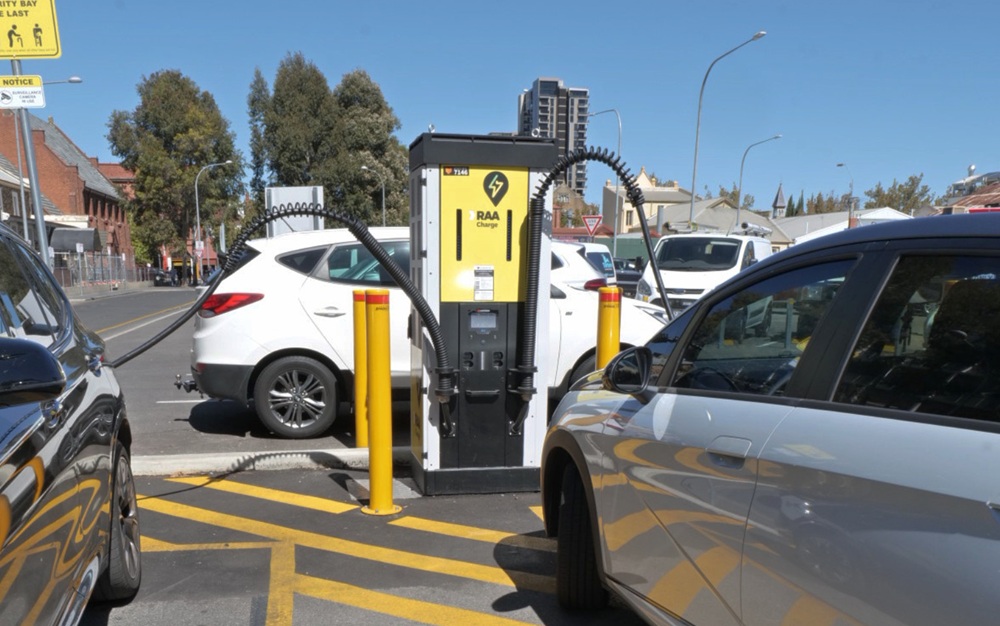
Level 3 DC Fast chargers are quicker but cost more.
Overall, public fast charging usually costs between $0.40 and $0.75 per kWh, depending on the network and speed. Even at the higher end, fast charging is still usually cheaper per kilometre than petrol, though the savings are smaller than charging at home.
In practice, use DC fast charging mainly for road trips, not for everyday charging. It’s a backup option, not where you’ll find the biggest savings.
What Changes These Numbers?
A handful of variables decide how much you’ll save:
- Your car’s efficiency. Some EVs use noticeably more or less than 18 kWh per 100 km – check your specific model.
- Your electricity plan. A standard flat tariff versus an off-peak can be the difference between big versus little savings. Don’t forget the Solar Sharer where electricity is free for three hours in the middle of the day.
- Whether you have solar, and how much of it you can direct to your car.
- How often do you rely on public DC fast charging? Frequent fast-charging narrows the savings; occasional road-trip use barely dents them.
- Where do you live? State electricity prices (and feed-in tariffs) differ meaningfully, and so does access to schemes like Solar Sharer.
What To Do Next
If you’re still deciding whether an EV makes financial sense for you, the charging cost side is good news, no matter how you charge. The real question is how much better than “good” you want it to be.
Calculate your own home tariff’s cost per 100 km using the method above. See if a better electricity plan or more solar panels could save you even more.
And if charging costs have you seriously considering making the switch, get a few quotes for solar and a home EV charger. It’s the fastest way to find out what your actual numbers would look like, not just the examples above.