
Three hours of free electricity every day sounds like a pretty good deal on the face of it.
That’s the promise behind the Solar Sharer Offer, a new scheme launching in NSW, South-East Queensland and South Australia from July 2026.
In a recent SolarQuotes video, SolarQuotes founder Finn Peacock breaks down what’s actually going on — and why “free power” isn’t quite as simple as it sounds.
What Is The Solar Sharer Offer?
From 1 July 2026, electricity retailers in NSW, SEQ and South Australia will be required to offer at least one residential plan that includes a three-hour block of free electricity in the middle of the day, with a 24 kWh daily cap.
But households aren’t forced onto these plans. Retailers must offer them — customers choose whether to opt in.
It’s a response to a grid that now produces too much solar in the middle of the day and not enough flexible demand to match it.
With more than 4 million rooftop solar systems across Australia, midday generation regularly pushes wholesale prices to zero or negative. In some cases, utility-scale solar is curtailed simply because there’s too much electricity and not enough demand.
The Solar Sharer idea is to shift that demand into the middle of the day instead of letting the energy go to waste.
There are also plans to expand the scheme nationally after the initial roll-out.
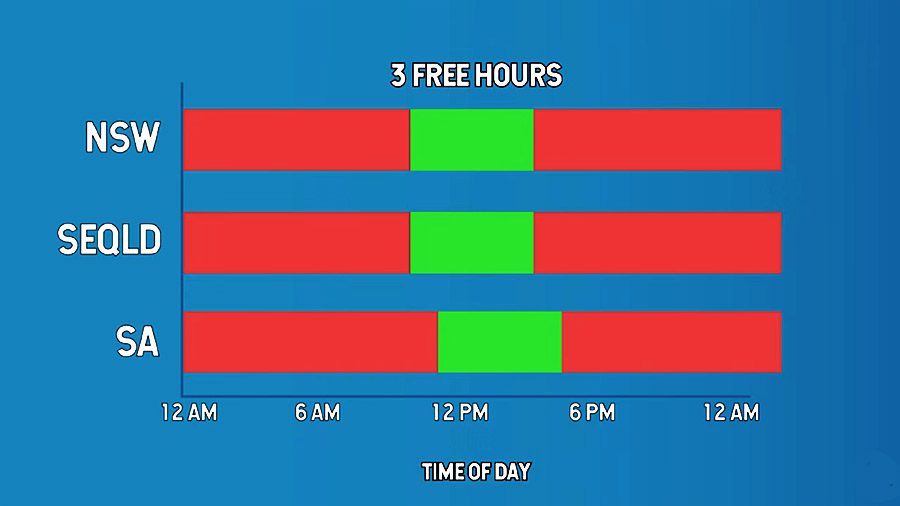
Three free hours of power in NSW, SEQ and SA – starting July 1st.
How The ‘Free’ Electricity Works
To access it, you’ll need a smart meter and an eligible plan.
Retailers still recover revenue elsewhere in the tariff, typically through higher peak rates, higher shoulder rates, or higher daily supply charges.
Some retailers already run versions of this voluntarily. From 2026, every retailer must offer at least one compliant plan — but the underlying cost balance doesn’t change.
Who Actually Benefits?
The biggest winners are households that can shift or store energy — and the difference can be significant.
Take solar batteries first. Charging during a zero-cost midday window and discharging during evening peak pricing is where the value really shows up.
EV charging is another big one, but timing is everything. A standard trickle charger might only add around 6 kWh in three hours — roughly 10% of a typical EV battery. A 3-phase home charger can push closer to 30 kWh in the same period — around 50% for many EVs. Same policy, completely different outcome depending on your hardware.
Hot water is also a major lever. Shifting a resistive electric or hot water heat pump system into the middle of the day can eliminate one of the largest daily loads in a typical household.
Then there’s everything else — dishwashers, washing machines, dryers, pool pumps, air conditioning. Individually small, but together they start to matter.
The rough rule of thumb is this: you need to shift at least around 6 kWh of daily consumption into the free period to come out ahead once higher peak and supply charges are factored in. For some households, that’s easy. For others, it’s a stretch.
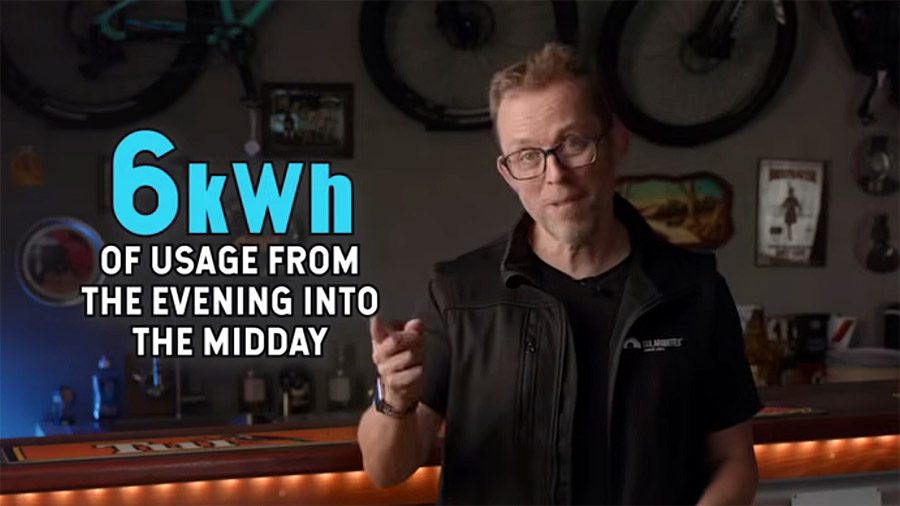
Finn reckons you need to move at least 6 kWh into the free window to make it work.
The Case For Solar Sharer
At a system level, the logic is hard to argue with.
Australia is already hitting periods where rooftop solar overwhelms daytime demand. That leads to curtailment, negative pricing, and wasted renewable generation.
Shifting consumption into the middle of the day helps absorb excess solar instead of switching it off.
It also takes pressure off the evening peak — still the most expensive and grid-stressed period.
And for battery owners, it creates a predictable midday charging window they can plan around.
The Case Against Solar Sharer
The biggest concern is that it could slow solar uptake.
If households hear “three hours of free electricity every day”, some will inevitably ask why they’d spend thousands on solar panels when they can simply use free grid power at lunchtime instead.
But that overlooks one of solar’s biggest advantages: autonomy. A household with a decent solar system isn’t tied to a Solar Sharer tariff and can choose from a wider range of electricity plans, including ones with lower peak rates and supply charges.
There are also concerns about the way the scheme is being implemented. Retailers are being required to offer a product with free electricity during part of the day, but the costs don’t disappear. Existing plans typically recover them through higher rates outside the free window.
The bigger issue is what happens if the message people take away is simply: “Why bother with solar?”
Australia needs to dramatically expand renewable generation over the coming decade, with around 65 GW of large-scale capacity needed by 2030 to stay on track with current targets. Rooftop solar remains a critical part of that transition.
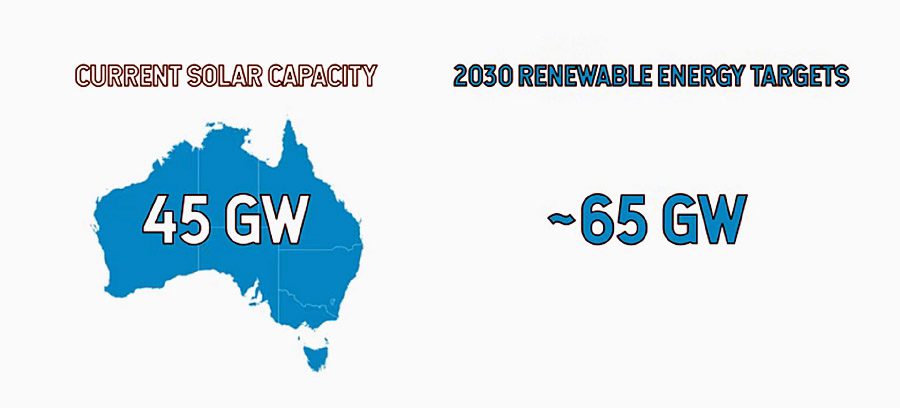
65 GW of renewable capacity is needed by 2030 to stay on track.
What This Means For Your Bill
The Solar Sharer Offer isn’t a gimmick, and it isn’t a universal discount either.
It’s a structural response to a grid that now produces too much solar in the middle of the day and not enough flexible demand to match it.
If you can shift or store energy, it could work strongly in your favour. If you can’t, it becomes another tariff design that needs careful comparison rather than headline optimism.
Either way, the key point remains: “free” electricity only works if you can actually move your usage into the right three-hour window — and have the setup in place to make it count.
To keep updated on the scheme as it rolls out in July, subscribe to our free weekly newsletter.
 About Kim Wainwright
 RSS - Posts






At present, I am on a plan that has O/P all weekend. Most other plans I have looked at have peak charges on the weekend abt 4pm>8pm. I am waiting until the deals near 1 July to be released to consider changing.
One thing I am unsure of is if the Peak-Shoulder-OffPeak are programmed into the meter or allocated by the retailer? When the times are changed, does the meter get re-programmed? I am in NSW Essential area, with a PlusES supplied meter.
Re. How Does Your Billing Meter Work?
The electronic “Smart meter” (with or without comms) always runs on Eastern Standard Time year round.
The Meter simply takes a “snap-shot” of the various internal counters/registers each 15 or 30 minutes… and records this data in nonvolatile memory ( a meter can record data for something like a year or more before any over-write occurs).
All this data is up-loaded to the data clearing house/provider(s) either by comms on a frequent and regular basis OR is uploaded to the meter man’s digital device each (3 monthly) visit.
All date/time adjustments (DST/EST) and peak/shoulder/off peak calculations are done upstream in accordance with your “plan/retailer” terms and conditions.
Hope this helps…
Yhx. But the meter must be programmed for the different times? Otherwise you would not see the different time rates when you step thru the meter display. So, the times must be programmed into the meter.
I understand sometimes the retail contract may have different time periods.
Do you know if this is being offered in ACT, specifically by ActewAGL?
I can’t find any mention of it on their website and when I spoke to them some days ago they couldn’t tell me/didn’t know.
Ross,
it seems it is all the East Coast energy area, so I guess the ACT is included in that area!
Sometimes the retailers know more than the energy suppliers.
We live in Ergon regional east territory and we just got our new tariff 11 costs.
yr 25-26 yr26-27
Feedin 0.0866 0.0658
$/kWh $0.32973 0.28895
Service fee $1.68842 1.80508
Ergon does not offer 3hours free in our area but it does not affect us in anyway as we don’t use any power from the grid. However, during the full year of 2025 we exported 14MWh from our bigger system and 7MWh from our rental unit system. After running the the new figures through Excel I found that we’ll be paying Ergon $200/year instead of receiving a small credit on our rental unit. Both systems have at least 12kWh of battery storage.
So I have made the decision to take our rental unit off grid and use it’s excess power for our EV charging and our bore pump for watering our garden. This will enable us to maximise our excess solar to the grid, which will only a slightly smaller return than last year.
Kim,
May be nit-picking, but your graphic of the green “free” period is wildly out of scale: the “free” segment is 40% larger than reality. And indicates 5 free hours, rather than 3 hours of the displayed 24 hours.
Yes Greg, I agree it’s a bit dodgy. I did a screenshot off the video to get the image. Try to live with as I am. It’s a struggle but we will get through this together 😉
I’m glad you mentioned 6 kw as a base it helps people quickly make a decision whether to look further into it 👍
Be great with resistive hot water and a time clock switch !! With a 3.6 element that’d be nearly 11 kw and enough to heat enough hot water for a lot of people’s needs for free !!
yes thats what I did on day 1 when I built a new house.
Takes between 90 and 12o mins per day to heat up, and it starts at 10 AM.
Got an electrician to put a timer on the direct circuit.
solar + battery + globird 4 hours free, takes care of it 100%
Can I plead with people to use Contactors to switch resistance HWS. If the timer contacts weld shut, your power bill will be astronomical! nb: there is sufficient reactance in a resistance HWS to weld the contacts with an arc. Even required for 2.4Kw elements!
Astronomical power bill ? I would have thought the HWS thermostat would open the power feed to the element down stream from the timer or am I missing something ? I totally agree about using a fit for purpose contactor,it’s a must.
The (Resistance) HWS runs 24/7 when the contacts weld. Correct that the thermostat opens, but the minute the water cools, energy is consumed again.
When I was an Energy Coach with Enova, I saw a few relay contacts weld up. It does increase the bill substantially due to loading during peak times, which normally would be off, & that is when the tap is likely to be turned on too.
When i doubled the size of my battery (thanks to the federal rebate), I took my resistive hot water off the controlled load timer and just had it wired into the board.
It cycles on and off maybe 3 times a day in summer, currently cycling about 5 times a day now in late June, using about 1 to 1 1/2 kWh each time it cycles. As long as you have a decent sized battery it is far cheaper to do this than put in a fancy timer.
If your battery isn’t big enough to handle this, put the bucks for installing a fancy switch towards a heat pump hot water system, which will have a timer you can set anyway, as well as using a lot less power.
Why do you still need solar?
One could say you need at least a coupe of panels as part of the install so you can claim the battery rebate for the 20kWh battery you are going to install to fill up in the 3 hours of free power to run your house for the rest of the day…
Otherwise installing solar has a lot less potential value/savings than it did before.
There is a lot happening politically, economically and socially that will feed into whether it has any long term benefits.
Considering the govt (voters) have pushed solar and batteries to benefit the environment surely when home owners make investments to such an end they should not be penalised if the retailers structure the plans to recoup lost revenue (in spades) by occasionally shifting the goal posts. I only have to visualise my accounts to know the antics.
If we are to reach the ~65 GW target by 2030 (aghast) we will need a bit more incentive that a few hours free energy during the day.
As a side note how many homes would be required to reach the 65GW target?
If not homes then solar and battery farms.
The mind boggles just thinking about it.
I would be interested in a table of energy retailers offering solar sharer plans.
I’m in Sydney (Ausgrid), and it looks like Globird and OVO have something in market, but finding alternatives feels like search work that could be done for the benefit of many.
Me too! Have been looking but not finding much at the moment. I guess there’ll be something in a week or two….
I referred this to the Compare (Govt) website. When one compares energy offers, there is only the choice of Solar Export or cheapest offer. I suggested there should be a comparison of battery optimised offers, inc free hours offer.
I checked the offers I found, & it seemed the energy rate & the daily charge increased by abt 20%. I feel I am better staying on my current plan. & finding a third party VPP that will buy my exports during the Evening peak.
One risk I want to cover is if my battery does not cover peak for some reason, my costs will not be excessive.
Likewise,I am with EA, I have not been offered a plan with “sharer” in the headline. I would like to see a calculation based on 5KWH system and 10 kwh battery. I do 30k km EV a year and charge at home mostly during the day. Not having a plan clouds our calculus on what we can do. Anybody?
I’m considering ditching gas hot water for an electric heat pump but Ovo’s fine print say it excludes controlled load usage during the 3Free window?
Does this refer to heat pumps?
Just get the HWS onto the regular circuit / meter, add a timer and you’re set.
Controlled load is like a ring fencing of cheap electricity during off peak or super off peak hours i.e. midnight to 6am and usually is for specific things only like EV charging or heavy usage appliances such as underfloor heating.
If you get a heat pump the usage is so small a controlled load for it wouldn’t be worthwhile in my experience.
I say this based on having an iStore 270L tank which for us typically uses 1.45-4kWh of electricity to heat all the hot water we need in a day which can easily be done in the ‘Free 3’ window of the solar sharer scheme. Obviously this might be different for your household if you’re likely to empty the 270L tank each day though!
We have already got access to 3 hours of free grid power through a globird plan in SE Qld. Being in a fortunate position of having solar, battery and fully electrified house, as well as EV, we don’t use the free grid infeed that often but it is a good backup to have when the sun is not shining and/or we have large load requirements (such as ev charging, water heating) that we can schedule for that time of the day. Hopefully in the bigger picture it is seen as a way to supplement home solar generation rather than replace it (as well as encouraging electricity usage behaviour to suit the grid).
We are trying to decide whether to install a battery with our new build. South facing roof so reduced solar output. Initially thought battery might not be worth it due to cost,long payback and possibly not fully charging each day but this 3 hours free offer should mean being able to charge our battery daily for night time use. Am I understanding this correctly?
Hi Susan,
Provided it’s not 40° pitch, the direction your roof slopes doesn’t matter much, just keep it a simple shape.
These days solar is so cheap the correct orientation is UP. You just cover the whole roof and if it’s fairly flat, install 10° pitched frames for self cleaning, placed back to back east/west.
However the best thing you can do before any solar, battery is design the house properly.
Passive solar design lets the winter sun inside to heat the place without any technology.
Correct size and placement of windows, shades, verandahs makes for inherent comfort.
Extra insulation from the ground up will pay for itself over and over because efficiency is the ultimate economy, and it doesn’t rely on any special retail deal to make sense.
Anthony, I was led to believe 15 degrees was the least slope to successfully clean panels. The issue seems to be that the lip holds some water, so the dirt accumulates there. 15 degrees I guess gives enough velocity to flush that dirt better.
With modern house design, they are better sealed than houses of old. Leaks thru the walls can cause mould due to temperature differentials. It is important now to ensure the air is exchanged: MVHR is best, but otherwise vents & positive extraction.
Yes, if you take up one of these plans, you will be able to fill the battery if your solar hasn’t filled it by the time free period start.
Yes, that is what I do. After the free power period, my battery is at 100%, and all the heavy lifting has been completed.
EV car, hws pool, + battery at 100%
I’m worried, though, that this plan might be withdrawn soon, as they are making no money out of me and many others, i expect
They’ll jack up the daily supply charge. Just happened to me with a 50 cent daily increase from July the 1st.
In WA we get free power or paid for each unit between 3 to 9pm. Synergy being WAsupplier Customer Service advised
1. Morning rebates provided you have not up graded for a new system as original system died I have went from 2Kw to 3.6Kw. Yes I have a lager number. Have the smallest system available as 2 Kw are not available. Upgraded no benefit
2 . Advised sunlight at 3pm to 9pm. I queried the hours and was advised I HAVE DAYLIGHT SAVING BENEFIT Free power for benefit.
HOW DUMB—-WA do not have dau light saving.Customer Service get paid for stupid comments
I had a good plan, but after July the daily connection +~60c/day, & energy up by 30%!! (Thought energy was supposed to be cheaper??)
They even had the temerity to charge 3% over the default rate! (How silly do they think I am??)
Looking at other options…
What I find interesting is that HWS energy usage ( and how to counter it ) is a major topic on forums ,Facebook MEEH page and on this offer -3 Hours Of Free Power.
We installed a rooftop solar HWS in the Peter Garrett era plan of energy efficiency many,many years ago.With the REC’s return we made around positive $100 on the installation ! We’ve gone through two two tanks,on the third but the panels and controller/pump haven’t missed a beat.On the NSW North Coast it costs probably $20 p.a. to occasionally boost it.
If we didn’t have that system it would make our decision on whether to go solar/batteries let alone considering utilizing the 3 free hours so much easier.
Hi Peter,
Close coupled solar HWS (tank on roof) are perfectly simple and reliable.
Split systems like yours aren’t as heavy on the building but they’re not as reliable sadly.
And further south in the country they can waste a lot of energy pumping hot water through the collector to prevent it freezing in winter.
A glycol heat exchanger fixes that problem with another layer of complexity.
Best tip for any split solar HWS owner is to ignore the pump & lights, just put your hands on the pipes to/from the panel when it’s sunny. The pipe from the panel should be hotter.
Also what we did years ago is not necessarily what we would do today. On my home, we have a Solar Edwards 400L: I rebuilt that system 10 years ago when we replaced the roof (Hail). new s/h collectors. Now the outer skin on the tank is falling off (rust). I built 2 flats that I used solar PV to power 2.4Kw on a timer (with contactor), that uses ~10Kw/day each. Now, I would use a heat pump (Which is what I will possibly replace the Solar Edwards system at home)
One advantage of using PV excess powered Resistive HWS, is the low cost & maintenance. Anything on the roof is very expensive to maintain/replace. The Heat Pumps seem to be more reliable now tho.
Confused about the EV charging comment, single phase is 7 KW/h, or close the 22 KW in the 3 hour window, 3 phase, 3 times that?
It is usually a Kw limit, so 3 phase would be ~1Hr at full 22Kw rate.
I wonder if the ´free´ window is worth it? Usually the rate for those plans is higher, so the retailer usually wins.
I had a good rate where most of my use was shoulder or O/P, but the retailer just jacked the rate to ensure it is not worth staying on that plan. Currently looking at other offers.
I feel all retailers should make the daily charge what the wholesaler charges + a small markup. The problem atm is the retailers do not have a level playing field, so it is hard to compare like with like. One needs to be a mathematician to calculate the deal that is the best value for ones circumstances.
The majority of electric cars are limited to 7kw single phase or 11kW 3 phase charging at home (dictated by whatever hardware the car makers install in the vehicle) but much higher with DC charging where the norm now seems to be 50-75 kWh up to 350kwh on the very fast chargers.
As far as i can see, the 3 free hours has a limit of 24kWh free power in the 3 hour window, once you exceed that you pay the going rate. It doesnt matter if you pull it from 1 or 3 phases.
Is anyone able to find or easily identify solar sharer plans on any of the comparison websites?
FWIW, Canstar say they will get something up shortly for this.
Ray — did Canstar’s land?
Kim’s ~6 kWh/day is the test. Watch controlled load: Andy noted OVO’s fine print excludes it from the free window, and energy.gov.au says hot water/pool pumps on controlled load may not be shiftable — so it can’t count towards the 6 kWh.
Pull 12 months of interval data from your retailer and see what you already draw 11–2.
Disclosure: FoxESS owner, building a free tool that does this off a usage CSV. Not linking it — send me your file and I’ll post the result back.
Back on 13 July they said they were now indicating Solar Share in the descriptions and a filter would be coming “soon”