
 From the start of this month, most energy retailers are required to offer plans offering three free hours of daytime electricity. We’ve put three Solar Sharer offers under the microscope to see the devil in the detail – just how much extra customers will be paying in daily supply charges and peak rates.
What Is The Solar Sharer Offer?
From 1 July 2026, retailers in New South Wales, South-East Queensland, and South Australia have to offer at least one plan with three hours of free electricity in the middle of the day. The free energy is capped at 24 kilowatt-hours (kWh) a day. Nobody’s forced onto it; you opt in.
The free window runs 11am to 2pm in NSW and South-East Queensland, and midday to 3pm in SA. You need a smart meter, but you don’t need solar panels. The offer is open to renters and non-solar households, too.
For more details on how the scheme works, check out our Solar Sharer explainer.
Three Solar Sharer Plans Compared
We’ve compared the Solar Sharer plans from AGL, Origin, and Red Energy with each company’s default plan for a Sydney address in postcode 2000 on the Ausgrid network (Origin is the owner of SolarQuotes, but has no involvement in our editorial content). We chose these companies as they are the most popular retailers in NSW with relevant plans (“big 3” retailer Energy Australia would have made the grade, but they failed to meet the government deadline to introduce a Solar Sharer plan).
We’re comparing the Solar Sharer deals with default plans for an even assessment across companies, but it’s worth noting that each retailer’s standing offer is not the best non-Solar Sharer deal available – it is just the offer that applies by default if you do not choose a plan, or if your old contract ends.
AGL: Solar Sharer Vs Residential Standing Offer
AGL Solar Sharer:
- Daily supply charge: 176.24 c/day
- Peak rate: 63.72 c/kWh
- Off-peak rate: 27.56 c/kWh
- Free window (first 24 kWh/day): 0.00 c/kWh
- Solar feed-in tariff: 0.0 c/kWh
AGL Residential Standing Offer:
- Daily supply charge: 166.19 c/day
- General use (single rate): 33.14 c/kWh
- Solar feed-in tariff: 0.0 c/kWh
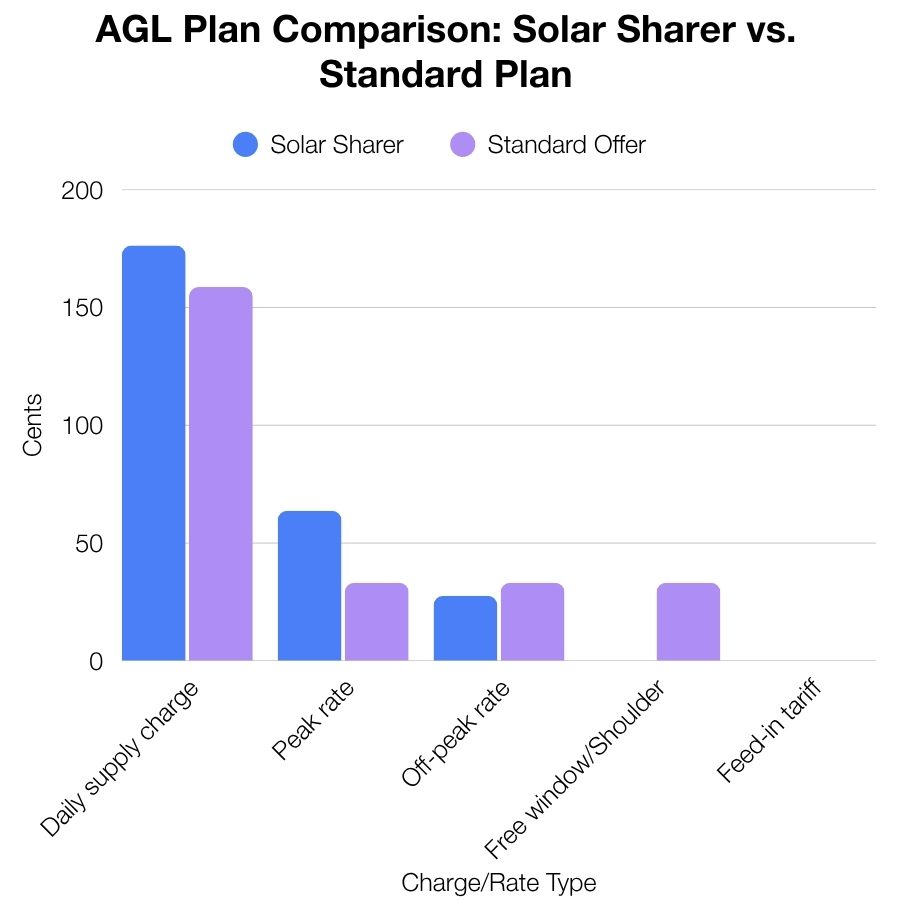
Here’s the Difference: The supply charge is 6% higher for the Solar Sharer plan, while the peak rate is 92% higher. Solar Sharer’s peak rate is almost double the flat rate. The off-peak rate is 17% lower than the flat rate. The feed-in tariff does not change.
Origin Energy: Solar Sharer Vs Standard Plan
Origin Solar Sharer:
- Daily supply charge: 176.41 c/day
- Peak rate: 63.69 c/kWh (no seasonal split)
- Off-peak rate: 27.56 c/kWh
- Free window (first 24 kWh/day): 0.0 c/kWh, then 27.6 c/kWh above the cap
- Solar feed-in tariff: 3.0 c/kWh
Origin Standing Offer:
- Daily supply charge: 166.21 c/day
- Usage charge (single rate): 33.14 c/kWh
- Controlled Load 1: 19.29 c/kWh, plus 4.71 c/day extra supply charge
- Controlled Load 2: 23.0 c/kWh, plus 8.88 c/day extra supply charge
- Solar feed-in tariff: 3.0 c/kWh
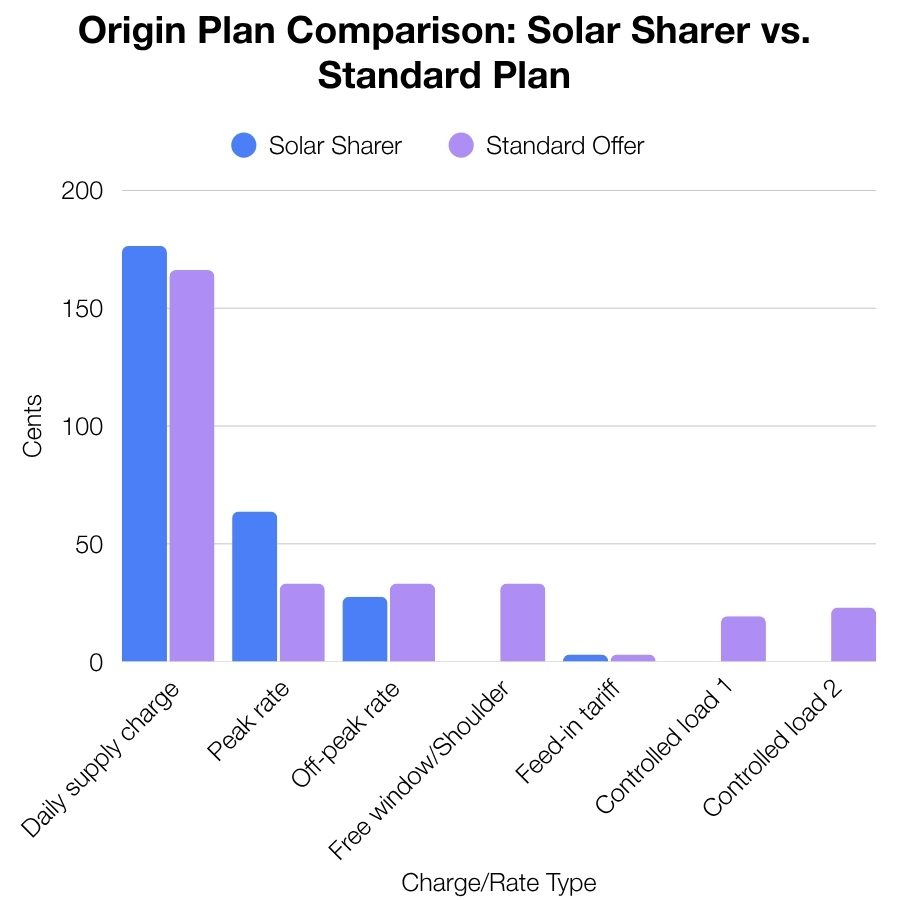
Here’s the Difference: The supply charge is 6% higher on Solar Sharer, at 176.41 c/day compared to 166.21 c/day for the standard plan. The peak rate is 92% higher than the flat rate. The off-peak rate is 17% lower than the flat rate. The feed-in tariff does not change. Both plans pay 3.0 c/kWh for solar sent back to the grid.
Red Energy: Solar Sharer Vs Standing Offer
Red Energy Solar Sharer:
- Daily supply charge: 176.41 c/day
- Peak rate: 63.72 c/kWh
- Off-peak rate: 27.56 c/kWh
- Free window: 0.00 c/kWh, then 27.56 c/kWh above the cap
- Solar feed-in tariff: 1.1 to 6.7 c/kWh exported, depending on time of day
Red Energy Standing Offer:
- Daily supply charge: 131.41 c/day
- Peak rate: 50.60 c/kWh
- Shoulder rate: 35.28 c/kWh
- Off-peak rate: 25.48 c/kWh
- Solar feed-in tariff: 1.1 to 6.7 c/kWh – the same tiers as Solar Sharer
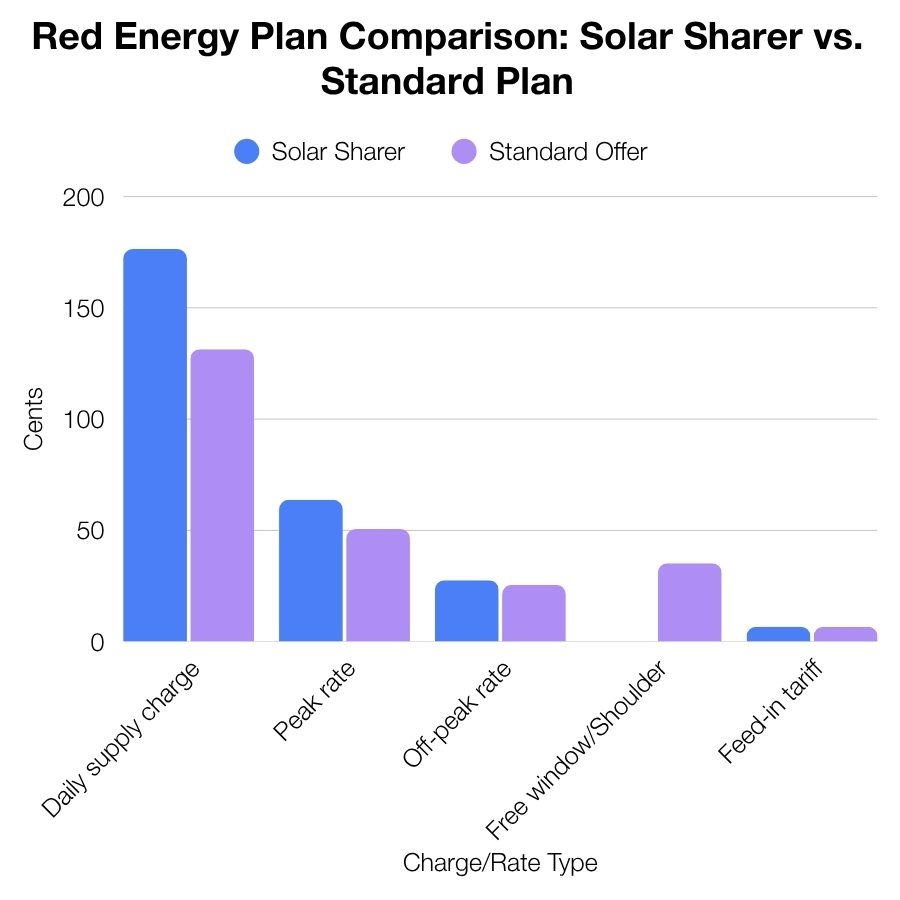
Here’s the Difference: The supply charge is 34% higher. The peak rate is 26% higher. The off-peak rate is 8% higher. The free window replaces the shoulder rate. The feed-in tariff remains unchanged.
Who Should Consider A Solar Sharer Plan?
We asked SolarQuotes’ resident factchecker Ronald Brakels what these numbers mean for someone deciding whether to switch.
“Not likely if you have solar, because it’s providing you with cheap (free-ish) power during the day, and only worthwhile if you don’t have solar if you can shift enough electricity use to around the middle of the day, which definitely should be possible,” he says. “But note the 24 kWh cap – and most homes can only draw around 15 kW, so you can’t get too carried away.”
That’s the main point. If you already have solar panels, you’re probably using your own midday power for almost nothing. The Solar Sharer’s free window doesn’t add much, but the higher peak rate is an extra cost.
It’s not quite that simple for every solar household, Ronald points out:
“I have relatives with a puny 2.5 kW solar system, and they benefit from being on a solar soaker time-of-use plan that charges 7 c/kWh during the day, because their solar isn’t big and the day is when they use most of their electricity. So solar households can come out ahead on cheap daytime electricity plans, but it definitely depends on circumstances.”
Households without solar have the best reason to switch, as long as they can shift enough of their daily electricity use into the free window. Running the dishwasher, washing machine, or heating water between 11 am and 2 pm all help.
A Home Battery Makes Solar Sharer Pay
A battery is the best way to get value from these plans. You can charge it for free during the midday window, then use it to power your home during the evening peak. This way, you mostly avoid the higher peak rate. If you charge your battery from the grid while your solar is feeding the home, you’ll make the most of those three free hours.
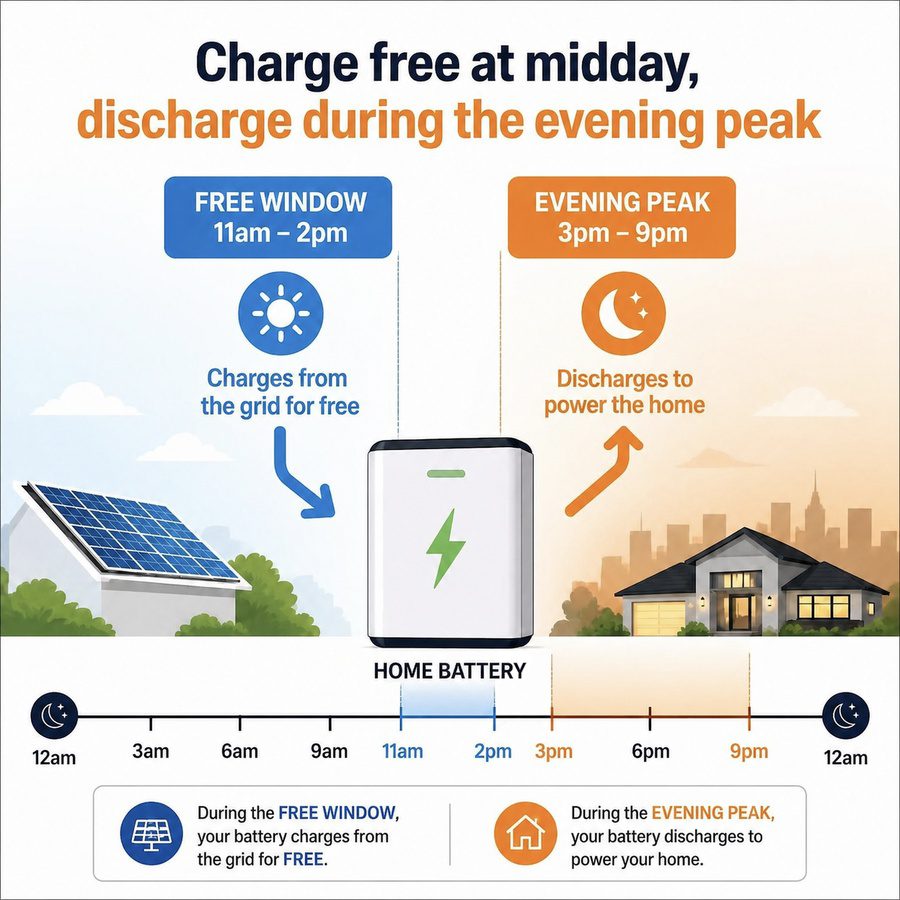
Is a bigger battery worth the extra cost? That depends on your retailer. Each one sets its own peak rate, supply charge, and free window. So the number of kilowatt-hours you need to shift to break even changes from retailer to retailer.
Check Your Postcode
All the information above is based on a Sydney address on the Ausgrid network. Rates, availability, and even the free window hours can vary depending on your state and network, so don’t assume the above numbers apply to your area.
Use our electricity plan comparison tool to search your postcode and check out and compare Solar Sharer plans in your area – note they are only available in NSW, SA and southern NSW at this stage, with similar plans on the way for Victoria in October.
 About Jacob Boyd
 RSS - Posts





Well done with the title of the article which is a more truthful description of Solar Sharer, that the three hours does come with a cost.
Yes, each Solar Shearer plan comes bundled with the Lunar Leecher plan.
It’s all quite perverse. The battery boom has been a boon for peak spot prices, but a bane for peak retail prices.
With peak price volatility almost gone (apologies to Les and other SA residents), Amber might be a better option right now, even without a battery. For me, their app says 3c at lunchtime, 14c at dinner time, and about 90c daily charge in SEQ on a demand plan. Shame about the support ghosting though.
That wasn’t a fair test. You should have compared the solar sharer plan vs the time of use plan default offer. I have a time of use meter and the peak rate is much higher than listed here on the comparator default rates listed here.
I agree. This is a misleading comparison
I’m on an Origin Energy Solar plan as I have solar panels and a battery. I’m in the Northern Rivers of NSW and as for the past couple of winters and the current one ,we have had more overcast and rainy days than sunny ones and my solar system has not been able to produce enough power to fill my battery. Accordingly, when the “free” power scheme was introduced on 1st July I thought that I would take advantage of it. I had no idea what a difficult task this is, Origin had no information on their website on how to apply for it and their chat bot didn’t work, and forget calling them as the wait times were ridiculous. So, I studied all their plans and by the time I finished my head was spinning, I had no idea what it all meant and whether I should change my plan so I just stayed on my existing plan and gave up. I’m now contacting other suppliers to see if they can do better.
Also in N Rivers. I changed currently to 1st Energy: Good o/p energy rate, & I can wait for the market. I charge my battery to 100% abt once a week, between 10pm & 7 am. My 2xEVs charge off the PV mostly, & I charge 22>7 if I need to go 100%.
I am really disappointed with the 3 free hours, which ally to huge energy costs & large daily charges. It is also really hard to compare offers, because the TOU times change & the daily charge is manipulated. The SQ tool helps there if you get your data from in our case, Essential Energy. (Takes abt 48 hours to arrive).
I still believe the Energy retailers should need to pass thru the wholesale daily cost (from EE in our case), with a markup for administration only. Then one could more easily compare apples with apples wrt energy costs. At present this cost is manipulated with no attachment to reality seemingly so the retailers can obfuscate the comparison.
It would really help to run a few sample household profiles through these plans and show the actual outcomes.
Understandably no two households are identical, but you can still build a few simple profiles with reasonable assumptions. That’s often enough to show how these plans behave for different types of users. Even basic profiles, like a family with two kids, a single person, a couple with no dependents, or a retired couple, give readers something concrete to compare against.
These are straightforward profiles to model, and assuming no EV, no solar, and no battery keeps the comparison focused on households most likely to consider these plans. It would give readers a much clearer sense of how the “solar sharer” structure plays out in real life.
We are all paying for “solar share” by huge rises in the daily supply charge, so the 3 hours is hardly ” free”
Why would you pay any of those when you could have the plan I have with Powershop:
Daily supply = 92.94 c/day
All usage: 30.30 c/kWh
I looked up Powershop. Their Daily Supply rate was higher (but still lower than Origin). However, I was held back from switching due to the very bad customer service rating I saw on various review sites. I’m a bit worried about that.
Same here Grace.
Powershop for me are .70 cents a day cheaper on the supply charge, but they also insist on direct debit.
I am with Origin and pay with Bpay, so hopefully the current Origin data hack won’t effect me because Origin don’t have my bank account information.
I don’t do Direct Debit either, so thanks for that additional information.
I tried to sign up with Powershop last year and they refused to do singe rate – it had to be TOU.
The problem with any of these comparisons is that there are so many different plans/retailers/wholesalers/usage scenarios that it is impossible to cover every option. Not to mention the personal whim of the person who happens to take your call, or how badly they want to keep you as a customer (which is when those secret plans miraculously appear).
I’ve given up thinking about it. I’ll leave the job to BillHero.
For my household, Tariff 12F would not reduce my electricity bill. While the tariff would have reduced my July energy charges by only $0.24 (2.98 kWh), the higher daily supply charge would have added $6.55 to the bill.
The result would have been a net increase of approximately $6.31 for the month. With a 10.03 kW solar system and a 13.6 kWh battery, my grid imports are already so low that lower energy rates cannot offset the higher fixed charge.
This is a good example of why fixed charges matter more than usage charges for households that have invested in solar and battery storage. As grid imports become very small, the daily supply charge becomes the dominant component of the electricity bill.
I’m struggling to decide whether to take up the Solar Share Offer so
I did some research and discovered that my smart meter has to be set to “Time of Use”. Further research said I should look on my bill for the actual words, “Time of Use” and so I did. When I found the phrase “Time of Use” I figured I could stop reading because surely my meter must already be set to TOU but I was wrong. When I rang my supplier (Energy Australia) I was told it’s only a label and that if I read further, it also said “Peak at all times”. Basically my bill says “Time of Use: Peak at all times” which is surely like saying “Time of Use: Not time of use”???
So I rang Energy Australia again, to change to TOU, and was told I should wait until September when they’d have a Solar Offer plan. But in the meantime, I’m paying the most expensive peak rate all day.
If Energy Australia isn’t providing you much joy, then perhaps it time to check other retailers offerings. And by the way, the electrcicity retailers were all required to have Solar Sharer Plans ready to go from 1/7/26 – including Energy Australia, Minister Bowen is on the case.
I am a light user, so the excessive increase in supply charge on these plans rules them out.
However, one of my properties is on ToU with AGL Solar Savers. In mid Feb., they changed the ToU rates and times. The Shoulder rate, now 10AM–2PM, is actually cheaper than night time Off peak!
So, that is not “Three Free Hours”, but it is 4 cheap hours.
Check your plans/bills, folks.
It’s ALL so ridiculously complex. I’m an ex-sparkie and electrical engineer and struggle to find the best plan and real prices and conditions. The average person (like for example my wife) would more than likely have no hope. The official comparison websites are basically useless and out of date.
I’m honestly disgusted that all these middle-men (retailers) were given the keys to the door to rip us all off.
A wise old banker friend told me many years ago “NEVER EVER privatise essential services such as power, water etc. It’s just a licence to print money.”
So true!
I couldn’t agree more David. It is profitability through obscurity.
Have a look at BillHero – it does all the comparison work for you. I saved my signup fee in the first month when it pointed me to a much cheaper gas plan.
Remember Monopoly? It was well worth owning all the services assetts…
Oh, how things have (not) changed.
As I said, please make the retailers pass the wholesale fixed cost supply with an admin markup, & stop all the shenanigans with manipulating the daily charge to obfuscate the calculations. All it takes is state regulation (or AEMO might be able to do it).
All the daily charges in my area for these and other provider’s solar sharer plans are around $2.70/day – is anyone getting the $1.76/day supply share as per the article?
My latest Amber bill shows everything in great detail. Potentially too much detail for some 🙂
Daily supply (inc. Metering charge) 69c
Amber subscription 82c
So effective daily cost: $ 1.51.
On top of that is consumption at wholesale price. VERY variable through the day, metered in five minute blocks. Right now (lunchtime) it’s 13 cents per kWH. The forecast for dinnertime tonight is mid 60 cents.
I’m still solar-free so no FiT for me.
Disclaimer: I have no affiliation with Amber other than being a happy customer of two years standing.