
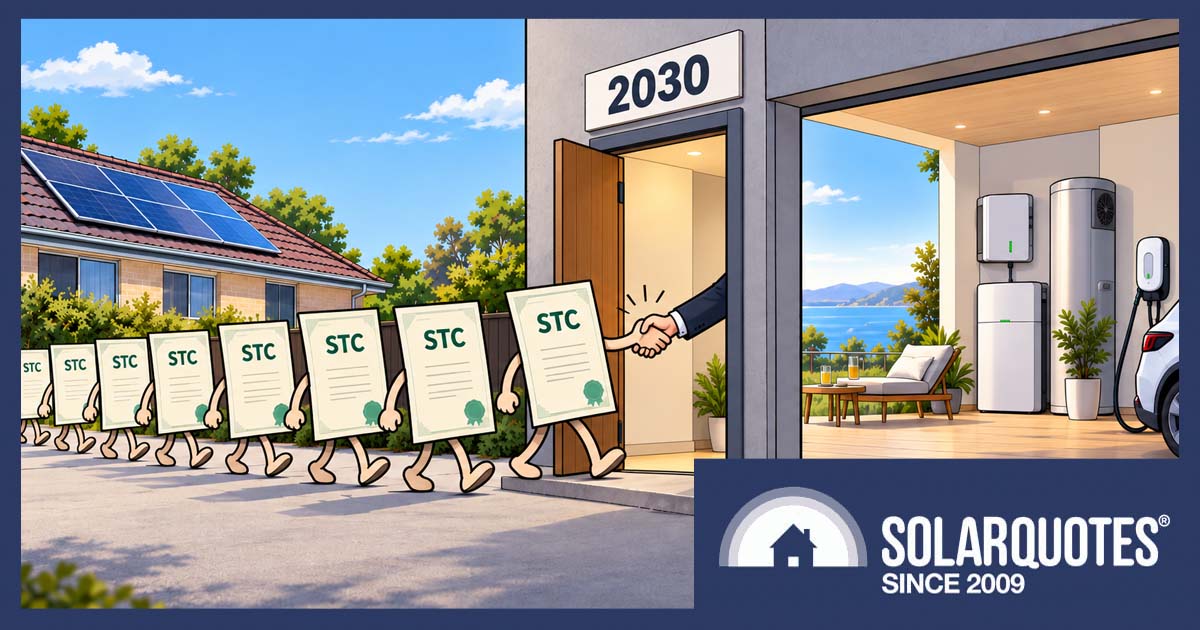
Australia’s federal solar rebate has an expiry date. At the end of 2030, the Small-scale Renewable Energy Scheme that has helped put solar on millions of roofs is scheduled to finish.
That was always the plan. The interesting part is that, with just over four years left, Australia keeps finding new things for the scheme to do.
Was The Solar Rebate Always Meant To End?
Pretty much.
The Small-scale Renewable Energy Scheme, or SRES, was never intended to subsidise rooftop solar forever. It was designed as a transitional measure, helping renewable technologies get established while costs fell and the market matured.
Solar systems receive Small-scale Technology Certificates, better known as STCs, based partly on how many years remain before the scheme ends.
In 2026 a new solar system gets five years of deemed generation. Next year it gets four, then three, two and finally one year in 2030. From 1 January 2031, new installations get no SRES support.
For a typical 6.6 kW solar system, SolarQuotes estimates the federal incentive is worth roughly $1,630 in 2026. That falls to around $1,300 next year, $980 in 2028, $650 in 2029 and about $330 in 2030.
So there is no enormous rebate cliff waiting on 1 January 2031. Most of today’s discount will already have quietly disappeared.
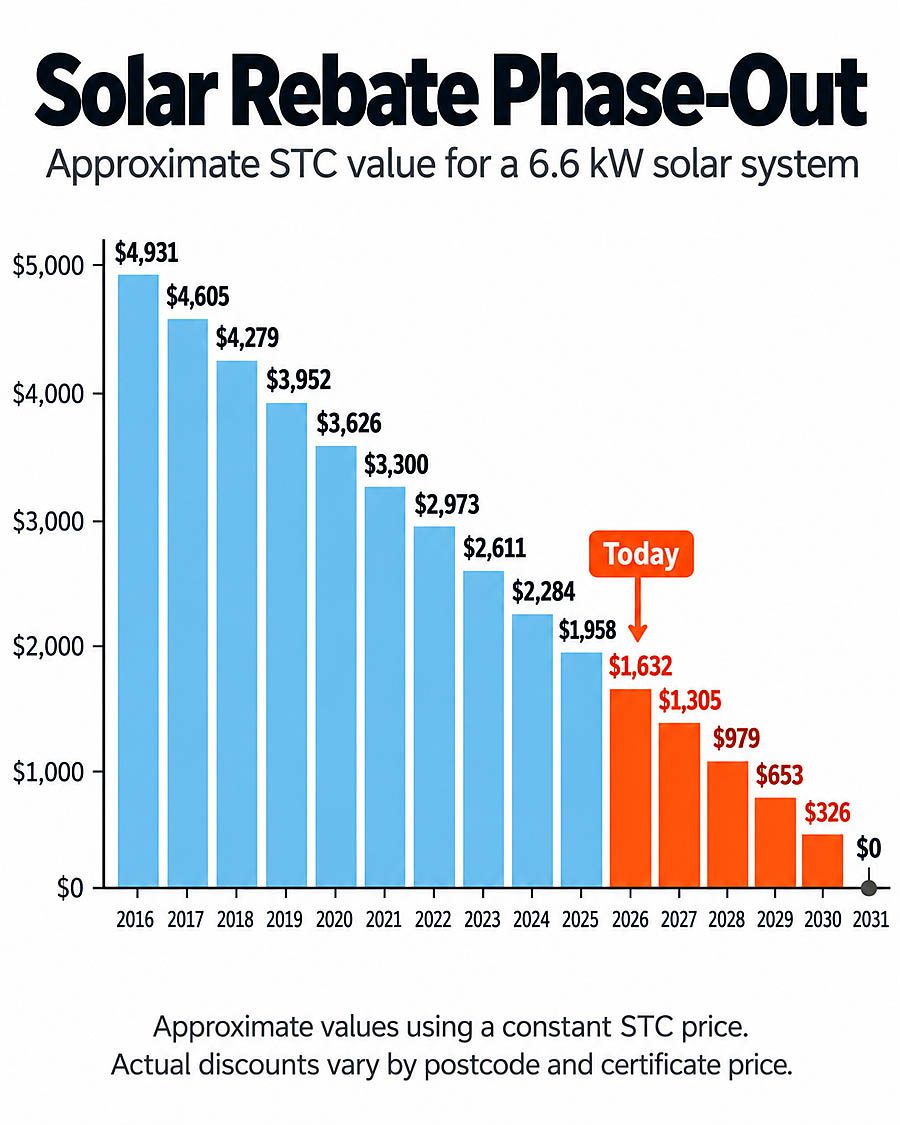
The federal solar rebate has been phased down year by year since 2016 and falls to zero for new systems from 2031.
Has It Done Its Job?
For rooftop solar, you could make a pretty convincing case that it has.
More than 4.5 million Australian homes and small businesses now have rooftop solar, and the latest Clean Energy Council figures show another 1.89 GW was installed in the first half of this year alone.
On current trends, the CEC says rooftop solar capacity will exceed AEMO’s 2029–30 forecast by 13%. That’s a long way from the expensive novelty the SRES was created to encourage. Hundreds of thousands of systems continue to be installed each year even as the incentive shrinks.
That is more or less what a successful temporary subsidy is supposed to do: create a market, help costs fall, then gradually get out of the way. If rooftop solar keeps selling without it, it would be difficult to argue the scheme failed.
Except rooftop solar is no longer the whole story.
Then We Gave The Scheme More Jobs
Home Batteries
The federal Cheaper Home Batteries Program operates through the SRES and currently aims to knock around 30% off the upfront cost of an eligible battery.
More than two million batteries are expected to be installed under the expanded program by 2030, but the rebate is also being wound down.
For a typical 10 kWh battery, the maximum theoretical STC value is about $2,720 today. By late 2030, it falls to around $840.
That doesn’t mean waiting automatically costs you nearly $2,000. Battery prices are expected to fall over the same period, and the rebate settings are reviewed with the aim of keeping the effective discount around 30%.
Whether batteries can follow solar down the cost curve and eventually stand on their own is something we won’t know until we get there.
Heat-Pump Hot Water
Heat-pump hot-water systems also receive STCs, with their entitlement being wound down towards 2030.
The discount is generally worth a few hundred dollars, although the exact amount depends on the model, its efficiency and where it is installed. More efficient units can receive more STCs because the certificates are based on expected energy savings.
Commercial Solar
Since 1 October this year, solar systems between 100 kW and 1 MW have become eligible for SRES support. Unlike household solar, these larger systems get a fixed five-year entitlement even when installed close to 2030.
So four years before the scheme is supposed to finish, Australia is still finding new uses for it.
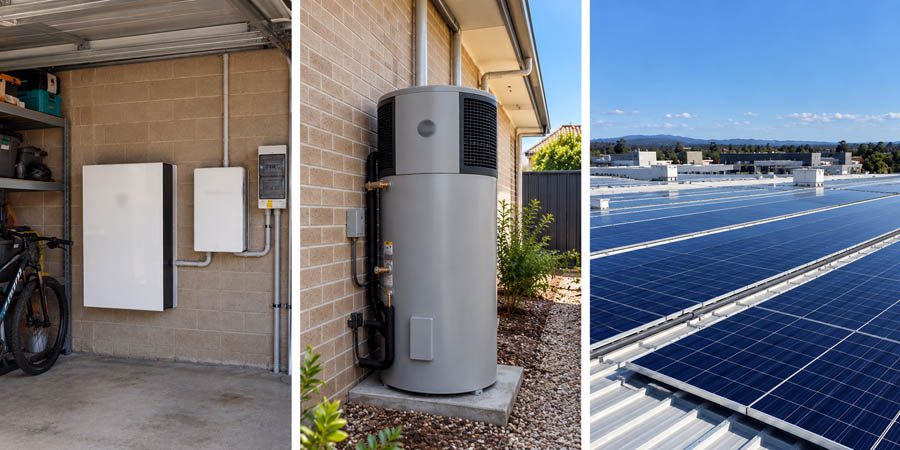
The SRES started as a way to support small-scale renewables, but now also props up home batteries, heat-pump hot water and larger solar systems.
It’s Not Just About The Discount
The SRES does more than make equipment cheaper. STC eligibility is tied to approved products, accredited installers and technical requirements. The Clean Energy Regulator can also inspect installations and remove access to STCs when requirements aren’t met. That gives regulators a useful financial stick.
Heat-pump hot water provides a good example. STC eligibility currently sets minimum performance requirements, doing some of the work of a formal efficiency standard. With STCs disappearing, the government is developing a permanent standard to replace that function.
A new national technical framework is also being developed for consumer energy equipment including solar and battery inverters and EV chargers.
So nobody appears to be planning to simply turn the SRES off and hope for the best. Some of the scaffolding is already being replaced.
Should Homeowners Do Anything About 2030?
Probably not anything drastic.
If solar makes sense for your house today, waiting means a smaller STC discount each year. But buying purely because the rebate ends in 2030 makes little sense because almost all of today’s incentive will already be gone by then.
Batteries are harder to call. Their rebate will shrink, but battery prices may fall with it. Nobody can reliably tell you today whether buying in 2029 will leave you better or worse off than buying in 2026.
Likewise, replacing a perfectly serviceable hot-water system years early just to collect some disappearing STCs would take some interesting arithmetic to justify.
The useful thing to remember is that 2030 is a real end date, but it isn’t four years of emergency. Be particularly wary of anyone turning a scheduled battery STC step-down into a “REBATE ENDING!” sales pitch. SolarQuotes has already seen examples of that.
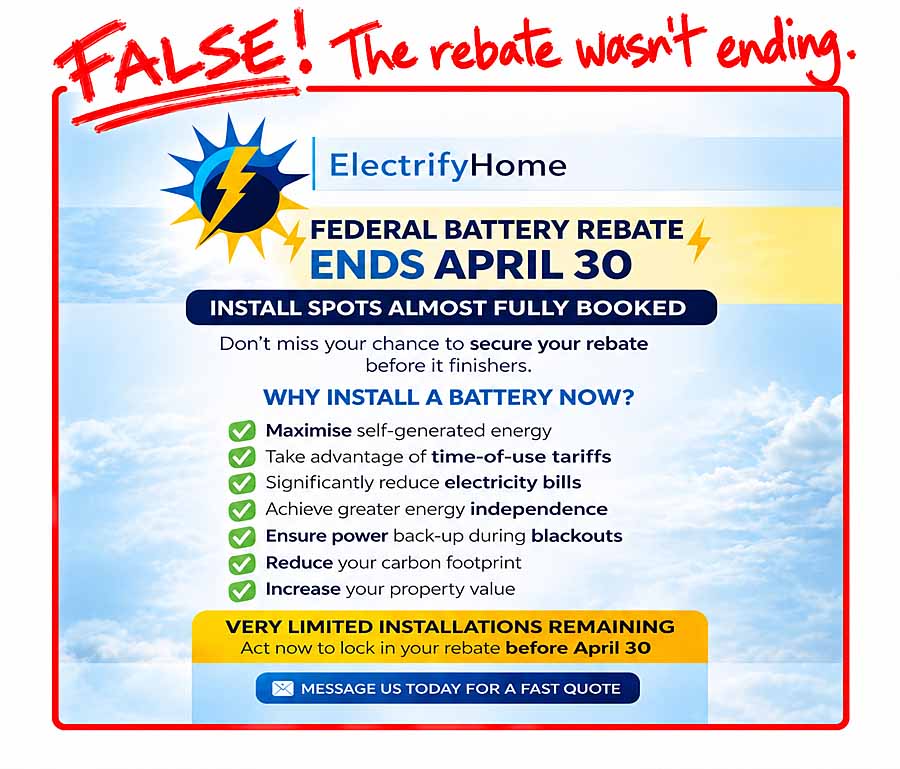
Nope, the federal battery rebate wasn’t ending on April 30 as this advert suggested. It still isn’t ending (not yet anyway) — only the value of the rebate will change every year until 2030.
So What Happens After 2030?
On the regulatory side, Australia’s energy ministers have endorsed a new national system for solar, batteries and EV chargers, including product rules, installer accreditation and a new technical regulator. That means some of the functions now tied to the SRES are already being moved elsewhere.
Whether financial support continues after 2030, and in what form, is still unresolved.
The Clean Energy Council wants the SRES extended to 2040, including support for batteries and other flexible energy equipment. The Climate Change Authority has also recommended considering support beyond 2030, potentially including household batteries and private EV chargers.
But there is no announced replacement for STCs after 2030, and no guarantee the current scheme will simply continue.
Rooftop solar may be ready to stand on its own by then. Batteries and other electrification technologies may be a different story. And, this is a big ‘and’, there’s another federal election before the SRES reaches its scheduled finish line. Ouch.
Want to see how much the federal solar incentive is worth for your system today? SolarQuotes’ STC Calculator shows the rebate based on system size, postcode and installation year.
 About Kim Wainwright
 RSS - Posts




Speak Your Mind