
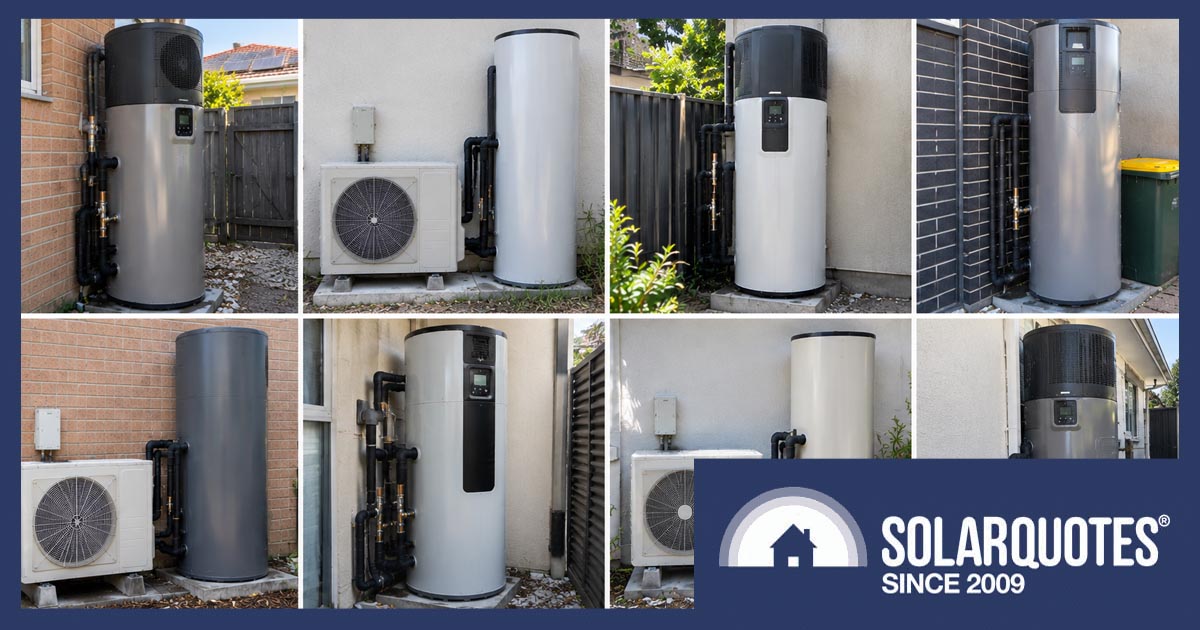
Buying a heat pump hot water system means wading through impressive-looking efficiency claims that aren’t always easy to compare.
Proposed federal government rules aim to change that by introducing a minimum efficiency standard for heat pump water heaters sold in Australia.
But a minimum efficiency standard doesn’t necessarily guarantee a good heat pump. So what will these rules actually achieve?
Will The New Rules Get Rid Of Bad Heat Pumps?
The proposed rules deal primarily with energy efficiency. They won’t guarantee that a heat pump is reliable, quiet, easy to repair, or backed by decent customer service. Nor can they rescue a bad installation.
SolarQuotes contributor and heat pump specialist Tim Johnston puts it plainly: “The issue with poor heat pumps is reliability.”
These rules aim to establish a clear performance baseline, helping homeowners feel more confident when comparing products and trusting their choices.
There’s a particular reason the government wants to establish that floor now. Australia already has something resembling a minimum efficiency standard for heat pump water heaters, but it’s tied to a rebate that’s gradually disappearing.
The STC Safety Net Is Disappearing
Heat pump water heaters don’t currently have a mandatory national Minimum Energy Performance Standard (MEPS).
However, to qualify for Small-scale Technology Certificates (STCs), heat pump water heaters have effectively had to clear an energy-efficiency hurdle. The government describes this as a “de facto MEPS”.
The problem is that STCs are winding down towards 2030.
As the incentive shrinks, so does the commercial value of qualifying for it. The government is concerned that this could eventually open the door to cheaper, less efficient products.
The proposed regulations would turn that temporary, rebate-driven efficiency floor into a permanent legal requirement. But how high will the government set the bar?
Setting The Efficiency Bar At COP 2.0
The proposed minimum is a coefficient of performance (COP) of 2.0 under the government’s prescribed test.
In simple terms, a COP of 2 means the water heater delivers two units of heat for every unit of electrical energy it consumes.
If you’ve looked at heat pumps advertising COPs of 4, 5, or even higher, that 2.0 minimum might sound extraordinarily low. That’s because it isn’t an apples-to-apples comparison.
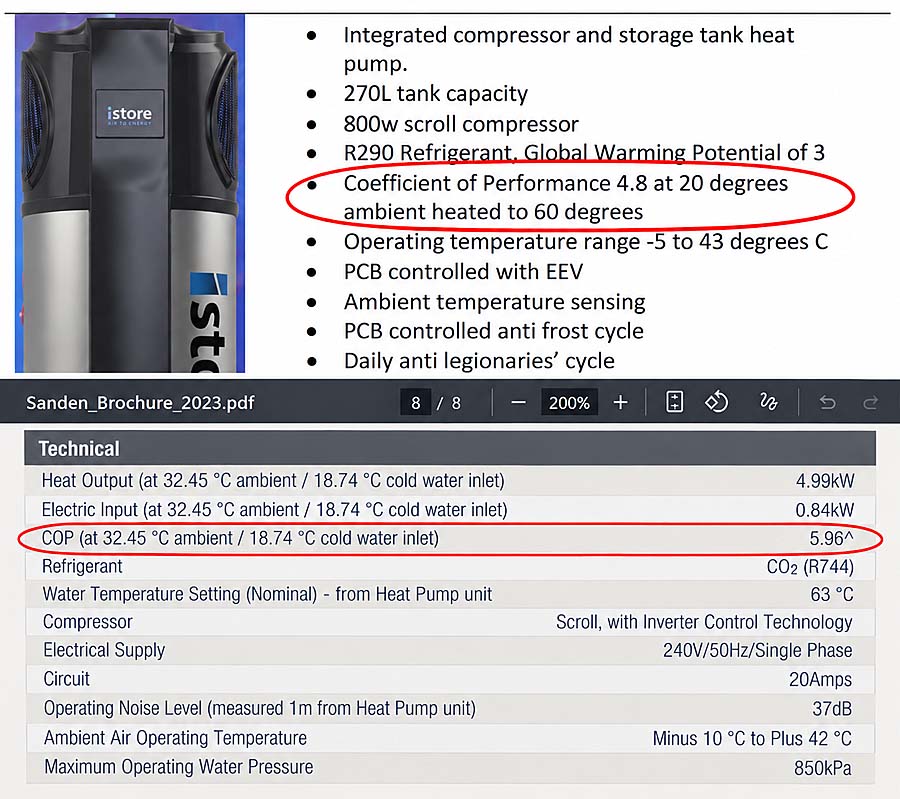
COP figures aren’t necessarily apples-to-apples. iStore (top image) quotes 4.8 at 20°C ambient, while Sanden (bottom image) quotes 5.96 at 32.45°C. Both state their test conditions, but the numbers aren’t directly comparable.
Manufacturers can quote COP under particular operating conditions. The proposed standard instead uses a prescribed 24-hour hot-water cycle at an ambient temperature of 9°C. This measures the performance of the complete system, including the effects of tank heat loss and standby energy consumption.
An advertised COP of 4.5, therefore, doesn’t mean a heat pump beats the proposed minimum by more than double.
Standardised testing should give us a more consistent picture of efficiency. But there’s another question: will the minimum of 2.0 actually exclude many of the heat pumps homeowners would be better off avoiding?
A Low Bar Won’t Necessarily Catch The Duds
Heat pump specialist Tim Johnston doesn’t expect the proposed minimum to remove poor products from the market.
He says some lower-end units advertise exceptionally high COPs because they’re tested under favourable conditions. He expects those figures to fall substantially short of the proposed test, but still believes the units will meet the minimum.
“It’s a very low bar. This comes down to ‘any heat pump is better than no heat pump’ because they are inherently superior and more efficient.”
But Johnston argues that efficiency is only part of the picture.
“The counter to ‘any heat pump is better than no heat pump’ is a heat pump that lasts 3 years and needs to be replaced. We need them to last.”
For Johnston, the problem with poor heat pumps is often reliability rather than efficiency alone. Customer service is another common shortfall.
That might sound like a disappointing outcome. But removing products from the market isn’t the only way the regulations could help consumers make better choices.
Apples With Apples
The proposed rules would also require suppliers to provide standardised figures for COP, maximum usable hot-water volume, heating capacity, and full reheat time.
At present, comparing those sorts of claims between manufacturers can be difficult because they’re not necessarily based on the same test conditions.
Under the proposed system, everyone has to run the same race.
Johnston sees this as a more promising aspect of the changes.
“It’s definitely a step in the right direction. I think it will be easier for consumers to interrogate these false claims of ‘world-leading efficiency.’ Standardised tests will make it easier to compare, and while poorer units won’t be removed from the market, perhaps they will be easier to spot.”
Different test conditions don’t automatically make an existing manufacturer’s claim misleading. Both products in our comparison above, for example, disclose the conditions behind their figures. The difficulty is comparing the numbers directly when those conditions differ.
A common testing method should make it easier to judge performance without having to decipher the fine print in two different specification sheets.
It won’t, however, introduce an Energy Rating star sticker for heat pumps just yet. More comprehensive consumer labelling is being considered for a later stage, potentially around 2028.
When Do The New Rules Start?
There’s no firm date yet.
The exposure draft is open for public consultation until 5 October 2026. Once feedback has been considered, the government intends to make the final determination on the Greenhouse and Energy Minimum Standards (GEMS).
The requirements would commence 12 months after the determination is registered, with a limited transition period for existing stock.
So this isn’t an overnight clean-out of Australia’s heat pump market.
The proposed standard should preserve an efficiency floor as STCs disappear, while standardised performance figures could make poorer products easier to identify.
It won’t filter out every dud, but it should give homeowners a better idea of what they’re buying.
If you’re considering switching, our SolarQuotes heat pump hot water guide explains what to look for when choosing a system and how much you can expect to pay.
 About Kim Wainwright
 RSS - Posts






While the argument is put that less reliable Heat Pump manufacturers could be boasting high COP figures using high ambient temperatures, in actual fact the highest boasted COP figures that “Mr Smith” has seen come from a very expensive Heat pump manufacturer, as your above example shows.
All heat pumps have lower COP when it is cold, and clearly it is best to run them in the day when air temps are higher and when the PV on our roof provides free power (or the retail time of use price is very low).
When using our PV generation which might get a 1c FIT (or none at all) the cost of my resistive heated water using 8kWh/day is 8c per day, while a HP with a COP of 4 would be 2c.
A 6c/day saving is $22/yr, and I can never justify spending $3000 to $6000 for a expensive Heat Pump HWS when a more reliable 15yo old school resistive costs barely over $1000. My 15year savings could be $315 while the extra interest on $2000 difference is $1125.
I agree and in my case being restricted to 5 kw export and with a 10 kw inverter a lot of the time with a 3.6 kw element l send 5 kw to the grid and heat the water for free, I’ve got a green catch diverter set on solar only hence never have to do anything !! Like you only get 1 cent fit anyway !!
Flynn,
Is there an argument to use the extra cost of a solar pump to install additional solar panels and together with a standard electrical hot water system? $2000+ in panels could offset the additional electricity consumption and the system would be quiet and have no moving parts, reducing failure rates.
Norbert,
In principle I’m sufficiently in agreement to have 27 kW (65 panels) up on the roof, and the 3.6 kW HWS element swapped out for a 2.4 kW, to be able to make do on more days. BUUUT, today’s rainy murk is yielding only 1.6 kW, not enough for even the downsized element. But I lit the wood heater last night, so the in-flue water heater could do its thing.
Most of that 1.6 kW is bringing the house battery up from an overnight low of 70% (due to a late electric excavator charge), going through 80% now.
Should have charged the BEV yesterday instead, as an unscheduled 66 km trip this morning has it down to 18%, 49 km range. The 7 kW AC charger can be throttled to 1.6 kW, but is inefficient at low throughput. I’m planning to let the house battery reach 100%, then smack 7 kW into the BEV, with 46 kWh to draw on.
If I were on-grid, there’d be no issue, but I’m not going to start the generator to charge the car. It is possible to squeak through without, Ra willing.
Norbert,
You’re right. Even off-grid, extra PV panels obviate any need for spinning ironmongery to heat water.
At midday today, in total grey overcast, with sheets of fine rain sweeping across the paddocks, my 27 kW of PV is yielding 6kW, peaking to 7 kW. While that’d do for two 3.6 kW HWS, without substantial off-grid battery draw, I’m at the moment whacking it into the BEV instead. (Even with just a resistive element, I have enough hot water already.)
Granted, the half-day yield is 14.2 kWh, and usage is 16.9 kWh, so the battery is doing a little bit, as I I’m also heating with the ircon, too lazy to fetch firewood for the wood heater. (It’s wet out there, seriously mooshy underfoot, 75 mm so far, Yay! 🙂
Rainwater in the new drainage ditch confirms the excavation levels are good. It’s as good as a spirit level. We don’t waste anything on the farm. Just stand back when back filling.
The GWM ora with 58 kw lithium battery and 6 kw v2l would be handy for off grid EH !!
Just thinking out loud !!
Peter,
That’s twice the V2L of my MG4, so not shabby at all.
The 42 km/h Level2 BEV charge rate limit means BEV raiding is best for dodging peak rates, then grab 3-free-hrs?
Off-grid, less so – here anyway: Going the other way this morning, taking 1 kW from the house battery to make up a 7 kW BEV charge rate in total overcast. (Yet again) … Ah, dropping to 0.24 kW battery draw, as the sky-soup thins a smidge.
Here, off-grid is rural, with a 65 km shopping trip. Thus last Friday’s 49 km residual range would have needed the nearest fast charger. (None used yet, in 2.7 years.) The house battery is about the same size as the BEV battery, and it can rooftop recharge while I’m zooming down the highway. I don’t have an extension cord long enough to do that directly on the car, and there’s none in the shopping centre carpark either. That makes the house battery as an extension of the BEV battery much more useful than vice versa. $1/kWh FiT-on-wheels is unbeatable too.
The ora 6kw inverter also might come in handy if the house inverter suddenly shit itself !!
CoP depends on a number of factors including primarily the refrigerant used & the ambient outdoor air temperature.
https://www.solarquotes.com.au/blog/heat-pumps-win-the-hot-water-efficiency-war/#comment-1727052
I think the unit performance should be specified for a range of ambient outdoor dry bulb temperatures, say for -10 °C, 0 °C, +10 °C, +20 °C, +30 °C, and +40 °C, and include the respective CoPs, input electrical power (kW) consumption, output thermal power (kW), and output hot water flow rate (litres/hour).
The water inlet temperature should be +4 °C for the -10 to +10 °C ambient air temperature range, and +18 °C for the +20 to +40 °C ambient air temperature range.
That should make it easier for prospective customers to compare performance characteristics.
While “performance” of racing cars might be something rev heads are acutely considering, most people just want hot water at the best price possible.
This price is made up of capital cost, interest cost, reliability cost, convenience cost and electricity cost (c/kWh x number of kWh used).
Heat pump HWS only win on savings of kwh of electricity used (which if the electricity price is low or free, means little or no gain), while in all other attributes the resistive HWS is ahead.
If you have no PV panels, or access to cheap TOU power, and you are a high hot water use household, only then will the Heat pump come out in front when all things are considered (not just performance).
I should mention that my 15yo resistive HWS has had no repair costs at all, just a new $74 sacrificial annode last week, so it should be good for a long time yet.
Tim Chirgwin: – “Heat pump HWS only win on savings of kwh of electricity used (which if the electricity price is low or free, means little or no gain), while in all other attributes the resistive HWS is ahead.”
Nothing is free! Solar-PV panels & inverters cost money to supply & install. Inverters & panels fail eventually. I’ve had two inverters fail with an average life of less than 5 years each.
The catch with Australia’s 3 hours of free midday electricity scheme (known as the Solar Sharer program federally or Midday Power Saver in Victoria) is that rates outside the free window can be significantly higher, counterbalancing the free period.
My Sanden heat-pump unit has been supplying me cheap, ample hot water for 11+ years.
I think you are also assuming everyone has ample, unobstructed roof space for 10+ kW of PV capacity. I don’t have that luxury, & I’d suggest more than a few people have a similar situation. Thus, energy efficiency is a priority for me.
Geoff,
You’re right – we are the product of our environment, so shading and roof area limitations militate towards efficient use of limited photon capture. It’s the most rational course in that situation. And Tim has granted that case, I infer.
But beneficent Ra freely gifts as much energy into space in a second as all nations combined produce in 650 millennia. That is more free than air. Given ample rooftop solar, the incremental cost of an extra kWh or two into a resistive HWS element asymptotes to zero.
And, yes, the embodied energy of a small resistive element is significantly less than a pile of spinning ironmongery. It also contains no GHG coolant, which may leak. (OK, it might not.) There is less to go bang in the night, and stop moving heat uphill.
It’s great that we have both, each for its use-case. Aircons, fridges, freezers, heat pumps – they’re all the same thing.
But whether I consume 6 kWh or 62 kWh of solar in a day, costs the same, and helps save civilisation.
Erik Christiansen: – “And, yes, the embodied energy of a small resistive element is significantly less than a pile of spinning ironmongery.”
Have you considered the “embodied energy” of the extra equipment needed to supply the substantial extra energy demanded by resistive element units, compared with the substantially less energy that heat-pumps require? No?
It seems you’re ignoring the embodied energy in the extra PV panels (and larger inverter) needed, particularly in winter, to accommodate the considerably larger energy demand. And if you require a bigger BESS coupled to your system, that’s more energy embodiment.
I’d suggest you (& others) are conveniently ignoring comparing the whole energy systems, & are only considering the water heating unit portion.
The cheapest energy is the energy one doesn’t use.
Erik Christiansen: – “There is less to go bang in the night, and stop moving heat uphill.”
Everything fails eventually; nothing lasts forever!
Geoff Miell
Some seem concerned that the full picture of energy is not considered, with the extra PV panels needed and even battery storage to adequately power the resistive element, over the lower needs of a heat pump, especially in the winter.
A few considerations are pertinent,…
Firstly the additional panels required will by far outlast the heatpump so this investment cost will likely last 30 years while the heatpumps could go 15 years, (many are much less),,,at which point ,the HP then require replacement (both embodied energy and further high financial input).
Secondly the winter period of colder ambient conditions require more energy for the Heat pump to produce the hot water so its usage is greater than the average figure boasted, and extra panels also are needed, while a RE does not suffer winter efficiency loss.
Thirdly,.. storage tanks do not require additional batteries to operate as they (on timers or catch control) store the energy as hot water directly
Tim Chirgwin: – “Firstly the additional panels required will by far outlast the heatpump…”
PV panels are DC power, while homes generally require AC power. It seems you have ignored the weakest link for solar-PV: the inverter. The typical service life of a solar PV string or hybrid inverter is 10-15 years, while microinverters often last 20 to 25 years.
I’ve had 2 string inverters fail in ≤5 years each.
Tim Chirgwin: – “at which point ,the HP then require replacement (both embodied energy and further high financial input).”
It depends on what fails. If there’s a failure of the compressor, or heat exchanger, or there’s a refrigerant leak, then I’d suggest the whole outdoor unit would likely be replaced. If it’s the tank, tank thermal sensor, water pump, fan, circuit boards, or water piping/connectors, then they can be individually replaced at much lower cost, to extend the life of the system.
HP is still more than twice as efficient at -10 °C temperature.
Geoff Miell;
The inverter that converts PV DC to AC does not significantly decrease in reliability if you put a few extra panels to provide the extra kwh that the resistive HWS use, and clearly if it fails then it will be replaced anyway,… so inverter failure is a moot point as both heat systems will need an inverter and pv panels to power them from sun.
Yes, the heat pump might have failure of multiple cheaper components over the years before a major failure causes the scrapping of unit completely, I hardly think that multiple call out fees are going to make you feel happy just because each of small components may be cheap.
If at -10 °C temperature your heat pump is using 1c worth of where the resistive uses 2c of FIT electricity is not really helping the case for cost, but I don’t think this point is realistic as most people who are concerned about cost and efficiency would endeaver to run the heater during the warmer parts of the day and when the sun is shining anyway.
Tim Chirgwin: – “The inverter that converts PV DC to AC does not significantly decrease in reliability if you put a few extra panels to provide the extra kwh that the resistive HWS use”
On a clear, sunny winter noon in Sydney, a 10 kW solar-PV system typically delivers a peak instantaneous power output of 6 kW to 8.5 kW (roughly 60% to 85% of its nameplate capacity), but on an overcast day at noon at the same location the same system will typically produce only 1.5 kW to 3.5 kW of peak power (about 15% to 35% of its rated capacity), depending on the thickness of the cloud cover.
Thus, there’s no capacity to sustain a 3.6 to 4.8 kW capacity resistive element hot water system in Sydney on overcast winter days only with a 10 kW solar-PV system, but it’s possible for a heat pump. But if there are other appliances demanding significant power, like fridges, air con, & EVs, then grid supply is required.
At 1.7 ºC the CoP is 2.75; at 10 ºC it’s 3.7; 19.4 ºC it’s 4.2.
For this reason, winter is when we’ll see peak pricing for this reason.
There will be no shortage in summer but a winter wind drought will mean the gas generators come out of mothballs.
Anthony Bennett: – “There will be no shortage in summer but a winter wind drought will mean the gas generators come out of mothballs.”
Where’s the gas coming from? Per the AEMO’s Gas Statement of Opportunities: For Australia’s East Coast Gas Market report published 26 Mar 2026, Fig. 25 indicates the combined 2P Developed + Undeveloped Reserves-to-Production is 16.3 years.
https://www.aemo.com.au/energy-systems/gas/gas-forecasting-and-planning/gas-statement-of-opportunities-gsoo
Alison Reeve said recently:
“So, what we wanted to talk about today was, I think, gas in particular. Um, and, I guess, well, let me, let me put it this way, at Grattan Institute, we, we start with the numbers, and if you look at the numbers around gas, gas production, and use in Australia is responsible for about 25% of Australia’s emissions. … gas in Australia is actually an industry that’s in decline.” https://youtu.be/KgjGQojPjqU?t=203
Gas supply will only get scarcer.
Hi Geoff,
I’m no fan of the gas industry but I expect they’re going to last longer than the coal clunkers.
Gas is at least responsive to demand, but happily grid scale batteries have, over the last year, delivered more MWh to the grid than OCGT & Diesel peakers combined.
Ideally we’ll have some alternatives to burning fossils, and soon.
Geoff Meil.
You are correct that on heavily overcast days the PV produces much less energy,.. over many years I have followed this and we have about 12 such days per year where the PV only produces 9% of the solar on the roof,..ie a 13kw array only yeilds 12kwh of energy,… which is more than my daily general usage without considering hot water through the resistive element HWS (which uses 8kWh per day).
So even with a heat pump I would still need to import from the grid.
The reality is that most 2 person households can get 3 days of hot water (6 showers and dish washing) from a 250L tank without top up heating, while we (living well south of Adelaide) never have had more than 2 of these very low insolation days in a row.
The catch control tops up the hot water without drawing from the grid so our hot water is from the sun,… or we give to the grid for almost nothing.
I quote the HP efficiency benefits, but I do not fool myself with efficiency at any cost, if alternatives exist.
Good luck getting a replacement circuit board for a 10yo HP system.
The only components likely to fail in a resistive HWS are the heating element and thermostat. Both are virtually generic items that any good plumber will carry in his van at all times.
BTW most HP HWS also contain a resistive element. The ‘back up’ in extra cold weather. Once that kicks in the system is, obviously, no more efficient than an old-school resistive HWS 🙂
Clive W, Melbourne.: – “BTW most HP HWS also contain a resistive element. The ‘back up’ in extra cold weather. Once that kicks in the system is, obviously, no more efficient than an old-school resistive HWS”
That may be so for some heat pump hot water systems, but Sanden, Reclaim and some other brands of heat pumps don’t have or need a resistive element. See the Heat Pump Comparison Table.
https://www.solarquotes.com.au/hot-water/heat-pump/
Sanden, Reclaim & Thermann Split brands, which use R744 (CO₂) refrigerant, all have an ambient air temperature operating range between -10 to +43 °C, & are more than twice as efficient as “old-school resistive HWS” at the lowest operating temperature, & substantially more above freezing, which is typically when these units operate.
Geoff Miell,
The brands that you mention all are over $5000, not everyone has that sort of cash to splash around,…at 7% interest and if they last 10 years without any faults or repairs the cost is effectively $950 per year, and with say 2 kWh/ day of controlled load electricity at 25c makes a yearly cost of $1150.00
A resistive HWS for $1000 over 20 years with interest will cost $120/year. Being less efficient it uses 8kWh/day, which at controlled load of 25c gives a total yearly cost of $850.00.
Could you enlighten us on how struggling people can justify the high cost of your HP choice?
The CO2 gas HPs operate at a significantly higher pressure than other refrigerants. Two points:
1. This higher pressure means components are under higher stress, which probably leads to earlier failure;
2. It’s also an excuse for these units to be priced significantly higher. Not helping the economic argument 😉
Now try to incorporate a hot water circulation pump to an HWS to save water. Resistive – no problem. HP – not compatible without a ‘header tank’. What’s a header tank you ask? Industry code for a small resistive HWS adjacent to the HP!
Hi Clive,
To the best of my knowledge a CO² heat pump can attain 90°C and so they’re suitable for ring mains without resistive boosting or what you might be referring to, a buffer tank?
Lesser heat pumps only make 65°C and rely on the inbuilt booster element to kill legionella when ambient temperatures are low.
In any case CO² heat pumps can manage large commercial loads like hotels & hospitals.
Tim Chirgwin, I suggest your assumptions are biased.
Full resistive hot water system replacement:
* Unit Purchase Price: $450 to $1,800 (depending on tank size, such as 50L to 315L/400L);
* Installation Cost: $350 to $1,000 for a simple “like-for-like” swap;
* Total Installed Cost: $800 to $2,800 depending on the brand, capacity, and whether electrical or plumbing modifications are required.
Annual Running Cost: 0.25c/kWh (O/P) x 3.6 kW x 2.3 h x 365 d/y = $756/y
Cost breakdown by Sanden system size (NSW Supply & Install):
160L: ~$6,850
250L: ~$5,950 – $6,499
300L / 315L: ~$6,050 – $6,699
Replacing an electric or gas system, regional incentives can further reduce out-of-pocket costs (bringing est. net pricing down closer to $5,160 in many NSW service areas).
Equivalent water use running cost (Lithgow):
Winter: 0.31c/kWh x 1.2 kW x 2.3 h x 91 d/y = $78
Spring/Autumn: 0.31c/kWh x 1 kW x 2 h x 180 d/y = $112
Summer: 0.31c/kWh x 1 kW x 1.8 h x 94 d/y = $52
Total: $242/y
Clive W, Melbourne.: – “1. This higher pressure means components are under higher stress, which probably leads to earlier failure;”
Do you have any evidence/data to support your claim: “probably leads to earlier failure”? No? Hitchens’s razor is an epistemological principle stating: “What can be asserted without evidence can also be dismissed without evidence”.
Clive W, Melbourne.: – “Now try to incorporate a hot water circulation pump to an HWS to save water.”
A hot water circulation pump delivers instant hot water to distant fixtures to stop water waste, but increases energy use because the water heater must constantly reheat water as it cools in the pipes. This standby heat loss can become a major energy drain.
The added complication of HW circulation typically costs between $400 – $5,000+, depending on whether you are doing a simple retrofit or installing a dedicated return line during a new build or major reno. And you’re quibbling about HWHP costs?
Gudday Anthony,
I don’t doubt your figures regarding temperatures, nor your awareness of them being installed in hotels and hospitals.
HOWEVER…
I have tried HARD to get a Reclaim HP ‘split’ HWS for my house however they haven’t read your memo. It took a lot of digging, they tell me the issue being there are sensors on the tank that expect ‘cold’ water at the supply inlet, not ‘warm’ water from a return line of a ring main. So they insist on a booster/header/buffer/call-it-whatever – it’s a separate resistive HWS in the ring circuit that makes up the heat lost in the ring without calling upon the main HP tank to supply this water.
Reclaim also explained the water in their tanks is ‘stratified’ as the heating loop from the compressor circulates through the top of the tank, unlike conventional storage HWS – either gas or electric – where the heating is done at the bottom. This suggests a 300 litre HP tank doesn’t actually store 300 litres of HOT water!
Geoff Meil,
You are correct, I am biased, instead of using the price of controlled load using a timer at 13.24c kWh (shown on my current AGL bill) I used the higher figure of 25c (average without my timer), so the numbers further favour the HP in reality.
I also just used the capital cost of the different units, as fitting costs are all relative to individual sites so it would be foolish of me to bring that also into the equation,… we all know that a resistive HWS can be fitted in more locations than the heat pump HWS.
I always have always included the greater usage of electricity
and which indeed favours the heat pump, but we must consider the high cost of finance and repayment of capital and the longevity of units,… which is often ignored,… but which favours the resistive HWS