

Here’s a roundup of the latest charging and home electrification news from Everything Electric Sydney 2026. There are smart solar EV chargers for under $1,000, EV chargers installed on power poles, and a pool pump that runs directly on solar power. Let’s dive in.
Smart EV Chargers Get Cheaper
Electric vehicle (EV) chargers were on display at Everything Electric Sydney, held from 18 to 20 September at Sydney Olympic Park. The most important news wasn’t about a new charger design, but about lower prices.
Solar-capable smart chargers are often expensive. As myenergi says, buyers have had to pick between “a dumb, cheap charger” or spending “a lot more money for a premium smart charger.” At the show, two single-phase charger brands offered smart chargers for under $1,000 (sort of).
myenergi zappi GLO
A UK company makes the zappi. Finn Peacock, the founder of SolarQuotes, didn’t have a good experience with an early model zappi charger, which he mentions on this page. But others were impressed with them. Currently, 121 people have rated them on their SolarQuotes review page, so we can say they are reasonably popular.
The zappi GLO is myenergi’s way of making smart charging more affordable for more homes. It has been available in the UK and Europe for a year, and myenergi says it quickly became their best-selling product. It’s available in Australia now for $999, including GST. This does not include installation.
By removing the screen, the GLO stays simple and affordable. However, you’ll need to use the app for all controls and information. If you prefer checking your charger’s status at a glance, consider this before buying.
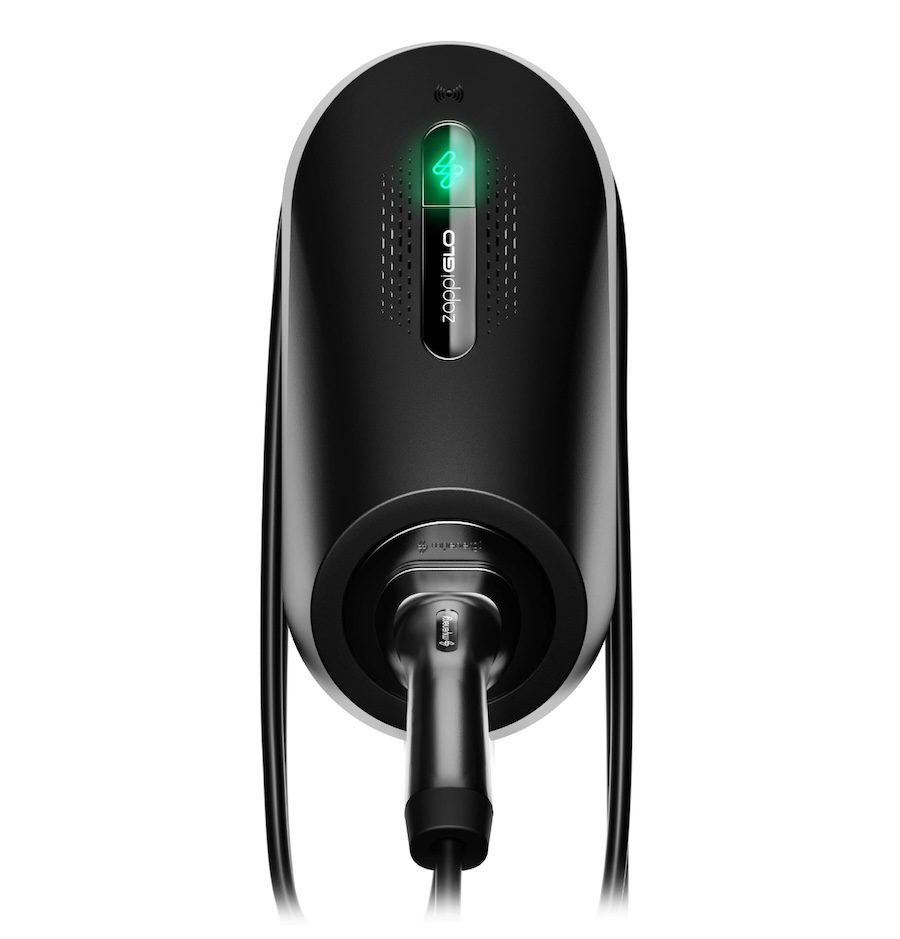
myenergi zappi GLO
Evnex E2 Flex
Evnex, a charger manufacturer from New Zealand, designs and builds its chargers in Christchurch. Evnex says it has installed over 20,000 chargers across Australia and New Zealand, with about 10,000 in each country.
The E2 Flex is Evnex’s most affordable smart charger, priced at $799. It seemed to be the lowest-priced smart charger at the show. However, solar charging is not included by default.
You can add solar charging later with a $349 software update over Wi-Fi. No hardware changes are needed, and your electrician does not need to return. This option works for people planning to get solar in the future or those who want a smart charger now and solar charging later.
In total, solar charging with the Flex costs $1,148, which is still reasonable, but above their advertised price point. You’ll need to pay for installation as well.
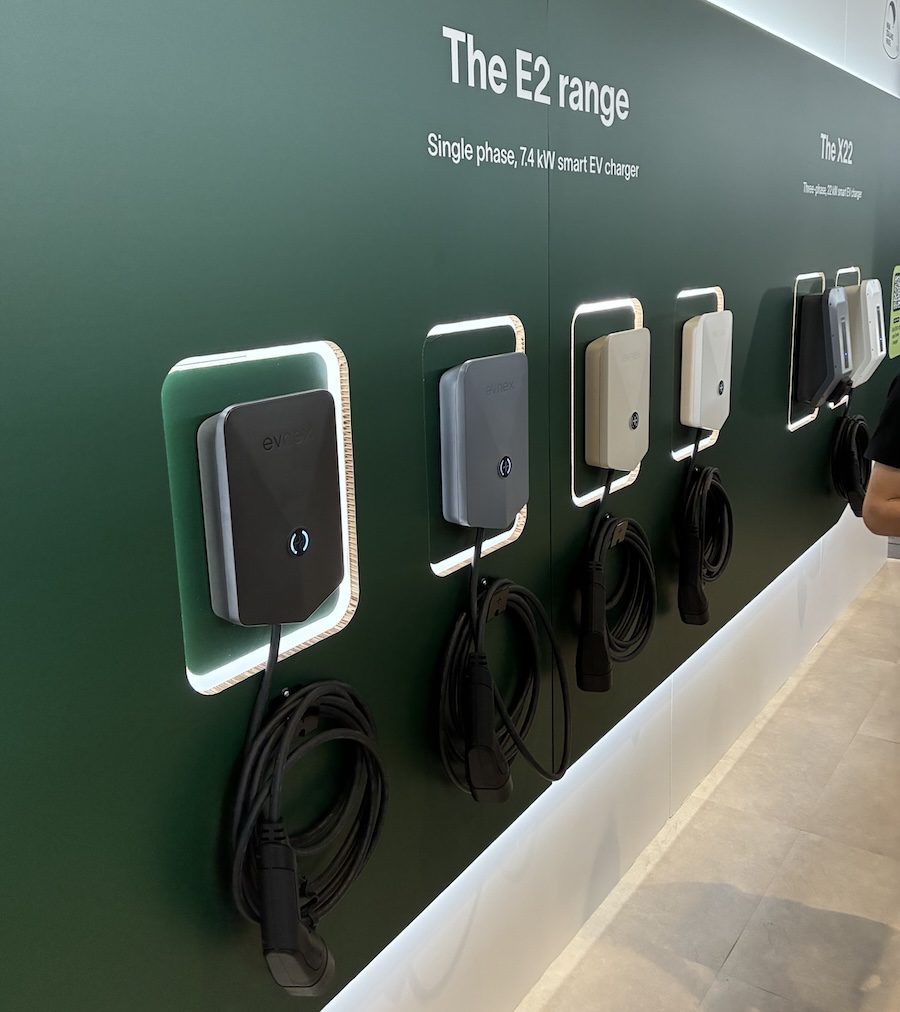
The Evnex lineup.
For more on the brand, see our Evnex review.
SOLAFLO, A Pool Pump That Runs Off Solar
Mark Kirtland, founder and CEO of SOLAFLO, spent seven years developing what he describes as the world’s first low-voltage, DC-powered pool pump that’s silent at all speeds.
Solar panels and home batteries produce direct current (DC). Your pool pump, like almost everything else in your house, runs on 230-volt alternating current (AC).
To run a pool pump on solar, you usually need to convert DC to AC using an inverter. Each time you do this, some energy is lost.
SOLAFLO’s pump operates directly on DC power. It uses a brushless DC motor, which is controlled electronically rather than with moving parts that touch. This design loses less energy and is quieter.
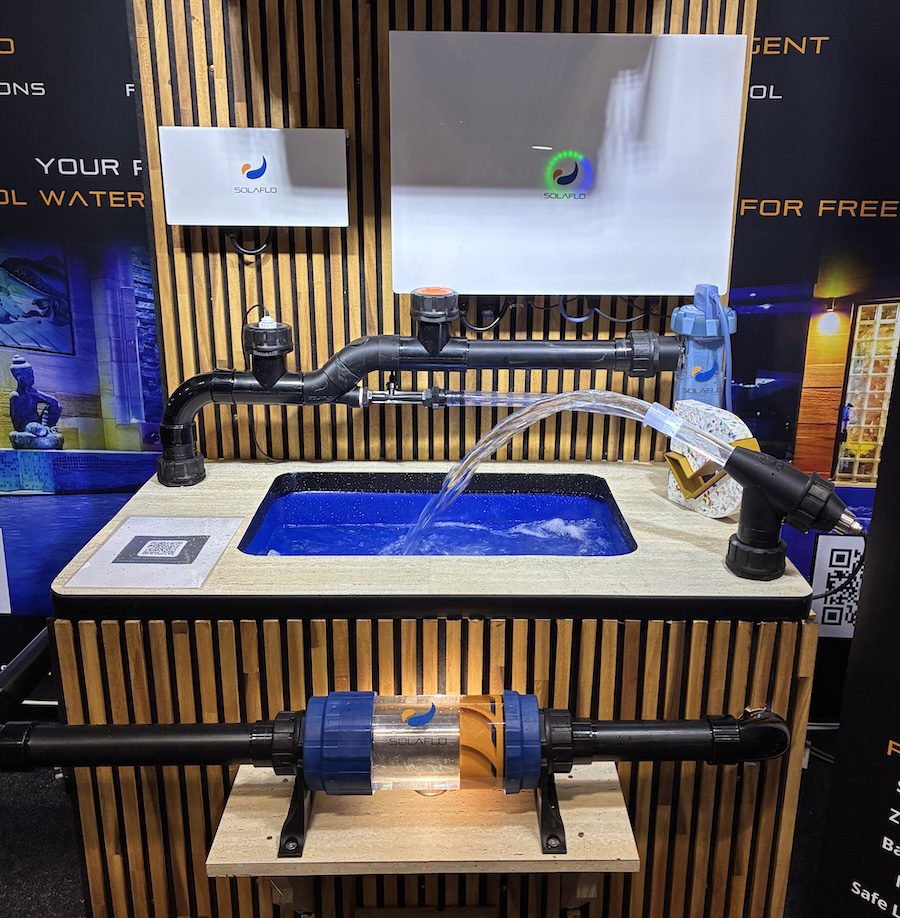
SOLAFLO pool pump.
Water flows over the motor to keep it cool. As a result, Kirtland says it is the first pool pump to be silent at all speeds, even at full power. Most variable-speed pumps are only quiet when running at lower speeds.
Pool pumps are usually among the biggest energy users in a home. Replacing an inefficient pump can free up energy for other uses, such as EV charging.
You have two ways to power it:
- Off-grid: You can run it from its own dedicated solar panel, so it costs nothing to operate.
- From your existing system: Kirtland claims you can use an auxiliary input or connect it to your current solar and battery setup.
The upfront cost is higher than a standard variable-speed pump. Kirtland said the savings on running costs usually cover the difference within two to three years. But given the energy consumption of a typical pool pump and the likely efficiency savings from a DC motor, we’re sceptical.
The pump is designed and made in Australia, using tooling and components from Adelaide and motors from Melbourne. While it is made for pools and spas first, SOLAFLO is also considering other off-grid uses, such as aeration for fish farms.
Pole Charging: Plugging In Without A Driveway
Many Australians cannot charge at home because they don’t have a driveway. Two exhibitors aim to solve this by installing chargers on existing street power poles, each using a different approach.
Ausgrid
Sydney’s electricity network operator, Ausgrid, is testing kerbside chargers mounted on its power poles. The aim is to give EV owners who park on the street the same flexibility as those with a garage.
Ausgrid wants to address an imbalance: when you charge at home, you can choose your electricity retailer, but when you charge on the street, you pay whatever the charger’s owner sets. Ausgrid’s idea is to allow competition at the charging point, so any company, including electricity retailers, could sell power through that pole.
It’s a trial, not a service you can sign up for yet.
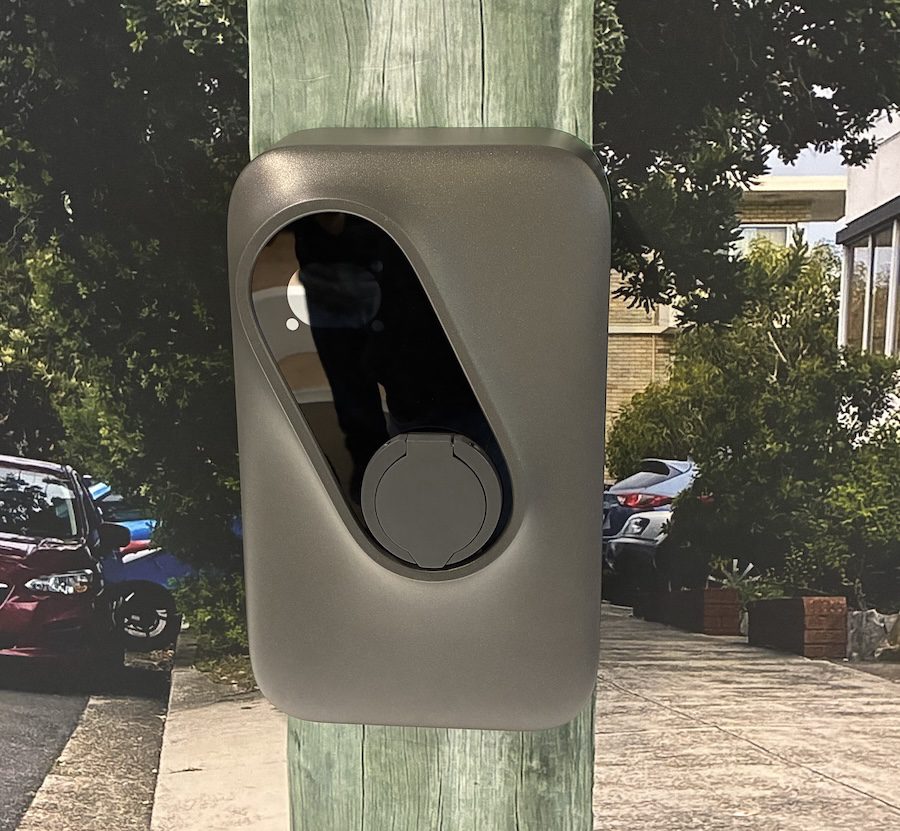
Ausgrid pole charger.
EVX
Private company EVX is not waiting for trials to finish. They claim that their kerbside AC charger, called the Pole Charger, has reached its 250th site across New South Wales, Victoria, and South Australia. EVX is also the company behind the Inner West Council rollout.
EVX said demand is highest in medium-density suburbs. The company has also installed about 50 chargers in regional NSW for visitors who stop for a pub lunch or a winery visit, where a two- to four-hour AC charge fits well for people parked for the afternoon.
Not every pole qualifies. It has to be structurally sound and free of termite damage, and its two ports have to line up with two parking spaces. The council must also reserve those spaces for EVs only, so a petrol ute can’t park across the charger for a week.
EVX says its advantage is the charger’s sturdy build. The company compares it to a pedestrian crossing button: simple, durable, and made to withstand years of public use.
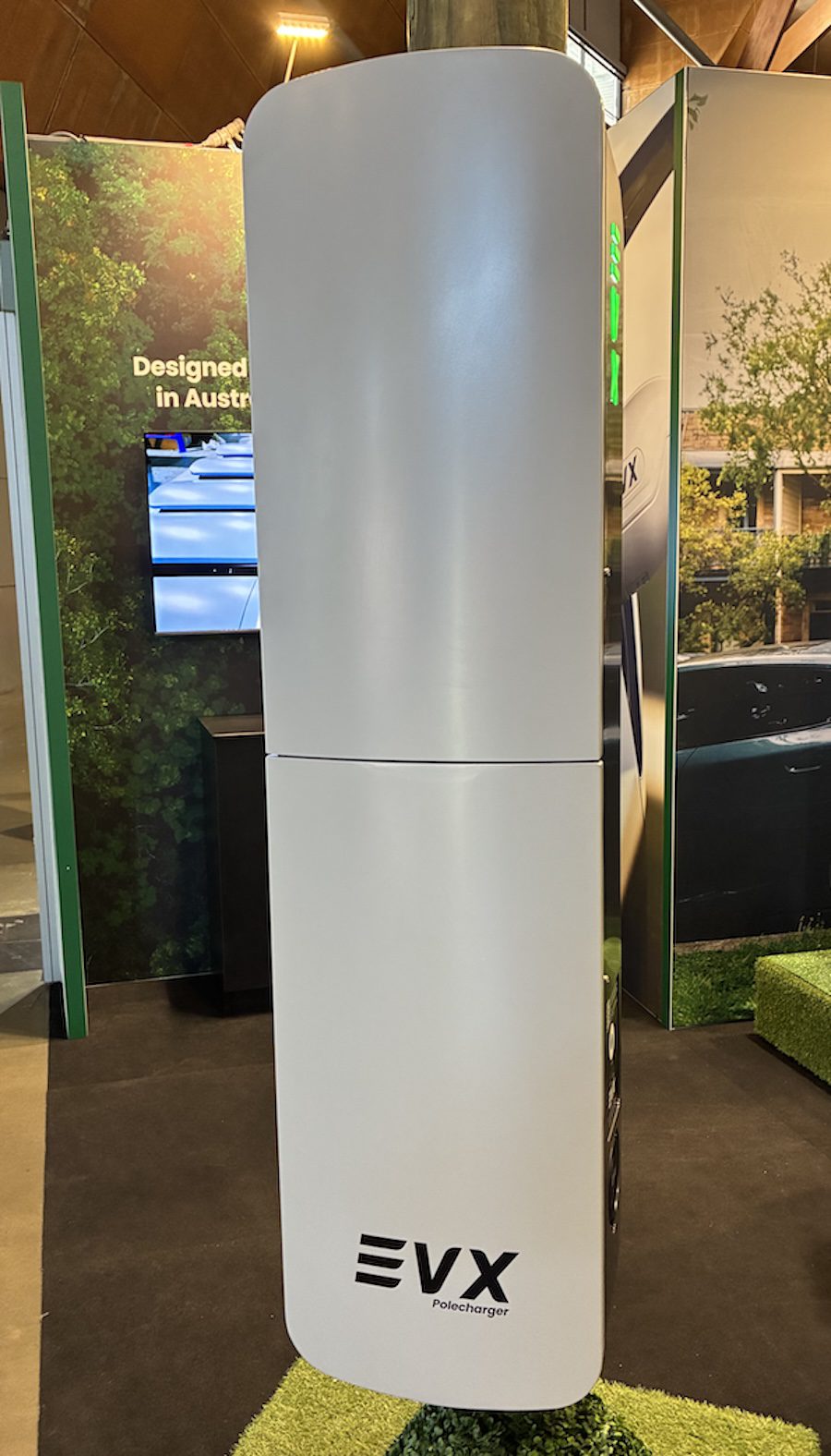
EVX Pole Charger
Who Pays For Network Chargers?
Days after the show, the Australian Energy Market Commission (AEMC) backed a federal plan in a draft ruling.
Under the plan, networks would help private companies install chargers in inner-city areas. Where private companies don’t take up a site, networks could build chargers themselves as a “supplier of last resort.” The same would apply in regional charging blackspots.
AEMC chair Anna Collyer says federal funding would cover about 30% of roughly 14,000 chargers. Networks would recover the rest, adding about $1 a year to typical bills in every state and territory except Western Australia and the Northern Territory, whether customers own an EV or not.
Critics argue that private companies already serve the market well. The program wouldn’t start until mid-2029, and a final decision is due by the end of 2026.
ZUUP: One App Instead Of Many
If you have driven an EV any distance in Australia, you know how challenging it can be to charge. You often need multiple apps, each with a different network.
ZUUP has created a roaming platform that brings together several public charging networks into one app. Instead of replacing these networks, ZUUP partners with them, so you only need one login for all.
The company says its app includes over 4,000 public charging locations, with live availability. You can check if a charger is available before you decide to go there.
Three features worth knowing:
- Scout, the in-app assistant, helps plan routes and suggests charging locations.
- Bay alerts notify you as soon as a busy charger becomes available.
- No markup: ZUUP claims it charges the same price as the network, so you do not need to compare prices between different apps.
Wrapping Up
Whether you have a garage, park on the street, or are planning a long trip, charging your EV is becoming easier and more affordable. Smart charging is less expensive, kerbside charging is expanding, and one app can now replace many.
If you are considering a home charger, you do not have to choose a basic model just to save money. Check out our home EV chargers guide to compare different brands and prices.
If you are enjoying our coverage of Everything Electric, please consider subscribing to our newsletter for future updates.
 About Jacob Boyd
 RSS - Posts






How about no app, just tap to pay? At least for DCFC charging where the pillars are already big enough to easily accommodate an NFC reader. Tap to pre-auth an amount and start the charge, tap again to stop and unlock. I’ll make an exception for AC destination or kerbside chargers because often they’re trying to be as small as possible. Surely we’ve made this a requirement…