
WA is about to become the first state to legalise plug-in solar and batteries. The draft standard, modelled on Germany’s rules, is open for comment until 9 December.
I’m a fan. Renters have been locked out of home batteries and solar for too long. And WA’s specs work great for a small, 5 kWh battery and 1-2 kW of solar, saving $300-$500 per year in electricity.
But even with plug-in solar panels, not everyone will have the space to install panels. They may not have enough space in the garden, they may not be allowed to hang panels off their balcony, or it might just be too hard or intimidating.
But almost anyone should have room for a plug-in battery. And with free power from the grid now available to most Aussies, a plug-in battery – without solar – could be a no-brainer for renters and other households currently locked out of the home solar and battery boom.
Unfortunately, there’s one rule in the draft that could cripple the payback of plug-in batteries everywhere in Australia that isn’t WA. Because WA’s rules won’t stay in WA. The draft says it expects to form the basis of future Australian Standards, and energy ministers want one national approach.
A Rule Written For WA
WA’s draft specification caps how fast a plug-in battery can discharge into your home at 800W. That’s sensible – backfeeding any more than that is a safety issue. That rule needs to stay.
But the rules also mandate that the battery can only charge from the wall at a maximum of 800 W. There is no safety reason for such a low charging power.
In WA, 800W charging is fine. WA’s Midday Saver retail plan gives six cheap hours in the middle of the day, and 800 W for six hours almost fills a 5 kWh battery.
NSW, south-east Queensland, VIC and SA have three free hours every day. 800 W for three hours is a piddly 2.4 kWh in your battery1. Copy the 800 W limit east, and a battery that works fine on WA’s Midday Saver starts losing money on a free-hours plan due to its higher daily charge and evening-peak pricing.
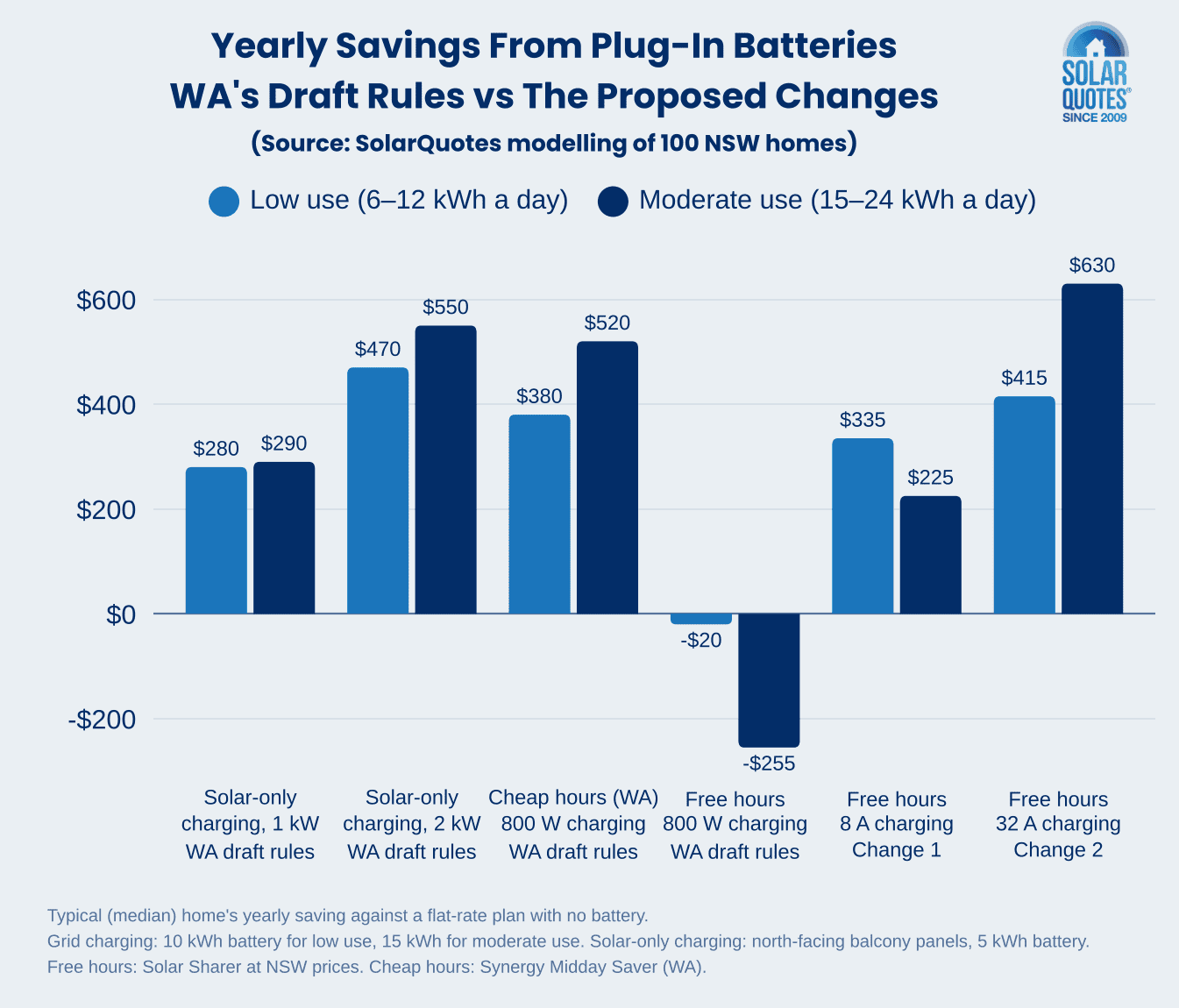
I ran a year of half-hourly data from 100 real homes through both tariffs, with solar-only kits alongside for reference:
How To Read The Chart
The first 3 pairs of bars show reasonable savings for a plug-in battery in WA to the WA specs, whether you charge it from solar or the grid.
But look at the fourth pair. Changing to a free hours plan (with its increased peak pricing) in states where it’s allowed and using a plug-in battery with WA specs is a disaster. You end up with a bigger electricity bill because you can’t fill up with enough free electricity to get through the peak. Don’t get me wrong – the battery saves money compared to someone on the solar sharer plan without it. But the household ends up behind because it switched plans to use the battery2.
But – as the last 2 pairs of bars show – if you increase the charging power allowed, plug-in batteries charged from free midday grid electricity suddenly make sense.
Three Changes.
I propose 3 changes to the rules for plug-in batteries. If all 3 are too hard, then at the very least, implement change #1.
None of these proposed changes forces anyone to build or install anything. Manufacturers can still make a battery that charges and discharges at 800W. My changes just stop WA’s rules from locking out better products that can take advantage of the install-free 800W discharging.
1. Let the battery charge at 8 A. That’s about 1.9 kW, which leaves headroom on a 10 A plug, with a temperature sensor in the plug like the better portable EV chargers have. Manufacturers don’t have to do it. They should be allowed to. On a free-hours plan, it turns a battery that loses money into one that saves a few hundred dollars a year.
2. Allow batteries that charge at up to 32 A. Nobody has to build it, and nobody has to install it. But for a plug-in battery to work properly, it already needs a sparky to fit a sensor on the mains so it can see what the house is using, and a 32 A socket is a small extra while they’re there. For a busy household on free hours, it nearly triples what change #1 delivers. And it gives savvy manufacturers and installers room to put together packages that could be very good value for renters, and for anyone else priced out of a conventional battery.
3. Allow three-phase plug-in batteries, discharging at 800W on each phase. The draft allows one plug-in unit per household, single-phase only. Let three-phase homes run a three-phase unit and see what the industry does with it. For heavy users on a free-hours plan, that’s worth over $1,000 a year. I envisage regular sparkies adding a 3-phase socket next to the switchboard to enable this.
And two tidy-ups. Let combined solar and battery units charge from the grid too. As drafted, only battery-only units can, and the one-unit-per-household rule means a renter has to pick solar charging or grid charging. And spell out that the 2,000 W DC limit on panels plus battery (clause 4.1) means power flowing at any one moment, not the sum of nameplate ratings. Read the second way, a 2 kW plug-in array leaves no room for a battery at all.
Write The Rules Wide
Battery makers and Aussie installers build whatever squeezes the most value out of the rules. Write the rules around 800 W, and you get 800 W boxes. Write them wider, and someone will build the box, someone else will install it, and a retailer will build the plan that makes it pay.
None of these changes touches the 800 VA output cap, the one that deals with overloading household wiring. They just stop a rule written for one state’s tariff from becoming everyone’s ceiling.
Submissions close at 5pm AWST on 9 December. The form is here, and the details are on the consultation page.
 About Finn Peacock
 RSS - Posts






Speak Your Mind