
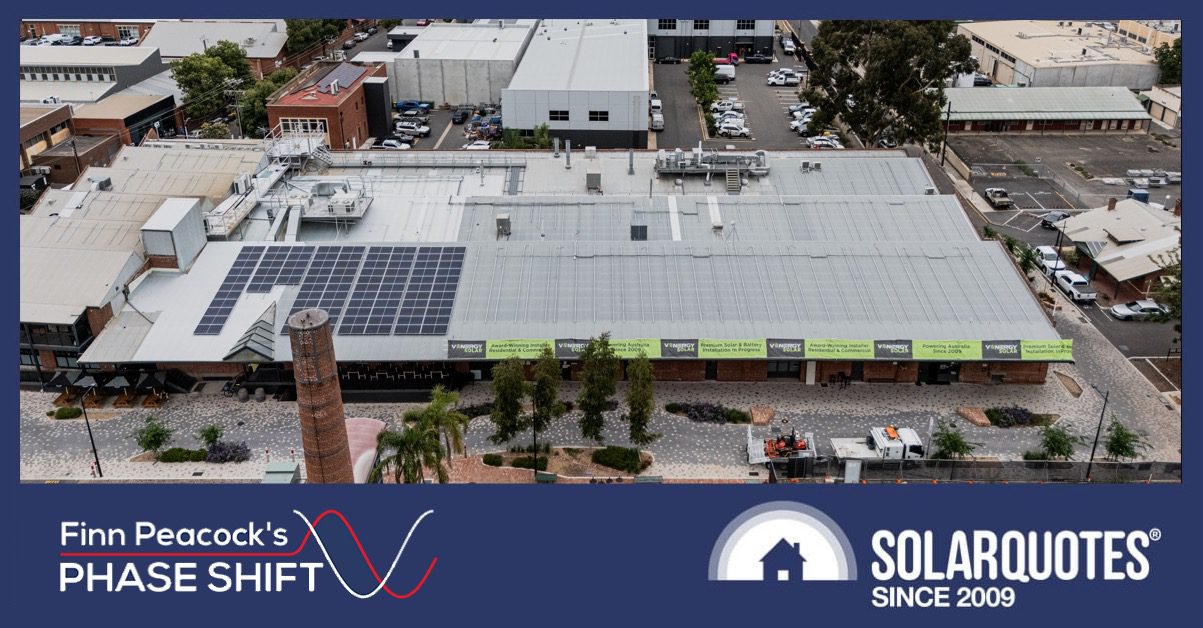
The installation progress (20 Nov 2026) showing solar panel rails and inverter/battery station frame (cage back left). The existing panels are a 30kW array installed by Brightstar Brewing – who make a cracking London Porter.
A little over a year ago, I got a quote for 386 solar panels and a 100 kWh battery for a commercial property in Thebarton in Adelaide’s inner west.
Then I sat back and waited. It’s a heritage-listed building, and the local council took about 10 months to approve the installation.
Solar & Battery Rebates
In the meantime, Canberra changed the rules. In August, Chris Bowen announced that the Solar Panel Rebate1 would be expanded from 100 kW to 1 MW for any systems installed from 1 October. And I’m installing mine now.
Under the previous rules, if you wanted to install a 250 kW solar system, you were essentially building a mini power station. Not only did it have to be accredited, but it would also be eligible only for large-scale certificates (LGCs) in one megawatt-hour (MWh) increments.
Under the new rules, it’s eligible for the Solar Rebate we all know and love, or, in technocrat talk, five years’ worth of small-scale technology certificates (STCs).
The numbers are simple. A 250.9 kW system in the Adelaide region gets 1.382 MWh/kW/year; multiplied by the system’s size and five years, that’s 1,733 STCs. Multiply that by around $38, and you’re looking at a discount of around $65k. Our Solar STC Calculator does the maths for you, and we’ve just updated it to handle the bigger systems.
On the other side of the ledger, while my heritage application was being pondered, the battery rebate went the other way.
Before 1 May 2026, the rebate applied to the first 50 kWh of a battery’s usable capacity. That has now been changed to a tapered system: full rebate up to 14 kWh, 60% to 28 kWh and 15% to 50 kWh. At this year’s factor, my 100 kWh battery gets 174 STCs. Under the 2025 rules, it would have been 465, so I’m losing about $11k. Our battery rebate calculator does the maths.
Claiming STCs on the panels also means I’ve lost the LGCs. Fair enough – no double-dipping. My quote assumed a value of $36 per certificate, giving an LGC income of $43,128. The truth is that LGCs traded most of 2026 between around $2 and $8.50, so the real figure is more like $9k.
Net result: the council’s dawdling put roughly $45k back in my pocket. It’s the first time I’ve wanted to send a planning department a fruit basket.
The System
The property will be fitted with 386 Longi Hi-MO X10 650 W panels, totalling 250.9 kW. I’ve been able to cover every inch of the roof not blocked by plant, structural, or heritage restrictions.
We’re using two Sungrow inverters, one 110 kW hybrid inverter and one 50 kW, for a total 160 kVA of AC. The battery is a 99.8 kWh Sungrow battery array, which is 0.2 kWh below the 100 kWh limit for the battery rebate.
The installer is Adelaide-based Venergy, an engineering-led outfit who have been in the SolarQuotes installer network for as long as I can remember.
Electricity Usage
The building used 285,541 kWh over the 12 months to the end of October. This is an average of 33 kW. At night, it’s around 20 kW. On a weekday at 1pm, it peaks at 53 kW. So most energy is used during the day – peaking around noon – perfect for solar!
The solar array is estimated to generate around 329,000 kWh per year. That’s more than the building uses. However, a lot of it will have nowhere to go.
By running the five-minute csv data from my meter against the new system, I worked out that about 46% of the solar is used as generated, with another 10% going through the battery. The other 44% will be excess. And my business power contract doesn’t pay me for exports.
Savings
Using the data in my bills, the model says the property will go from paying Origin about $74k a year to paying about $33k excluding GST – saving around $41k a year.
Most of this ($37k) is the difference between buying power from the grid and generating it on the roof. The rest is savings on the demand charges.
And yes, I use Origin, which owns SolarQuotes. And they’re about to sell me 60% less power. Writing this just reminded me to check the supply contract… oops: clause 13b requires me to get written consent to install generation at the site.
Excuse me whilst I send a quick email!
… Done.
Demand Charges
Most businesses don’t understand demand charges, so I’ll quickly explain. On top of a network-use fee for every kWh, the network (the local poles-and-wires company) charges your retailer based on the times when the building uses the most power.
The big one here in SA is your highest average power use between 5pm and 9pm on any day in the summer period (November to March). If you have one evening where you use a lot of power, you get charged that for a whole year.
This is great for a battery, because it’s usually fully charged by 5pm. In my model, it reduces the evening demand peak from 70 kVA to around 50 kVA.
There’s another, smaller demand charge based on the single half-hour of highest demand. Combined, I’ll save between $3k and $4k a year on demand charges.
Payback
So here’s where we’re at. The system costs about $290k without solar STCs. Saving $41k a year, with energy prices rising 3% a year, this is a payback of six and a half years. But if you take off the $65k in STCs the council delay gave me, the payback is just over five years.
But there’s another trick. SA Power Networks puts any business that uses more than 160 MWh per year on a large-business tariff, including the evening demand charge.
My grid imports should go from 285 MWh down to around 110 MWh. This means I should move from the large business to the medium business band. Based on my data, this would save another $5k to $6k a year in network charges.
I’m not factoring it in at the moment. If it does happen, the payback period should be closer to 4.7 years.
I reckon that’s a pretty compelling, low-risk investment for a business. If you’ve put your solar project on hold for a large commercial roof because the system would exceed 100 kW, then the numbers changed from 1 October. Go out and get some quotes.
Next week: I’ve consistently advocated that solar buyers fill the roof, grab the battery rebate, and get proper backup. On my own building, I’ve scored two out of three. In 7 days, I’ll explain why…
Footnotes
- technically the Small-scale Renewable Energy Scheme (SRES) ↩
 About Finn Peacock
 RSS - Posts






Speak Your Mind