
Two years ago, I rang state and territory government departments across the country to get information, straight from the horse’s mouth, on how much deposit installers could legally ask for. But this didn’t go well, because sometimes the horses turned out to be asses. This resulted in me putting some wrong information in a blog post, while other information is now outdated. To fix this, here’s a new blog post on how much deposit solar and battery installers can charge by state and territory.
I can’t be 100% certain everything is correct, but this time, because I’m not calling anyone, you can 100% blame me for any mistakes.
Some people — possibly those who work in consulting — could say I can’t complain about government departments giving incorrect information, because I got it for free and you shouldn’t look a gift horse in the mouth. But I still blame them for putting me in the worse position of looking in the mouth of an ass.
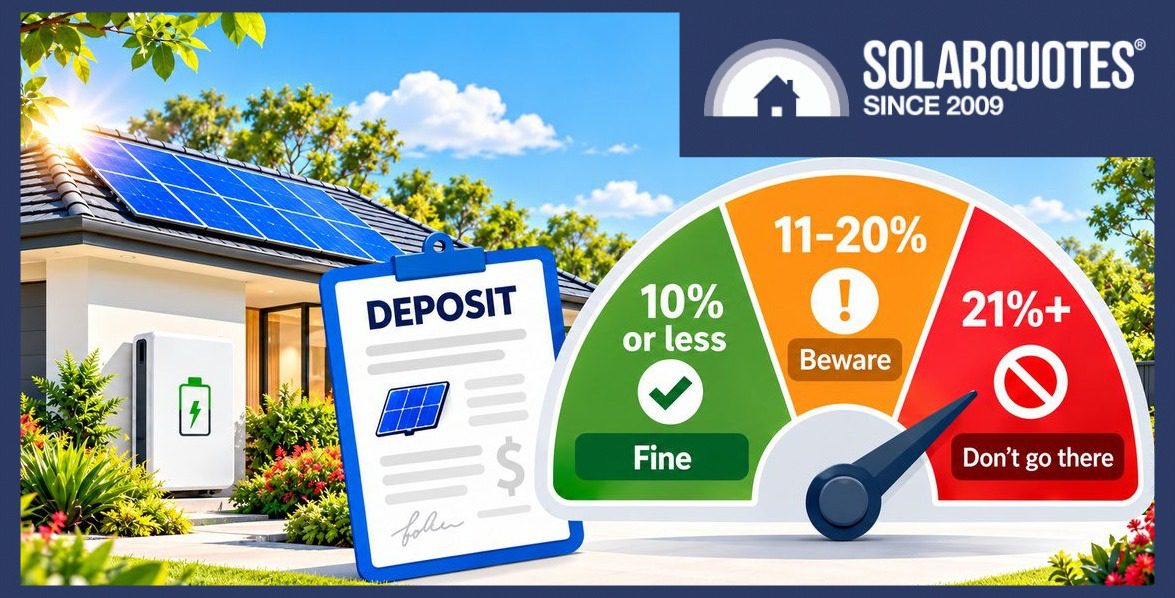
10% Deposits Are Common Practice
The most common deposit for solar and/or battery installation in Australia is 10%. Some installers may ask for less, and in some situations, they legally have to. But a 10% deposit is usual. As in 10% of the quoted price the customer has to pay, and not the price before it’s reduced by the solar rebate and/or federal battery rebate.
However, in many cases, installers are legally allowed to ask for more than 10%. If you are asked for more, my advice is to only consider paying it if special circumstances apply. Some reasons that aren’t unreasonable include:
- You live beyond a black stump.
- You’ve requested hardware the installer doesn’t normally stock.
- The roof is high enough off the ground that solar installation requires additional safety equipment, cherry picker rental, etc.
- There are other circumstances that make the job particularly difficult.
But if none of these apply, I recommend turning down any deposit request over 10%. If there are special circumstances, I recommend paying no more than 20%. The reason I recommend rejection is not that the installer has necessarily done anything wrong. Instead, it’s due to the information asymmetry between installers and customers.

It Pays To Reject High Deposits
It doesn’t matter what the business is; if they sell to the public and are in financial distress, they have an incentive to ask for higher deposits. Often, it’s because they’re honestly trying to dig themselves out of the financial hole they are in, but other times it’s because they’re trying to grab as much cash as they can before going bust.
The problem is that you, the customer, have no way of knowing if a request for an above 10% deposit is from…
- A financially healthy company, requesting it for valid business reasons.
- A business that honestly intends to install your system but is at risk of bankruptcy.
- Someone who intends to grab your money and run, because they’re as dishonest as a US President with Burger Ring packet skin.
If the company is financially healthy, paying an over 10% deposit is unlikely to be a problem. But if the company is in such dire straits that it’s making the Strait of Hormuz look good, it doesn’t matter if they honestly intend to install your solar system or if they just want to take your money and run — the pain to you will be the same if the company goes bust and your deposit disappears before your system is installed.
Unless you’re willing to pay a private dick to dig into financial records every time you’re asked for an above-average deposit, you have no way of knowing whether or not it’s a sign of financial distress. The safest course is to assume the worst and reject quotes with high deposits, regardless of how trustworthy the company’s representatives may seem.
Pay By Card For Protection
If you pay a deposit by credit card or by debit card using Visa or Mastercard payment systems, and something goes wrong, you can use chargeback protection to get the payment reversed. The Australian Financial Complaints Authority has information on the process here, and says customers can have chargeback rights when services have been paid for but not supplied.
While getting a chargeback is not guaranteed, the extra protection means I highly recommend paying deposits by card. I’ll go as far as to say you should pay by card when making a deposit.
Legal Deposit Maximums By State & Territory
Depending on where you are and how much you’re quoted, an installer may legally have to request less than a 10% deposit. Or there may be no limit, and they can ask for 100% up front, simply to see if you’re a sucker. (Since there’s only one born every minute, the odds of you being a sucker are around 0.4%.)
I’ve looked up the legal limits for every state, as well as the only two territories most Australians can name, and put them in the graphic below. Territories with less than 3,000 people are left out, so sorry, Norfolk Island and Jervis Bay. And I’m not even sure if Christmas Island belongs to Australia or the Republic of Santa.
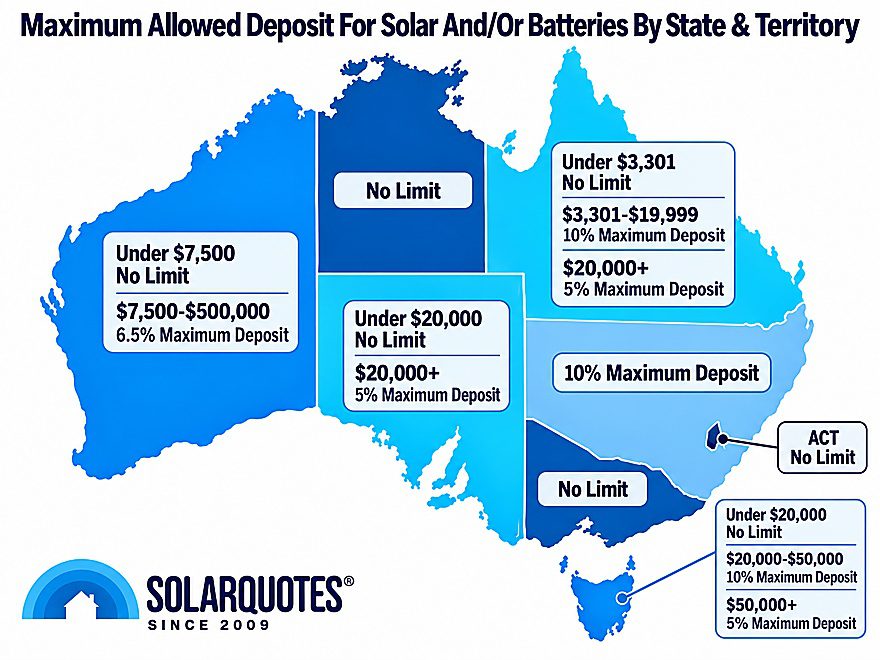
Whoever made this diagram was apparently too rushed to get the country’s proportions right, or prevent NSW from conquering Brisbane, but they somehow had the time to Slartibartfast the entire continent and make the coastline extra crinkly.
Normally, these deposit maximums apply to the contract price the customer pays, which is after the solar rebate and/or federal battery rebate lower the price. South Australia is the exception. There, it applies before rebates.
I’ve put the state and territory details below in alphabetical order, which is not necessarily the order they are in our hearts, so I don’t want to hear any complaints, WA. (One more peep out of you, and you’re going straight into my sub-cardiac region.)
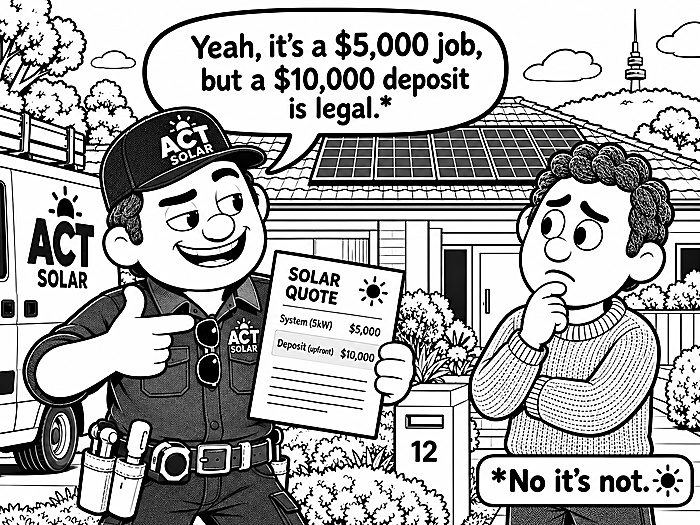
ACT: No Limit
In the ACT, there’s no limit on how much deposit installers can request, so they can ask for 100% if they want. And if you want, you can tell them to go stick their head in a pig. But since you’re in the ACT, you’d probably be much more polite than that and say something along the lines of, “I cordially invite you to place your face within the confines of a swine.”
NSW: 10% Maximum Deposit
This NSW government page on installing solar panels says the maximum allowed deposit is 10% of the total amount payable under a contract. Electrical installation is considered specialist work, so there is no exception for work under $5,000. This means the 10% maximum should apply to all solar and battery installations.
Deposits are 10% of the price the customer pays, and not 10% before rebates are applied. However, whether a solar and/or battery installation meets the $20,000 threshold for requiring Home Building Compensation Insurance is based on the price before rebates. The NSW government states this partway down their page on installing solar panels, under the sub-heading “What you must do before you pay”.
NT: Normally No Limit
In the Northern Territory, there is normally no limit on deposits. There is a 5% maximum deposit for “prescribed building work”, but normal solar and/or battery installations don’t fall into this category. However, in an unusual situation where solar and/or batteries are included in the builder’s contract for the construction of a new house, then a 5% maximum deposit would apply to all the work done under the contract, provided the total price is over $25,000. (It would be a small house if it weren’t at least that much.)
QLD: Varies By Price — Usually 10%
In QLD, the maximum deposit depends on the contract price of the solar and/or battery system:
- $3,300 or less: No limit
- $3,301-$19,999: 10% maximum deposit
- $20,000+: 5% maximum deposit
The contract price is based on what the customer pays after the solar and/or federal battery rebate.
While there’s no limit for work under $3,301, the Queensland Building and Construction Commission (QBCC) says:
“The QBCC recommends you should never pay more than a 20% deposit before work commences, and do not pay the full price until you have checked that all the agreed work has been completed.”
But on this page, the Queensland Office of Fair Trading recommends:
“No more than 25% of the full price.”
SA: Varies By Price
Whether there’s a deposit limit depends on the contract value in SA:
- Under $20,000: No limit
- $20,000+: 5% maximum deposit
In SA, the contract value of a solar and/or battery system is before the solar rebate and/or federal battery rebate reduces the quoted price. So if you’re quoted a price of $16,000 for a solar and battery system, because the price before rebates was likely over $20,000, a 5% maximum deposit limit will probably apply.
While there’s no deposit limit for systems under $20,000 before rebates, on this page, under “Before signing a contract”, SA Consumer and Business Services recommends:
“You should not pay more than $1,000 as a deposit.”
TAS: Varies By Price
The Apple Isle is another location where deposit limits depend on contract price, after it has been lowered by rebates:
- Under $20,000: No limit
- $20,000 to under $50,000: 10% maximum deposit
- $50,000 or more: 5% maximum deposit
VIC: No Limit
In Victoria, there are normally no legal deposit limits for solar and/or battery installations. Generally, installers ask for 10% of the quoted price. On this page, Consumer Affairs Victoria states:
“Negotiate the amount required as a deposit (usually 10%).”
As the Northern Territory has a similar lack of restrictions, this means Australia has 2 unlimited:
WA: Varies By Price
In WA, deposits depend on how much you pay:
- Under $7,500: No limit
- $7,500-$500,000: 6.5% maximum deposit
- Over %500,000: No limit
The contract price is based on what the homeowner pays after the solar rebate and/or federal battery rebate have reduced the price.
While there is no legal limit on deposits for systems under $7,500, the WA Department of Mines, Industry Regulation, and Safety says on their Solar Panel Systems factsheet:
“Generally, we recommend not paying a deposit of more than 10%…”
The Double Danger Of High Deposits
If someone asks for more than the legally allowed deposit, don’t pay it! It’s a sure sign that they’re either dodgy or don’t know what they’re doing. The first is really bad, but you don’t want the second sort to put in a system either.
To sum up this post: For places and price levels that legally allow higher deposits, unless there are special circumstances, don’t pay more than 10%. If special circumstances apply, you can consider paying 20%, but don’t pay more than that. This is not because every installer asking for a higher deposit is doing something dodgy, but because the typical punter has no way of knowing if a request for a high deposit is an indicator of financial distress.
If you pay a 10% deposit, you can’t be absolutely certain the business won’t disappear and take your money with it. But if you pay 30%, not only will you lose three times as much if they suddenly go into receivership, but the risk of them going bust is higher than for a company that charges 10% or lower deposits.
Wondering if a solar & battery system is worth it for you? Put your details into our solar & battery calculator to find out the payback period and what it would do to your bills.
 About Ronald Brakels
 RSS - Posts





Speak Your Mind