
The federal government is looking for ways to rein in spending on its popular home battery rebate and electric vehicle tax incentives. Reducing the size of battery subsidies and bringing forward their scheduled reductions are among the leading options being considered ahead of December’s Mid-Year Economic and Fiscal Outlook (MYEFO).
Other possibilities raised in the debate include means testing, compulsory virtual power plant (VPP) participation and even an early end to the battery scheme, although none has been identified as a leading option in the latest reporting.
So where might the cuts fall, and what could they mean for homeowners?
Could Battery Rebates Be Cut Faster?
The government is reportedly considering reducing the subsidy available per battery and accelerating scheduled reductions from every six months to every four months, according to the Australian Financial Review.
The Cheaper Home Batteries Program has already undergone a significant overhaul. Changes announced in December 2025 and introduced in May 2026 reduced the level of support, accelerated the scheduled decline and introduced different rebate rates depending on battery capacity.
Under the current rules, the subsidy factor falls from 6.8 to 5.7 on 1 January 2027, followed by another reduction to 5.2 on 1 July.
For a battery with 10 kWh of usable capacity, that’s a $440 reduction in the rebate value, from $2,720 to $2,280, assuming small-scale technology certificates (STCs) are worth $40 each. That’s before any further cuts the government might announce.
Modelling by the Grattan Institute found a 20% reduction in rebates could save the government more than $1 billion over four years. Accelerating the phase-out could produce similar savings. However, no additional reduction amounts or commencement dates have been announced.
Means Testing Battery & EV Incentives
Another possibility is restricting access to battery and EV incentives according to household income. Critics argue that subsidies disproportionately benefit wealthier Australians who can already afford batteries and electric vehicles.
Former prime minister Malcolm Turnbull has weighed in on the debate, suggesting the incentives should eventually be phased out or means-tested.
“The subsidies are important to get these things going, and then there comes a point when … they should either drop off entirely or be simply means tested.”
However, research from Rewiring Australia challenges the suggestion that the battery rebate predominantly benefits wealthy Australians.
Its analysis found more than 80% of installations were in areas with median household incomes between $60,000 and $120,000. That doesn’t establish the incomes of individual battery buyers, but suggests uptake extends well beyond the wealthiest suburbs.
There were similar findings regarding EVs in a separate analysis for the National Automotive Leasing and Salary Packaging Association, which found that Cranbourne, Tarneit, Craigieburn and Werribee were among the top 10 postcodes for new EV novated leases – and are also the postcodes with the highest number of mortgage holders in the country.
“These aren’t inner-city elites. They’re families in Werribee, Tarneit, Kellyville and Marsden Park who have a mortgage, a long commute and are counting every dollar. For many of them, an EV only became realistic because of the discount.” NALSPA CEO Rohan Martin said.
Compulsory VPP Participation
Another possibility is making membership of a Virtual Power Plant (VPP) a condition of receiving the battery rebate. Currently, grid-connected batteries must be VPP-capable to qualify for the federal subsidy, but owners aren’t required to join one.
VPPs coordinate participating household batteries to help manage electricity supply and demand, including during periods of high demand.
Rewiring Australia has suggested linking subsidy eligibility to VPP participation as an alternative to reducing the rebate. The argument is that batteries supported by taxpayers should provide wider benefits to the electricity system, not just the households that own them.
However, the AFR reports that compulsory VPP participation isn’t considered a viable short-term option within government.
Making VPP participation compulsory could limit homeowners’ freedom to choose how their battery operates, although the impact would depend on the conditions imposed.
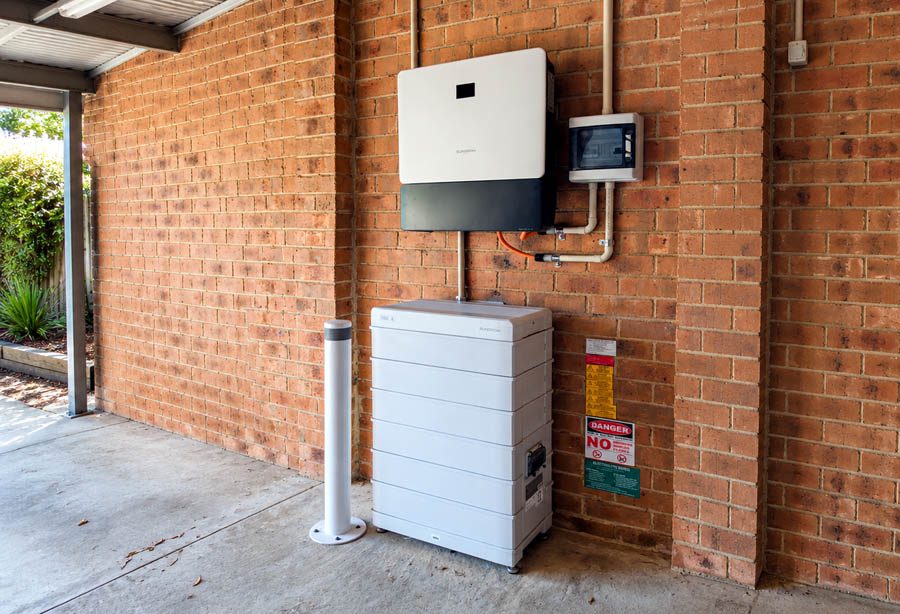
Further changes to the federal rebate could affect what households pay for systems like this.
Ending The Battery Program Early
A more drastic possibility is bringing the rebate program to an end before its scheduled expiry in December 2030.
Early termination has been mentioned in recent reporting, although there’s no clear evidence it’s a leading option in the current budget deliberations.
The AFR suggests the government is more inclined to scale back assistance than eliminate it altogether, given the potential consequences for the industry.
Another Option: Target The Largest Batteries
SolarQuotes technical writer and energy analyst Ronald Brakels believes the government shouldn’t cut the rebate again at all.
He argues that repeatedly changing the scheme undermines confidence among homeowners and installers, particularly after the substantial changes introduced earlier this year. However, if further savings are unavoidable, he suggests a different approach.
“If they absolutely had to cut the federal battery rebate, one option would be to simply get rid of the third tier, so there would be no rebate after 28 usable kWh.”
Under the existing rules, the first 14 kWh of usable battery capacity attracts the full subsidy rate, the next 14 kWh receives 60%, and capacity above 28 kWh receives just 15%, up to the 50 kWh subsidy limit.
Removing that final tier would reduce assistance for the largest systems without affecting the rebate on smaller batteries. Brakels says 28 kWh is sufficient for most households, although larger batteries can benefit high-consumption homes and the electricity grid.
Industry Warns Against Instability
The Smart Energy Council has acknowledged that the rapid uptake of the battery rebate requires careful management, while warning against further instability.
Its chief executive, David McElrea, is concerned that sudden changes could undermine confidence in the industry.
“We don’t want another solar coaster or battery coaster, with the damaging boom-and-bust cycles we’ve seen in the past.”
McElrea argues there’s an important difference between responsibly managing the program and abandoning it altogether.
What Should Homeowners Do Now?
For now, the battery rebate remains available under the existing rules, including the scheduled reduction on 1 January 2027. There’s no confirmed additional cut, income test, compulsory VPP requirement or early closure.
Anyone considering a battery should remember that the applicable subsidy factor depends on the installation date, not when a contract is signed.
But rushing into a purchase based on speculation could be costly. The installed price, appropriate battery capacity, expected savings and quality of the installer remain important considerations.
Changes to the EV concession meanwhile were already announced in the May 2026 federal budget.
Under those proposals, eligible EVs costing more than $75,000 would receive a reduced concession from April 2027, while the full exemption would continue for eligible vehicles costing $75,000 or less until April 2029. From then, the reduced concession would apply more widely.
Existing eligible lease arrangements would be protected under the proposed transitional rules, which have not yet become law. Whether additional EV incentive cuts will emerge from December’s MYEFO remains uncertain.
Until then, homeowners should be weighing up the batteries and EVs that best suit their circumstances, rather than trying to second-guess decisions the government hasn’t made.
If you’re considering installing a battery, try our home battery calculator to see if the numbers add up.
If you’re looking at an EV, use our EV charging cost calculator to compare the running expenses with those of a petrol vehicle.
 About Kim Wainwright
 RSS - Posts






Speak Your Mind