
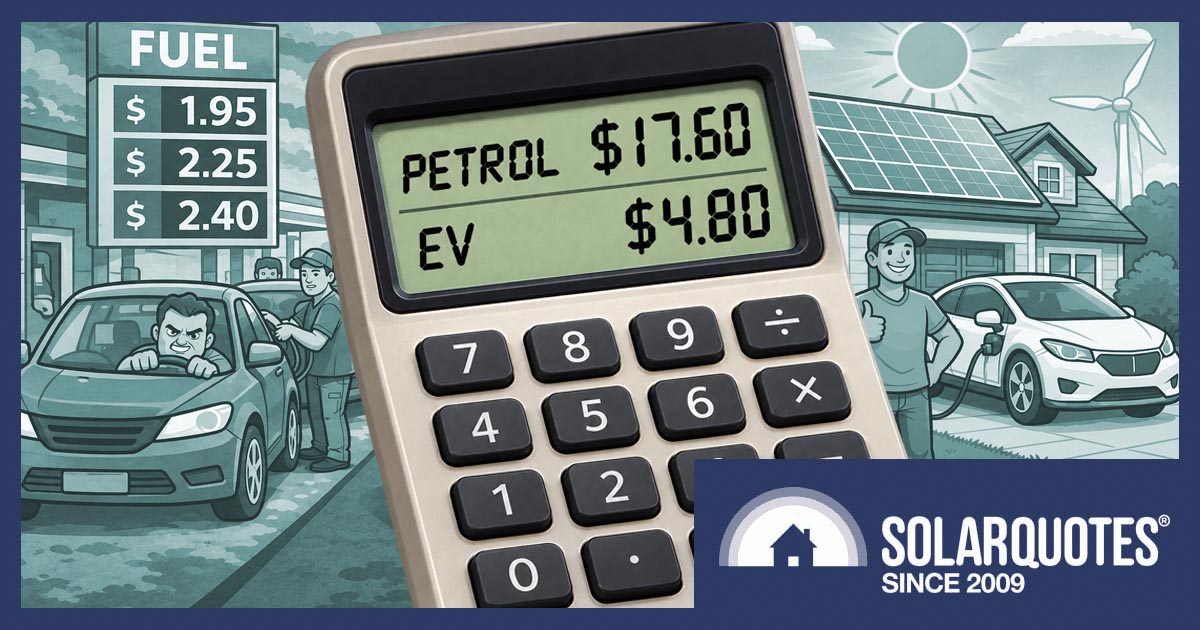
How much cheaper is it to drive an electric vehicle than a petrol car? The answer depends on what you drive, what you pay for energy, and how you charge your EV.
Charging from the grid can already offer substantial savings, but rooftop solar and free-electricity periods can make quite a difference.
SolarQuotes recently released an EV Charging Cost Calculator that lets you compare these options using your own figures. We’ve put it through its paces with three examples to show how it works and what the results mean.
How Much Cheaper Is An EV To Run?
Let’s start with two hypothetical vehicles. Our petrol car consumes 8 litres per 100 km, while our EV uses 16 kWh over the same distance. We’re paying $2.20 per litre for petrol and 30 cents per kWh for grid electricity.
These are illustrative figures, not national averages or a comparison of two particular car models. You can substitute the figures for your own vehicles.
Enter the vehicle efficiencies and petrol price under “Your cars”, then the electricity price under “Your electricity rates”. We’ve selected a 7 kW single-phase charger, set surplus solar charging to 0%, and entered 0% for free electricity available to the EV.
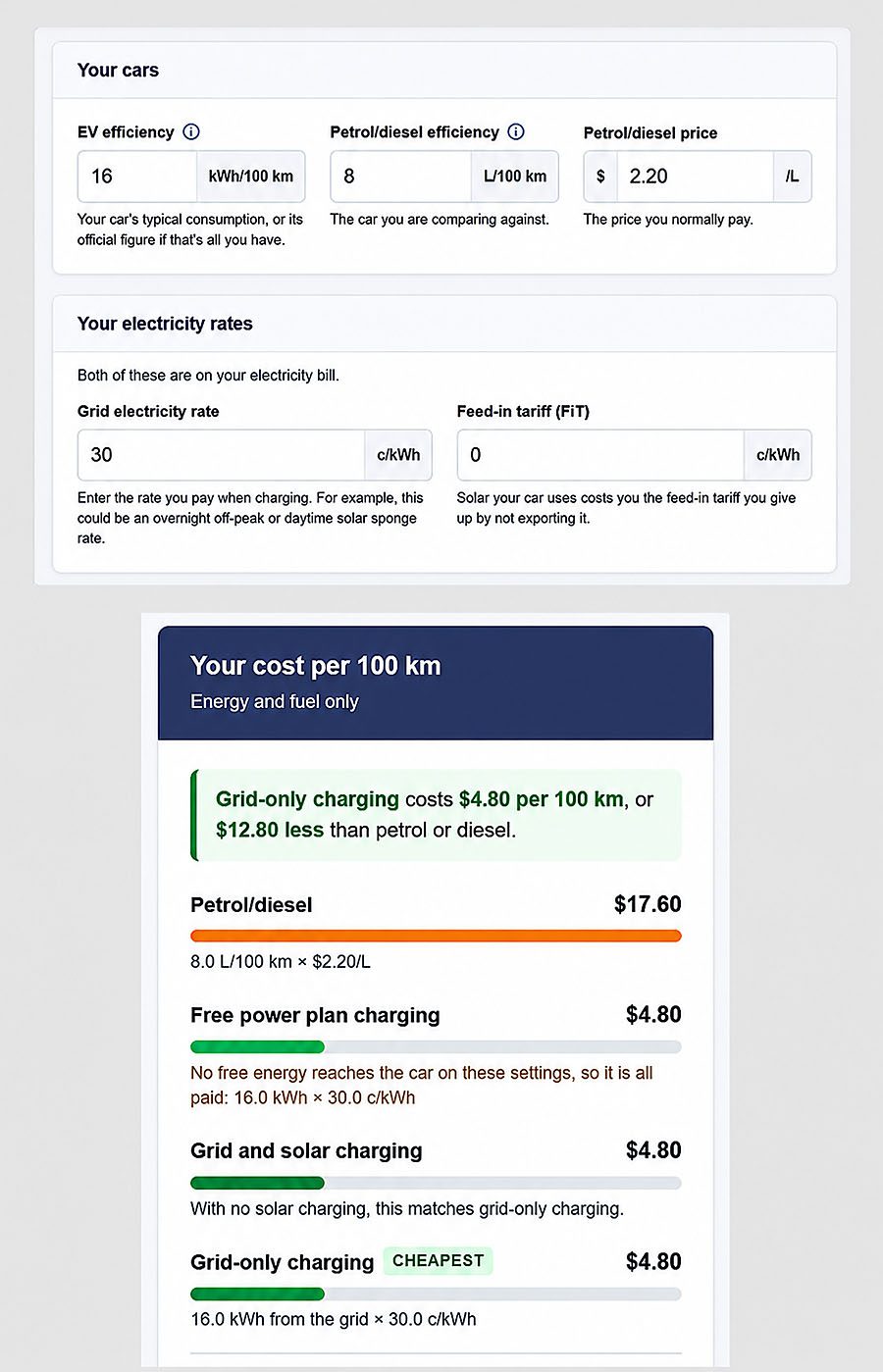
Comparing petrol with grid-only EV charging.
The calculator gives us $17.60 per 100 km for petrol and $4.80 for grid-only EV charging. That’s a saving of $12.80, or around 73%, on energy costs alone.
You’ll notice the results panel doesn’t just give you one result. It compares grid-only, solar-assisted and free-power charging side by side, so you can see what difference each might make.
In our first example, all three EV charging options come out at $4.80 because we’ve allocated no solar or free electricity to the car. As we change those settings in the next two examples, the costs begin to separate. The Cheapest label moves to whichever charging option has the lowest calculated cost.
Adding Rooftop Solar
Now let’s assume our EV owner has rooftop solar and can cover half their charging from surplus generation.
We keep the vehicle efficiencies, petrol price and grid electricity rate unchanged, but move the surplus solar slider to 50% and enter a feed-in tariff of 3 cents per kWh.
The feed-in tariff matters because solar electricity used to charge your car is electricity you can no longer export. In this example, we treat that lost export income as the cost of solar charging.
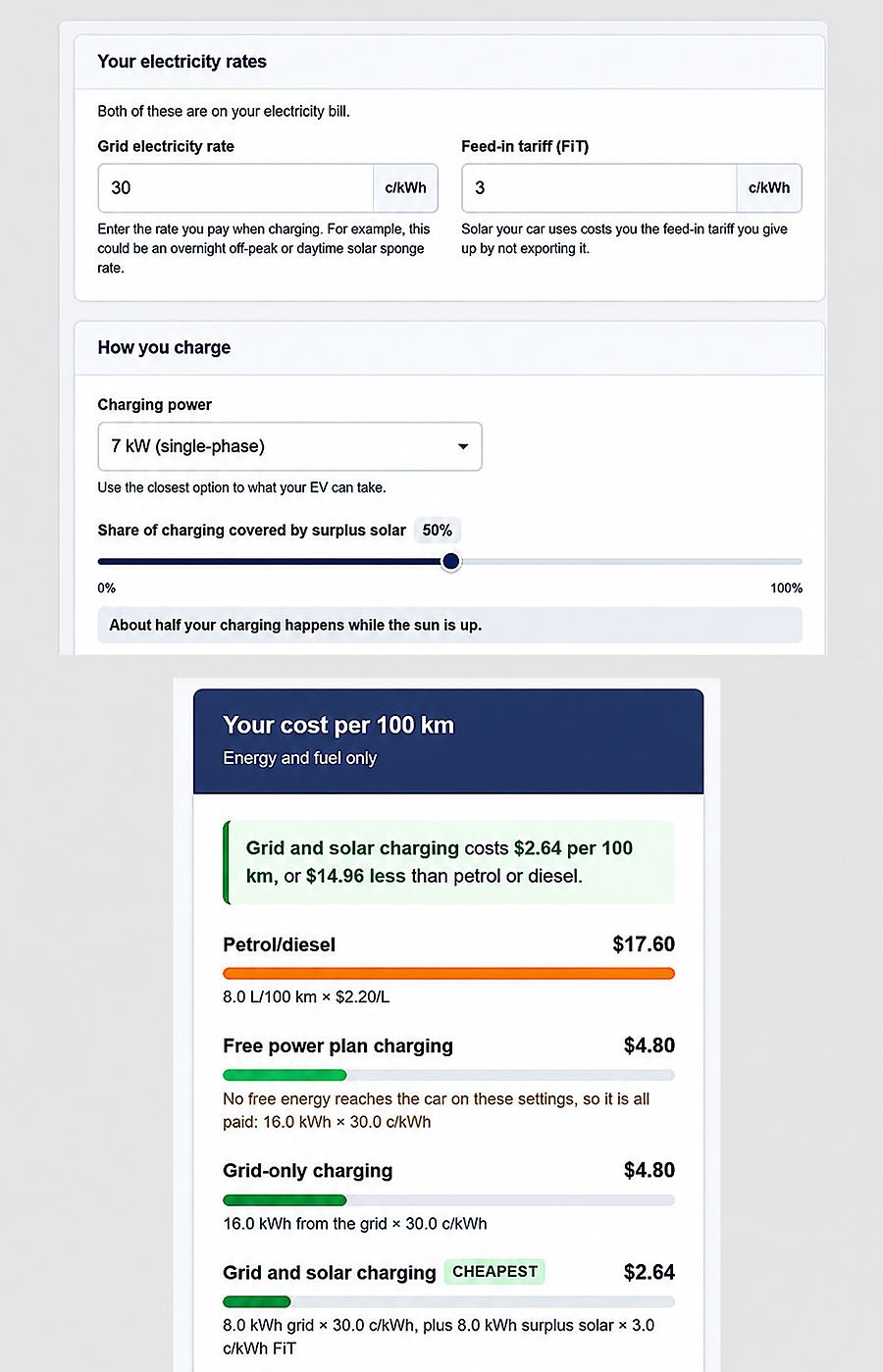
Adding surplus rooftop solar to the calculation.
The calculator now splits our 16 kWh between 8 kWh of grid electricity costing $2.40 and 8 kWh of surplus solar valued at 24 cents.
That reduces the EV’s energy cost to $2.64 per 100 km, compared with $4.80 when charging entirely from the grid.
Of course, getting half your EV’s electricity from surplus solar depends on when your car is at home, how much spare solar generation you have and how you manage charging. If you’re usually away during daylight hours, you might not get much charging done from solar.
Adding A Free Electricity Plan To The Mix
Some electricity plans offer a daily window of free electricity. The calculator has a section for these plans, allowing you to account for the free-power allowance, its duration and how much electricity remains available after other household loads.
For our third example, we return surplus solar charging to 0% and use a hypothetical plan offering a three-hour free window with a daily household allowance of 24 kWh.
We assume 60% of that allowance is available to the EV, with charging continuing at 30 cents per kWh once the free electricity runs out.
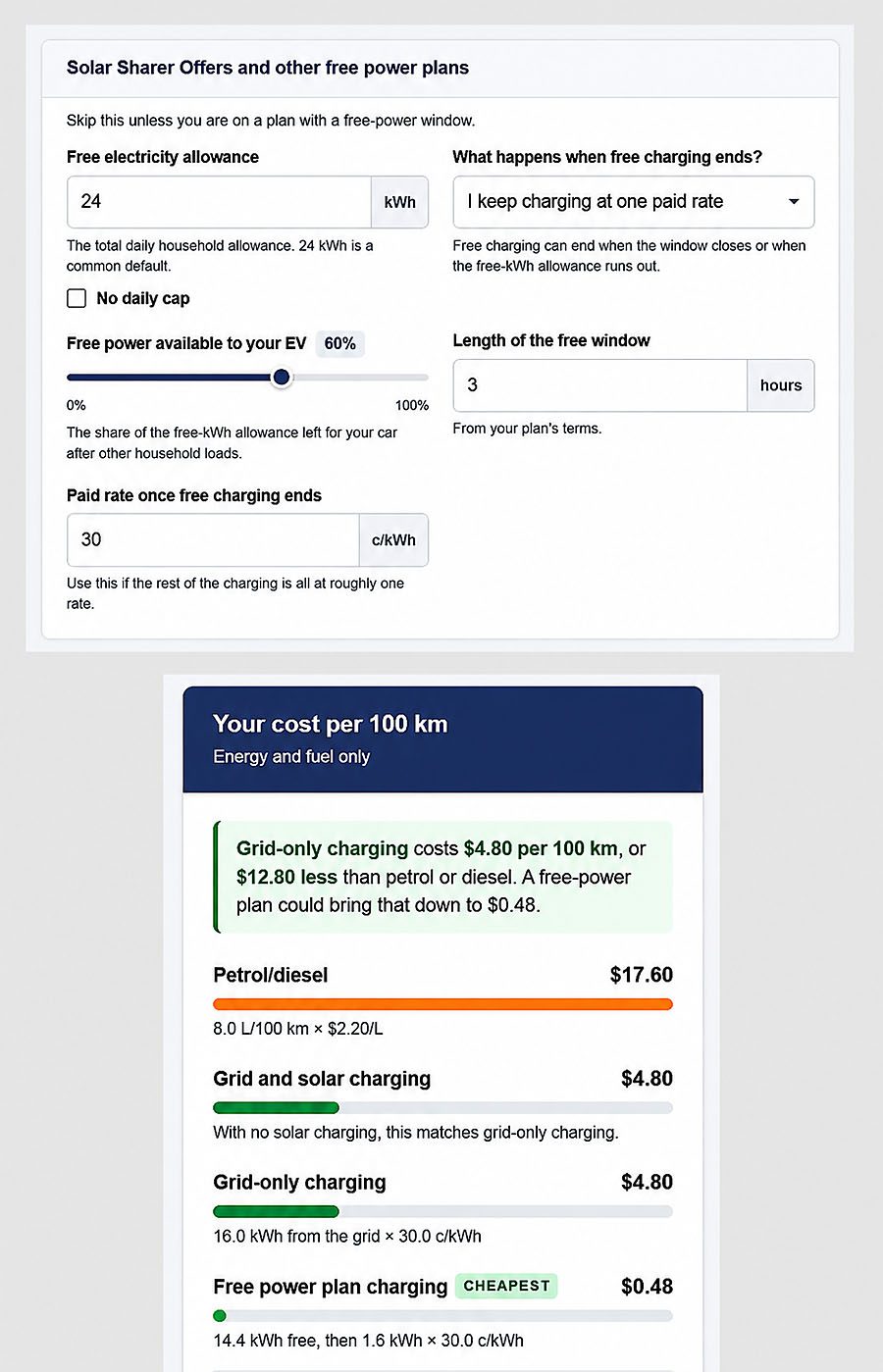
Free electricity doesn’t always mean free EV charging.
Sixty per cent of 24 kWh gives the car 14.4 kWh of free electricity. That’s not quite enough for our 16 kWh/100 km EV, leaving 1.6 kWh to purchase from the grid. The result is just 48 cents per 100 km.
Move the available share to 70%, however, and the car has access to 16.8 kWh of free electricity. That’s enough to cover the full 100 km at zero energy cost.
There’s a catch, of course. The vehicle must be able to charge during the free window, sufficient free electricity must be available, and the plan’s conditions must allow it. Our 7 kW charger can theoretically deliver up to 21 kWh over three hours, so charging power isn’t the limiting factor in this particular example.
Comparing The Results
So, how did our three EV charging scenarios stack up against petrol?
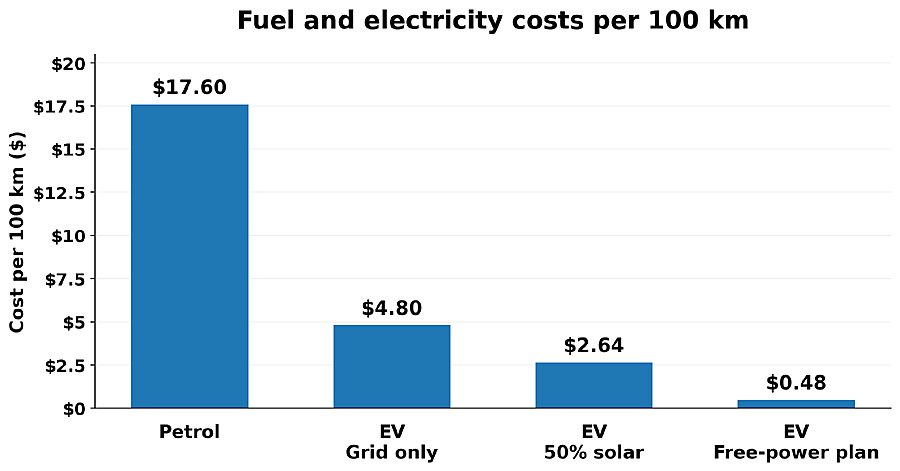
Illustrative fuel and electricity costs per 100 km for our hypothetical petrol car and EV, using the three charging scenarios tested. Actual costs will depend on your vehicle, electricity tariff and charging arrangements.
Of course, cheaper fuel doesn’t necessarily mean a cheaper car to own. Purchase price, depreciation, insurance and servicing all contribute to the total cost of ownership. The calculator concentrates on fuel and electricity costs, but if you want to dig deeper, we’ve previously developed an EV versus petrol total cost of ownership spreadsheet that lets you explore the bigger picture. It was published in 2023, so some of its default assumptions will need updating to reflect today’s costs.
Want to see how the numbers stack up for your own car? Try the SolarQuotes EV Charging Cost Calculator using your own fuel prices, electricity rates and charging habits.
 About Kim Wainwright
 RSS - Posts






Speak Your Mind