Applications are now open to apply the federal solar rebate to mid-scale systems, after the government incentive was expanded to cover arrays between 100 kW and 1 MW. The rebate is available to mid-sized solar systems installed on or after 1 October 2026. Here’s how it works.
Who Qualifies For The Mid-Scale Solar Rebate?
A mid-scale solar system is any setup with a total capacity between 100 kW and 1 MW. Where the solar rebate previously was mostly relevant to residential purposes, the expanded scheme offers a lot more for commercial-scale operations.
The installation date is the testing and commissioning date listed on the electrical compliance certificate. If this date is on or after 1 October 2026, the system qualifies, no matter when planning started.
Expansions are also eligible. The CER’s transitional guidance says that if you add 40 kW to an existing 80 kW system, you now have a 120 kW mid-scale system. The rebate only applies to the new 40 kW you add.
If your project started before the new rules and you’re unsure if it qualifies, the CER asks you to get in touch “no later than one week after applications for mid-scale systems open.” That’s around 24 November 2026.
What Is The Mid-Scale Solar Rebate Worth?
The government estimates that the new rules will cut the cost of larger systems by about 20%. For example, you could save around $68,000 on a 250 kW system or about $136,000 on a 500 kW system.
The rebate comes as Small-scale Technology Certificates (STCs), which your installer applies upfront to lower your quote. The number of STCs depends on your system size, your postcode’s zone (sunnier areas get more), and the deeming period, which is the number of years of future generation paid upfront. You can find the basics in our solar rebate guide.
An STC has a maximum worth of $40. In practice, market prices and agent fees usually lower the $40. Even our own rebate guide uses about $36 per STC after fees as an average.
At $36 per STC, the figures are as follows:
| System size | Zone 3 (e.g. Sydney, Brisbane, Adelaide, Perth, Canberra) | Zone 4 (e.g. Melbourne, Hobart) |
|---|---|---|
| 150 kW | 1,036 STCs, about $37,300 | 888 STCs, about $32,000 |
| 250 kW | 1,727 STCs, about $62,200 | 1,481 STCs, about $53,300 |
| 500 kW | 3,455 STCs, about $124,400 | 2,962 STCs, about $106,600 |
| 1 MW | 6,910 STCs, about $248,800 | 5,925 STCs, about $213,300 |
Check your postcode’s zone, then use the CER’s mid-scale STC calculator.
Mid-scale systems get a fixed five-year deeming period, no matter when they’re installed.
Businesses don’t need to worry about the rebate dropping each January, so they can take their time to get the design, approvals, and installer right.
Other Solar On Your Site Counts
The 1 MW limit covers all related solar on a site, not just the new system you want to install. The CER decides what counts as “related” by looking at things like physical location, common ownership, shared wiring, how systems are metered, and the type of grid connection.
Here are two examples from the CER:
A retail complex of ten stores each installing 30 kW. They share a grid connection, but each has its own sub-meter, and none are wired together. The CER treats them as ten separate small-scale systems, not one 300 kW system.
For an industrial site, a factory that already has a related 100 kW system (STCs) and a 600 kW accredited power station (LGCs), then adds another 500 kW (STCs). This brings the total to 1,200 kW (1.2 MW), so the new system does not qualify for STCs because it has a total limit above 1 MW.
Building your system in stages won’t let you get around the cap. If your site already has solar, ask your installer to confirm the total related capacity in writing before you sign anything.
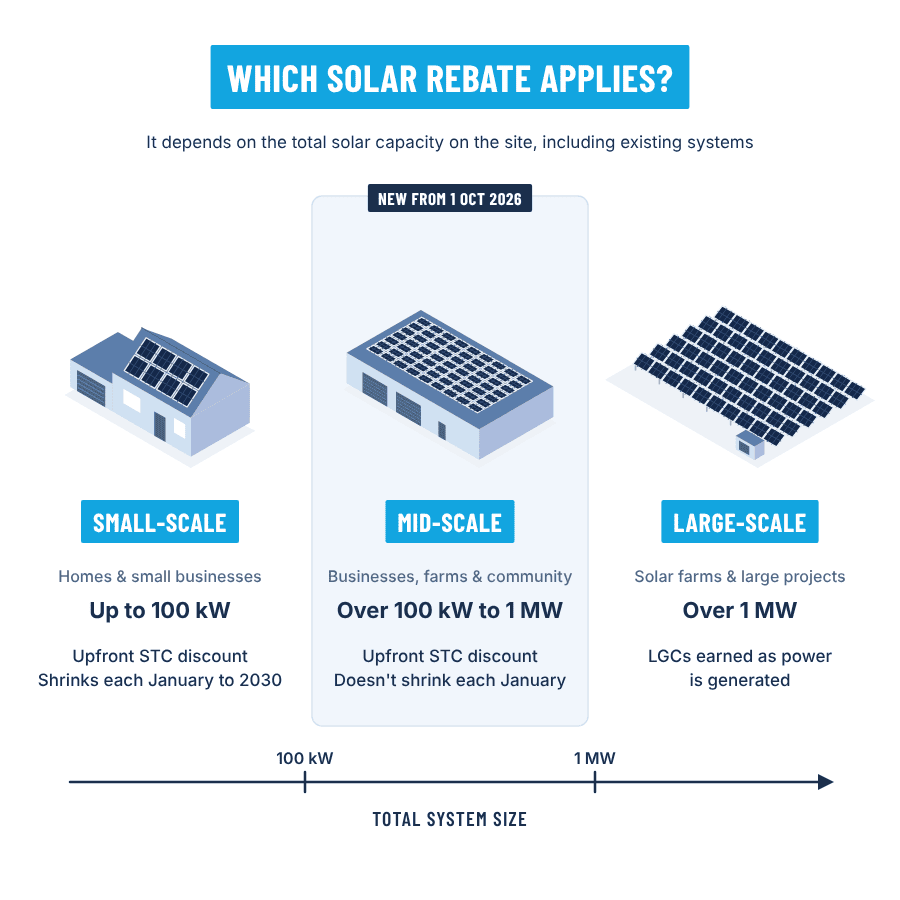
Mid-scale systems get five years of deemed generation whenever they’re installed. A household system installed in 2030 gets just one year’s worth.
What Paperwork Do Installers Need To File?
The usual rules still apply. All components must be on the Clean Energy Council approved list, and the installer must be accredited by Solar Accreditation Australia.
The CER also requires:
- Evidence that all planning and approval requirements are met, plus a written statement from the installer.
- An as-built structural engineering report.
- An electrical single-line diagram.
- A connection agreement.
You’ll need geotagged, time-stamped photos of the accredited installer with the equipment, taken on the final day of commissioning.
One more thing to consider: if you claim STCs, you can’t create Renewable Electricity Guarantee of Origin certificates, which track renewable generation. This is important for businesses that report their emissions for sustainability targets, so consider it before deciding.
What To Do Next
If you’ve been considering commercial-scale solar but the numbers haven’t quite added up, now might be the time to take a fresh look. For guidance, check out our tips for commercial solar.
If you’ve already installed a mid-scale system since 1 October, make sure your installer is preparing the claim.
The 12-month deadline has already started. If you miss this deadline, you lose eligibility for the rebate.
Ask your installer for written confirmation that your claim has been filed, and keep copies of submitted documents for your records.
To keep up to date with stories like this one, subscribe to our free weekly newsletter.
 About Jacob Boyd
 RSS - Posts




Speak Your Mind