
After years of warnings, the Clean Energy Regulator seems to be getting serious about dodgy solar and battery installations. The recently published annual inspection report makes for interesting reading.
As much as it pains me to report, Australia’s solar and battery industry has a bit of a quality problem. And the CER has just put out some embarrassing numbers on it – more than six out of ten home battery installations failed to meet standards.
That’s not a typo – 61.2% of 3,129 battery installations inspected had problems.
Worse still, almost 1% were rated unsafe.
The CER is issuing warnings, banning repeat offenders and kicking companies out of the federal rebate scheme. At last it seems the regulator has found their glasses, applied some denture grip and is starting to bite. Frankly, it’s about bloody time.
Six Out Of Ten Batteries Aren’t Up To Scratch
The CER’s 2025–26 inspection report covers the first year of inspections under the federal battery rebate scheme.
Of 3,373 randomly inspected battery installations, the results were:
| Inspection result | Batteries | Solar panels |
| Adequate | 37.9% | 76.0% |
| Substandard | 61.2% | 23.1% |
| Unsafe | 0.95% | 0.93% |
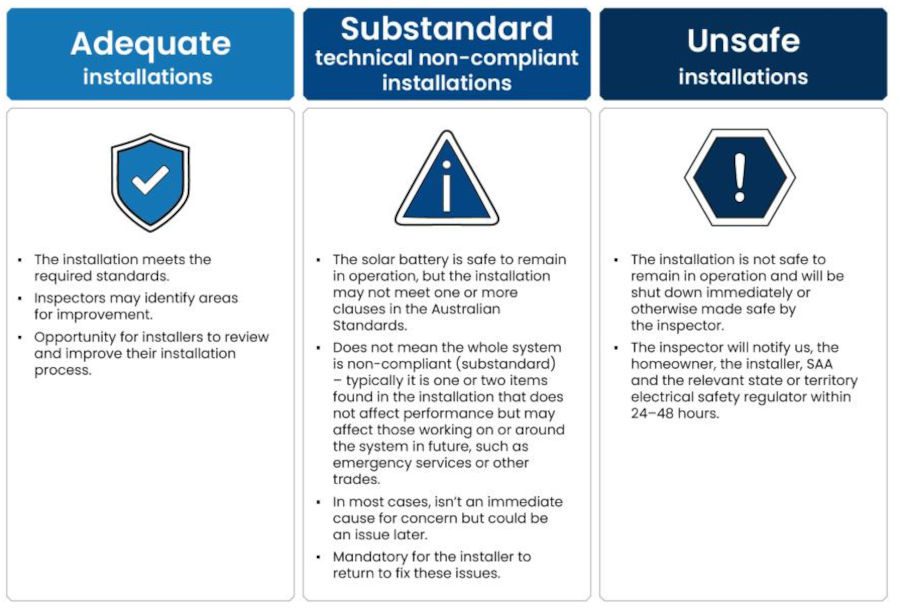
In other words, a battery installation was about 2.6 times more likely to be rated substandard than a solar panel installation, but don’t panic; substandard doesn’t necessarily mean dangerous. It can mean badly worded warning labels, poor cable protection or incomplete documentation.
Unsafe is a separate category, reserved for more serious problems, but that’s hardly a free pass.
These are electrical systems costing households and taxpayers thousands of dollars, so getting them right shouldn’t be optional.
The Scale Is Staggering
Depending on who you ask, Australian battery installations are second only to Germany. On average, our batteries are more than 3 times the size, but we’re doing it with one third the population. Australia installed 4.6 GWh of home battery capacity in the second half of 2025 alone, more than the 4.4 GWh Germany’s households added in the whole of 2025.
In the past year, grid-scale batteries have delivered more energy to the NEM than open-cycle gas and diesel peaking generators combined, which means batteries are now setting a lower price for everyone. What’s even more interesting is that we now have more small-scale batteries behind the meter than we do big ones in battery farms.
If the inspection results were applied to 700,000 battery installations, we’d be looking at roughly 400,000 systems needing rectification work, based on installation-related findings.
Around 4,800 could have unsafe installation work.
Those are our rough estimates, and they assume the inspection sample reflects the wider market, which, to be honest, it doesn’t. If the CER finds a dodgy install in the random sample, they do target that installer for more inspections.
Still, that’s a lot of electricians being sent back to jobs they should have finished the first time properly.
We’re Taking Better Photos. Wiring? Not So Much.
There’s an interesting trend buried in the report. Early inspections found that missing or incorrect labels were the biggest cause of battery installations failing inspection.
Before the (F)right wing outrage machine could fire up the hyperbole generator about 98% non-compliance, the CER introduced mandatory geotagged and timestamped photos of critical battery labels from 1 March 2026, which seems to have helped because labelling’s share of rectification findings dropped from around 50% to around 40% over the reporting period.
However, wiring’s share rose from roughly 12% to 37% – and that is a much tougher pill to swallow.
The final quarter’s figures are incomplete, but the message is we’re getting better at fixing things a camera can see. The stuff hidden inside switchboards is sadly another matter.
One of the most common serious faults involves neutral continuity on backup circuits.
Put simply, when a battery takes over during a blackout, the home’s electrical wiring still needs a safe and reliable path for fault currents.
Get the neutral arrangement wrong, and appliances can blow up, or safety devices may not work properly. Worse still, a tap or earthed appliance might give you a shock. A nice photo of a warning sticker won’t catch that.
Other common problems include non-compliant or missing safety switches (ie outdated RCDs offering inadequate circuit protection) and poor backup wiring, which can overload the active wiring links or busbar.
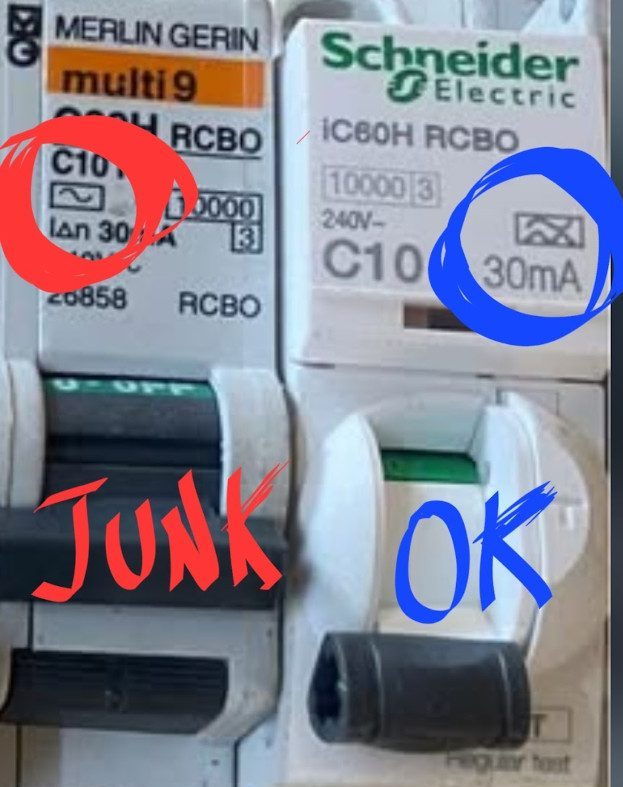
A non-compliant RCD switch next to a compliant RCD.
Proper Testing Is Essential
Installers need to test the installation, not just flick the switch on and swear about fault finding if the safety switches trip.
A responsible electrician has to understand the backup circuits, check the RCD arrangements and TEST WITH A METER.
They must make sure the neutral continuity is good, especially when running in backup mode. They must also check that the earthing is up to snuff and the insulation is passable. The results should be recorded and attached to the compliance certificate. It’s not just tick a box and head off to the next job, because that won’t cut it when you’re called in front of the coroner.
At Least The Numbers Are Moving In The Right Direction
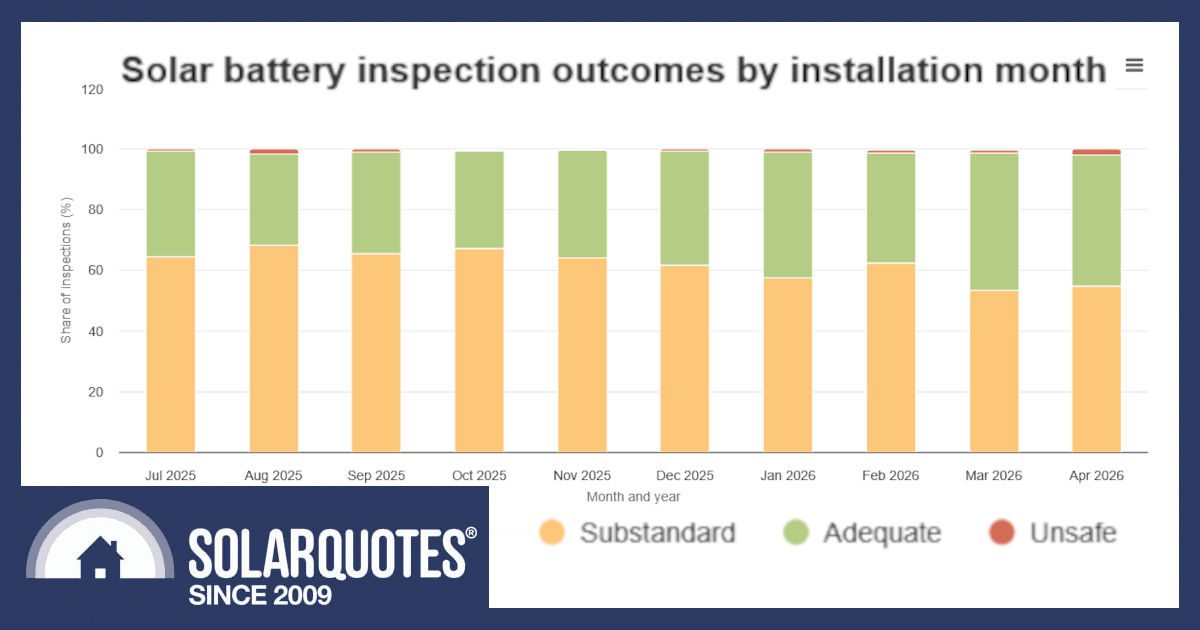
It’s not all bad news – the CER says the substandard rate for batteries installed in August 2025 was 68.3%, and by April 2026, that had dropped to 54.9%.
That’s a decent improvement, although more than half of inspected installations still failing isn’t exactly cause for champagne.
Thankfully, the CER isn’t just collecting statistics, which brings us to a recent example.
Five Months On The Sidelines
Under Regulation 47, the CER can declare an installer ineligible after adverse inspection findings on three separate occasions. South Australian accredited installer David Mogg has met this dubious honour following repeated flaws in systems he installed.
CER Chair Tony Chappel says installers have been warned:
“If that advice is not taken seriously and issues continue, we will act.”
Fair enough. Everyone makes mistakes sometimes, even the people doing the inspections; however, repeated failures after warnings suggest something isn’t being fixed.
As it happens, Mogg was briefly a SolarQuotes installer many years ago but failed to pay an early invoice, which was a red flag in our books, so he was removed from the network.
Carrots Withdrawn But What About Bigger Sticks?
Small-scale Technology Certificates (STCs & BSTCs) are the incentive that makes eligible solar and battery installations affordable.
While the CER declaration is in force, systems installed by Mogg won’t qualify for STCs/BSTCs. I reckon that’s a bit like being flogged with a warm lettuce leaf.
What would clean things up even more is preventing the shonks from doing any electrical work. If a character who can’t sign off on STCs can still install EV chargers and air conditioners, it’s really not much of a penalty.
Maybe if they added some fines, or better still compelled people to repay STCs already claimed, that would be more akin to a flogging with a whole lettuce, preferably a frozen one.
Many in the solar industry argue that the whole system of qualification and compliance underpinned by STC incentives should get in the bin, so that state technical authorities can resume their traditional role in policing electricians. Either way, the South Australian Office of Consumer and Business Affairs could take an interest in Mr. Mogg’s electrical licence.
Other companies have also copped CER penalties, including Solar Power Nation, which has been suspended from the federal solar rebate scheme.
Warnings Are Fine. Consequences Are Better.
The CER says it has contacted more than 830 installers since July 2025 about adverse inspection outcomes.
That includes 718 initial advisory letters and 121 warning letters for repeated non-compliance.
The inspection report itself records engagement with 183 installers during the 2025–26 reporting period, so these figures cover different reporting windows, but either way, the regulator is clearly spending more time chasing poor workmanship, and it’s promising more follow-up inspections and faster checks after installations are completed.
That’s important because finding a wiring fault months after an installation is better than never finding it. Finding it before the electrician leaves the driveway would be better still.
What Does This Mean If You’ve Bought A Battery?
If you’ve recently had a battery installed, don’t assume it’s dangerous because of these statistics – the overwhelming majority of inspected systems were not found to be unsafe, but it’s reasonable to expect your installer to show that the work has been properly checked.
Ask for your electrical compliance paperwork, commissioning records and confirmation that backup circuits and safety switches have been tested.
If you’ve got concerns, contact your installer first. If they won’t help, your state electrical safety regulator or the CER may be able to assist.
And if you’re still shopping for a battery, don’t choose an installer on price alone. A cheap installation that needs three return visits isn’t much of a bargain.
You shouldn’t be shopping for the absolute cheapest piece of junk to bolt to your most expensive asset – your home.
Good, Cheap, Fast – Pick Only Two
In defence of the electricians doing this work, at least some of the blame must be sheeted home to the average Australian tightarse. We’ll get a better class of installation if we can find a better class of customer, but at least we’re not paying what they do overseas.
Installed prices in Australian dollars — 2026
|
Country |
Rooftop solar A$/kWp | Home battery A$/kWh |
| 🇦🇺 Australia | 1,200–1,600 | 800–1,400 |
| 🇺🇸 USA | 3,700–4,500 | 1,400–2,100 |
| 🇬🇧 UK | 2,800–3,600 | 900–1,500 |
| 🇨🇦 Canada | 2,500–3,500 | 1,200–1,900 |
Indicative residential market ranges, rounded to the nearest A$100. Before incentives, including normal installation and local taxes.
It Isn’t Hard To Set Some Standards
SolarQuotes is undeniably improving standards via two routes.
Firstly, we set about educating the customer on what they should be buying, where the pitfalls are, and simply checking the one-star reviews before laying down your hard-earned.
Secondly, for every installer, we spend around 12 hours vetting around 75 different points before we deem them good enough to get your business. Financials, licensing, insurance, marketing claims & workmanship- they all get a lookover.
Vetting means we can offer a third-party guarantee on work sourced via our platform, and we simply couldn’t afford to do that if the companies we recommend were doing a shocking job.
If you’re after a reputable installer for solar, batteries, EV charging or hot water heat pumps, get multiple quotes from our vetted network.
 About Anthony Bennett
 RSS - Posts






Speak Your Mind