
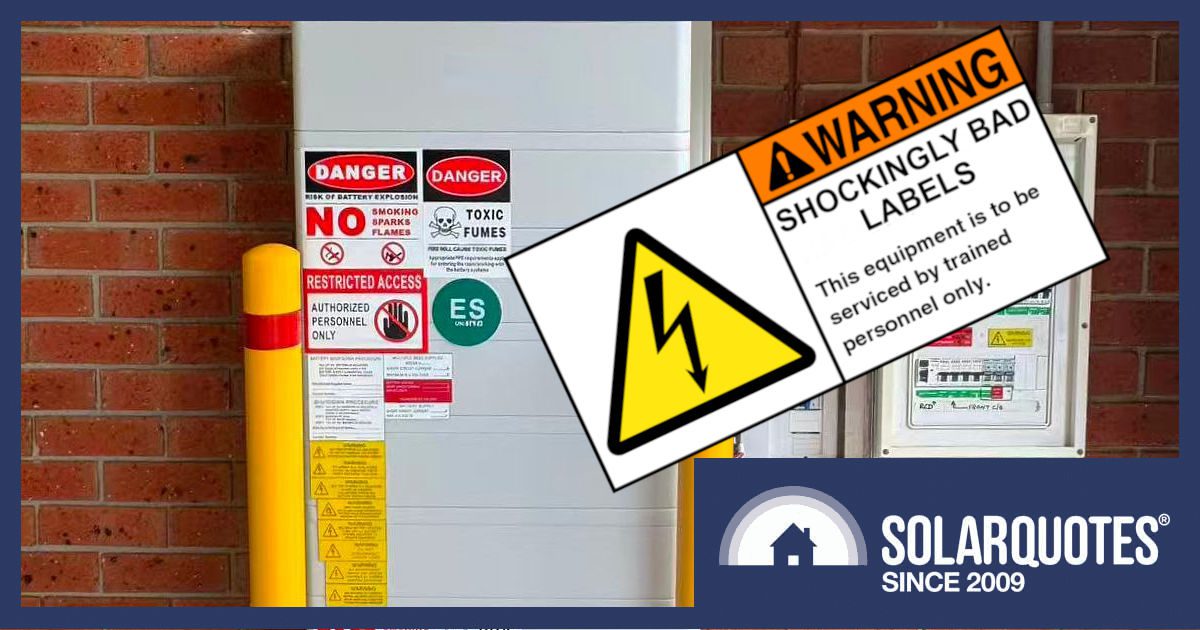
Apparently a recent raft of audits showed 98% of battery installations were defective. Does that mean the entire solar installation industry is incompetent? No, but the people writing the rules…?
Labelling The Problem
The vast bulk of rule breaches aren’t serious safety concerns – there’s no spate of fires or rash of electrocutions to fuel a conservative media beatup or festival of (f) right-wing outrage.
Most are just technical defects involving labels. The wrong sticker with the wrong jargon in the wrong place is all it amounts to.
The thing is though, someone has to burn time and petrol to go back and label a system that’s quite functional, but doesn’t meet a pedant’s checklist.
Semantics Don’t Help In A Fire
Standards committees need to step back. If 100% of battery installations aren’t compliant, then basically it’s because the rules are made & interpreted by smart arse grammar Nastis.
Arguing the semantics of switch or isolator, defining specific words to describe an electrical supply – this might be fun for electricians trying to one up each other, but it’s all bullshit when the house is on fire or there’s a flood coming. Jargon does not make things safer.
I’ve supported customers on the phone and struggled with how little prior knowledge they have. They might sail through a pub quiz night, reeling off the names of all the world’s oceans, but confronted with a switchboard, they’re all at sea.
This image below was sent to me by a customer simply trying to reset her system. She was befuddled about switching off the AC supply, so I made notes on her photo and sent it back.
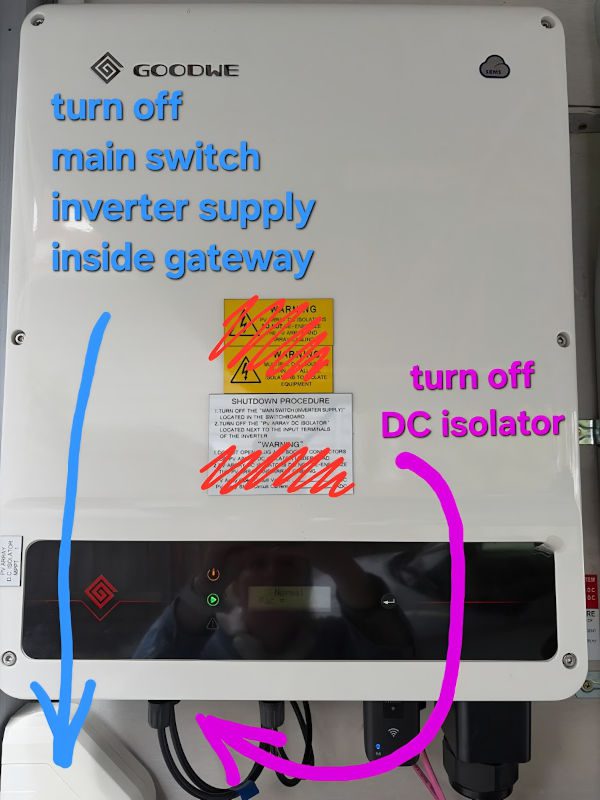
Irrelevant jargon crossed out with red to focus attention on the parts that matter.
What really opened my eyes was this; despite having an expert coach on the phone, despite perfectly compliant labelling, you can’t flip, flick or fondle a switch if you’re blissfully ignorant of what the boxes on the wall are even there for. When you don’t even realise the shiny glass front of a Tesla gateway is in fact a switchboard door; well you don’t know what you don’t know.
Once I sent the image below, with fundamental components identified, the penny dropped, and the statutory warning stickers began to make a little sense to the customer who was otherwise embarrassed she had no idea.
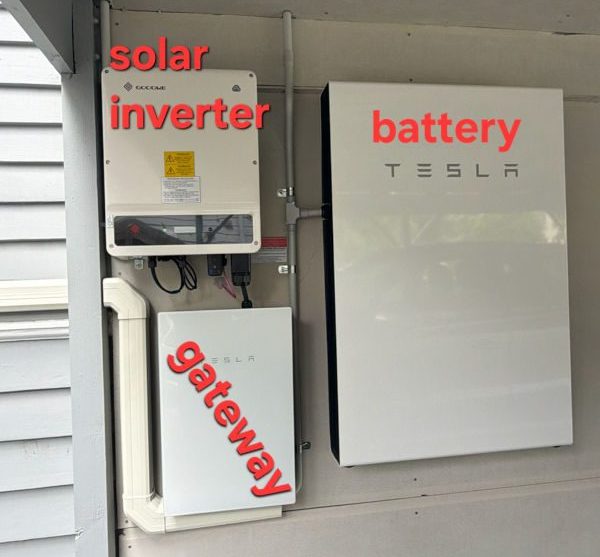
Labels need to be basic.
You might complain about people who flunked science class, or don’t care how the world works, but consider this – the Tesla Powerwall has a shiny glass facade, and the same design language carries over to the gateway.
To fanbois it’s uber slick minimalism, to others it’s featureless appliance white, but the thing is, a fridge always has a handle and I’ve never found one that’s not intuitive to open.
A fridge could also kill you – it could topple over, you could suffocate inside it, chewing on the high voltage cable might cause burns or electrocution, the R600 refrigerant could leak out and burst into flames; but I’ve never seen a fridge with engraved yellow warning labels, exclamation marks and lightning bolts.
The epiphany I had is one we could all benefit from – the warning stickers are no help. In fact they’re counterproductive.
When equipment is plastered with fear and danger warnings, the perceived risk of breaking it prevents people from learning.
The System Is Failing Electricians
Solar Accreditation Australia has released new guidance on compliant labelling. But electricians are already well trained – they have to be, because they’re expected to test and certify the work they do as safe with a document admissible as court evidence.
To get your SAA-approved solar endorsement, there are 4 nationally accredited units of study. Put another way, that’s a week long course, plus required homework, or about 80 odd hours of training.
And to install batteries you need an additional 3 units. In my experience, that’s another week of face-to-face academic courses, testing, and practical demonstrations to deliver another 80 hours of “rigorous training and assessment by qualified teachers resulting in a national qualification”.
So the person signing off on your battery hybrid solar installation has at minimum done a 4 year apprenticeship and another fortnight of technical study, 160 hours plus homework.
Once they’ve been on the tools for 12 months, they’re required to earn 100 points per year in Continuous Personal Development courses, which invariably involve sitting through several live or recorded presentations and then passing quizzes.
So if people are required to undertake that level of training, and 98% still fail to produce compliant work, it’s seriously time we started looking at the rules. The system is failing those expected to deliver it.
Fun Fact: During the dark days of the white Australia policy, potential immigrants were screened by a dictation test. People had to prove their fluency, so if the vetting officer liked you, the test was in English. However the rules allowed any European language, so if your skin was a little brown you could be tested in Bulgarian.
The system was designed to fail you.
We Do Need A Document Holder
Used house dealers are lucky to give you the right set of keys, let alone instructions for a pool pump or the WiFi password for solar monitoring. And we know other trades can easily render switchboards non-compliant and solar energy management useless if they don’t have enough information.
Improvements should start with the National Construction Code, mandating a decent document holder in the main switchboard. My local network authority already requires that a map of the underground main supply must be painted (not texta pen) inside the meter box door.
The solar standards require a map of the roof and solar disconnection points must be left in the meter board. And the customer must receive a handover pack containing technical specifications, warranty details, procedures, maintenance requirements, etc.
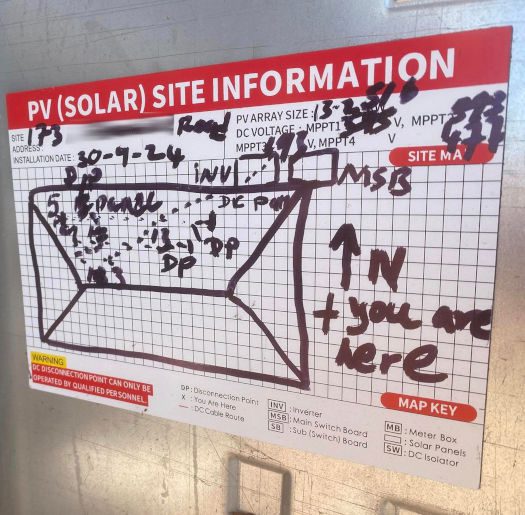
We hardly had to blur this one as it was unreadable anyway. At least a QR code might be legible.
Some more innovative solar companies make all this information available via QR code, like manufacturers do for inverter manuals. It’s a great way to transfer a variety of documents in rich detail, right up until the company goes broke or the server goes down.
However, the numpty who takes a paper map of their solar array (not durable, colourfast or compliant) and glues it over the mains supply drawing? They want to be tarred and feathered.
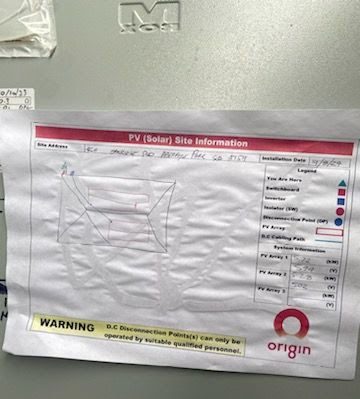
The most prominent thing about this piss poor excuse for a map is the pattern of the silicone used to glue it down. These Origin subcontractors can get in the bin (a comment I’m happy to make despite Origin owning SolarQuotes).
Battery Standards Must Be Free To Access
Electricians refer to AS 3000 wiring rules as the good book, but unlike all the goat herder’s guides to the galaxy they study in religious circles, ours gets updated sporadically and it’s cited in laws, not lore.
Sadly our seminary doesn’t have soaring architecture and stained glass – rather TAFE colleges sorely need funding to improve their strained capabilities (we should tax the churches and nationalise all the schools while we’re at it).
The point is, electricians must be trained, steeped, and familiarised with the jargon before they’re able to open the book and interpret the contents. If you don’t have that context, then you’re not qualified to do the work, nor offer an opinion.
It’s worth remembering that if you see a “rate my installation” post on social media, the armchair experts aren’t coughing up $300 per copy for the multiple standards applicable.
Inverters Should Supply Their Own Labels
One key question is why inverter makers aren’t supplying the labels that belong with their specific model of hardware.
Some inverters are non-compliant because a cover blocks access to the DC isolator. In fact AlphaESS have a cover screwed on, so technically they need a second isolator added beside the unit.
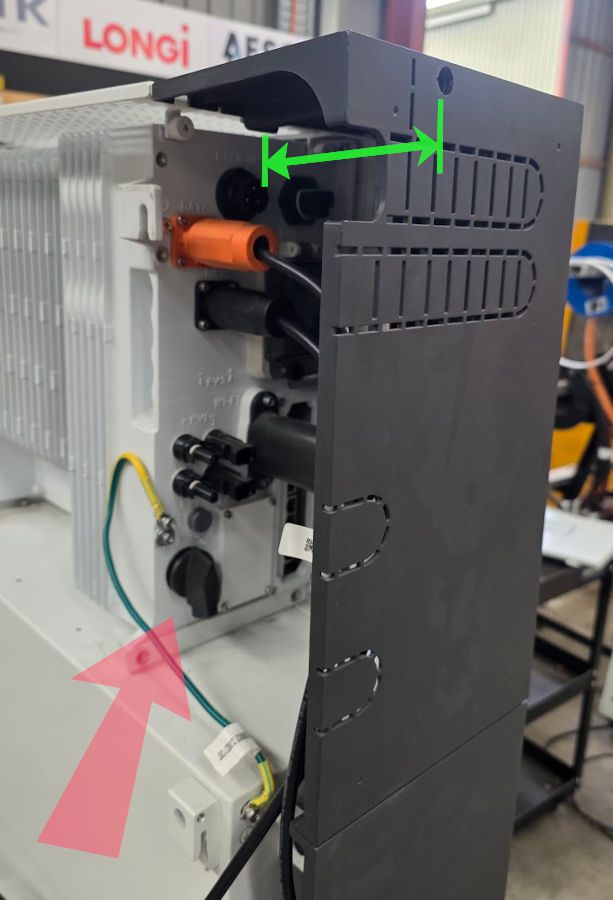
As seen from behind, this AlphaESS requires a long screwdriver (green) to get the cover off and access the DC isolator. It’s not a compliant product. Credit to Solar Training Centre
Sigenergy fans point to an isolator buried behind a cover, which you need two hands to remove, but without really specific labelling it’s not obvious. Vanity stops them from removing a “knock out” in the moulding to create access, but either way, the isolator isn’t easy to see. And the shutdown procedure requires you to push a separate button, which again can’t be explained by a generic label.
GoodWe need specific labelling too, but in my opinion they have the right compromise in the design. With one finger you can flick the cover off and then it’s easy to see and operate the isolator.
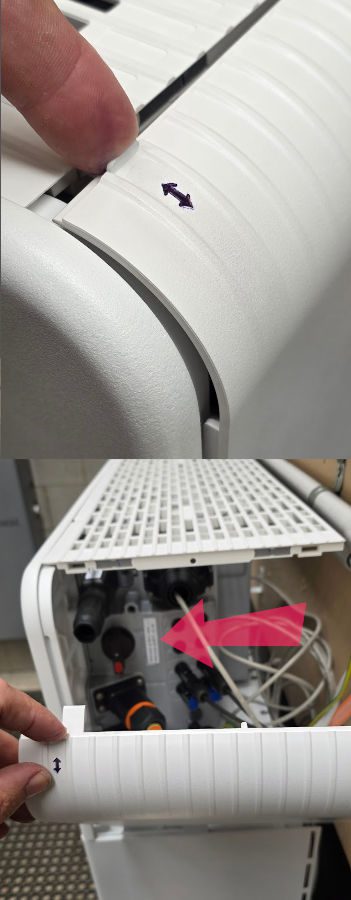
GoodWe have moulded the arrow into the cover (highlighted black) so access to the isolator isn’t difficult.
The best labels I’ve seen recently are designed specifically for the GoodWe ESA. These are available for download from Ultec and they’re a great example of dedicated Australian support.
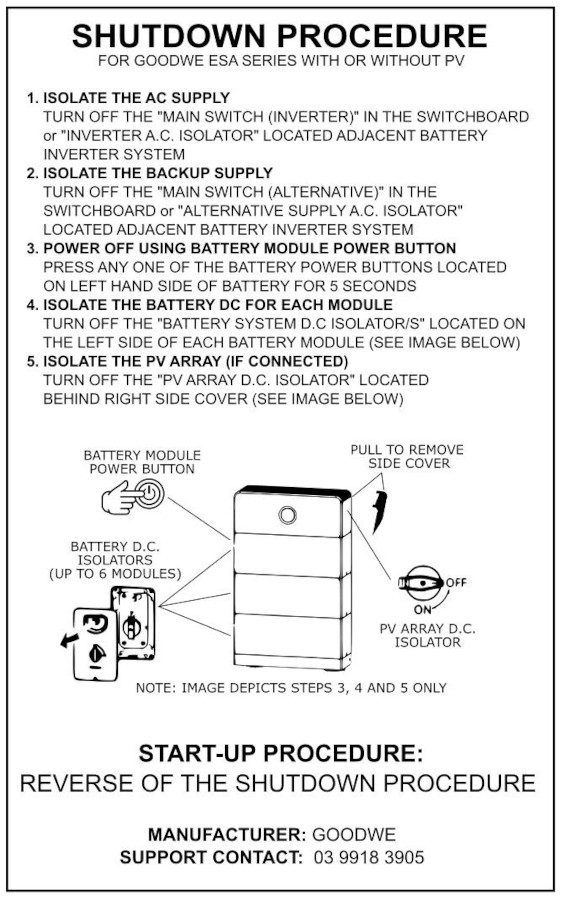
This really shows the punters what you need to do and how to go about it.
I’ll argue that if you can’t see the handle, and operate it with one hand, it’s not accessible and not compliant.
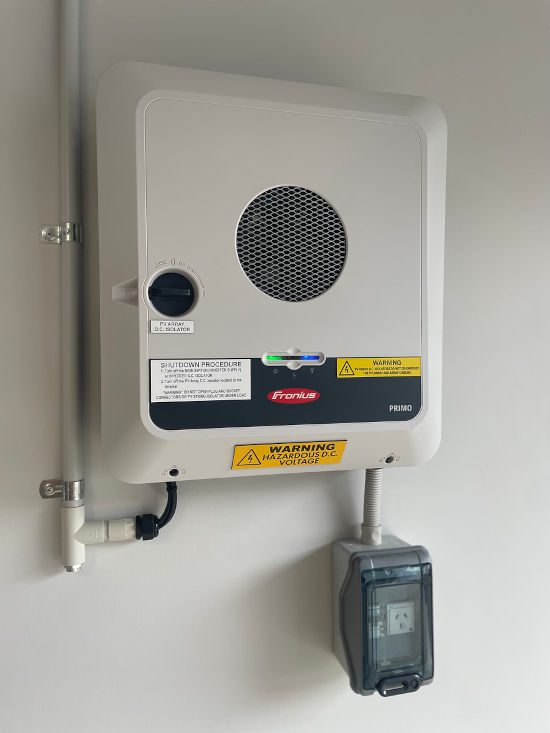
As a customer, there is no “HAZARDOUS DC VOLTAGE” available from this Fronius inverter, unless you single out the black wiring and have at it with some scissors. At least the big black round knob makes the DC isolator obvious
Numbers Are Universal
Let’s face it, not everyone is good with English, let alone electrical jargon. So without resorting to ambiguous pictograms, Egyptian hieroglyphics or the latest raft of emojis, you can instruct people on how to shut down a power system using numbers.
When I built remote-area power systems, there were sometimes a dozen or more steps in the shutdown procedure. We would apply the statutory jargon, but every system was different, so they all got a unique laminated placard.
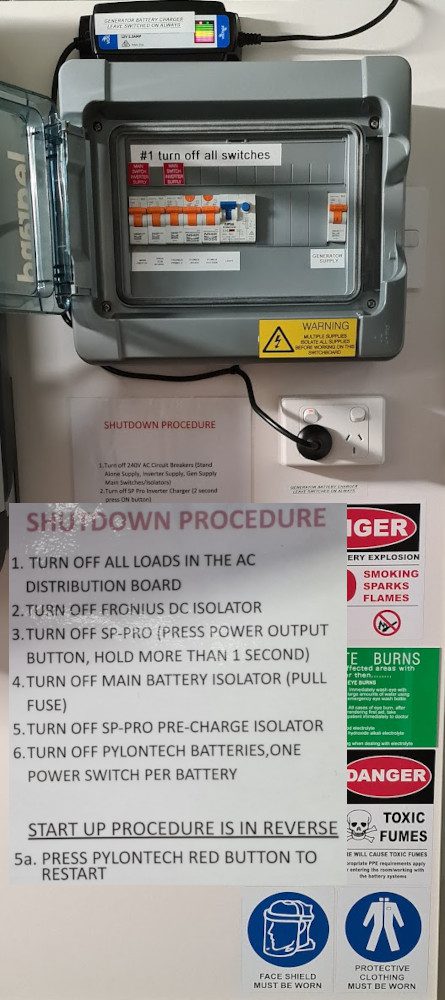
In this example, the startup procedure needs extra steps when you reverse the shutdown order.
The real test was in the handover, watching the customer follow the instructions without skilled intervention.
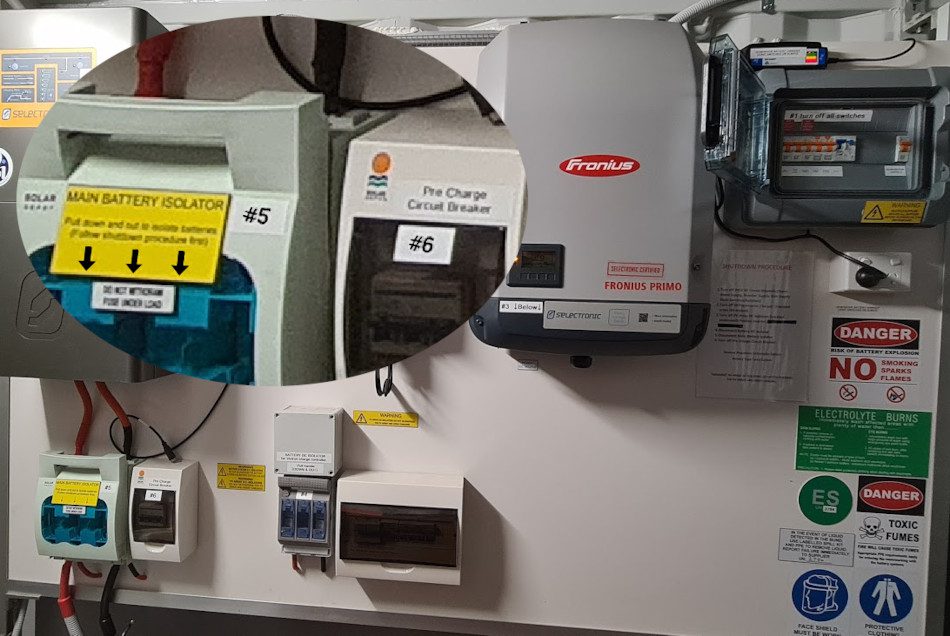
#NUMBERS give you the order, while arrows explain you need to pull firmly on a “rat trap” fuse disconnect.
Shutdown labels must have a numbered order, something your 5-year-old can follow. And to make it work, the switches, circuit breakers or handles themselves must have numbers attached to identify them.
Emergency Stop!
Follow this order to switch off:
- 1. Open Here >>>
- 2. Flip the toggle down to switch off the mains power
- 3. Turn the handle to switch off the solar from the roof
- 4. Push the red button to switch off the battery
Notice I’ve deliberately avoided the term isolate here; because despite my electrical instinct, I know we’d be better off talking to a junior primary teacher about the most obvious words to use. So have at it in the comments section please.
This Is The Bottom Line
I can’t stress this enough, because all the standards, all the labels, all the audits, all the hand wringing & finger pointing is just a pointless waste of time and resources, unless we make the labels something a completely untrained punter can comprehend.
Labelling must be simple to apply
and even simpler to understand.
For more, read about how the safety theatre of labelling rules distract from the issues that really matter.
 About Anthony Bennett
 RSS - Posts





Thanks Anthony for calling out the chaos that is “safety” labelling of solar and battery systems.
As one of the “smart arse grammar Nastis” on the committee that wrote these standards, I totally agree that labelling is a mess.
I far prefer the German approach where for instance a solar installation has only one sign, a picture of a house with a solar panel on it. The logic is that if you’re going to work on this, you should know what you’re doing!
Thanks Glen,
I’m glad people like you are there trying to make things better.
Sometimes there has to be a bomb thrower but I’m glad you’re taking the feedback in the right spirit. I’d probably offend the committee members, but please forward it to them 😉
I totally LOVE the German approach !!
I believe that KISS (Keep It Simple, Stupid) should ALWAYS be the guiding principle in any design particularly when it involves a range of users (ie. normal people) with varying levels of knowledge, expertise and, dare I say, intelligence.
Otherwise, why even bother in the first place designing or building a system/product if they can’t or won’t use ?
The labelling for my solar PV system and Tesla batteries quite confusing. I don’t blame the installers for this. I blame the people who established the regulations and rules for them, because those people (perhaps not including you ?) need to have really good honest look at themselves and think very critically about what it is that they’re trying to achieve with these labels. If (almost ?) everyone is having trouble understanding them then for goodness sakes, revise them because they are useless – maybe even dangerous – as things stand.
Personally, I’d like to see a few more warning signs on my battery. You can never have too many.
Warning: large quantity of small print may cause eye strain when reading.
Warning: Bend knees when trying to read shutdown procedure located near skirting board – do not stoop.
Warning: battery capacity greater than 40kWh. Avoid sounding too smug when posting on Solar Quotes blog.
Thanks Glen,
I’m actually thinking I’ll completely coat my battery top to bottom with an insulating layer of plastic labels.
We had a trade show last night where one of the inspectors pointed out that you can be defected for having the wrong wording, but it’s difficult for them to pick on a job that has excessive labelling.
ie While the green “electrolyte” label doesn’t apply to lithium batteries, lots of people plaster them on anyway, however meaningless.
A lot of the time safety is about box ticking and not actual safety. Complying with a rule for the sake of complying with a rule, no actual thought or effort into actually making anything safer. Rules such as label information content have often been drafted by a desk jockey with no proper understanding of the job they have been tasked and no trade background.
Affirm. Always understand that all safety rules/regs are NOT written for your safety, they are solely to cover the ar5e of those above you!
absolutely agree, its a minefield that serves noone
Thanks Anthony for another great article! I love it when I can learn something new and have a good laugh while doing so! Having had a 5/5 experience with 1 of your installers, I did encounter a recent hiccup with the labelling after we had an internet outage and we followed the Sigenergy AI help app to reset. I found that the Shutdown Procedure (Sigenergy’s label on the wall next to the unit) referred to switch labels in the Gateway that did not exist – not even close. I let the installer know and he is sending new instructions for me to put on the wall.
With regards the DC switch/red button on the Sygenergy inverter – yes, these are behind a cover, (top left) but this is VERY easy to remove once you know how.
My suggestion for those having installs done is to not let the installer leave without explaining all of this clearly to you – and for you to physically do the switching.
That GoodWe shutdown diagram is excellent – assuming its correct 😄. ALL suppliers should follow suit
I too have had the recent experience where I tried to follow the shutdown instructions on a PW3 installation and the instructions on the label did not match the equipment installed or the labelling elsewhere.
Reason offered “These labels are purchased for this product from supplier who does this for the industry”.
In my example, instruction #3 referred to an item not installed. Solution was not to make a new label but to cover over that instruction with a blank label!
I think that the installation contractors need their installation designer to think about this and make the labels to suit.
I like the idea of putting the numbers next to the items of equipment.
Hi Rob,
There are specific kits available for Yesla and others.
Some installers just use a generic label set and assume it’s all bollocks anyway.
Hi Anthony,
thanks for your post, can you please provide me with the information or link where these specific kits are available?
Hi Rob,
There’s a hyperlink in the article for the GoodWe specific labels. Otherwise the best I’ve seen for other brands come from AC Solar Warehouse or PV Connections.
thanks Anthony, appreciated.
Reminds me of the photo of a sign that’s been floating arounf the interweb for decades . . .
WARNING !
This sign has sharp edges.
Good on Goodwe for having someone with excellent English language skills look over their lableling, and not require a chinglish translation app.
There could be a role for the supplier of some systems particulary hybrid systems. The thing is the guys doing the job know its wrong. My labels are worng but installer is not bothered. The circuit diagram does not help with with isolation points. I still have the isolator on the roof which I am sure does not help in a fire as well as being a source for faults.
I recently had a third party look at a fault on my system & he agreed the labels were just generic. He did comment about the isolator being wrong but he did not elaborate.
The some of the labels on my installation was placed on the inverter. Some where on the brick wall.
Then my inverter broke down and had to be replaced. Away came the labels and now my replacement inverter didn’t came with any.
Where does that put my battery.
My installer did even provide a map where the battery is, but the emergency team just needs to look at the right to see the battery when looking at my switchboard.
Unfortunately as with all the electrical trades, we have handed over FAR too much say and authority to non trade bureaucrats.
The 80/20 rules should apply as with most things.
80% trade input and 20% bureaucrat. Unfortunately it has been the other way around for decades.
The abundance of stickers is absolutely stupid. They fade rapidly if outside. Ok so it produces smoke….i would be more concerned for the fire that creates smoke. Shutdown is not particularly difficult.
There is no particular order.
If the isolator to PV is off check
1. Is battery off,? It has a button. OFF. Inverse in ON
2. Is inverter off?
3.Turn off submeter to inverter..it is isolated
4. In a emergency also turn off breaker AND main. Fireys will always do this
The most important are the big green ones on the meterbox. They tell sparkie and fireys of the risk. Source : my mate the firey!
Turning the power off at the pole is easy but only shuts down the mains, the array & battery are still alive in my house as I have full black out protection. Isolating the array is easy and isolating the battery is easy. Having the accurate information to inform the owner/ emergency services is impoertant because time is of the essence. All three are energy sources in their own right and should be isolated. I am an engineer so I can work it out but not everyone understands. I would be frighteded to share the diagram that was provided by the installer.
The problem is you are fighting so many existing conventions and rules that have existed in the industry for decades. Attempts to simplify have nade it worse. Doubly so the two tiered system where not all licensed electricians are solar and battery accredited (they SHOULD be).
We create and produce all our own signage to make sure both contractors and the owners can clearly understand. It also makes for much neater appearance. It can get pretty confusing when you have one site with multipple buildings and boards, fed both by mains, solar and standby generator supplies with Essential and Non Essential sets of sub mains and loads.
The meaning of terms like “Isolator”, “Main Switch”, “Line side” and “Load side” need to be clearly spelt out. And yes, a correct shutdown procedure in PLAIN ENGLISH is essential.
Hi Paul,
We probably need to dice the telecommunications training for electricians because nobody is wiring 50 twisted pairs of phone cable into buildings anymore.
In place of that we should mandate solar training, preferably early on when doing fundamental DC subjects.
These labels are so great and the instructions are so clear that ALL label kits sold by different vendors are different. I thought it was standard.
Sigh.
When was the last time a residential lead-acid battery was sold? (green label)
Everyone is pointing the finger at the installers having no clue what they are doing (many don’t, sadly) but we can only work with the labels we are provided with.
The DC label kits from our suppliers are so useful that we end up throwing 85% of the labels/stickers in them…
It’s good to provide training on what to do. Who is training the distributors on what to sell?
Not too many labels on my Sig battery module, but so far, after 10 months, the labels – technically correct or not – are still in place. AND the battery stack is outside.
However, the thick label affixed to my Sig battery’s Gateway, which is inside, didn’t take long to fall off. Do you think that by re-applying the label, it stayed in place? NO!!!
The adhesive is not good enough – and that’s in a temperature & humidity controlled environment!!!!
The label sits on the shelf, under the Gateway.
Not only should the content of said labels be correct, they ALL need to permanently adhere to their assigned equipment door/cover faces.
Knowing what a gateway is and knowing that the front panel is a swinging door (and being a retired electrical engineer) didn’t help me get the door open the first time. First finding the latch, then figuring out which way to open it wasn’t the end of it because the door seal was just about welded shut and needed a lot of force to get it unstuck.
Elon might have some smart people on his team, but some are not very practical.
Yes, labelling is a real schamozzle. Not only their meaning, but the sheer number supposedly needing to be plastered all over the front of the battery enclosure.
I contacted Sigenergy by raising a support ticket to request emergency shut down procedures sticker. They wrote back to stat that no such sticker was available at this stage. I was totally shocked. Then on the Sigenergy users group on fb lots of people posted thiers but some where so complicated I couldn’t understand what buttons to press. It is just stupid.