
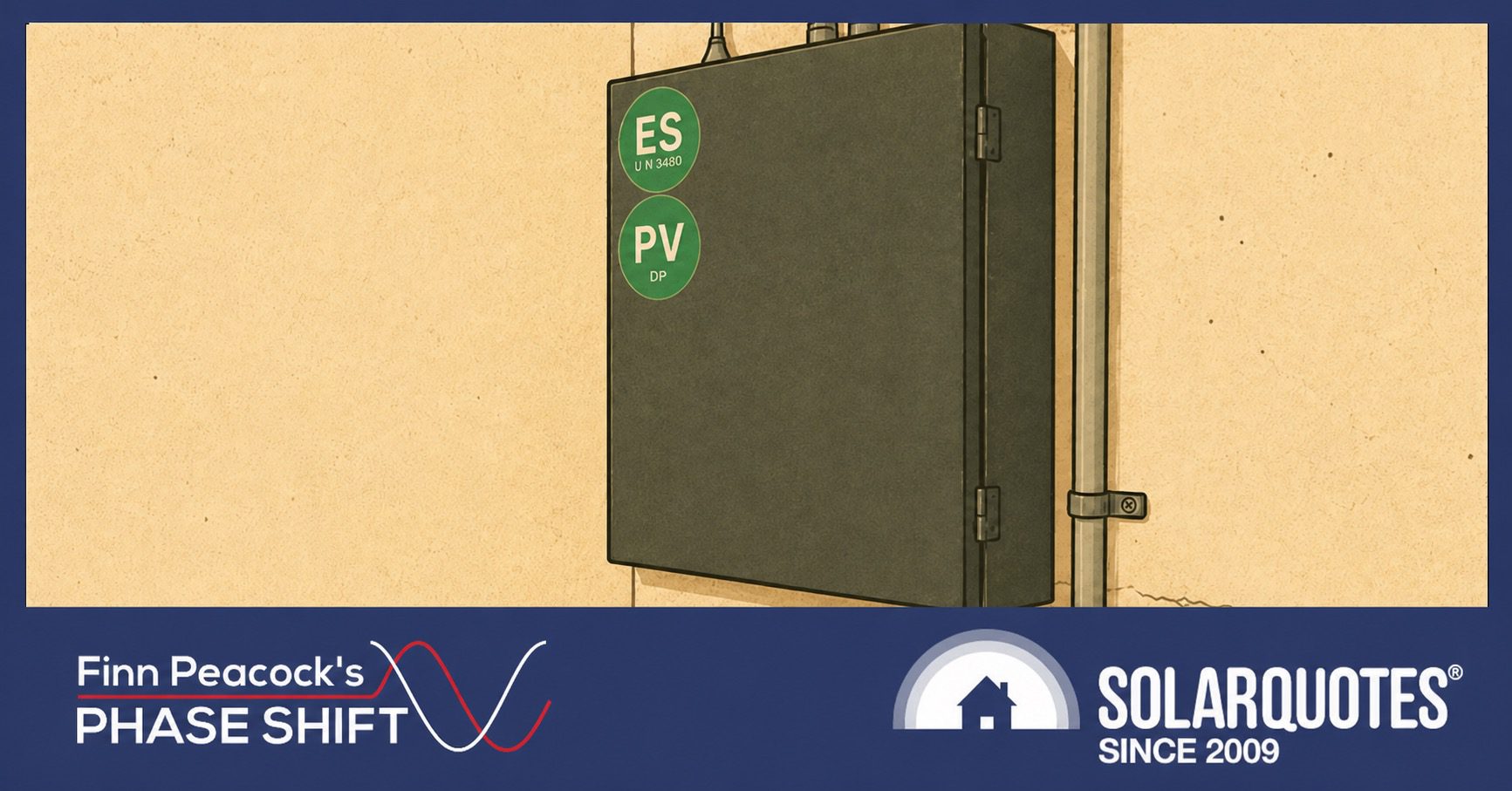
Your solar and battery installation comes with a lot of stickers. Warning labels, voltage signs, shutdown procedures, danger signs, restricted access notices. The standards (AS/NZS 5033 and AS/NZS 5139) mandate a small library of signage.
But two of those stickers matter more than all the others combined.
They’re both green. They’re both circular. They’re both reflective. And they both go in the same place: on your main switchboard.
Sticker #1: The Green “PV” Sign
AS/NZS 5033:2021 Clause 5.4 requires every solar installation to have a circular green reflective sign, at least 100mm in diameter, with the letters “PV” on or immediately adjacent to the main metering panel and main switchboard. It must be readily visible to approaching emergency workers.
Underneath “PV”, there’s a sub-code that tells you what kind of isolation the system has:
- AC means low-voltage DC (under 120V) with panels close to the inverter. Lower risk. Think Enphase.
- SW means there’s a load-break switch that can be flipped to isolate.
- DP means there’s a disconnection point, that can be pulled apart. This is the most common.
Sticker #2: The Green “ES” Sign
AS/NZS 5139:2019 Clause 7.3 requires every battery installation to have a circular green reflective sign, at least 100mm in diameter, with the letters “ES” (Energy Storage) on or immediately adjacent to the main metering panel and main switchboard. Again, readily visible to approaching emergency workers.
Underneath “ES” goes the UN number for the battery chemistry:
- UN 3480 = Lithium-ion (including polymer)
- UN 3090 = Lithium metal
- UN 2794 = Flooded lead-acid
- UN 2800 = VRLA / AGM / gel
- UN 3496 = Nickel-metal hydride
That UN number links to SAA/SNZ HB 76, the reference guide that first responders use to figure out how to handle hazardous materials. Different chemistries mean different hazards: a lithium-ion thermal runaway is a very different beast to a lead-acid electrolyte spill1.
Why These Two Are The Most Important Labels On The Job
Every other label mandated by these standards gives you detail about a hazard you already know exists. The danger signs, the arc flash labels, the shutdown procedures, the toxic fume warnings, they’re all mounted on or near the battery system or inverter. They’re useful, but they all assume you’ve already found the equipment and you’re standing in front of it.
The green PV and ES stickers are the only ones that tell you the hazard exists in the first place.
They sit at the one point every person interacting with the electrical installation will begin their work: the switchboard.
The Irony Of Getting It Backwards
Here’s what I see too often: an installer plasters the battery stack with every label in the kit, including the green ES sticker, then walks past the switchboard, packs up the van, and drives away.
It’s like putting a “beware of dog” sign inside the dog’s kennel.
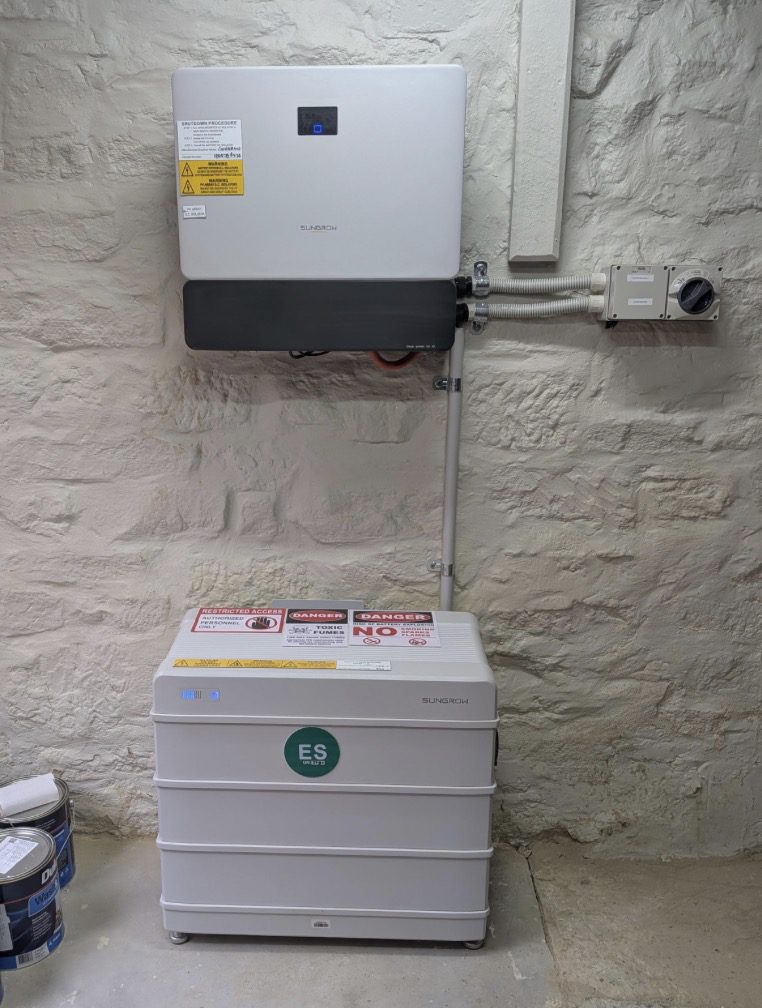
The round, green sticker should be on the switchboard.
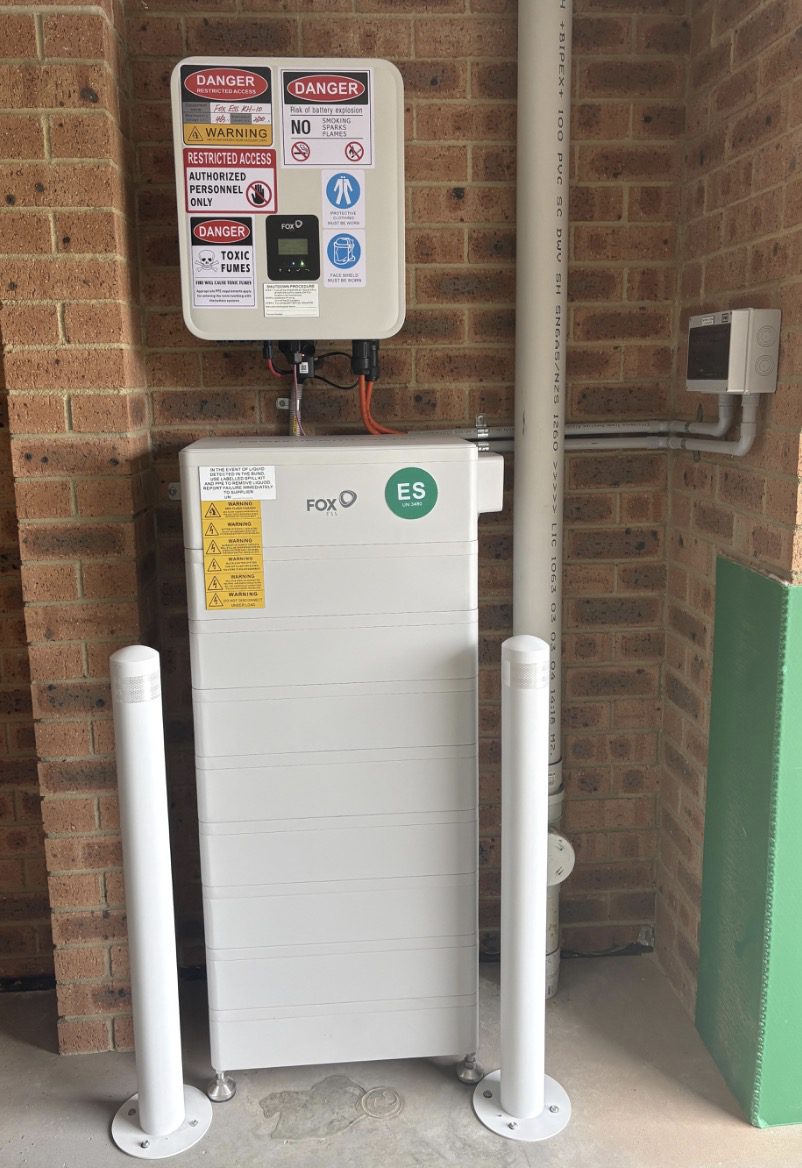
For Fox sake.
Please, Just Stick Them On The Switchboard
These two green stickers are protecting firefighters, future sparkies, and homeowners for the next 20 years. They take two minutes to walk over and stick on the switchboard. That’s all anyone is asking. Two stickers, two minutes, and every person who ever interacts with that switchboard will know what they’re dealing with before they find out the hard way.
Footnotes
- Speaking of electrolyte – there should never be a “Danger Of Electrolyte Spills” sticker on a lithium ion battery but they are everywhere. ↩
 About Finn Peacock
 RSS - Posts





I need one of these label kits for my ICE car. I mean, FFS, it’s far more hazardous than a home solar/battery install:
Authorised Personnel Only adjacent to the driver’s door handle;
Toxic Fumes by the exhaust pipe;
No Naked Flames by the fuel cap, and another under the car on the tank, just in case the mechanic is considering smoking whilst he services the vehicle;
The top of the bonnet provides plenty of real estate for a plethora of stickers warning of real dangers that lurk beneath –
Danger of Electrolyte Burns for the lead acid battery;
Several PPE warnings for face masks and the like [you never know when that fan belt might disintegrate];
Not forgetting: Keep Clear of Moving Parts, several Hot Surfaces and also Compressed Gas [I have air conditioning].
Oh wait, I almost forgot: Pinch Point by every door hinge.
Probably don’t need a Confined Space warning as my car doesn’t have a boot.
Standards Australia – fill your boots! What have I overlooked?
What about a licence for handling dangerous goods when you refuel at the petrol station?.
Is there a post for the recommended stickers required and where they should be placed. Seeing a proliferation of stickers would be mind boggling for a home in owner.
I’ve asked my installer to put all stickers apart from the ev and pv ones onto a metal sign located next to the batteries. Mainly as god the above picture is ugly! So much so, I’d imagine if decreases your property value.
Not hard to get an aluminium sign made up that these stickers can go on.
Then again… By the sound of it. A lot of installers are dodgy and so many batteries don’t even meet code, so what do you expect will happen.
I heard today that when the battery scheme came out, over 2000 new companies were listed. Where did these companies come from and why are so many declaring bankruptcy…
So where does the average home owner get replacement stickers from?
My DP sticker is still in great nick, but my ES sticker, the top layer is starting to peel up around the edges and the UN code, well there is a little box for it, but no numbers are not visible at all anymore.
Only been just on 2 years since the stickers went on, not excited at the prospect of paying for an electricians call out just to refresh the stickers when ever they fade away…
eBay: https://www.ebay.com.au/itm/336186658492
cheers Finn, never occurred to me to try fleabay!
EBay: https://www.ebay.com.au/itm/336186658492
I’ve got my ES sticker ( added to my existing PV sticker ) on the cover to my main switchboard following my battery installation in December. The battery itself is free of any sticker business. My installer seems to know whats what.
“For Fox sake”
Finn never missing an opportunity to take a swipe at Fox (Australia’s #1 battery).
I would love you to just do a blog about why you hate them so much and come clean about your opinion. Is your issue the few installers that admittedly took the micky? Or do you think they are an unsafe product (more unsafe than used EV batteries with DIY software to connect to a grid). Did they just take a swipe out of your earnings? I am sorry some of your clients overcapitalised.
p.s. love the “Assume positive intention” guideline when you LOVE to throw so much shade their way.
Hi Ben,
Being #1 cuts both ways.
When you’re successful there’s lots of data points to judge, so if you peruse any of the social media groups and look at the Fox installs, about 90% of them are roughly executed, void warranty or are simply non compliant.
Not all of them are shonks of course.
However basing success on being cheap naturally attracts the lowest class installer, and worst kind of customer too.
I don’t see why there can’t be balance with FoxESS. Installers being cowboys is a different issue to the product itself. It is a great battery that has made the market accessible to people who would never have installed a BESS. Celebrate that! Be critical when needed, but be balanced. Or maybe cast the same doom and gloom on Sigergy for their melting plugs (which was design, but mostly installers being a bit average).
If you want to improve and assist the marketplace rather than only bash I would genuinely love to see some content that is “Cheaper batteries can be okay for some” or “how to police your FoxESS installer on install day, a great battery when installed well” Should people have to? no, but for the price, get involved in positively helping!
A Mercedes EQE vs a BYD Atto 1 buyer may rightfully cop the same ‘kind of customer’ moniker but they’re different capital outlays undeserving of such ridicule.
This could be your office watershed moment to change your frame of mind!
touche’