
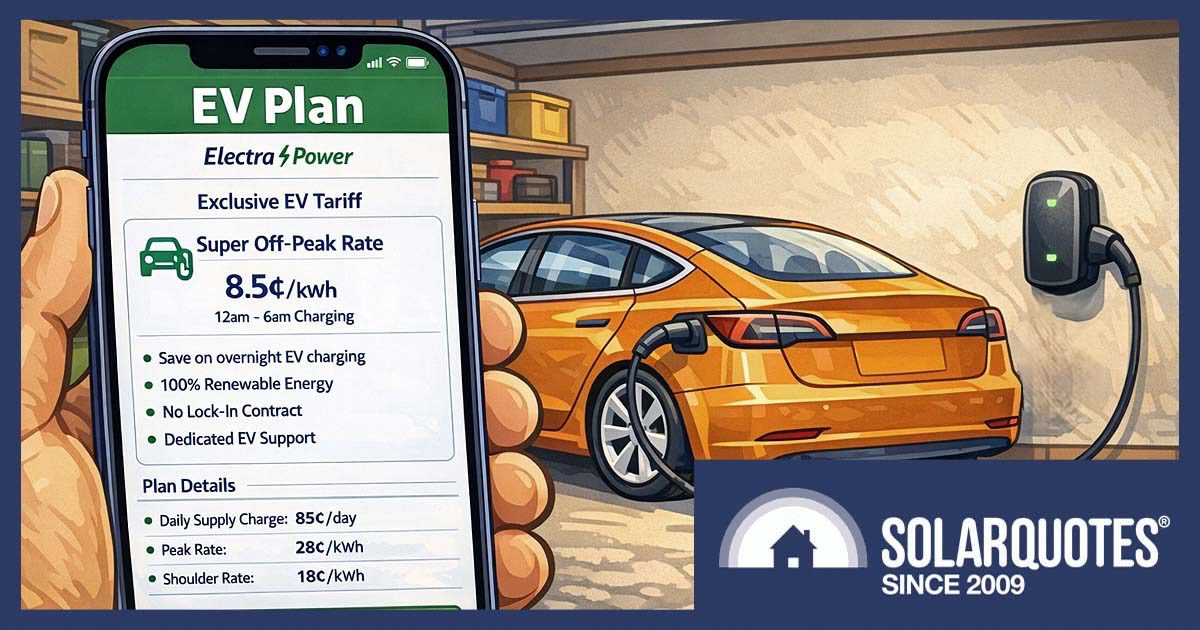
This article explains how EV-specific electricity plans work and what EV plans are currently available in Australia
EV plans are typically time-of-use tariffs marketed as EV products. They can offer very low electricity prices during a defined overnight window, but that discount is usually offset by higher prices at other times of the day.
EV Electricity Plans in Australia
The EV plan market in Australia is still evolving, with retailers testing different tariff structures and charging incentives.
The rates and time windows below focus on each plan’s lowest-cost EV charging period. This shows how each plan is structured, but doesn’t represent the full tariff — higher rates apply at other times and outcomes vary by state, network area, and meter setup. For exact details, follow the plan links for your area.
In practice, most EV plans fall into two main structures: night-based charging tariffs and alternative or managed charging options — the differences become clearer when you look at real plans.
Night Charging Plans
These are the most common EV-specific plans, offering a dedicated overnight window where electricity is significantly cheaper.
Good for: Overnight charging households
Benefit: Very low overnight rate (~4.5c/kWh, typically 12am–6am)
Watch out for: Higher peak rates
Good for: Predictable night charging
Benefit: Overnight charging credit (~10c/kWh credit during 12am–6am window)
Watch out for: Fixed window
Good for: Heavy night-time users
Benefit: Lower overnight rate (~8c/kWh, typically 12am–6am)
Watch out for: Higher peak rates
EnergyAustralia – EV Night Boost
Good for: Off-peak EV charging
Benefit: Discounted overnight rate (~10–20c/kWh equivalent, varies by network window)
Watch out for: Complex structure
Good for: Night charging users
Benefit: Lower overnight rate (~10–20c/kWh equivalent, off-peak window)
Watch out for: Peak rates
Good for: WA EV users
Benefit: Multi-period EV tariff including cheaper overnight and daytime super off-peak charging windows (~8c/kWh daytime / ~19c/kWh overnight).
Watch out for: State-specific tariff and multi-period pricing structure
Other EV Charging Plans
These use alternative structures such as daytime discounts, weekend incentives, or managed charging systems rather than a single overnight window.
Good for: Daytime charging / solar alignment
Benefit: Lower daytime rate (~10–25c/kWh equivalent, midday window)
Watch out for: Peak rates
Red Energy – EV Saver (Weekend Free Window)
Good for: Weekend charging
Benefit: Free electricity window (effectively $0/kWh during weekend period)
Watch out for: Fixed window
Good for: Managed / flexible charging households
Benefit: Smart charging with a discounted rate (~8c/kWh when charging is scheduled automatically by Origin)
Watch out for: Not a fixed tariff — charging times are controlled, and standard plan rates apply outside scheduled sessions
(Disclosure: SolarQuotes is owned by Origin Energy.)
Free Daytime Charging Offers
Some retailers include a free 3-4 hour daytime window around midday. While they are not always labelled as EV-specific plans, they can still be used for EV charging where the timing suits the household and your EV charger is fast enough to take advantage.
Are EV Plans Worth It?
EV electricity plans can save you money, but only if the pricing fits your charging routine.
Home overnight? EV plans are probably your cheapest option.
Home during the day with good solar? Smart solar charging off your excess generation will likely beat an off-peak tariff.
Home during the day but solar can’t keep up year-round? An overnight EV tariff or ‘3 free’ plan is great for cheap top-ups.
Got a home battery too? An EV tariff paired with a grid-configured charger lets you fill the car without draining the valuable kWh in your home battery.
Thinking of a home battery? An EV plan lets you buy a smaller battery because you don’t have to charge your car from your home battery.
The Bottom Line
Whether an EV tariff is for you depends on when your car is home, what generation and storage you have, and how much you actually drive. And don’t sign up for an EV tariff, without checking what happens to your daytime rates. There’s no point saving money on EV charging only to lose it powering the rest of your home.
 About Kim Wainwright
 RSS - Posts






You might wish to check your info about synergy (wa). The ev specific rate also includes a day time (9am to 3pm) reduced tariff of 8c/kwh.
Thanks for the heads up, Pamela. We’ve updated the article to better reflect the daytime super off-peak component of the Synergy tariff.
Just be aware that QLD Regional Power Prices [Ergon] involves a consultative process undertaken by the Queensland Competition Authority [QCA] that recommends the price for all classes of Tariffs fixed [which is currently the case] for each financial year.
My understanding is that it is not QCA’s intention to recommend to the State Energy Minister the introduction of a ToU Regional Tariff in which any time interval in the current day [off-peak] rate, now 11:00 am to 4:00 pm, would offer zero cost per kWh imported.
QCA publicly intends to submit the final recommendation on 5 June 2026.
Almost forgot to mention that the Queensland Competition Authority [QCA] have also published a draft recommendation for an EV Tariff
This will all change once we can get 3 hours of free electricity in the middle of the day when the Solar Sharer program commences (on 1 July 2026 in SE Qld, and some other states).
I can’t have solar and I always charge at home during the middle of the day to get the greenest electricity. I currently pay 21 cents/kWh – but on 1 July I will shift to free electricity from 11 am until 2 pm (capped at 24kWh/day).
I previously paid 8 cents/kWh to charge in the middle of the day using an EV electricity plan, and this worked very well. I only stopped using an EV Electricity Plan because I bought into the Haystacks community-owned solar farm which gives me ongoing electricity bill credits and I had change to an electricity retailer without an EV Electricity Plan (but all is good because the solar farm bill credits mean that my electricity account is always in credit).
Agree. For full-monty electric homes the economics can be attractive. The solar becomes less critical. At 11am each morning we start all the big loads — battery charging, EVs, two HWSs, dishwasher, washing machine, cooking, aircon in summer.
On a cloudy day, it can reach 80A from the grid across two-phases.
We use a lot of electricity but the grid part is all during the free hours with Globird. A little bit gets sold back to the grid in the evenings to cover the daily charges.
ENGIE – EV Flex Charge – is a 10c discount off a high, for me, 41c base rate. The big perk of EV Flex was the 12c(NSW) unlimited solar feed in, discontinued now. Still rocking a negative bill so can’t see this lasting. They would be losing money on me.
Batteries reduce consumption costs but lower the FIT, a credit that can offset the daily fixed fee. You do not have to be a genius to predict that the current pricing model, based on cost recovery built into the import tariff, will not change in order to capture distributed PV.
So the question then becomes: does the Battery’s operating system support consumption and export strategies to minimise reliance on the grid and the cost of being connected to the energy provider of last resort [continuity of power insurance].
Regional Queensland power pricing: according to QCA data, the loss of revenue attributed to the recovery of fixed costs [other than generation] for a domestic solar system is $0.19-$0.22 per kWh behind the meter consumption.
I would ask:
“Is the current recovery of cost other than generation in the existing import kWh pricing model likely to change?”
Well, the issue is that not everyone’s kWh consumption profile is exactly the same.
I am an Age Pensioner, which means my power consumption is spread across my up-and-around hours. That is not the same as someone who works 9-5 or shift work for 7.30-8.00 hours in any 24-hour period.
We could talk about automation designed to spread the load when day rates apply in a ToU Tariff for any consumption profile.
With a properly sized solar system and storage battery, the BEV charging strategy based on a ToU tariff is pretty much eliminated.
Let’s discuss whether you can salary-sacrifice the cost of power to charge a BEV provided by your employer, who chooses the most cost-effective ToU tariff based on that consumption profile.
once upon a time Qld government employees could salary sacrifice their power bills (as the power was generated by the Qld Government) . Back in the 90’s I think it was. But they changed the rules and that nice little benefit went away.
The company I worked for had staff benefits at advantageous pricing on products and services it sold retail; those benefits were eliminated on the introduction of the Fringe Benefits Tax.
I rather think that for some employers and employees, the introduction of that tax may have had unintended consequences.
First: I am not a financial specialist, & am a bit out of date. On speaking to the Novated Lease Co that was at the recent Energy Conf in Sydney, it seems the easiest way to get re-imbursed for EV charging is by a cents/Km rate (5.5c?). DC fast charging can be re-inbursed in full, but I am not sure how the 2 are differentiated. 5.5c/Km at 16Kw/100 works out to abt 34c/Kw which is probably abt correct for the av single rate acct. If one has battery & lower rates one is on a winner.
In my case, I am retired so no need to worry abt above!. How I manage my charging is I have a 15a Granny connected to the o/p of my battery, & a 7Kw single phase OCPP charger connected to the grid side. I balance my 2 vehicles between the 2 options. Most of my charging is done in the daytime off excess pv on the Granny.
Waiting till July to see what is offered as far as ´Free´ daytime period. atm I am on a ´Saver´ tariff that has a realistic rate at all time except Peak 5>8PM weeknights.
My understanding is that the ToU tariff, which has a zero-kWh cost for a three-hour interval, will not be rolled out universally across Australia.
The Origin Power Up only works for Tesla and Mercedes.
Use to work for our BMW, but BMW changed its “third party access protocols” (to make it more secure ) and it works no more.
It’s been 6 months and still not sorted out by BMW.
I liked the way it use to work. If it was windy then charging might start at 9 or 10 pm and not stop until the car was full.
Otherwise, start at midnight and stop at 6am.
Think I’ll hassle BMW ……….again !
I’ve found the AGL Night Saver EV plan pretty good for our household.
Even without a battery, but decent solar to offset all solar hours usage, we can manage (so far) the peak 13 hours TOU a day to a minimum, and without EV charging usage was down around $3 a day (with supply charge).
Not sure yet when we may get a battery, the sums for now = all ok.
The EV charging gets up into the $5 a day mark total, this is with 2 EVs, one of which normally gets the greater part of the 6 hours @ 8c level 2, while the other may get topped off by solar free during the day, or 4 or 5 hours 8c on the granny charger.
Works out to about $1.60 – $1.70 or so in power per 100km, hard to complain about that, was $200 a month for ULP with ICE Elantra.
We also have the HWS timed for the 6 hour window @ 8c, as I assume for most of these plans all power into the home in the relative cheap windows is same rate ?
What gets me though, is how / why 8c is offered 0000 – 0600, surely this must just be coal standby ?
We have a 40kWh battery which is charged up overnight (along with the car and hot water). We then use the battery for the remainder of the day.
We are with Ovo (4.7c kWh) so with round trip losses into the battery I suspect our electricity costs us around 5c kWh.
The system hasn’t run through a winter yet, so I’m not sure if the battery will make it through the day, but if it lasts from 6am to 9pm it’ll avoid most of the intermediate tariff and all of the peak tariff times.
I have solar + battery and currently charge my EV with a granny charger from excess solar at 8c/kWh as FIT revenue forgone. I have spent $345 using public chargers in the past 12 months. Some of this has been on journeys but occasionally the granny charger can’t keep up with usage during long periods of overcast weather so I stop charging when I start pulling from the grid. I then top up while enjoying a coffee at a local 22kW AC charger at 30c/kWh which is cheaper (and quicker) than the 39c/kWh grid charge.
Depending on season, my home battery will last the night or finish around midnight, mostly due to air conditioner use for heating or cooling. It seems to me I would need a 7kW charger to take full advantage of these night EV plans and maybe use some to also top up the home battery overnight. This would stop the need to use local public charging and just charge on long journeys. Time to do the sums again and thankfully my electricity provider supplies hourly usage data.
You forgot to mention looking at a flat-rate plan (yes, non-EV plans), where you are not relying on the ups and downs of charging and not charging. Flat rate plans give you the freedom to charge whenever and at much the same prices as the EV shoulder plans. These flat-rate plans would be more beneficial for shift workers, who aren’t home regularly between 12 am and 6 am, and for renters, who don’t have the advantage of using solar to charge at times.
I’m with OVO, have EV and 13.5 KWH Battery.
I ignored their EV offer, and instead went with the 3 hours free.
During that 3 hours, I top up the battery and put up to 75 Km range into the car from a 15A wall socket.
As has been pointed out before, overnight use just helps the coal fired generators, while daytime load reduces throttling of renewable generation.
One thing worth keeping in mind with overnight tarifs is FIT. My own situation, solar array, no battery and a dumb charger. At first I used to try and charge during the day using solar, but doing that efficiently is quite difficult and I would commonly find myself charging the vehicle using high premium tarifs.
Then I made the choice to switch to an overnight tarif plan – at 8c/kwh. But when I take into consideration that although I am not doing “free” solar charging, I am also not forgoing the FIT, which for me is 3.5c/kwh. So in effect I am paying 4.5c/kwh to charge the car – or about $270 a year. I just dont think it makes sense to spend money to be able to utilise the solar efficiently.
Solar and battery are a home improvement not a business opportunity. The rules that apply is the better use of capital calculation. The calculation is the aggregated cashflow not paid to purchase power divided by the capital used to purchase the assets. The magic is the cashflow value is tax free.
As you are owned by Origin it would have been prudent to state that their plan applies only to Tesla and Mercedes EVs. Too bad if you own any other brand of ev.
Hi Cesare,
Origin’s EV Power Up only supports selected Tesla and Mercedes-Benz EQ models at this stage (per their compatibility list), but it’s not a “Tesla and Merc club” in principle — it’s a defined supported vehicle list within the program. https://www.originenergy.com.au/ev-power-up/#eligibility
We don’t mention any brand restrictions for any of the plans in the article — all plans are described in general terms, with readers directed to the retailer links for full eligibility and tariff details.
The article isn’t a deep dive into fine details of all plans, otherwise it would be a constant work in progress.
I should also point out we’re literally not on Origin’s payroll. SolarQuotes is an independent business with full editorial control.
yesss, but i suspect if you are subscribing to an late night EV plan, you are helping to extend the life of coal fired power stations by buying power from them …
Regarding Engie EV Plan … quoting from their website “Plus, from 12am to 6am AEST we’ll credit back 10c per kWh of energy you use at home”.
You made it sound like you only pay 10c pkWh but in actuality you pay more (current off-peak night rate of 28c less 10c = 18c pkWh).
Thanks Mark. We’ve adjusted the wording in the article to better reflect how the ENGIE offer is structured.