
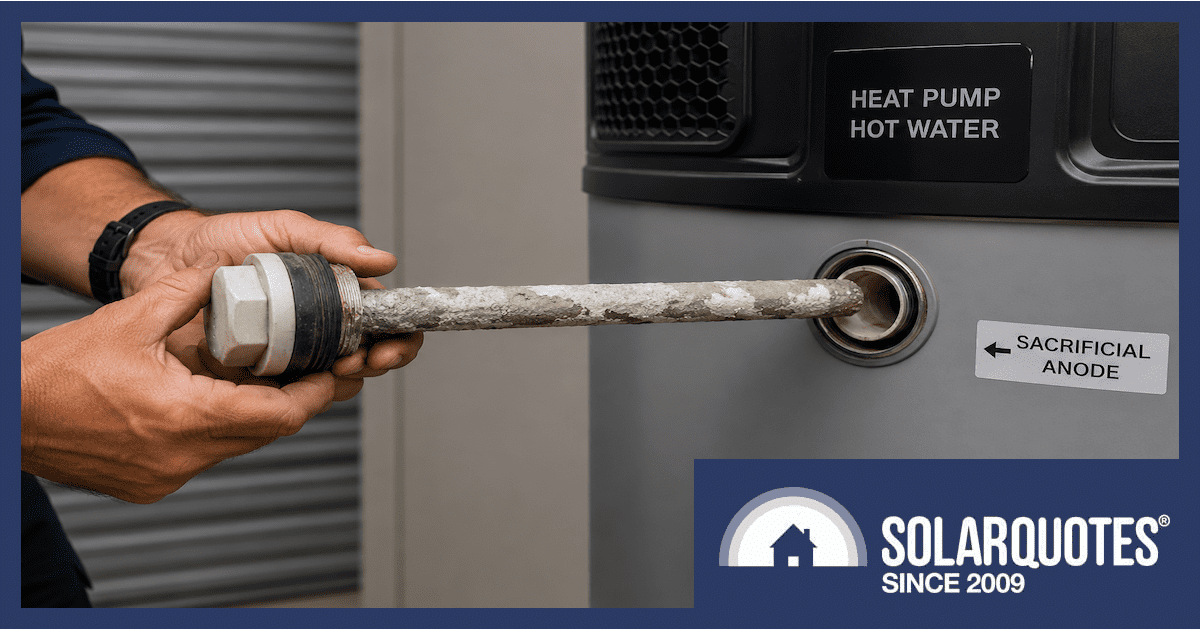
 Heat pump hot water systems are the most efficient and cheapest way to heat water for your home. Regular servicing and a few simple checks can help maximise efficiency, extend the life of the unit and protect your warranty.
A high-quality heat pump should provide many years of reliable performance with relatively minimal upkeep – but understanding your maintenance requirements is important.
General Heat Pump Hot Water Maintenance
Most heat pump hot water systems require only basic ongoing maintenance. Homeowners can often carry out some simple checks themselves, while scheduled services may be recommended every five years or so.
Keep Ventilation Areas Clear
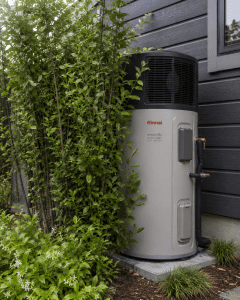
Heat pumps work by extracting heat from the surrounding air. For the system to operate efficiently, the airflow around the unit must remain unobstructed.
Leaves, dirt, cobwebs, garden growth, and stored items should be kept away from the air intake and discharge areas. Restricted airflow can reduce efficiency, increase running costs, and place unnecessary strain on the compressor.
It’s also a good idea to occasionally inspect the evaporator coil and fan area for debris build-up.
Check Drainage
Heat pumps produce condensation during operation, both from the condensate drain and the PTR drain. This water must drain away correctly.
Owners should periodically check that the condensate drain is clear and water is draining freely.
Owners should check this while the unit is operating (that is, making a noise). The unit should not drain or leak while it is not working.
Blocked drains can lead to water damage, corrosion, and in severe cases if water is not draining at all, can build up in the heat pump and cause the unit to malfunction.
Flush The Tank Periodically
Over time, sediment and mineral build-up can accumulate inside the tank, particularly in areas with harder water.
Many manufacturers recommend flushing the tank approximately every five years as part of a major service. This helps remove sediment build-up, maintain heating efficiency, improve water quality and ultimately extend the life of the system.
Some systems may require more frequent flushes depending on water quality and the tank protection method used.
PTR Valve Maintenance
One of the most-forgotten maintenance tasks on any hot water system is operating the PTR valve.
The PTR valve (Pressure & Temperature Relief valve) is designed to release pressure if the system experiences excessive temperature or pressure.
Homeowners are generally advised to operate the PTR valve every six months. Regular operation helps prevent pressure build-up and ensures the valve is functioning correctly. If pressure cannot be relieved properly, it can place significant stress on the tank over time.
Operating the PTR valve is typically a simple process:
- Carefully lift the PTR valve lever for a few seconds.
- Allow water to discharge through the drain line.
- Release the lever and ensure the valve reseats correctly.
Most hot water systems allow homeowners to perform this maintenance themselves, while others require a licensed plumber or service technician.
Owners should always follow the manufacturer’s instructions and safety recommendations, including standing back from the PTR drain to ensure they aren’t splashed with hot water.
Understanding Tank Protection
All hot water systems need to be protected from corrosion. Over time, a unit will rust and the tank will crack if it is not protected. There are three main ways a tank is protected from corrosion.
Many glass-lined tanks use a sacrificial anode.
A sacrificial anode is a metal rod designed to corrode (or “sacrifice” itself) instead of the tank. Over time, the anode gradually degrades and must eventually be replaced. We need to periodically check that the anode is still there, performing as it is supposed to.
If the anode is not replaced when required, the tank may become vulnerable to corrosion and premature failure.
- Impressed Current Anodes (eg: Aquatech)
Some systems use an impressed current anode. Rather than sacrificing metal over time, these systems use a small electrical current to protect the tank from corrosion.
Impressed current systems are often considered a more advanced solution compared to traditional sacrificial anodes and require less maintenance (and less ongoing costs!)
- Stainless Steel Tanks (eg: Reclaim stainless steel)
Stainless steel tanks provide corrosion resistance through the tank material itself.
Because they do not rely on sacrificial anodes, they generally require very little ongoing tank maintenance.
Premium stainless steel systems are often regarded as some of the lowest-maintenance heat pump options available.
Maintenance Should Be Considered Before You Buy
When comparing heat pump hot water systems, many people focus only on the upfront purchase price. However, long-term maintenance requirements can significantly impact lifetime performance and the true cost of ownership.
A cheaper system at the beginning may ultimately cost more over time if it requires more maintenance: more frequent visits from a plumber will cost more, as well as being a hassle to remember and co-ordinate. There’s also a risk of a warranty being voided if maintenance requirements are not met.
This is an important consideration that many buyers overlook.
Manufacturer Requirements
Some manufacturers allow owners to perform basic maintenance tasks themselves, such as operating the PTR valve.
Others may stipulate that maintenance must be completed by a licensed trade professional to maintain warranty coverage.
For example, some models from Emerald technically require maintenance to be performed by a licensed professional. In practice, this may mean arranging and paying for a plumber every six months simply to operate the PTR valve and document maintenance.
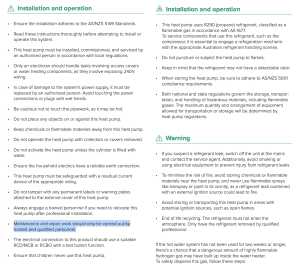
If these requirements are not followed, there is a potential risk of warranty disputes or reduced warranty coverage.
The Right Heat Pump Setup Requires Little Maintenance
A well-designed heat pump hot water system generally requires very little maintenance.
We should periodically:
- ensure airflow is clear and unobstructed
- check drains are working properly;
- operate the PTR valve every six months;
- service the unit every five years (or however often is required by the manufacturer)
Systems that use sacrificial anodes may require additional maintenance and replacement costs over time. By contrast, systems with impressed current anodes or stainless steel tanks often have lower maintenance requirements.
Top-quality systems such as those from Reclaim Energy, which use stainless steel tanks, are widely regarded as some of the lowest-maintenance heat pump hot water systems available, with very few ongoing servicing requirements beyond routine checks and periodic general servicing.
When choosing a heat pump hot water system, it’s important to consider not just the upfront price, but also the long-term maintenance obligations, servicing costs, and warranty requirements that will apply throughout the life of the unit.
For more, take a look through SolarQuotes’ hot water heat pump reviews portal to work out which system suits your needs.
 About Tim Johnston
 RSS - Posts






This opinion was clearly the work of someone intimately involved in heat pumps..Quite frankly it is EXTREMELY biased and misleading..Heat pumps are not necessarily cost-effective or reliable … they are quite complex needing several different trade skills for installation and maintenance, the complexity / maintenance cost guarantees a short lifespan, and they only ever work in a few areas.
This is quite a strong reaction to an article that simply offers hot water heat pump maintenance tips. Resistive has its merits but heat pumps are more energy efficient by quite some distance – we break down the differences here
I’ve had sufficient exposure to heat pumps to ensure that they are permanently on my blacklist. I positively detest those abortions..They have never worked properly in my present area, those I have encountered were bloody noisy, they are horribly expensive to buy and to service, and the complexity introduces a whole raft of issues including very short life which destroys cost-effectiveness. Simplicity is high on my agenda .. Where possible I avoid reliance on tradies. Given that I have an abundance of off-grid solar which I can maintain myself, a high-tech / high cost heat pump is the very last thing I need.. There are other simpler and very cost-effective ways to heat water. Others may well be in a different situation to me … they are perfectly entitled to set their own course.
I agree, resistive heaps cheaper last twice as long even much much longer if you get a cheap heat pump, these days with low fit people sending power back to the grid for peanuts efficiency isn’t as important !!
Every one to their own eh !!
Doug Young: – “I’ve had sufficient exposure to heat pumps to ensure that they are permanently on my blacklist.”
Does that include blacklisting air conditioners? Air sourced hot water heat pumps are no more complex than air sourced heat pump air cons.
Doug Young: – “They have never worked properly in my present area…”
Where’s your area? Freezing Thredbo? Charlotte’s Pass? High plateau of central Tasmania?
I’d suggest if the minimum air temperature doesn’t go below -10 °C then CO₂ (R744) refrigerant hot water heat pumps are suitable. Mine has worked for 10+ years in Lithgow. If it works in cold Lithgow then it can work in most other places in Australia (subject to water hardness limits).
D Y: – “those I have encountered were bloody noisy”
How noisy? The Sanden unit is rated at 37dB (at 1 m distance from the unit). My air con is rated at 60 dB(A).
D Y: – “There are other simpler and very cost-effective ways to heat water.”
Evidence/data?
Doug Young – “Heat pumps are not necessarily cost-effective or reliable”
Evidence/data? I’ve had a Sanden Heat Pump Hot Water System since Aug 2015. My Hot Water System certainly has been cost effective & generally reliable (apart from a cockroach rupturing a circuit board fuse, which was easily repaired). It has already paid for itself, compared with gas or resistive electric systems.
https://www.solarquotes.com.au/blog/heat-pumps-win-the-hot-water-efficiency-war/#comment-1727052
Doug Young – “they are quite complex needing several different trade skills for installation and maintenance”
Installation of my system required an electrician & plumber (water/gas) to disconnect the gas hot water unit & replace with the Sanden outdoor unit, S/S tank, piping, valves & insulation.
What trade skills for maintenance?
Doug Young – “the complexity / maintenance cost guarantees a short lifespan, and they only ever work in a few areas.”
10+ years in Lithgow.
Hi Doug,
As someone who has been using a Reclaim Energy HP HWS with the Earthworker Stainless Steel tank, I am going to say please kindly keep your misleading opinions to yourself.
There is effectively no maintenance on this unit.
As far as installation goes, you generally need a licensed plumber and a sparky to run a dedicated circuit (if one doesn’t already exist on site).
Yes, the installation requires dual trade and is complicated. But you are not installing a new HWS every year, are you?
As for the cheaper all-in-one units from the likes of Midea, Emerald, etc. you get what you pay for. These units are cheap for a reason so that a lot of scam VEU traders install a whole bunch of these in a rush job, and then disband their company so that they are free from any warranty obligations that arise. Their conduct has bought some disrepute to the industry, and some folks wrongly blame the product / technology when they should have spent more money on a decent installer.
My experience is as relevant as yours however I don’t have any financial interest in promoting heat pumps whereas you do. IMO that makes my opinion more objective than yours.
No heat pump I’ve encountered was a ‘cheap’ one … they were all supposedly high end Australian brand names
There were a number of them installed in my area (temperate rainforest) but none are still in place because they all failed to do what was experced of them.
A few others were in Brisbane and Townsville areas … none performed satisfactorily and were removed from service.
Your suggestion that heat pumps are the cheapest way to heat water is most definitely NOT correct and I am not the only one to object to your claim. There is a very significant upfront cost well in excess of resistive units, and as I pointed out earlier, there is no operating cost with an excess of solar.
Hi Doug,
Sadly I think you’ve been poisoned by the first generation of locally built heat pumps that were in fact rubbish.
I’ve spoken to plumbers & even collared a manufacturer engineer at AllEnergy conference and he admitted they were poorly developed then rushed to market, only to prove unreliable.
However the current crop of heat pumps are much better and I know of some at a fast food joint that are 15 years old and still going.
Resistive is perfectly simple and there’s great elegance to that if you have a vast solar array.
However it’s winter when the energy grid will struggle going forward so efficiency really is going to matter.
Nobody is arguing they want to keep their kerosene fridge because it’s simpler & more reliable.
Heat pump hot water should be just as reliable as your fridge if you buy the right one.
If the current crop of heat pumps and fridges are so reliable why only a few years warranty, it’d be great if they had a 10 year warranty !!
Doug Young: – “There is a very significant upfront cost well in excess of resistive units, and as I pointed out earlier, there is no operating cost with an excess of solar.”
It appears to me you have ignored the capital cost of having “excess” solar – more PV panels & a larger inverter to offset the substantial increased demand from a resistive element hot water unit compared with HPs.
You also assume everyone can have “excess” solar. I don’t have that luxury because of limited suitable roof space, & I’d suggest I’m not the only one.
You talk about hot water heat pumps being “quite complex needing several different trade skills for installation and maintenance“. I’d suggest solar PV inverters are quite complex electronic systems. I’ve had two PV inverters fail on me, with an average life of less than 5 years per unit.
The cheapest energy is the one you don’t use. Energy efficiency & reduction are more cost-effective than building new power generation.
I’ve only used Victron gear for many years and I’m.quite competent with that stuff..Panels are cheap and simple, and I have a substantial roof space. Simplicity is the order of the day for me and that includes devices I can handle without tradies. A straight solar water heater would always be my first choice, fillowed by a resistive system.. At present I have quick recovery gas that was forced on me by moronic political arrangements at the time. That will be replaced in the forseeable future by an evacuated tube system …. I will nevet have anything to do with something as complex as a heat pump while there are vastly superior alternatives. ‘Superior’ for my situation, not someone with a vested interest in flogging the things.
Doug Young: – “I will nevet have anything to do with something as complex as a heat pump while there are vastly superior alternatives.”
So you will never have anything to do with air conditioners and refrigerators/freezers then? These are heat pumps too!
Surviving without air con & refrigerators/freezers in an area that you describe as “temperate rainforest” may become increasingly problematic in the coming years/decades.
https://images.squarespace-cdn.com/content/v1/5bc6826490f904980a50659a/0105c0ea-c715-4925-97e3-c484b9e04380/HCN-FullSequence_c.gif?format=1500w
Doug Young: – “‘Superior’ for my situation, not someone with a vested interest in flogging the things.”
Why is your view apparently deemed not a vested interest, yet anyone who presents a positive heat pump hot water system experience is deemed by you as “a vested interest in flogging the things”?
It seems to me you have an ideological zealotry against heat pumps.
Geoff, Doug,
It wasn’t till I worte a few articles that each generated 100+ comment threads that I realised hot water was a deeply held religious belief… 😉
Ahh … you have experience with Rheems … that were a rebadged Dux’s …
And then *everything* was excluded from warranty.
Wouldn’t touch a Dux *anything*.
Try a decent brand.
We must not overlook directly using solar for heating hot water. Anyone coming to change from an existing grid powered resistive heating system and who has solar panels would find the cheapest option is to use their solar energy to directly heat water. A simple time switch can turn on the power to the storage tank during the middle of the day. A more refined system is to use a solar diverter that automatically diverts any excess power to the tank instead of sending it to the grid. I changed to a diverter two years ago and with 10kW of panels I have not run out of hot water – even in the wettest periods. I have not paid for grid energy to heat water since installing a diverter. Magic!
Hi Vic,
A lot of people forget they already own a cheap as chips 13kWh battery… heating water directly with solar makes 1000% more sense than using a lithium battery to run a jug element to heat water, that’s for sure.
At grid scale, heat pumps are going to be the way forward to help us meet high demand during low solar season though. You can export surplus energy and get paid in the depths of winter with any luck.
Exactly the same with me I set my diverter on solar only and it sends any electricity that would’ve went to the grid for 1 cent fit to the hot water system until the thermostat switches it off !! Even if there’s only 200 watts excess it sends that so like you only costs the 1 cent a kw i would’ve got sending it back to the grid !!
The issue with diverters is fundamental … in winter, there’s not much excess solar, because solar energy generation is half versus summer.
The $1,000 that you spend getting a diverter installed, is better put towards a heatpump HWU that uses 1/4 of the energy.
In summer, your HWU is only consuming 6-8kWh of energy, but in winter, that doubles to 12-16kWh, when solar generation halves and your demand for A/C heating increases.
A heatpump HWU only consumes 2-2.5kWh in summer and 3-4kWh in winter, leaving 12kWh of winter solar energy for everything else (heating).
I took this path in 2018, when we had a huge (at the time) 7.68kWh PV solar system on our roof. In early June 2018, we discovered that the rheem 400L electric HWU was consuming 16kWh/day average .. in the 24hrs prior to replacement it consumed 20kWh … when our PV solar system was only generating 20kWh per day (winter average). New HPHWU consumed 3.5kWh/day in winter.
Since, we’ve added 2 EVs + home battery & added AC.
Everyone’s circumstances are different I’m single and even in winter with my 10kw solar and diverter have never had to even boost yet !! The provider actually owes me over 200$ so in my case I’d be mad to pay more than twice as much for a heat pump that lasts half as long !!
I don’t have airconditioning because my house is extremely energy-wfficient and was deliberately designed to not need aircondioning. A refeigerator / freezer is mature, relatively simple technology with very long service life and not particularly expensive to service or replace. Heat pumps may use aome of the same technology but from my experience they are complex, unreliable, short lived and expensive compared with alternative water heating technologies. I can maintain all types of water heaters bar heat pumps by myself, consequently there is no value to me going that way regardless of a seller’s view of ‘efficiency’ and which simoly doesn’t work for me.
Doug Young: – “I don’t have airconditioning because my house is extremely energy-wfficient and was deliberately designed to not need aircondioning.”
Can your house tolerate 50+ °C ambient dry bulb air temperatures? Australians should brace for longer and more frequent heatwaves, with climate scientists warning that 50+ °C days are now a permanent reality.
https://www.youtube.com/watch?v=goMyuDCKS9M
Or high to potentially lethal (i.e. 25-30+ °C) wet bulb temperatures?
https://www.nature.com/articles/s41467-023-43121-5
Doug Young: – “Heat pumps may use aome of the same technology but from my experience they are complex, unreliable, short lived and expensive compared with alternative water heating technologies.”
You’ve clearly had a bad experience with a particular HPHWU, but I’d suggest this is not definitive for all HPHWUs.
You say you can’t maintain a HPHWU. What is it that you find so difficult? I don’t have any problem maintaining mine.
I wish plumbers would explain these basic maintenance schedules when a unit is installed but most do not. On this topic this is a great article.
However, “Heat pump hot water systems are the most efficient and cheapest way to heat water” is not necessarily correct. The cheapest water heating cost is the standard resistive element system that can utilise the solar power generated onsite. If this is not available then the heat pump is the cheapest to run.
EXACTLY … the OP is apparently in the heat pump business and looking for custom. One could go through a tribe of resistive water heaters before getting anywhere near the cost of a single heat pump, and from my experience the life of a resistive unit is about 4 times that of a heat pump. Who gives a rats about horrendously expensive and short lived ‘efficiency’ when there is a surplus of green electrons that would otherwise be wasted or donated to electricity industry bloodsuckers !!
While my way of expressing it may be a bit different to yours, Doug, I do agree. If you have enough spare solar capacity, a resistive system makes sense. Inexpensive, quick and cheaper install, less and less complex maintenance more able to be done by a mildy skilled layperson, cheaper parts and less labour for repairs and generally longer lasting.
I have that excess solar so that is what I am installing with switched control of heating timing.
We actually approached Tim to do some educational articles on heat pumps for us as he’s the best writer on the subject going around in our opinion. This is a pretty innocuous article educating heat pump owners on how to maintain their system to minimise the chance of problems. You are welcome to continue using resistive hot water Doug.
I often wonder why the rooftop solar siphon systems that we had for years before cheap solar electric panels became available never seem to be included in the cost comparison discussions. You still see a lot of these systems on older homes that have provided years of service only needing an occasional flick of the boost switch when you have visitors. In one of the homes I lived in we never used the boost and our energy costs were well below our neighbours. So should we still consider these systems a real option? They still require a couple of the maintenance tasks listed in the article but they were pretty easy to look after
Hi John,
I’ve installed a lot of Solahart close coupled hot water systems and found them brilliant.
Problem these days is getting the plumbing (and the plumber) up to the roof.
Technically the building has to be engineered for the weight but they never fall through the roof in reality.
I only wish they’d make one with evacuated glass tube collectors (that isn’t a chintzy low pressure imported one)
You could assembe a Solahart tank and Apricus collector but it would be expensive, like anything good.
One of my guilty pleasures is retaining an instant gas hot water unit for now. It’s a highly efficient unit, has a tiny footprint on a wall, and hasn’t missed a beat in 13 years. Zero maintenance and negligible gas bills, even with a house of 5. Of course more expensive to run than a heat pump hot water system, which we’ll get when the gas unit eventually retires. Hopefully by then the price of the latter will have come down even further.
The installing plumber plumbed in the tempering valve right over the sacrificial anode and so will require disassembly to ever check and replace. Quite dirty on myself for not realising sooner.
Sanden with a stainless steel tank since 2017. Ha twice thrown up an error of a blocked filter. Easily cleaned myself. PTR is there whatever system you have.
David
Great article, really useful information. I’m disappointed to see a negative nancy in the comments section here. Heat-pump HWS is the right choice for most people.
What can be cheaper than a 150l tank for pensioners or larger for families plus solar plus a Fronius inverter, which can be made to switch on the H/W when the production reaches 2,400W for the element?
One tip though, my builder ignored my call for a 1,800W element to the tank as there will be more lower wattage for longer.
The section on anodes overlooks some complications:
1. Some all-in-one heat pumps have multiple sacrificial anodes. iStore has 2, and some Haier models have 3! Often these are inconveniently located on the top of the tank and must be accessed through the maze of compressor, heat exchanger and fan equipment in the head of the unit.
2. Impressed current anodes in some systems such as Aquatech are often supplemented with a conventional sacrificial anode, to protect the tank during extended periods without mains power (in a holiday home perhaps, or if an external timer is used for some reason). The conventional anode still needs to be inspected and replaced if necessary every 5 years, so the maintenance costs are not reduced.
3. Stainless steel tanks can actually corrode more quickly than a glass-lined tank if the local water chemistry is unsuitable. Rheem publish “stainless steel product availability maps” showing the areas in each state where SS tank warranty is void.