
Aldi Solar is expanding, with people in Western Australia and South Australia now able to get in line. But there are plenty of red flags to be aware of before getting a solar and battery system from a discount supermarket.
Where Is Aldi Solar Available?
Aldi Solar went live in metropolitan Western Australia and South Australia on 5 August 2026, having previously been limited to the eastern seaboard and the Australian Capital Territory.
Announcing the expansion, Aldi Australia Group Director Simon Padovani-Ginies made the case for standardisation over customisation:
“If you shop with Aldi, you know what you’re going to get day in and day out. It’s a simple shopping experience with fewer options, a clean store layout and the best value in the market. And we’re making sure that we carry that through with our services, and Aldi Solar is no different..”
Here’s what’s on offer:
- 7 kW solar with a 5 kWh battery: $7,499
- 7 kW solar with a 10 kWh battery: $8,499
- 7 kW solar with a 15 kWh battery: $9,499
- 7.9 kW solar with a 20 kWh battery: $10,999
- Battery-only add-ons for existing solar owners: 15 kWh at $5,499 or 20 kWh at $6,499, both with a 6 kW hybrid inverter
There are extra installation costs on top of the advertised Aldi Solar package price:
- Fire-resistant panel (required for weatherboard or timber homes): $385
- Two-storey property surcharge: $275
- Inverter mounted more than 6 m from the switchboard: $390
- Three-phase load meter upgrade (for three-phase homes): $350
- Smart electricity meter, if you don’t already have one: no fixed price from Aldi, arranged and charged through your electricity retailer
You’ll only pay these extra charges if your property needs them. Most single-storey brick homes with single-phase power won’t have to worry about these costs.
A homeowner might end up paying for two or three of these extras ($385 + $275 + $390 = $1,050) before the work is finished, which can make the final price much higher than what the ads suggest.
This is the third time Aldi Solar has changed its pricing since the Melbourne-only trial in February 2025 and the later east-coast rollout.
Who Installs An Aldi Solar System?
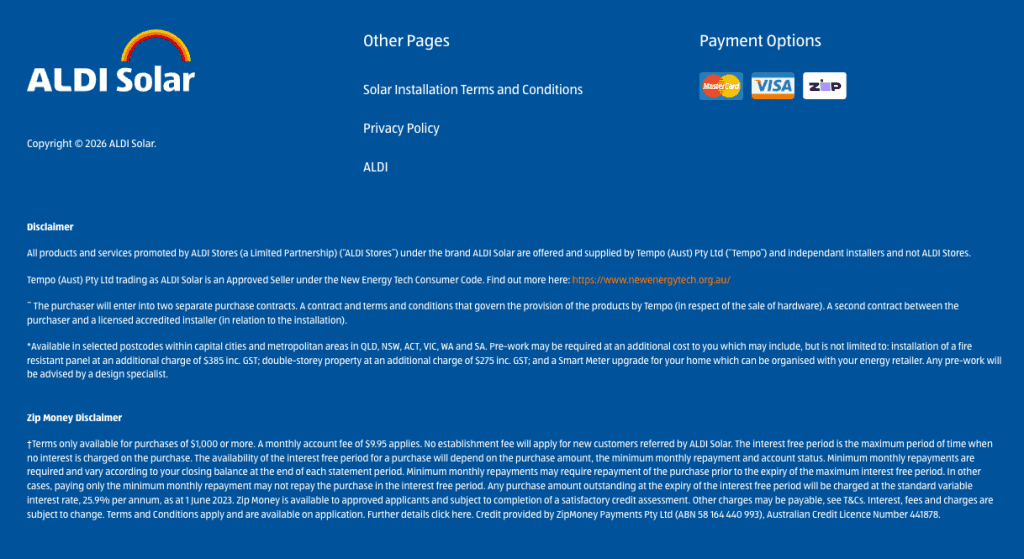
Here’s the part Aldi might prefer you skimmed: Aldi doesn’t supply or install any solar systems. It licenses its name to Tempo (Aust) Pty Ltd.
As SolarQuotes founder Finn Peacock told Choice last year:
“You are buying it from a seemingly unrelated company that is licensing the name Aldi Solar from Aldi.”
Somewhere, a marketing executive is very proud of how quietly that sentence got buried on the website, down at the bottom. Essentially, it takes the blame for a bad installation away from Aldi:
What Do Installers Say About Aldi Solar?
We spoke to someone who has done an installation job for Aldi Solar/Tempo, though they prefer to stay anonymous.
They didn’t seek out the job. Instead, someone they knew who was hired to run the solar and battery division contacted them directly – more like asking a friend for help than a company hiring a subcontractor.
Our source agreed to take the job, but claims no one trained them on the hardware beforehand. As far as they could tell, they were expected to figure it out while working on the roof.
They completed two installations, but both jobs started with the wrong materials being delivered, which made things difficult from the start. Both customers were left disappointed with extra costs. When asked about the hardware, our source didn’t hold back:
“It seemed like it was from the 1940s.”
Eventually, someone from Victoria came to help fix the problems. Our source believes they were company staff, and they didn’t seem happy to be dealing with the situation.
There’s talk of a new all-in-one system coming soon, but our source wants no part of it. A friend convinced him to take the job, but after seeing what it involved, he left and doesn’t plan to return.
We’ve also heard reports of someone associated with Aldi Solar attempting to improve standards, only to stop getting work with the company.
Terms And Conditions: The Fine Print Nobody Reads
Along with the installer’s firsthand experience above, let’s quickly look at Aldi Solar’s terms and conditions. It’s on Aldi’s website, but every clause actually ties you to Tempo, not Aldi. Some of the terms are surprisingly strict, adding layers of secrecy.
Tempo doesn’t send anyone to look at your roof before designing your system. Clause 16(c) of the terms and conditions says it plainly:
“Tempo does not conduct a site visit prior to the system design. We use satellite imagery and images provided by the customer to determine the optimal positioning for your solar products.”
Then, a few clauses later, Tempo pre-forgives itself for exactly what that approach misses. Clause 21(b) says you’re not entitled to a discount or price reduction if your system underperforms due to “obstructions on your roof,” shading “caused by trees or structures,” or panels stuck on a flat roof with no tilt. Hope the satellite catches all that.
They design it without inspecting it, then write themselves an exemption for when the design doesn’t match reality.
The installation page also promises that:
“Installers have undergone additional training on the specifics of the Aldi Solar system, ensuring consistency and high quality on every installation.”
Delivery gets the same treatment. The “Agreed Date” for your system, per clause 14, is “an intended target and not a strict deadline,” and if the stock isn’t there when it’s meant to be, Tempo says the resulting delay is “beyond our control” and carries no liability.
If your system is delivered late or the stock isn’t in, Tempo’s contract says the delay is ‘beyond our control’ and specifically rules out compensating you for any resulting loss. Don’t expect anything back for the inconvenience.
And if anything does go wrong, clause 28 caps what you can actually claim: liability limited to the price you paid, with loss of expected savings, feed-in tariff losses and “any damage to the system resulting from building defects” all specifically excluded.
Other concerns include an ambiguous 10-year warranty on the Aldi Solar homepage. It’s unclear whether the 10-year warranty is a product warranty or a workmanship warranty. The performance warranty is 25 years according to their data sheet.
A 25-year performance warranty is pretty close to standard in the solar industry. It covers the panel’s performance for 25 years. It’s frequently paired with a product warranty of about the same length that covers manufacturing defects. These days, a lot of panels have a 25-year product warranty and a 30-year performance warranty.
This screenshot of their terms and conditions does mention a product warranty, but it does not specify if it applies to solar panels. It might. It might just be for the battery or inverter. Those are also products they install. A performance warranty without an accompanying product warranty is uncomfortably ambiguous.
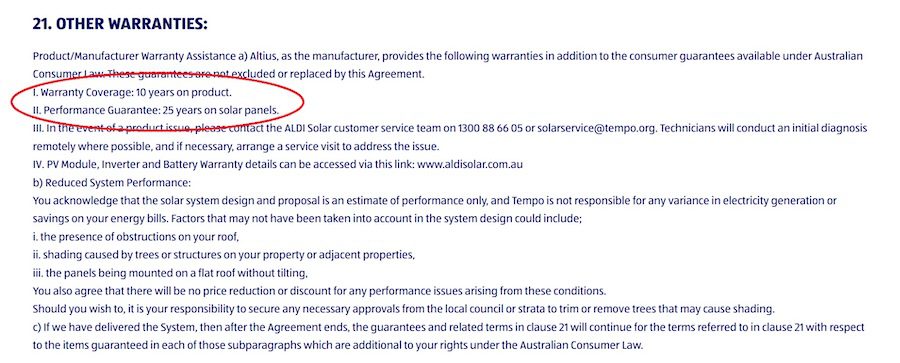
10 years on product, but which product?
One Size Fits Every Roof?
Every solar and battery system installed in Australia has been required to come with a specific documentation package, including a site inspection checklist, a system connection diagram, a declaration of compliance, and, notably, a “system performance estimate, with numbers for monthly yield.”
It’s difficult to provide a site inspection checklist when no one actually visits the site. And a yield estimate meant to reflect your roof’s real shading is only as accurate as the information used, which here is just satellite photos and what the customer mentions.
There’s a full breakdown of what’s required, and a companion piece on what to check before your installer packs up and leaves, which is worth a look too.
We asked Anthony Bennett, SolarQuotes’ in-house installer, to look over the fine print. He came back with better questions than the ones we started with:
- Does Tempo sign off on the system design itself, or just the sale?
- Is the documentation enough to meet the standard, or a watered-down version of it?
- And that “mandatory yield graph” every system is supposed to come with, the one estimating your monthly output, does it actually account for shading on your specific roof, or is it just filling in a box on a form?
Anthony summarised:
“I haven’t worked for them, but I’d be surprised if a few stock-sized systems can be made to fit so many different Australian houses.”
One Genuine Upside For Aldi Solar: Price
To be fair, the main advantage here is the price. By bundling rebates into one upfront cost, Aldi’s offer is cheaper than buying the battery and inverter separately. That’s why a company can sell solar systems through a supermarket loyalty program.
The downside is that a low price only matters if the system is installed correctly. According to our source, that’s the part that still needs improvement, no matter how good the numbers look.
Economical solar is a win for everyone, but there’s a difference between working within a budget and just buying the cheapest option.
Here’s something else that gives us pause: even though many of these systems have been installed across Australia, SolarQuotes’ review pages for Altius (ALDI Solar’s preferred brand) panels, Altius inverter, and Altius battery all show 0.0, with no customer ratings at all.
If you’ve had one installed, the internet is waiting for your review.
There haven’t been many reviews elsewhere either – on productreview.com.au, there are three reviews for Aldi Solar at the time of writing. Two are negative, in one case involving incomplete work and in the other a failure to show up for the job in the first place. There was also a positive review, however, which noted that the “system has worked well so far” aside from a “minor issue with the subcontract installer”.
Aldi Solar’s Response
We reached out to Aldi Solar and this is what they had to say:
“At Aldi, we deliver exceptional value without compromising on quality or safety. We take our ALDI Solar installation standards incredibly seriously, which is why:
- every single installer must hold a current electrical licence and SAA accreditation;
- they are formally onboarded, equipped with comprehensive Aldi Solar installation guides; and
- are required to meticulously track everything from component serial numbers to geo-tagged photos at every stage of the build.
Our quality control doesn’t stop when the installer leaves. We back our work with independent post-installation inspections by licensed electrical inspectors, auditing 100% of jobs in Victoria and 25% across all other states. Every customer receives a fully documented Owner’s Manual and a formal Certificate of Compliance.
To give our customers the best possible price, we use Pylon solar design software to generate our customer proposals. Pylon uses aerial imagery and advanced algorithms to generate solar and battery performance estimates. It is widely used across the solar industry. Our accredited installers will always verify the design and chat through any necessary adjustments on-site with the customer before any tools are even picked up.”
Pylon software using aerial imagery, with the installer verifying the design on-site “before any tools are even picked up,” is a more reassuring answer to the no-site-visit question than clause 16(c) alone gave us. A Certificate of Compliance and Owner’s Manual for every customer is a real answer on the documentation front, too.
But read the reply closely and it raises a question of its own. Independent post-installation inspections occur on 100% of jobs in Victoria and 25% elsewhere. That means three out of every four Aldi Solar customers outside Victoria, including everyone in this week’s WA and SA rollout, get no independent check at all.
And “formally onboarded,” “comprehensive installation guides,” and installers who “meticulously track” component serial numbers sit awkwardly next to what our source told us: no training before he was on the roof, and a supervisor role that existed mostly on paper. Two accounts of the same job, pointing in opposite directions. We’ll leave it to you to decide which one sounds more like the installation happening at your place.
Either way, if you’re in that 75 per cent, we’d suggest keeping your own photos handy. Just in case the audit lottery skips your postcode.
Should You Buy Solar From Aldi?
A low-cost, fixed-price system can be a good deal if it’s installed by someone who knows what they’re doing. But keep in mind, you get what you pay for. Just because you recognise the logo doesn’t guarantee quality.
Our source’s story is just one installer’s experience, not a judgment on every ALDI Solar installation. Still, a low-cost, supermarket-branded system is a major piece of electrical equipment on your home, which is often your biggest investment. It deserves more careful consideration than your weekly grocery shop.
Before signing anything:
- Know that it’s Tempo, not Aldi, supplying and installing your system, and that distinction matters more than it sounds. They will be responsible for your warranties.
- Check the individual installer’s own Solar Accreditation Australia (SAA) accreditation rather than trusting a vague company-level claim.
- Treat a fixed package as a trade-off. It’s not designed around your specific roof, usage or tariff. It is not customised to your unique energy needs and goals. That’s something a vetted installer does.
- Get at least one comparison quote from someone willing to actually inspect your property.
The original version of this article has been updated with comment and corrections from Aldi Solar.
 About Jacob Boyd
 RSS - Posts





Zero post install inspections by Aldi, they referring to DNSP/ grid operator standard inspections, to be fair they way busy already stocking grocery shelves with low budget obscurely named products.
Very much like their obscurely named Solar/ battery product/s they wrap in curated ambiguity while also low budget options.
Their value proposition they responded with in article is the stock standard minimum standards of CEC compliance while their own terms and conditions waive away one of the most crucial elements, minimum standards installation design expectations, aka avoiding performance expectations with permission of customers foolish enough to sign up to this nonsense offer.
Yeah, but they probably fit a niche in the industry. If you have a bog standard roof with no issues, and are chasing the cheapest install you can get away with, this might be the way you go – assuming you get other quotes to ensure it is indeed the cheapest available.
There are always fools who base their decision on the lowest quote, at least this might offer a better option for them than dodgy brothers fly by night advertising on facebook about “how your postcode qualifies for government rebates but that the rebate is about to disappear so act now!….”
It’s a suckers deal and they not even hiding that it is. Non brands with disclaimers on production expectation outputs. Niche is way too fancy a word for what they peddling
To be fair re the lack of reviews of the hardware, it looks like Altius is rebadged Afore New Energy hardware, with Afore having a full EIGHT reviews since 2015. 😉
https://www.solarquotes.com.au/inverters/afore-new-energy-technology-shanghai-review.html
Afore, lovely from past experience known for being for low budget not quality savvy customers so that tracks well, small wonder why they rebadged it then.
Small apology for using Afore and lovely in the same sentence…
Interestingly, the Choice website has a review of Aldi Solar – ‘Are Aldi Solar’s new deals worth it? What you need to know before buying
Solar’s best bargain or buyer beware?, Last updated: 24 Sep 2025.
Our Finn has made a contribution in that review and it is similar in its caution.
We purchased the 6.6Kw, 10.5Kw battery deal as it suited my particular needs:
1. single level house with no shading;
2. we plan a new build nearby, so will sell this house in 2-3 years, so payback is not there with the higher priced systems;
3. just came out of a townhouse with endless BodyCorp battles by techno phobes blocking us installing a system, so wanted something despite short payback window;
Experience was good. It took a long time to install, like 6mths wait. Installer was excellent with good reviews and I acknowledge this was luck as I believe Aldi were shopping around for installers – we got a good one.
Aldi (Tempo) have responded very quickly to later config changes.
System works excellently, and is a great learning experience re our demand and battery use and size. It has been a much better way to see it in action than any spreadsheet modelling was ever able to show me.
I am much more informed for our next larger more expensive system in a few years time.