
With full EVs accounting for more than one in five cars sold in July 2026, home EV chargers are selling like hot cakes.
To find out which chargers the experts trust, we asked our network of installers a simple question:
“Which EV charger would you choose for your own home?”
When the votes were tallied, Sigenergy came out on top by a massive margin.
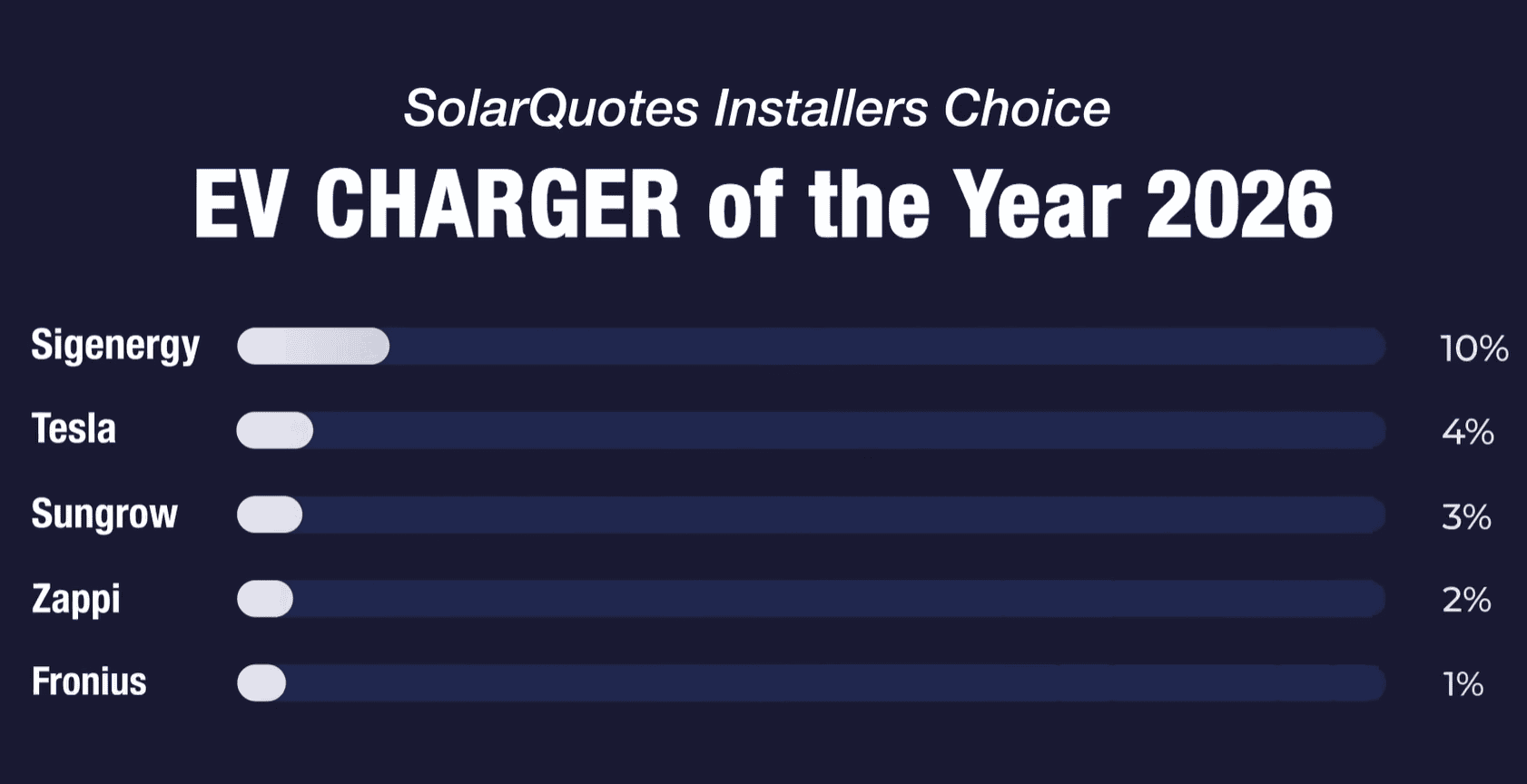
Sigenergy got 24% of installer votes, double that of runner-up Tesla’s 12%. Sungrow came third.
Sigenergy Takes Top Spot
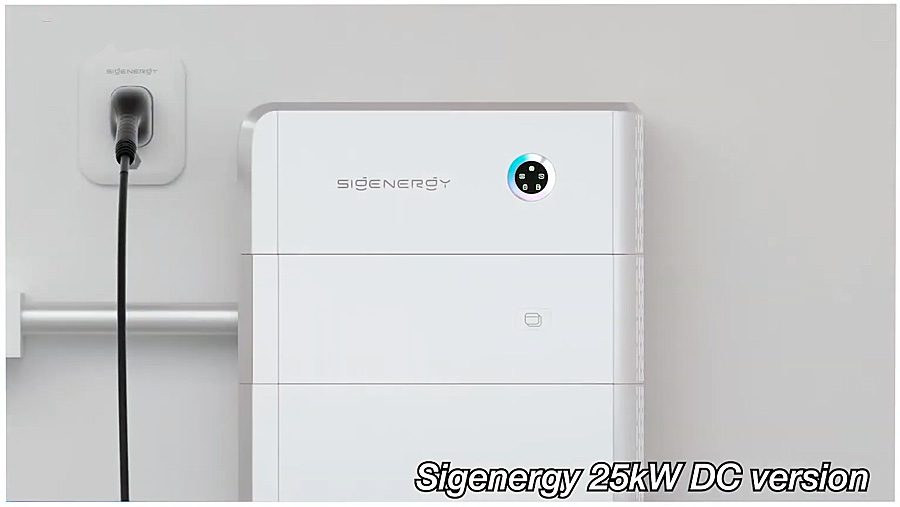
Sigenergy’s DC EV charger can be integrated directly into the modular battery and inverter stack.
Installers are telling us they’d put a Sigenergy charger on their own home, presumably integrated into the Sigenergy inverter and batteries that they also voted for.
Sigenergy’s flagship DC charger can deliver up to 25 kW of charging power. A single-phase AC charger can only charge at 7kW. Even a 3-phase AC charger with a 22 kW nameplate charging power is generally limited to 7-11kW by the car. The DC charger bypasses the car’s limited AC charger – allowing 25 kW to flow.
But it’s not just speed, the Signergy is also bi-directional – if your car supports it – so your car can power your home.
But you don’t have to fork out thousands for a DC charger if you want Sigenergy. They also offer a more conventional AC charger, and are about to release their 2nd generation AC charger, they market as “bi-directional ready”, presumably waiting for car manufacturers to come to the AC bi-directional party.
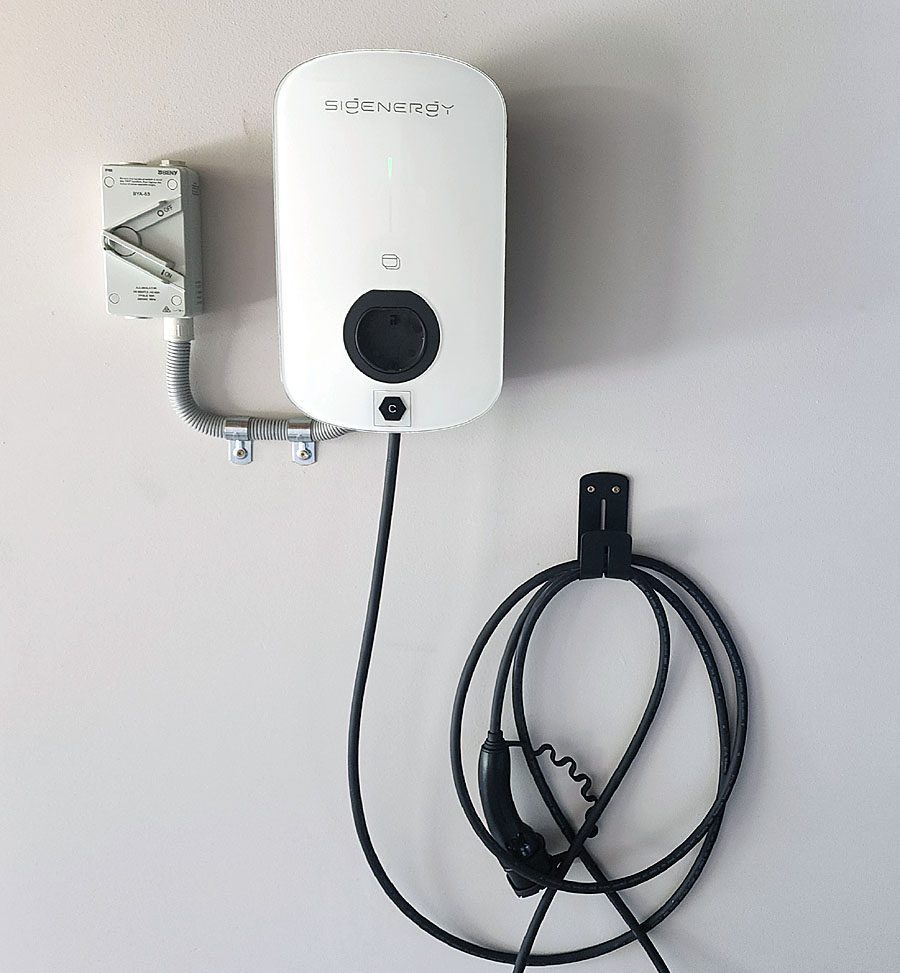
Sigenergy EV AC charger installed by Green Solar
On the flipside, some Sigenergy inverters suffered an overheating issue that led to a recall, still ongoing, which is the reason they are not currently on our recommended brands chart.
Read up on customer experiences on Sigenergy’s EV charger review page.
Tesla Takes Second Place
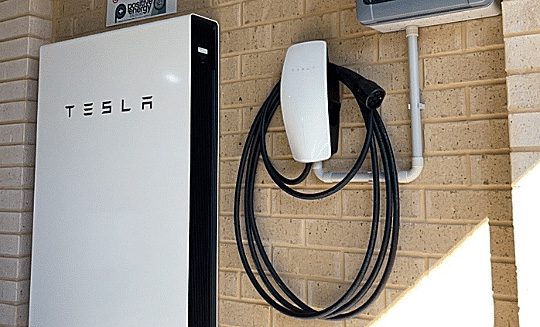
Tesla AC EV Charger installed by Positive Energy Solutions
Finishing second with 12% of the vote is Tesla.
The Tesla Wall Connector doesn’t try to be the most feature-rich charger on the market, but installers continue to value it for being reliable, straightforward and cheap.
For many households, that’s exactly what an EV charger needs to be.
Tesla’s charger is super smart – if paired with a Tesla car. Even smarter if paired with a Powerwall battery. Otherwise, don’t expect it to do more than charge your car reliably, at full power every time you plug in.
Read up on customer experiences on Tesla’s EV charger review page.
Sungrow Charges Into Third
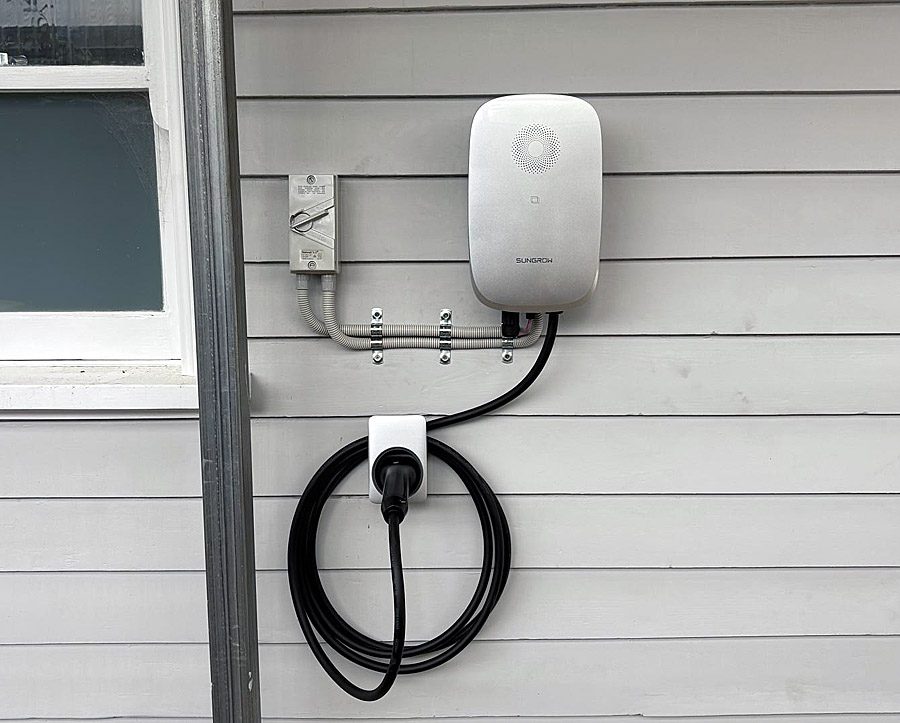
Sungrow EV charger installed by Local Energy Group
Rounding out the podium is Sungrow, who arrived very late to the EV charging party, only releasing its home AC charger this year. The good news is – it looks to be a hit with installers.
Read about customer experiences on Sungrow’s home EV charger review page.
The Best EV Charger Is The One That Talks To Your Battery
Up until July 1 2026, an important feature to look for in an EV charger was smart solar charging – that it could talk to your solar inverter and only use free, excess solar to charge. Now we have 3 free hours of power – that feature can be replaced by a timer in the car or charger settings.
The non-negotiable feature of a home EV charger in 2026 is that it talks to your home battery – ensuring it charges from free grid electricity – not your battery when the grid is free or cheap – and charges from your home battery – only when absolutely necessary.
The easiest way to do that is to buy the same brand EV charger as your battery system, which goes a long way to explaining why the EV charger podium is taken by three battery manufacturers.
I suspect the days of stand-alone EV charger manufacturers are numbered.
If you’re comparing EV charger options for your own home, SolarQuotes’ EV charger guide covers charger types, solar integration, costs and key features to consider before buying.
Stay tuned as we reveal the winner of the final Installer’s Choice category next week: Best Heat Pump Hot Water System.
Or if you’re ready to install an EV charger, SolarQuotes can help you compare up to three quotes from trusted, vetted installers who know how to design a system that suits your home and driving habits.
 About Finn Peacock
 RSS - Posts






I go with Tesla for car, battery and charger because (as your advice often says, and it seems more true all the time) integration will be the critical thing, as homes electrify. I’ve never regretted using that one ecosystem, something no other manufacturer offers, for those 3 products together (that I know of, unless maybe BYD?)
All of my fiends avoided Tesla because of the social media-driven pile-on against them. Every single one of them has now had problems, with individual products and/or integration of the products with each other. I’ve never had a single issue with the Tesla ecosystem, it just works. And improves all the time, usually with free over-the-air updates.
“All of my fiends avoided Tesla because of the social media-driven pile-on against them.”
Yes, people are definitely unable to make decisions on their own about the quality of Elon Musk. It’s all just social media driven.
Elon Musk is one person.
Tesla is a company of over 130,000 employees, many of them brilliant.
The only Western company really driving progress in some key renewable energy areas.
I will bet the people who avoid Tesla because of Musk would struggle to name one CEO of other companies they regularly buy from, or what that CEO’s views are.
”
I will bet the people who avoid Tesla because of Musk
would struggle to name one CEO of other companies they regularly buy from, or what that CEO’s views are
”
Amazon – Bezos? Yeah, I don’t want to defend him.
Temu/Shein/Ali/Wish/BYD? Oh, and Sungrow. Yeah, I buy from them.
I buy the best products for what I need. I don’t use a filter that says how much I like the different people running the company. When I was running a business I told the staff the fastest way to get fired was to confuse the interpersonal with the outcomes of the company. The world would quickly grind to a halt if we only transacted with the people we like.
“I will bet the people who avoid Tesla because of Musk would struggle to name one CEO of other companies they regularly buy from, or what that CEO’s views are.”
Doesn’t that make the point right there why you shouldn’t buy Tesla products? You know a company CEO mainly because they are really good or really bad. We know Musk because…?
His personal views that people (including me) find appalling have exactly zero connection to the mission of the company. The mission of Tesla, as a company, is superb and exactly what the world needs. It pioneered many shifts the world was in critical need of.
I’ll repeat the same question, do people go around their workplaces surveying peoples’ personal views on things, and then decide whether to work with them or not depending on their answers? How is it even relevant what Musk’s views are, unless they’re also reflected in the work his company does?
I recommend George Bernard Shaw’s Major Barbara, where the hero is a weapons manufacturer, as a healthy counter to the ‘snivelling moralism’ (Shaw’s words) in play around Musk.
So for the sake of economy should we not purchase a “smaller” house battery and purchase an EV with “power to home” (or plus grid).
While it would be more convenient to have a large house battery,.. it seems that the cost of oversize batteries is hard to justify.
While power prices may continue to rise, so it may justify the expense over time,.. at todays money it seems hard yo justify the prices being quoted vs the savings.
Perhaps solar quotes could set up a few different but typical examples costed to show the real benefits?
I cannot seem to get the numbers to justify adding batteries to my home,.. especially after putting simple timers on resistive hot water, freezers and of course using the smarts of washers, dryers, slow cookers and ovens to run on sun directly.
But when the vehicle itself can charge and run the home from solar or from cheaper mains the game might be a lot smarter,.. for both home costs and driving as combined savings.
Tim
Yes I think the idea of at least ‘right-sizing’ the battery got thrown out the window a bit with the battery rebates, and a huge number of people immediately showed the same trend we’ve seen in cars, towards ridiculous bloat. More about status than functionality, plus I think some are genuinely terrified at the idea of having to download one joule of energy from the grid.
I calculated 27 kWh for the batteries at my place, which turned out to be perfect. More than that and I’d rarely if ever fill them, especially in the winter, even with nearly 12 kW of solar. Or use the charge from them except to charge the EV as well, but with overnight cheap grid rates it doesn’t seem a great ROI.
I don’t just judge their value financially. I like the energy security they also give, with increasing disruptions to grid supply. The micro-grid has helped us several times already. I think climate chnage will make that important over time.
Interesting you presume you are the only one able to apply critical thinking skills about Elon Musk and if your friends conclusion is repeatedly different from yours, they are somehow lacking in judgement. You might want to ask yourself why they keep reaching a different conclusion to you instead.
Anyway as in investing, people can make a judgement call on a product or company for whatever reason they choose.
They all declared their reason. Musk. Nothing was hidden about it.
I’ve worked for and with many companies where the CEO and other senior staff were literal sociopaths. Many were very fine companies producing brilliant things.
If people can’t separate the personal from the professional…well, that explains a lot about our world today, for me anyway.
I’m sure if Musk were to keep his personal derangement to himself and act like a professional rather than pushing it on the rest of us then we’d be more likely to reciprocate, until then why encourage him when there are better alternatives.
It’s interesting that you can see no problem with financially supporting a literal sociopath.
That explains a lot about our world today, for me anyway.
I’m genuinely curious if people survey all the people they work with, to make sure they have political and other views they agree with, otherwise they refuse to work together.
It’s like the whole world never progresses emotionally past about Year 9 now. I saw a young couple the other day where one had ended the relationship because the other wasn’t sufficiently righteous about certain political issues.
Tesla do brilliant engineering. That’s all anybody needs to consider.
My son has a 7 kW EVNEX battery charger made in NZ to very high Standards. It is rated for outdoor installation too. His electrical contractor said it was one of the best chargers he has installed and commissioned. It has been going perfectly for 18 months now
I am on the market for an EV charger.
I don’t have any of those battery brands, so Sigenergy, Sungrow, or Fronius are out.
Tesla, as per your review is a dumb charger. With a single phase 63 amp house with batteries, I can’t afford a dumb one else I’ll suffer from regular MCB tripping while charging during free electricity hours.
Zappi is not rated for AU summer weather due to derating down 6 amps. Would you still recommend it?
Evnex comes highly recommended by SolarQuotes installers being NZ made with AU presence and office.
What battery and solar do you have? Do you charge during the day or the evening? What tariff will you be using? How many EVs do you have? Is the charger going outside or inside?
I have solaredge for solar and AlphaESS for battery.
Family will have 2 EV soon – Tesla + Zeekr
I’m on Globird ZeroHero with 11-2 pm free electricity. I may change this to an EV plan if it doesn’t work
EV charger will be in under a carport, not a garage.
I have had quite a mixed experience which ultimately taught me the installation is the most important part.
I went a full Sungrow setup for ecosystem smarts. A well know retailer in Adelaide said they could sell and install the Sungrow EV charger when we were ready at a future date.
They did a great job with the Sungrow Inverter, battery & solar upgrade.
But a year later when ready for the charger their story changed and I was forced to source it myself.
The trick with Sungrow is that they require the iHome Manager to be fitted too which cost me much more than the initial quote.
Here I found the installation wanting.
They either took the shortcut or just didn’t know where to properly place the CT clamp and such none of the smart solar features work as intended and I essentially have a ‘dumb’ charger. On a cloudy day it will take from the grid to maintain a full 7kw charge I stead of ramping up and down as required. Being told it’s software and not their install is frustrating.
Very happy with my Ohme iPod. I went with it as it had a higher temperature rating than the Zappi and worked well for me in an outside installation, also untethered so no cable clutter when not in use (cable purchase was additional cost).
Have had Evnex X22 for 3.5 years now. Going strong. Support from NZ pretty good (sometimes quick on email, sometimes slow).
Got Sigenergy battery 12 months ago. If I were getting an EV charger today I’d just go Sigenergy for simplicity/compatibility. Otherwise, happy with Evnex.
It was resolved via a firmware update years ago
https://support.myenergi.com/hc/en-gb/articles/41782331453201-Concerns-about-zappi-overheating-in-hot-environments
If you are getting ripped off with the battery purchase, you might as well getting ripped off on everything else.
I didn’t expect anything else. If sigenergy won the battery rewards, there is not point in suddenly getting an EVSE from a different brand and then loose connectivity and a whole bunch of smart options.
I would always take something that supports OCPP over anything else.
I just feel for the people that paid likely 100% too much on their whole system, just because they weren’t shown all the options on the market.
A system that cost half as much and is likely 90-95% as good (foxess) was likely never advertised by the installer.
Just a word of caution for anyone shopping for an EV charger. The Wallbox Pulsar was reviewed by Solarquotes a few years ago. If you read the reviews you will find that several of us have pointed out that, as of last year, there is no local (physical) support for Wallbox in Australia. The summary at the top of the review has not been updated with this “con”.
AC chargers are no chargers, it’s just a relay contact, and communication to set the amount of current that the EV is allowed to draw. I´m using a Solax wallmount box, one of the lowest cost available. This solax talks to the current sensor at the end of the driveway to measure the amount of export power at the meter, and adjusts the EV draw accordingly to have solar only charging.
I’m delighted with my Enphase IQ EV charger 2. I find it really customisable to suit various sunlight scenarios. It will smart charge changing with the solar production or a fully manual charge from 32A down to 6A. Designed for single and three phase household and great warranty.
Can we have a review of the Exnex Chargers please which have been recommended to me by a reputable installer?
With the LDV eDeliver 5 having V2L output of up to 6.6kW, I wonder why the above article does not refer to V2H “chargers”, or, “two-way chargers”, and, whether the 6.6kW V2L capacity can be used for V2H energy transfer.
Hi,
What is with the surface mounted conduits between inverter and charger in all the examples?
Whether it is a brick veneer or framed wall, there is no excuse for not concealing the conduits.
Was the owner even asked if they consent to agricultural surface mounted conduits despoiling the installation and marring their home?
Not good enough.
Cheers
Richard
I note that the above list of EV chargers does not include the Goodwe HCA Generation 2 charger, and, I note that the web pae at https://www.solarquotes.com.au/ev-chargers/solar/ does not include it, and, the web page at https://www.solarquotes.com.au/ev-chargers/reviews/goodwe-review.html has not been updated to include it.
See https://www.goodwe.com.au/hca-g2
However, if and when I get a BEV (if an appropriate one becomes available in WA – stocked by the retailers), I would be more inclined, for a one way (charging the vehicle and not discharging the vehicle, until discharging from the vehicle to the house, becomes available and feasible) charger, to get a 15A circuit installed, for one of these https://evse.com.au/product/mini-portable-type-2-ev-charger-15-amp-plug-10-metre/ due to the distance travelled daily and the comparative costs involved with a 7kW single phase one way charger.
I recently got a Wattpilot charger, which doesn’t appear to be capable of settings that allow full speed of charging from the Grid, without draining the battery, unless I turn off battery discharge altogether, or wire it outside the battery. That seems pointless in the current environment.