
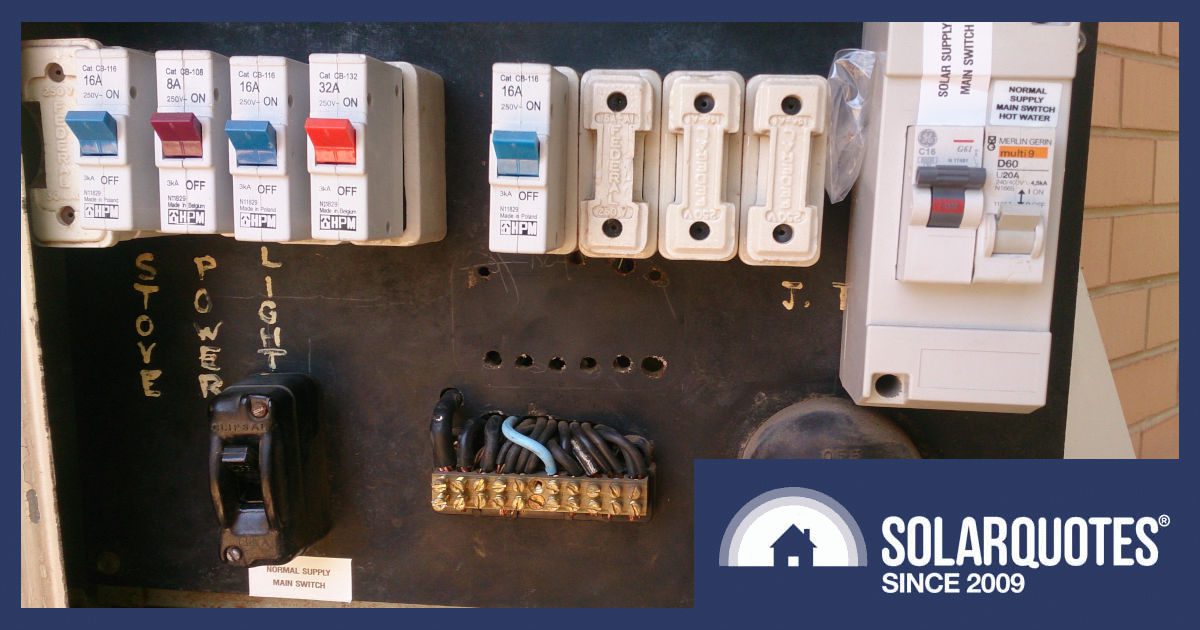
At least 11 circuits share 8 available positions in the brass neutral bar
Solar and in particular battery installation often dictates you must have a switchboard update.
Can this expose otherwise hidden issues in your house? Not always, but as night follows day, one thing can lead to another.
Safety switches save lives. As much as we might curse at them for flicking off the lights from time to time, better that than stopping your heart.
However the other heart stopper you might encounter is the bill you get, after a day of electrical fault finding which follows a switchboard rebuild.
The problems we’re explaining in this article arise when electrical upgrades expose flaws in your house wiring that weren’t evident in simpler times.
If you remember when talkback AM radio was king (before home filter taps were a thing), the adverts instead featured electrical companies spruiking capital-S Safety. The equipment was expensive and there was a market for retrofits on houses that didn’t have any. It was a pretty simple job to add a single safety switch which covered the entire* house.
Except The Lights*
For years electricians would leave the lights out of the safety switch circuit, and it was legal to do so. The reasoning was simple enough, lights were usually out of reach1 but because they’re fitted to the ceiling or eaves, they’re prone to getting wet.
It doesn’t take much to trip an RCD, so if your outdoor light gets damp in a rainstorm, you don’t want the entire house to go dark. Worse still you don’t want a pool of possum piss making your downlights damp… and the freezer thawing out because the safety switch won’t reset.
Batteries Dictate Updates
The last update of the AS/NZS3000 wiring rules changed the type of safety switches we have to use. Any modification to the supply means downstream circuits must be made compliant, so whatever wiring is connected to your new battery supply needs to have the latest type A protective devices, which supersede the type AC your switchboard is likely full of already.
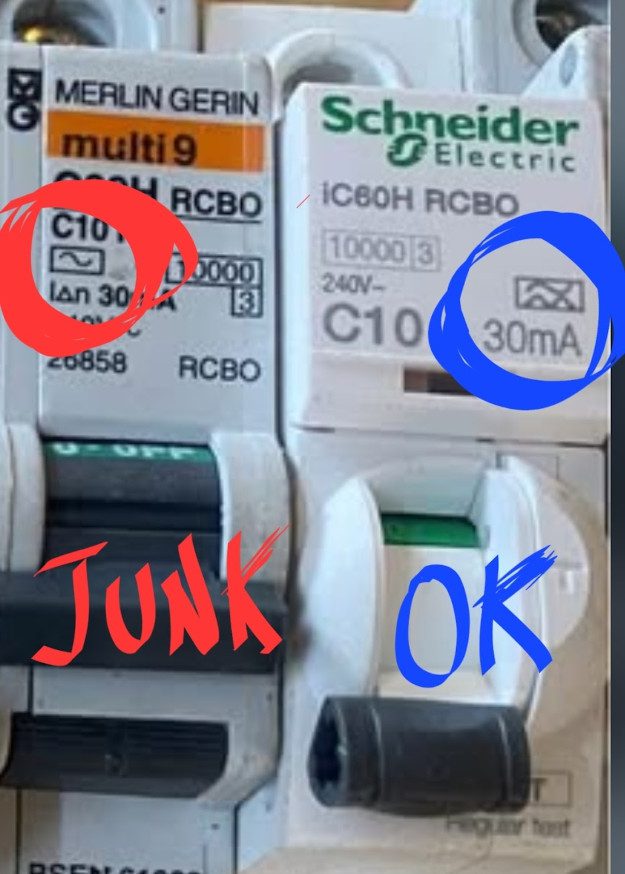
If your installer requests pictures of the switchboard, the images must be good quality. If they can’t read these symbols, the quote could be $2000 off the mark.
Why The Change?
As batteries have proliferated through modern life, in power tools, bikes and an ever-increasing number of cordless appliances, the need to charge them means we have a lot more DC power supplies plugged in everywhere. They’re not inherently dangerous, but they do bring some risk.
If there’s a fault in the equipment, there could be DC electricity injected into the AC supply. The problem is that older safety switches are blind to DC, so they won’t trip if DC current is leaking out of the circuit and into your body.
In classic electrical industry fashion, these things are confusingly named. Though the words type A or type AC aren’t used on the hardware, if you look in your switchboard there are symbols that denote the difference.
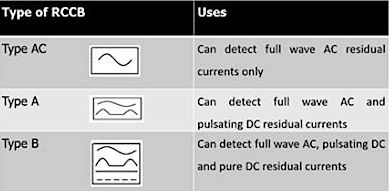
Type B are the ones used for EV charging, often built into the EVSE box itself.
The Core Problem
A safety switch uses a transformer core to measure what’s going out on the (red/brown) active wire, which is in balance with what returns on the (black/blue) neutral wire. In your switchboard, all the loads are divided up with circuit breakers on the active supply to protect the wiring, but every circuit comes back to a common neutral busbar, so when the whole house is on one safety switch, there’s no problem.
However if you have more than one, two or three safety switches, there is a neutral connection for each one. In modern switchboards, RCBOs give you a safety switch for every single circuit.
In decades past, electricians would wire up houses or modify existing circuits, knowing everything was going back to one common neutral bar.
When the next trade divides all the outgoing circuits from the switchboard to have their own neutral, they might find there are circuits which share a neutral wire, and this causes the safety switch to trip every single time a particular light or power point is used.
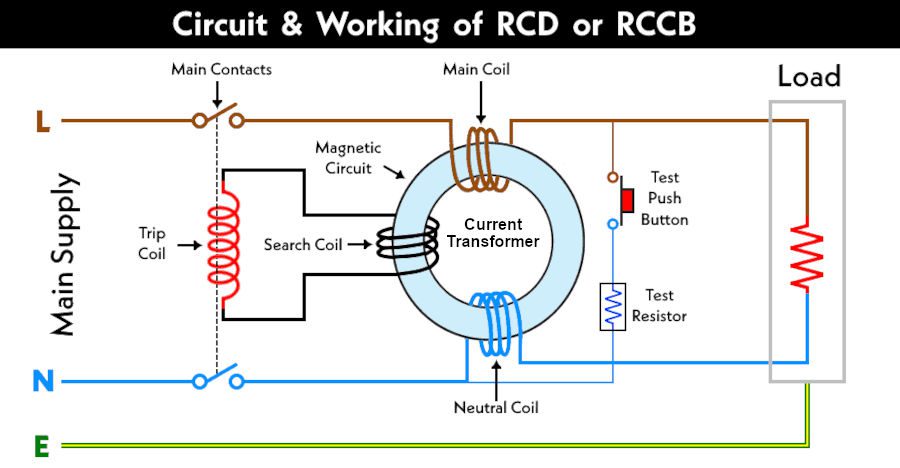
Current flowing through the line and back along the neutral is normally balanced. When electricity “leaks” out of the functional circuit and disappears down the earth wire, the imbalance energises the search coil & trips the RCD.
Crossed Neutral Curse
In this example, our company’s youngest electrician rebuilt a whole switchboard in a dental surgery, which at some point in its 150-year (?) life had been two separate tenancies. Late in the afternoon he found the two outgoing light circuits would trip, but the day was waning and the surgery had to open tomorrow.
People have different skill sets, not all electricians are great fault finders, however training as an auto electrician is a masterclass methodical problem solving. So a week later I got the short straw to scrabble around in the roof looking for the problems I didn’t make. I’ve done this a few times but it’s often hot, dirty work which requires you to root through the roof like the rats have before you.
Crossed neutrals certainly aren’t restricted to lighting, they’re equally a problem in power circuits. In some instances it can be simpler, faster and cheaper to rewire a problem circuit instead of painstakingly searching every cable, switch, junction box and light fitting.
North Versus South
Switching breakers on/off I found the building was divided up the middle, with lights grouped on each side. Thankfully, there was no connection to the general power circuits, compressor, vacuum pump, X-ray machine, etc., etc.
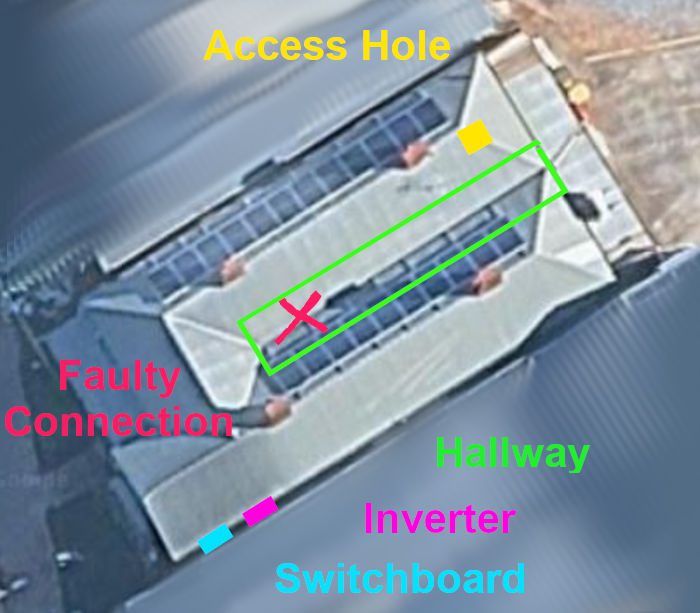
It was a long trip, scrabble through the roof, down the ladder, along the hall and out through the front door to get to the switchboard, check a breaker and return.
However the central hallway had switches on both sides and light fittings right under a box gutter in the middle of the roof. Knowing that there would be a neutral jumped from one side to the other, somewhere, I began taking lights off the ceiling and switches off the door frames.
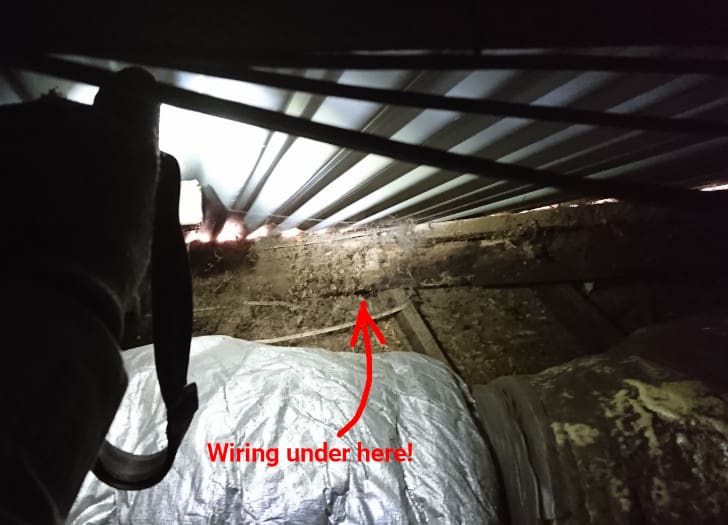
Climb over that duct, don’t wreck it, but find some wiring under the filth if you can.
Sometimes you have to partially disconnect wiring, or try to pull enough slack to measure a single conductor with an inductive clamp ammeter, and if you don’t have an apprentice with a walky-talkie, it means a lot of walky walky, going to and from the switchboard after every single change.
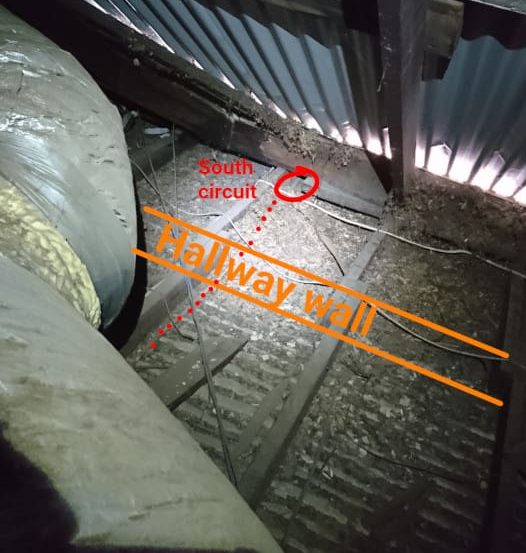
So part of the problem is working out where you are in the roof in relation to the walls and the existing wiring, especially when the hallway lights fittings are right under the box gutter.
Solutions Sound Simple
You just have to find somewhere, sometime in the past, somebody connected a neutral wire. For example, the 3 hallway lights and 3-way switching might share a wire with the back door light, which is now incorporated into the rumpus room and supplied from another portion of the house.
The fine idea of separating outside lights and dividing the house for greater redundancy can suddenly be a maddening adventure I assure you, especially when you peel off a roof sheet to find non-compliant wiring strewn around, which needs more attention.
The upshot is probably one of three options.
- Leave all the lights on one circuit protected by one RCBO
- Rewire various light circuits, eliminating the spurious connection in the process
- Disconnect some wiring and do your rumpus activities in the dark
The fundamental point is this: every circuit in your house needs to have its own return circuit. These days neutral wires can’t be shared, and as an electrician, I can’t legally leave a circuit without protecting it with a safety switch.
While your legacy wiring might be legal because it was installed under old standards, battery systems trigger requirements that a less-than-ethical solar retailer might gloss over.
When getting quotes for a battery-backed solar system, make sure the upgrades you’ll need are documented and check the fine print on the contract to understand who’s liable if the upgrades go sideways. There might be 5 hours labour quoted for a switchboard rebuild and that can double when you need to search out a crossed neutral.
Thinking of adding a battery to your solar setup? Read more in our detailed guide to solar batteries.
Footnotes
- Out of reach is a technical definition from AS3000 where things are considered safe from interference by the end user simply because you need a ladder to get to them ↩
 About Anthony Bennett
 RSS - Posts





I had exactly this issue when my battery was installed. My issue was one I personally had created. 2 story house, 2 lighting circuits upstairs and downstairs, however the stairwell had 2 way switching 1 upstairs and the other downstairs. So is the downstairs switch downstairs from a wiring perspective or upstairs? It all depends on where the neutrals come from. People who know will say, how did this cause an issue a 2 way switch switches 2 alternate actives, and so it does until replaced with smart switches where they draw small currents always… I cheated and used a downstairs neutral for an upstairs active…. As soon as the sparky swapped the safety’s and turned the Upstairs brkr on and then the downstairs which immediately switched both off I knew what I’d done. I had it fixed in minutes and the sparky looked at me like I was a child prodigy… He envisaged hours of fault-finding…but I knew what I’d done…
In fact the reason why there were 2 seperate lighting circuits relates to realities of old filament light bulbs. Today I could have every single light in the house on 24×7 and never get withing cooee of meeting a single lighting circuits capacity given every light in the house is LED. Back then there were too many filament bulbs drawing huge currents by comparison hence the need for 2 seperate lighting circuits. Arguably combining the 2 into 1, would be more practical but I suspect not within standards becourse somewhere there’s still a box of old filament bulbs just waiting for some old dear to swap out their failed LED bulb…
Hi Andy,
I take your point but it’s more about redundancy in a lot of cases.
Separating the essential lights inside the house from the outside ones more likely to give trouble.
In some instances I wire the bathroom for it’s own dedicated light circuit, partly to handle load from heat lamps but mainly because there maybe no windows, and trying to dry yourself in the dark is treacherous.
Looks like you’ve seen it all, Anthony.
That’s the situation here, bathroom in the middle of the house, no windows.
To avoid having to turn on bright lights in the middle of the night, I have a little Aldi night-light plugged into a GPO. That covers any sudden loss of lights too.
The 1 kW of heat lamps are on now, dumping a little excess solar energy into the floor slab – just on 11 kW going into the BEV, HWS, aircon, heat lamps.
I’d drawn a skylight on the building plans, but it had to be (costlier) BAL19, and would have lost heat in winter. Solar + battery makes any lights equivalent to a “solar skylight”, the marketed separate solar panel and LED light kit which can replace a heat-leaking skylight.
There’s a skylight in the bathroom in the old house. In the old days it was startling to find the room brightly lit on a fullmoon night, after the generator had stopped, and the rest of the house was dark. (Usually 10 p.m.) But that’s all solar powered too, now. Yes, new switchboard.
About a year ago setting up our blackout protection the sparky was working on our battery & his apprentice was working on the power board. The apprentice connected a live wire to neutral and shorted out the whole circuit. Killing our French door fridge, in built microwave, inbuilt dishwasher, reticulation controller, Google home display, our tv antenna booster causing $8,000 damage instantly. We were lucky, we were dealing with a reputable well known company and everything was paid for without delay. Accidents can occur but I wonder how many smaller installers would have mucked us around with insurance etc.
Yes – our house, built in about 1972, had this exact problem when the switchboard was all updated to include RCDs.
There was two way switching for stairs and switching the stair light on top or bottom would trip one circuit and then the other as soon as you flip the switch again.
Getting access and solving the problem completely would have been a real nightmare, just not worth the hassle.
The easy fix at the switchboard was to put all lights on one circuit. No redundancy if there’s a problem, but that’s never happened in over twenty years. (All our lights are now energy efficient and there is no possible way the circuit could ever be overloaded, unlike the old days of incandescent bulbs.)
I often wonder if people are better off getting switchboard upgrades down separately to other work.
When it’s as part of some other installation activity, it becomes the secondary job that is being done.
Which often means not enough time has been set aside for solving problems. As the article states crossed neutrals can be a pain in the arse to solve, even with decent fault finding skills.
Phantom trips of safety switches can be a pain and sometimes is down to equipment attached creating issues.
I have a bunch of smart lights in my house, a combination of bulbs and switches. Before I replaced the old RCD with RCBOs, getting the RCD to reset after a trip could be tricky. Often needing all the light switches to be turned off.
Nothing faulty with the gear, it was all from reputable companies, just induced some odd currents on aggregate.
we had “fun” recently we have a 3 phase supply.
after we had solar installed including a a new main switchboard.
and a new weatherproof outlet wired in.
plug anything into that outlet it wpuld trip the rcd.
plug same item into any other outlet no problem
all they could find was a phase to neutral fualt. “its in the cable under ground somwhere dunno where”said the sparky.
so 12 grand and change later we now have 10mm2 instead of 6mm cables to feed front shed and have extended a32amp supply to the back shed for lights and power.
what gets me is the old supply never tripped the main rcd in the meter box. it was only after the new weather proof was wired in that we had issues.
A supply to a shed is typically not RCD protected, the subcircuits at the shed are. I’m guessing the sparky threw a RCD on the supply as the subcircuits were not protected to make it compliant cheaply.
While the cable is likely to have failed allowed insulation values if tested they can last years with low order faults with only a MCB or fuse protection.
While they are a great invention RCD’s have brought me much pain over the years during upgrades.
Staring at switchboards – wired in continuous steel conduit with dozens of circuits with crossed neutrals quite literally cost me 2 years on 1 project.
What used to get done on some industrial sites makes a house look like the TAFE training board.
Dear Darren,
Steel conduit sounds like a fuel refinery or flour mill. I feel your pain.
Not as much as Curley:
https://youtu.be/3qb5Is1Z1rk?si=5SPoH7AErqTVpZWU&t=166
You can’t beat my favourite Three Stooges episode ‘A Plumbing We Will Go’ for learning the ins and out from the days of steel pipe plumbing and steel conduits for mains wiring.
I’m on single phase and had to have my switchboard upgraded – cost $1320.00 – before the Sigenstor was installed. I knew the switchboard work and $’s cost needed doing, it all part of the home battery adventure and happy with it all.
I have 3 phase & after installation of my 19.2kW battery our state electrical authority inspected our system & upgrade. The electrical inspector identified several issues with the work and any work completed work including blackout protection circuits had to comply to state regulations. Our meter box was rebuilt & upgraded circuit breakers installed to all circuits running the pv & electrical storage circuits all of the required upgrades were at the installer’s cost & the work was prioritised for instant compliance. We had 3 electricians at our residence until 8 30 at night & Western Power scheduled a follow-up inspection & extra remedial work before certification of our installation. No additional costs were charged to us.