

In the ongoing fight for saving money on energy bills, there is a sneaky charge that energy retailers pass on to homeowners: a demand tariff.
A demand tariff bills you for your single busiest half-hour of grid usage during a peak evening window. Then they charge you for that figure every day of the month. That’s in addition to your regular electricity use. For most households, it’s a bad deal.
We’re going to cover:
- How demand tariffs work.
- Why they rarely suit households.
- Which networks still use them.
- How to check your bill.
What Is A Demand Tariff?
Most electricity plans charge you for energy: the kilowatt-hours (kWh) you use. A demand tariff adds a second charge for power: how much you use from the grid at one time. That’s measured in kilowatts (kW). If those two terms seem to blur together, our power vs energy explainer will sort it out for you.
Your smart meter logs your usage in 30-minute blocks. Within the peak demand window (late afternoon into the evening), your retailer looks for your busiest half-hour.
This is where the demand tariff comes in. It measures the busiest half-hour of power in kW and applies that as an additional charge to your energy bill.
After your energy retailer has the figure for any power usage peaks, they then apply that number to every day of the month. That’s how one bad half-hour turns into 31 days of higher charges.
The 30-minute averaging is important. Ausgrid uses the hair dryer as its example: plenty of watts, but it’s switched off so quickly that it barely affects the half-hour average.
Long, heavy loads are the problem. A hair dryer uses plenty of watts, and won’t hurt you much. But an EV charger will.
A typical single-phase home EV charger runs at about 7 kW, and it will happily run for the full half-hour and beyond. Ducted air conditioning, an oven, and a clothes dryer all running through the evening can add up quickly.
So why would anyone sign up for a plan with this tariff? A lot of customers don’t know they’re on one.
SolarQuotes author and fact-checker Ronald Brakels has been warning readers off residential demand tariffs since 2016. His view hasn’t softened.
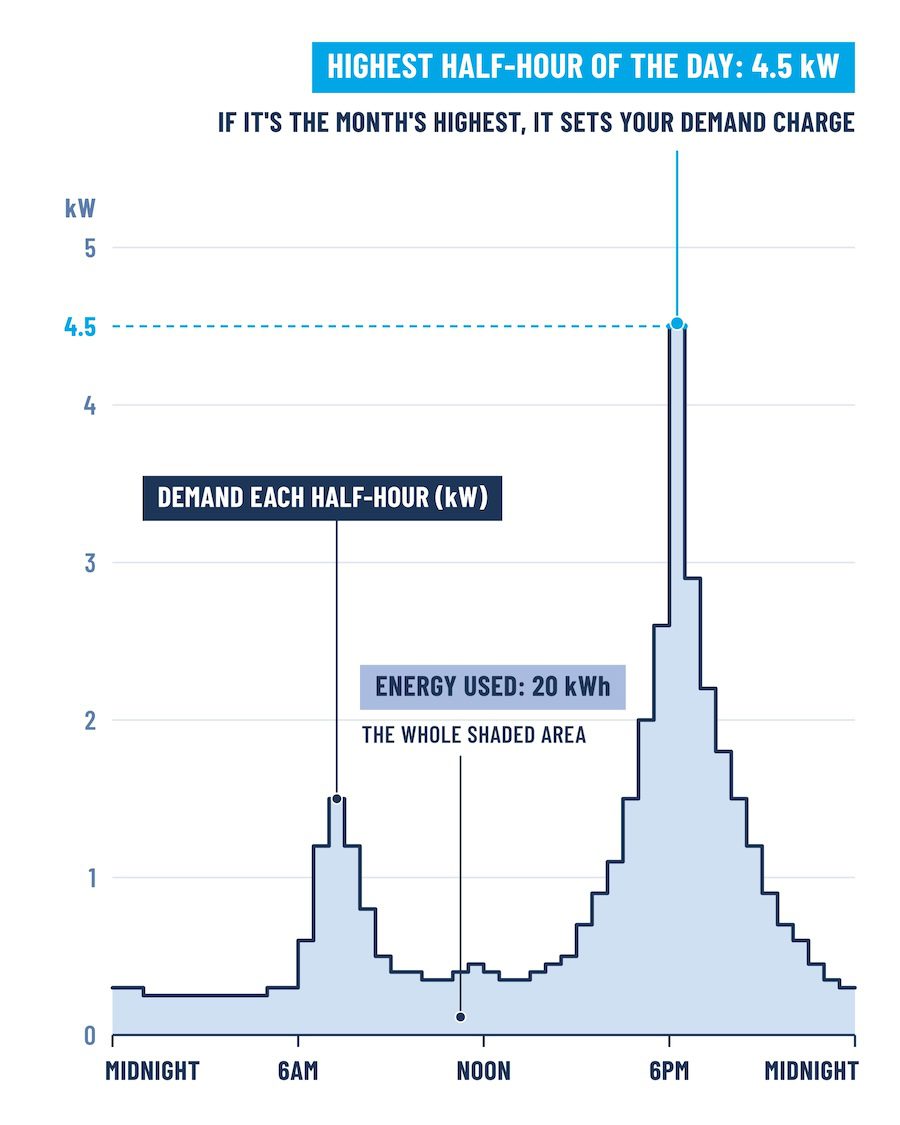
kW measures how hard you draw power at once; kWh measures how much you use in total. A demand tariff charges on your highest half-hour.
Demand Charges Are A Bad Deal For Most Homes
A heatwave, a houseful of guests, or an EV plugged in at the wrong moment can lock in your demand charge early in the month. Nothing you do for the rest of the month will bring it back down. One half-hour determines the whole month.
The Distribution Network Service Providers (DNSPs) justify demand charges by pointing out that evening peaks strain the grid. To be fair to the networks, they have a point. Bigger evening peaks mean more grid usage. Additionally, the grid comes under real pressure more and more often these days, with home electrification moving forward.
However, a demand charge measures your household’s peak, not the network’s.
Swapping gas and petrol for electric appliances and an EV puts more of your life through the meter. The biggest electric loads, like EV charging, ducted heating and cooling, and cooking, are exactly the ones a demand tariff penalises.
Which Networks Use And Default To Demand Tariffs
Your local electricity network, the business that runs the power lines in your street, charges your energy retailer a network tariff. Sometimes, that charge gets passed on to you.
This is where things stand with energy networks across Australia.
| State | Network | Residential demand tariff? | Network default for new connections and meter upgrades |
|---|---|---|---|
| NSW | Ausgrid | Yes | Demand |
| NSW | Endeavour Energy | Yes | Time-of-use |
| NSW | Essential Energy | Yes, opt-in | Time-of-use (“Sun Soaker”) |
| ACT | Evoenergy | Yes | Demand |
| Qld | Energex | Yes, opt-in | Time-of-use |
| Qld | Ergon | Yes | Time-of-use |
| Vic | AusNet | Closed 1 July 2026 | Time-of-use |
| Vic | CitiPower | Closed 1 July 2026 | Time-of-use |
| Vic | Jemena | Closed 1 July 2026 | Time-of-use |
| Vic | Powercor | Closed 1 July 2026 | Time-of-use |
| Vic | United Energy | Closed 1 July 2026 | Time-of-use |
| SA | SA Power Networks | No | Time-of-use or Single-rate depending on meter |
| Tas | TasNetworks | Yes, opt-in | Time-of-use |
| WA | Synergy / Horizon Power (regulated retailers) | No | n/a |
| NT | Jacana Energy (regulated retailer) | No | n/a |
These are network tariffs. Your retailer decides how they show up in the plan you pay for.
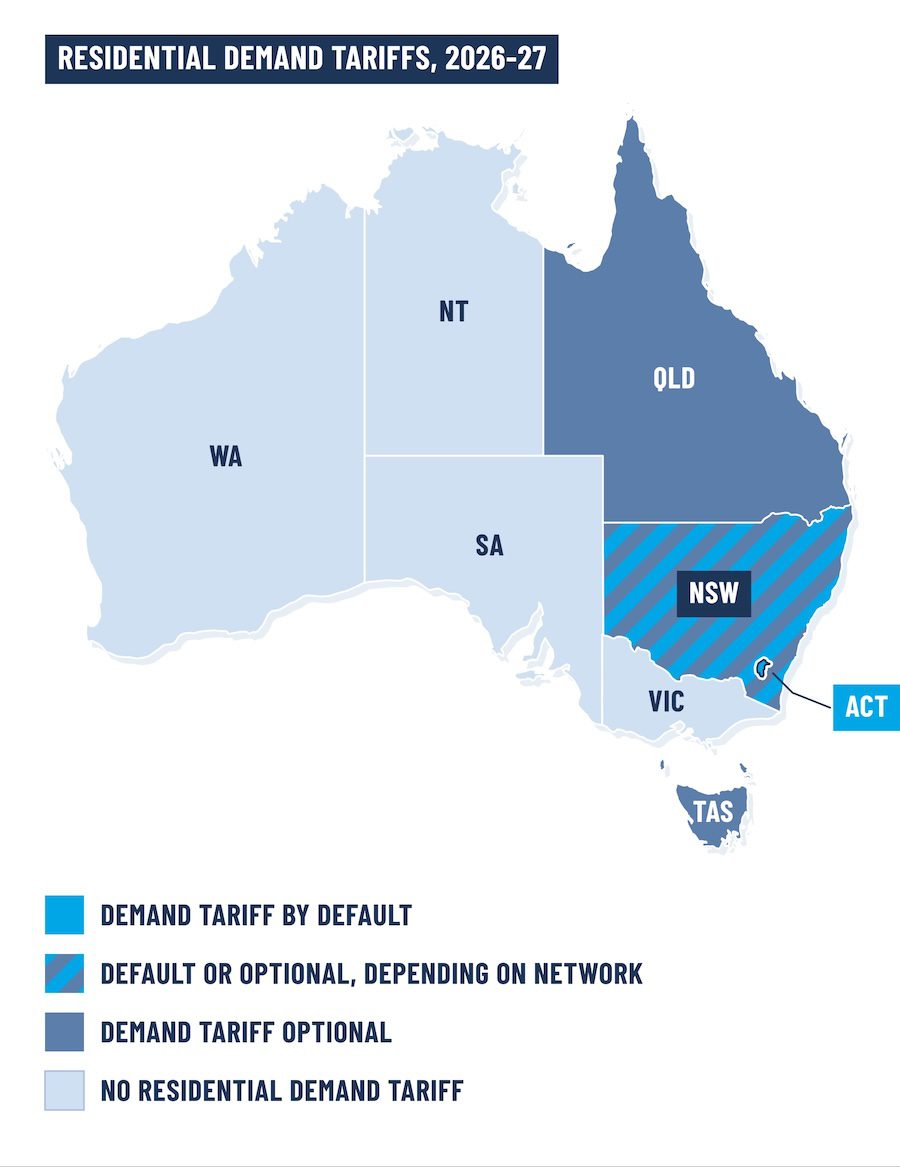
In NSW it depends on your network: Ausgrid makes demand the default, while Endeavour Energy and Essential Energy offer it as an option. Victoria’s networks closed their residential demand tariffs on 1 July 2026.
How To Check Your Bill For A Demand Tariff
Grab your latest bill and run through these checks:
- Look for anything that says “demand.” It might say “demand charge,” “network demand,” or “peak demand.”
- Look for kW instead of kWh. Retailers bill usage per kWh. Any rate charged per kW, whether per day or per month, is a demand charge.
- Read your plan’s fact sheet. Retailers publish a Basic Plan Information Document (BPID) for every plan, and you can look yours up on the government’s Energy Made Easy site.
- Check your app. Your retailer’s app or website might have this, including your peak-window demand.
- Still not sure? Ask them. Call your retailer and ask: “Does my plan have a demand charge?”
What About Free Daytime Power?
Free hours could change the case for a demand tariff. The Solar Sharer Offer gives smart meter households in NSW, SA, and South East Queensland 3 free hours of grid power every day. Victoria has a similar plan as well.
A home battery (if you have one) could fill up at midday for nothing, then carry the house through the evening. If you’re keen on this approach, start with Ronald’s real-world example for his sister and his follow-up on the best battery size for Solar Sharer.
To make the most of free or cheap hours, shift your big daytime-friendly loads into the free window whenever possible. That means EV charging, hot water on a timer, the dishwasher, the pool pump, and battery top-ups.
Check the whole plan, though. Free hours get paid for somewhere.
A solar with a battery reduces the risk, but even with these systems you can still get caught out in a few ways:
- Too many cloudy days. A day or two of grey skies for your solar system can leave the battery too empty, as Ronald pointed out in 2021.
- A virtual power plant (VPP) empties it. If your battery is in a VPP, a grid event can drain it right before you need it.
- The house needs more than the battery can output. A battery can only discharge so fast. If your load exceeds its output, the grid makes up the difference, and your retailer records it.
- Breakdowns and maintenance. A fault can take the battery offline when you need it.
- Ordinary life. Visitors, a heatwave, or an EV schedule someone changed.
What To Do Next
You can avoid a demand tariff if you do the following:
- Check your bill today. Look for any charge measured in kW. If there isn’t one, you’re not on a demand tariff.
- On a demand tariff without a home battery. Ask your retailer to move you to a flat-rate or time-of-use plan, and compare plans before you switch. Ask how the move affects your network tariff.
- On a demand tariff with a home battery. Ask your retailer or network for your data and run the numbers against a time-of-use or Solar Sharer plan. If the demand charges you’ve paid outweigh what you’ve saved on usage, switch.
If you’re ready to start comparing time-of-use plans, a good place to start is our online energy retailer comparison tool. It’s an excellent jumping-off point to see what’s out there.
 About Jacob Boyd
 RSS - Posts





Speak Your Mind