
 I’m a man with a mission. And that mission is to decide what size battery my sister should get, while taking into account that she’ll be topping it up with free daytime electricity. If I give her a bad answer, I will still be a man — but it may become much more difficult for me to immediately prove it.
Last week, in Part One, I examined my sister’s electricity consumption to estimate how much she would save from various sized batteries. This week, in the Part Two finale, I will work out exactly how much battery capacity my sister should install to make the most of one of the newly released Solar Sharer plans that now offer 3 or more hours of free daytime grid electricity.
There definitely won’t be any Part Three, unless my sister forces me to decide which VPP she should join.
Working Out Battery Size
Last week, I worked out how much my sister could save from a range of battery sizes, based on her past 12 months’ electricity consumption. But to determine what size would be best, I’ll need to work out:
- The return on investment my sister considers acceptable.
- The effect of battery capacity loss.
- The benefit from joining a VPP.
- How much a battery will likely cost.
- What will happen with future electricity prices.
- How much importance she puts on backup power.
Only after taking all the above into account will I be able to arrive at around the right answer.
Finding The Right Electricity Plan
It’s also necessary to find a suitable electricity plan. I decided on one last week, but some good news if you’re looking for a Solar Sharer or other electricity plan: we have a newly updated electricity plan comparison tool you can check out. After entering your postcode, select ‘features’ and ‘free power periods’ to only compare plans with free daytime electricity periods.
Battery Vs. Home Loan
It only makes financial sense for my sister to get a battery if it provides a return better than what she could otherwise get with the money. In her case, she would probably put it towards paying off her home, so a battery will have to beat that. I expect a decent quality battery to last around 15 years, so if total battery savings beat the benefit of putting the money towards her mortgage over that time, the battery will come out ahead.
Current home loan rates are around 6%, but I want to keep everything in today’s money. To do this, I’ll use real interest rates, which are inflation-adjusted figures. There’s a formula for working them out, but a real interest rate is approximately equal to the current interest rate minus inflation. Over the past 15 years, the average real home loan interest rate has been around 2%, and I think it’s reasonable to use the same figure for the next 15 years. But because I want to be sure the return will be better than paying off a home loan, I’ll make the required real return 2.5%.
If my sister invested $10,000 for 15 years at 2.5% real interest, she’d have $14,550 in today’s money. That’s around 46% more than what she started with, but to make things simple, I’ll say that a battery with a 15-year lifespan has to result in my sister having 50% more money, in today’s dollars, than what it cost her. This provides considerable wiggle room, so I’m confident this will result in a battery system that gives a better return than putting the money towards her mortgage.
If my sister wanted a very high return, she might ask for one similar to the Australian share market, which has averaged around 6.5% real return over the past 100 years or so. But I don’t think investing in a home battery is directly comparable to putting money in the share market because a battery’s return is far more constant, and you don’t have to pay tax on electricity bill savings.
If you do demand a high return from a home battery, then you may want a smaller battery that will be used at a higher average capacity factor and pay itself off more quickly. But this can cause warranty issues…

This image has nothing to do with my sister. Except for the abomination part.
Higher Returns Can Shorten Warranties
If you’re chasing higher returns, getting a smaller battery and working it harder each day is one way to get them. But this can shorten the battery’s warranty. Most batteries have a throughput limit, and if you go over it, the warranty ends. Using your battery at a high capacity factor is also likely to increase its capacity loss and shorten its overall lifespan. So, attempting to increase return by undersizing your battery may provide less benefit than you expect.
I’m certain the battery capacity I end up recommending to my sister will be large enough to ensure its warranty lasts a full 10 years — or potentially longer for some batteries — but it’s still something to watch out for.
Battery Capacity Loss
Lithium home batteries are the only type available on the market these days, and they all lose capacity with use and over time. Most warranties promise they’ll retain at least 70% of their original capacity at the end of 10 years. I expect decent quality batteries will do considerably better, but I don’t want to be in trouble with my sister by being too optimistic, so I’ll assume her battery capacity will fall to around 70% at the end of 15 years. If we assume this loss is linear, then it will operate at an average of 85% of its original capacity over its lifespan. For most households, a 15% decline in battery capacity will result in less than a 15% fall in battery savings, but the exact effect will depend on household consumption patterns and electricity plan.
VPP Benefit
I will definitely recommend my sister join a VPP, despite the fact that I know she’ll make me do the work of deciding which one is best. VPP payments don’t amount to much, but — provided you join a VPP that suits you — they should be worthwhile.
Battery capacity and power can affect VPP payments, but often not by much. I’ll make the simple assumption that net VPP payments will be $150 per year, plus $1 for every kWh of battery capacity.
There is also a NSW incentive for joining a VPP. While batteries up to 50 kWh can receive it, the maximum payment is reached at 28 kWh. The amount received by households is around $36 per kWh, making the maximum around $1,000.
Battery Cost
A fistful of factors will affect what my sister will pay for an installed battery:
- She’s in a rural area, and this is likely to bump up prices while decreasing options.
- The federal battery rebate is tiered — there’s a big drop in rebate amount per kWh after 14 kWh, and a massive drop after 28 kWh.
- Larger batteries cost less per kWh.
- If she gets a battery over 16 kWh, she’ll want enough inverter capacity to charge it at over 5 kW, which can increase costs.
- She doesn’t already have a hybrid inverter on her solar system, so there will be no savings from that.
- My sister would be a bit thick not to get the NSW VPP payment, so I may as well knock that off the price.
- Batteries vary in price and quality — my sister will want one that’s reliable but not high-end and expensive.
Taking all this into account, I’ll assume she’ll have to pay roughly the following for a fully installed battery:
- 13 kWh $10,050
- 16 kWh $10,400
- 20 kWh $12,200
- 24 kWh $13,650
- 28 kWh $15,500
- 32 kWh $17,400
In practice, you’re unlikely to be able to choose the exact battery capacity you want. You’ll be limited to what’s available and will have to pick what’s close to it.
The battery prices above may also be too low for her rural location, but I figured that if I’m a little optimistic, they’ll be of more use to the majority of people who don’t have to pay the beyond the black stump premium.
Future Electricity Prices
Total savings over a battery’s lifespan depend on future electricity prices. While I’m sure they’ll fall in the long term, at the moment our electricity is still over 50% fossil fuel, and every time an old coal power station closes down, electricity prices are pushed up. Because I don’t expect large falls in electricity prices any time soon, I’ll base battery savings for the first 8 years on the current Solar Sharer plan I recommend my sister get, and for the final 7 years of the battery’s lifespan, I’ll assume savings will be 20% less to allow for potentially lower electricity prices.
Total Battery Savings
Last week, in Part One, I created a graph showing the annual savings my sister would see from batteries of various capacities. Now I’m going to make a graph showing the total savings for different capacity batteries over a 15 year lifespan and use it to determine how large a battery my sister should get.
To calculate total battery savings, I’ve taken the following into account:
- Annual net VPP payments of $150 + $1 per kWh of battery capacity.
- An average usable capacity of 85% to allow for capacity loss.
- Annual savings reduced by 20% in the last 7 years of battery lifespan to allow for potential electricity price falls.
This gives a range of total battery savings for different battery capacities, and is indicated by the blue dotted line on the graph below.
I’ve also calculated how much money my sister would have if she had instead invested the cost of different sized batteries at 2.5% real return for 15 years. This is shown by the orange dotted line on the graph below.
The highest point where the two lines intersect is the financial sweet spot where I’m confident a battery will provide a better return than what my sister would get from putting the money towards her home loan, while not causing her to miss out on battery savings she would consider worthwhile by getting a battery that’s too small.
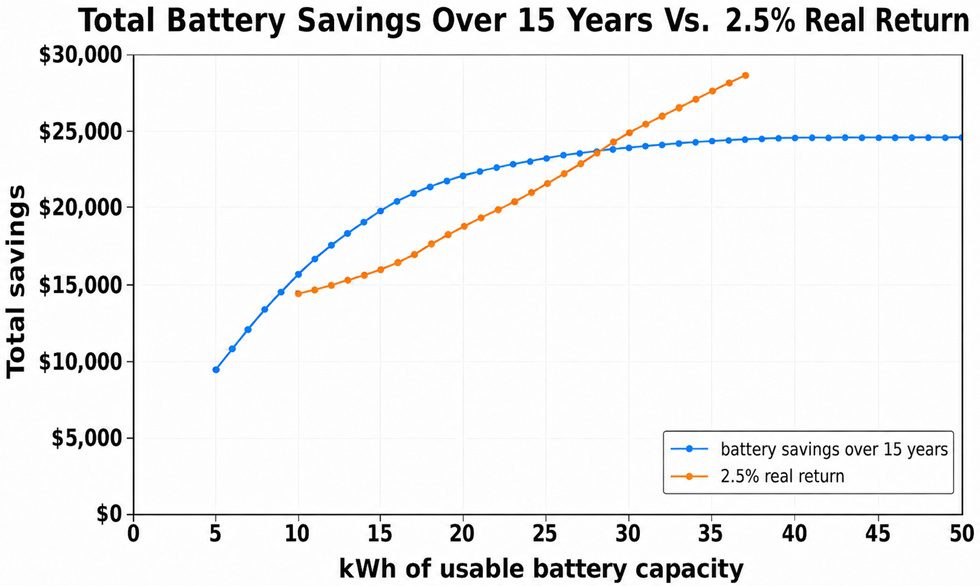
This is a graph of estimated total battery savings over 15 years, by battery capacity, versus investing the cost of a battery at a little over 2.5% real return for 15 years, for my sister. If you’re not my sister, you may get a considerably different result, even if, like her, you’re in NSW & use around 6,500 kWh of grid electricity per year.
The graph above shows the lines intersecting at a little over 28 kWh, so this is the battery capacity my sister should get if she wants to maximise her electricity bill savings. It’s considerably more than I expected when I first started pulling apart her electricity bills.
Battery Capacity & 2% Real Return
I used 2.5% real return above because I promised my sister a return better than paying off her home loan. But if she was happy with a battery return that was only roughly equal to paying off her mortgage, and didn’t mind if it was a little higher or a little lower, then I would instead use a 2% real return, which gives the following result:
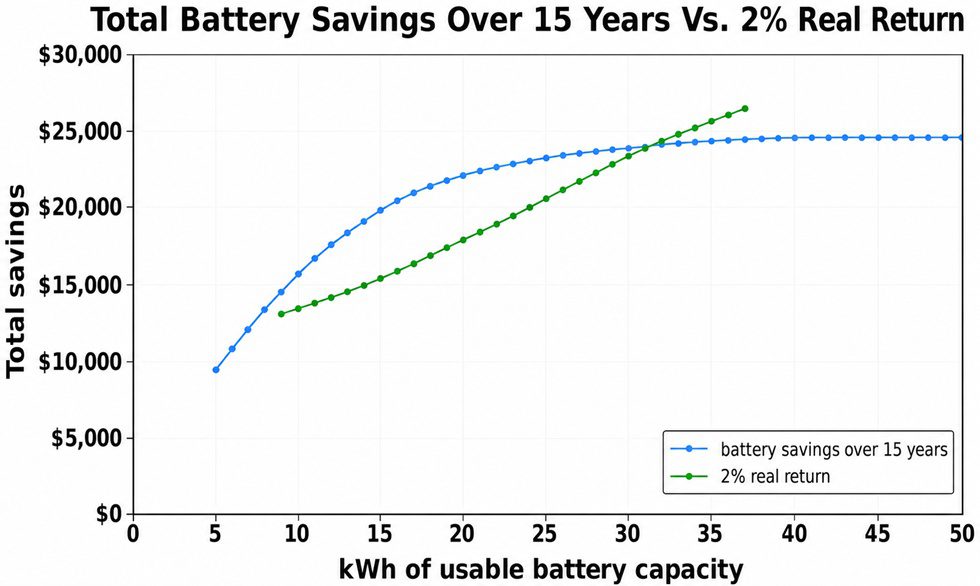
The line intersects at just past 31 kWh, which is 3 kWh more than if she were aiming for a 2.5% real return. This shows that being satisfied with a lower return increases the optimal battery size.
Battery Capacity & 4% Real Return
If my sister insisted on a 4% real return from a battery, then the sweet spot would be just under 22 kWh, as shown by the intersection of lines on the graph below:
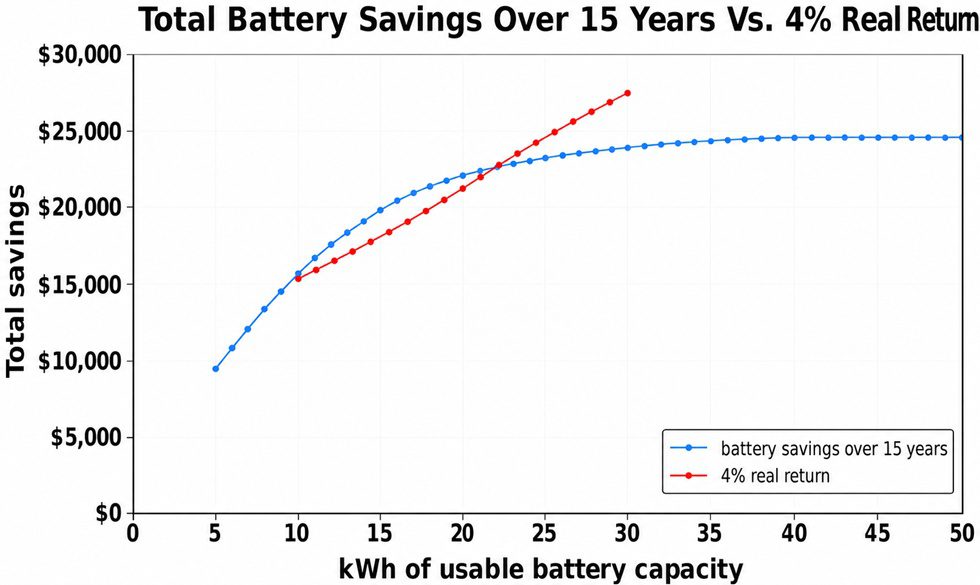
If my sister instead demanded a 5% return, then she’s out of luck, because the lines on the graph would miss each other and not intersect at all. This means it would be impossible for her to make a 5% return from a battery with the assumptions I’ve made.
But this doesn’t mean it’s impossible for other people to get a 5% or higher return. If they don’t have to pay as much for a battery, or use more peak period electricity, it’s definitely possible.
Backup Power — Less Important With Daily Charging
While I’ll recommend my sister install 28 kWh of battery capacity to maximise her electricity bill savings, if she’s interested in having reliable backup power, she should install more.
But my sister isn’t really interested in reliable backup power. While she has nothing against it and would appreciate having it if a blackout does occur, she’s not interested in paying more than a trivial amount for it. This is because blackouts rarely happen where she lives and because she grew up in Queensland, where blackouts were common when we were kids, so they hardly bother her.
But with a 28 kWh battery charged daily with free electricity on a Solar Sharer plan, there’s an excellent chance there will still be a decent amount of charge in her battery when a blackout occurs. So my advice for her is to get a battery that’s 5% larger and use that for a small 5% battery reserve, so there will always be enough charge to at least run the lights, fridge and freezer, and charge her phone during a blackout, until her solar starts producing power again.
A few extra kWh may only cost her around $1,500 or just $100 a year for the expected life of the battery. But I don’t think she’ll consider it worthwhile. This is because with a 28 kWh battery that’s charged from the grid every day, she can simply cross her fingers and hope there will be a decent amount of energy in the battery when a blackout occurs. Most of the time, she’ll be fine, as when the grid fails, she’ll usually have enough charge to get through without any battery reserve.
If you have a decent-sized battery and are planning to charge it daily with free grid power, you can consider whether it’s worthwhile to reduce your reserve, or perhaps get rid of it entirely.
Survival Odds
I think I’ve done a pretty good job of working out how large a battery my sister should buy. If my assumptions are correct, I’ve shown that a home with a fairly typical annual grid consumption of around 6,500 kWh a year, that doesn’t use a large portion of it during the expensive evening peak period, should install a large 28 kWh battery, or slightly more if having reliable backup power capability is important — which it will be for most people.
But I could be wrong. Batteries beyond the black stump may be more expensive than I estimated, or my sister may suddenly demand a considerably higher battery return. It’s even possible she could change her electricity consumption habits. If she ever stops roasting the souls of the dead in an electric arc furnace in the wee hours of winter mornings, that would reduce battery savings — although perhaps not by as much as you’d expect, as she’ll have a low early morning rate.
While my sister could get a higher rate of return by getting a smaller battery, my advice is don’t be too cautious. You only get one use of the federal battery rebate per property, as well as one NSW VPP incentive. You don’t want to blow them on a small battery and wind up realising you should have gone bigger. If you do make a mistake in the other direction and get a battery that’s a little larger than you need, then that will make it more capable of providing backup power, and it’s also likely to last longer and lose capacity at a lower rate because it will be used at a lower capacity factor. You might miss the “financial sweetspot”, but that’s not likely to be a disaster.
Unless you’re me. For me, disaster is definitely on the cards. While I think I’ve done a good job of estimating what size battery my sister should get, I only put my personal odds of survival at around 80%. If she makes me decide which VPP she should join, then I probably won’t be of much further use to her after that, so my odds will probably drop to around 50/50.
 About Ronald Brakels
 RSS - Posts






I’m not surprised that complex calculation agrees with rule of thumb and unqualified guess, as seen on the internet forums. So many, wanting so much, and giving so little data to work with.
The final decision will be what your sister can afford.
However, if you pay for the whole lot, your body and soul will be safe.
Or perhaps just get a FoxESS CQ7 42kWh battery installed for $9.5K as seen in current Aussie Solar Batteries advertising and you really don’t need any of these calculations at all. Our 48kWh Fox battery has been installed for 3 months now and is working perfectly, neat compliant install, and included a 15kW 3P inverter – all for $9K at the time. 12 year warranty and a local Canberra installer. When the price is so good, it throws all the other calculations out the window. And similar to panel sizing, you’re never going to have anyone say – “Gee, I wish my battery was smaller!”
I think your assumptions are way off here.
Maybe the average RBA cash rate approached 2.5%, but here in punter land you were paying 4.5-5% if you were paying attention and constantly switching and closer to 5.5-6% if you were too lazy/busy to compare.
The only time real rates approached 2.5% was during COVID. If you exclude those years your average probably has a 6 in front (maybe high 5s)
The other thing to consider is tax implications. Assuming your primary residence, that offset account deposit is returning savings that are tax free. Same with the savings from energy you didn’t buy. Shares/super/etc, you need to factor in the haircut you are going to get from those returns.
Ronald is using real rates in his analysis, i.e. the nominal rate LESS inflation. 5% nominal rates, leading to 2 1/2% real rates and 2 1/2% inflation feels a reasonable assumption to me.
Rates (nominal and real) have been suppressed since the GFC. I’d likely argue for a slightly higher real rate (than 2 1/2%), but these are in the right ballpark.
If you read it a bit more closely, he said “real interest rates” and defined them as the actual interest rate adjusted for inflation. So if the bank mortgage rate was 5.5% and the inflation rate was 3.5%, the real rate would be 2%.
Where did you get the average home loan rate of 2% from?? Its actually averaged 5% over the last 15 years and never hit a low of 2%. This wrong assumption completely skews the numbers. If you compare battery savings to that cost being left in a home loan offset account at that 5% rate or current rate of 6+%, it’s nearly impossible to get the numbers to stack up.
It’s the real interest rate for home loans. The quick and rough way of calculating it is to just subtract inflation from the interest rate. It allows price figures to be kept in today’s money, which is less confusing than giving figures in inflated future dollars.
I’ve added a sentence to the post to give a better explanation of them.
Hi Ronald – an excellent and informative analysis of your possibly terminal challenge to find the right sized battery for your sister.
I am assuming that your sister, whatever the result of this advice, has a similar sense of humour to you. The evidence of this is that both she is genetically related to you (we haven’t seen any DNA proof otherwise), you presumably grew up together and your “proof of manhood” still survives (again, with no proof available though nor needed to be displayed thanks!) and the fact she may still see a need for your services in the future. Or maybe not.
Coincidentally she has also been provided with very good advice that I as a NSW regional resident can use and definitely gain advantage, not to mention money, from. And your manhood is safe with me. Figuratively speaking of course.
And thanks for your calculator and the continuing upgrading work. I will soon make use of all the information you provide.
Please stay above ground.
Thanks for your kind words. I’m happy to report I am not dead yet, and also no more maimed than usual.
When you quote the battery capacity at 28 kWh and then crunch all your numbers using that number are you taking into account that you are recommended to only use 80% of the capacity?
Yes, I was wondering the same thing Ross. There’s also apparently a loss of efficiency at low temperatures which is a worry for me as I live in a cold climate. Way too many variables in this puzzle.
Only discharging by a maximum of 80% (potentially by setting a 20% battery reserve) is definitely good for the battery, but I haven’t assumed my sister will do that. I’ve assumed that, at times, she will discharge it by as much as its warranty allows. But, in spring, summer, and autumn she will normally discharge a 28 kWh battery by much less than 80% overnight. It’s only in winter that she’s likely to discharge all its usable capacity. While hard on the battery, I consider it okay because manufacturers appear confident it won’t cause too much harm, otherwise warranty conditions would be different. On top of this, a battery system can fail for reasons unrelated to battery deterioration, so going easy on them may not provide as much benefit as hoped. Also, I expect that, with a 10 year or potentially longer warranty, by the time she’s in the market for a new battery, home batteries will be much cheaper, and this will also reduce the benefit of carefully extending a battery’s life.
Venergy
Great for product purchase and reasonable time for installation, ALL downhill from there. Not working since last October, rudeness, aggression and dodging any communication. Paid heaps and all should be under warranty…. Not fit for purpose. Don’t go near them!!!
Great article but if she put her money on an offset account she would save whatever the current interest rate is on the $10,000.
My take on this is obviously to pay the least amount.
With that in mind you probably:
– never want to pay peak rates
– want a system that fills your battery by the end of the free electricity period
– your battery last well past the peak period
Most solar sharer plans limit to 24kW so you probably need to keep that in mind.
My offset account is at 6%, but with inflation at about 4%, that’s only around a 2% real return. I’m sure my sister’s is much the same and she wouldn’t have got herself a better rate. (She mostly only uses her powers of intimidation on me… mostly.)
The 24 kWh daily cap on Solar Sharer plans is one of the reasons why the savings per additional kWh of battery capacity falls off rapidly as battery capacity expands.
Well what a lovely read, your sister is very lucky that you took the time to take her through the pros and cons so intricately.
I do feel sorry for you both though I think it was cruel having taken all you QLD. kids through the experience of bending all those bananas, I bet it still gives you night mares box after box, day and night. I feel you should seek help from Origin and start up a class action gather up all those others resurrect JOH and do him slowly.
I am sorry I shouldn’t bring that back to you like that, it’s damaging no wonder you moved south.
As I read your yarn my installers are back after 9 months, they are making adjustments to my whole house back to really cover the complete electrical foot print of the property. I ended up with 24kwh so close to your calculations.
Look before I go you would remember the old days the ceramic fuse holders, and the little cards kept in the fuse box the card had the fuse wire wrapped around it, you have one stuck in your beard.
Don’t feel too sorry for my sister and I. We used to steal our banana quota from Kingaroy, and not a straight thing was ever grown from that soil.
The rules of power supply will change SO much over 5 years, let alone 15 years, it’s impossible to predict anything now.
The 3 for free might be canned by govco, retailers will get the ok to raise other tariffs for the other 21 hours of the day, double, triple, or quadruple DSCs to much higher levels for a “fairer” market for all :/
On the other hand, FITs for battery owners will probably go somewhat higher, as coal / gas get less use, and more retailers compete for renewables rooftop generation in non solar hours (or they’ll just invest a lot more into their own solar / battery reserves, and profit from those).
At least I hope FITs change for the better in peak demand times, as it’s about the only thing that might change for the benefit of those having invested / going to invest in solar / battery.
You must feel for those that can’t afford, or can’t install solar and / or batteries for whatever reason, and can’t make reasonable use of SSO’s, they will feel the sting even more soon.
Les,
Just one of the disturbances you allude to, electric transport, can clobber the 3-free-hrs within 5 years, I suspect. Diesel supply is even now threatened not only by the Hormuz bottleneck expanding to Houthi attacks on the Red Sea, blocking Saudi oil as well, but also Ukraine’s damage to 40% of Russia’s refineries severely hobbling the world’s 2nd largest diesel exporter.
Electric trucking requires a minimum of 50 MWh of battery at a muti-station truck charger. As they are increasingly fast-tracked due to lack of diesel, and BEV cars similarly head to 95% of sales by 2030, midday solar will find paying demand.
V2G is a peripheral factor, it seems to me. By the time bigger BEV batteries eliminate range anxiety, home/grid batteries will be so cheap, there’s no need for it. (Instead: Discharging my 46 kWh home battery into the BEV here now, for grey-weather range boost.)
VPP seems unlikely to pay enough to make it worth the rort-dodging. Just 30 to 50 kWh for own resilience.
Just checked out the new SQ electricity plan comparison tool . . . very neat.
Looking at best FIT filter for SA metro, ioEnergy (SA postcodes only I think ?) comes up tops, but the FITs are variable, and the 2c FIT you have on the comparo tool shows 2c, while it is -2c for solar soak.
12:00am-9:59am • 4c/kWh•(Rebate)
10:00am-3:59pm • -2c/kWh•(Charge)
4:00pm-5:59pm • 4c/kWh•(Rebate)
6:00pm-8:59pm • 30c/kWh•(Rebate)
9:00pm-11:59pm • 4c/kWh•(Rebate)
This is a great plan for SA battery owners, I can’t find much better, even 8c power 6 hours 1000 – 1600 for winter battery top off or EV charging.
Very difficult subject & very subjective. I respect the exercise you have done & the objective views in the comments.
When we buy a car most people could buy the cheapest model as it will get you from a to b. Most will justify something bigger and better than what they need & buy what they can afford.
Every battery you get will reduce your electricity bill which is what you are trying to do. If we ignore people looking to make money from having batteries by buying & selling, you would buy what you can afford.
I would say if you can afford to buy a battery that covers your supply needs through shoulder & peak you will only ever pay off peak rates.
The killer is the daily supply charge which you cannot avoid & for me you should not be looking to offset this charge. What the government needs to do is to get tougher on these increases and also look into the mark up by retailer. You should only be charged what the network operator charges. Additional retail cost should be in the rates.
My memory of Part 1 leaves a bit to be desired…
Given there is a loss round trip loss on charging/discharging the battery. To charge it up to 28 kWhs would require typically at least 28/.95 = 29.5 kWhs and then discharging the battery would (I may be missing something here, but isn’t there a loss on each stage, not just the initial charge) see 28 * .95 = 26.6 kWhs provided.
To charge up within the 3 hour window, in winter with near zero kWhs would require a 10 kW inverter capacity – correct?
_____________________________
Moving on to the financial engineering done by the various retailers to try & ensure every customer pays more post 1/7/26 – using a spreadsheet I updated after being forced onto TOU (kicking & screaming knowing who brought this to Australia & why). It uses my past usage, days, records past rates/conditions. Then I can compare a new set of rates vs the current (or any 2nd set) over many past actual usage figures.
Sees me worse off with every plan offered.
A typical home battery has around 90% roundtrip efficiency. If 90% efficiency is assumed, then putting the full 24kWh maximum of free daily electricity into a battery would mean only 21.6kWh could be discharged. To do that in 3 hours would require an 8kW or larger inverter. So if my sister got a 28 kWh battery with an 8kW inverter, she could charge it with 21.6 kWh of free daytime electricity, and even if it started the day completely flat, on most days, her solar would be able to top it up to full. But there will be days in winter when it doesn’t get fully charged. The 24 kWh free electricity cap is one reason savings rapidly drop off as battery capacity increases.
A battery not worth it in my case with 13 kw of solar only pay 500 $ a year including hot water for electricity and down here quoted 13000 $ for 13 kw battery hence I’d save 5 grand over 10 years a loss of 8 grand !! I’ve got a 4 kw portable battery for emergencies !!
Sounds like a good set up! If your overnight electricity consumption is very low, a battery definitely may not be worthwhile. However, one thing to watch out for is your solar feed-in tariff disguising how much you’re actually spending on grid electricity. If you’re just going by your total electricity bill damage but have a decent feed-in tariff, what you’re actually spending on grid electricity could be several hundred dollars more. But even if this is the case, it’s still not likely to make a battery worthwhile for you. Still something to be aware of, though.
Hi, I’m in Perth and have a 6 year old system, wanting to add a battery, don’t want new panels as roof full. Do I have to go AC coupled or can I get DC? I keep reading that AC is ‘easier’ is that legislation or just a bit cheaper?
I live in WA and after doing a lot of complex spreadsheets with actual consumption figures and battery output constraints etc I am intrigued how most people would actually save money installing a battery!
It ultimately came down to: “How long would it take to pay off an installation if it replaced all your consumption?” Fixed charges are fixed. In WA, any system with an inverter larger than 5kW has $0 FIT. So that would be an extra loss (cost) for an existing system and also no income for a new system.
For a battery capacity of 20-30kWh (relatively “normal” to have a chance of replacing average consumption), you’d also need to add more solar – an extra cost). About 10kW total would be the minimum.
WA does not have the retail options of the eastern states, so it is not as cheap to charge from the grid here, regardless of your plan.
I have not yet seen an economic case to install batteries here! I’d love to see your spreadsheet!
Just had a thought…is income received from selling power to a VPP taxable?
If so, it would make it even less desirable/viable.