
 With Australia in the grip of winter, a new breed of free daytime electricity plans have arrived just in time to keep your home warm on the cheap. Here’s how to time your electric heating – and cooling – to make the most of the Solar Sharer Offer’s free electricity period.
Solar Sharer launched on 1 July 2026, giving households in select areas of Australia the opportunity to switch to a plan with three hours of free daytime electricity.
Electricity retailers with more than 1000 customers are required to offer a plan with up to 24 kWh of free electricity a day from 11 am–2 pm in NSW and South East Queensland. In SA the free period covers 12 pm–3 pm, while Victoria is launching its own version, the Midday Power Saver, on October 1.
It’s a genuine chance to cut your bill, but only if you can shift usage into the free electricity period. Your aircon/heating system is the biggest lever you have for doing that. If you get the timing right, you can heat or cool your whole home for close to nothing. If you get it wrong, you’re just moving your usual bill into a different time slot.
Is Solar Sharer Actually Worth It?
Solar Sharer plans only help if you can change when you use electricity. There’s a catch that retailers don’t mention: they often make up the cost with higher peak rates and/or daily supply charges.
The free period only saves you money if you actually use it. So, what should you move to that time?
Heating and cooling usually run for much of the day to keep your home comfortable. They use more power than anything else you can control, so they’re the best things to focus on for this strategy.
Heating Your House, On The House
A modern reverse-cycle system uses most of its energy to bring your home up or down to the temperature you want. Once it reaches that point, it uses much less power to keep things steady.
That’s the main idea: get your home to the right temperature, then let the system maintain it.
Aim for 24–26°C in summer and 18–20°C in winter. Going higher or lower than these ranges uses much more energy for diminishing returns.
Start as soon as the free period begins, using the first 20–30 minutes to bring your home to the right temperature. You’ll be using free electricity for the most energy-intensive part, so even if you keep running your aircon past the free period, you’ve avoided much of the running costs.
However, a built-in aircon timer can only work on a fixed schedule. It won’t adjust based on today’s weather, and it can’t tell if you’re home.
Smart Control: Sensibo And Solectair
If your split system has a remote, you don’t need to replace it to make it smart. Devices like Sensibo attach to the wall and read your remote’s infrared signals, so they need a clear line of sight to work well.
With Sensibo, you can set up 7-day schedules, use your phone’s location, and create rules in the app. This lets you program your system to start heating or cooling as soon as the free period begins, without needing to do anything manually.
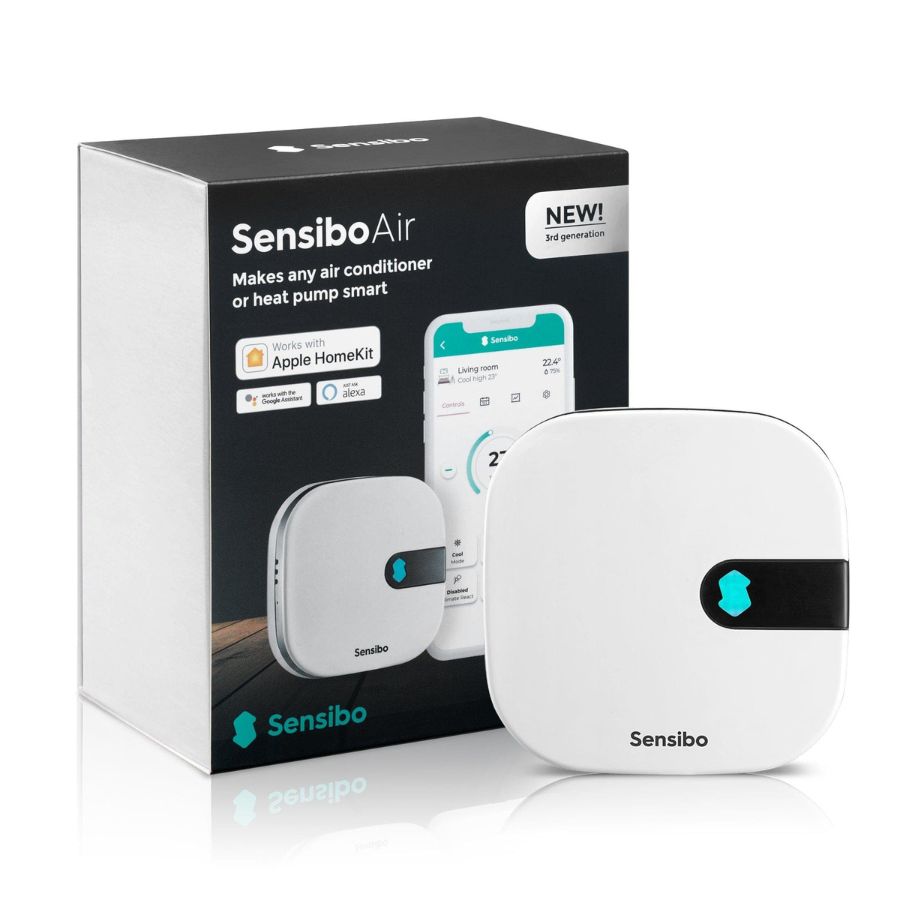
Courtesy: Sensibo.com
Geo-location turns the system off when you leave home, using your phone’s location. An optional room sensor can track the temperature where you are, not just where the unit is. It can pause the system if you leave the room or if a door is left open. This is an affordable way to make an old air conditioner work like a smart one.
Solectair, a ducted solar heating system that’s been around for decades, pulls warm air directly from the roof space and pushes it through ducting into the house.
On a sunny day, even in winter, a roof cavity can sit well above room temperature. Solectair’s controller switches on a fan whenever the roof space is hotter than the house, transfers free heat into the home, and lets the home’s own thermal mass (your walls and floor) soak it up and release it slowly overnight.
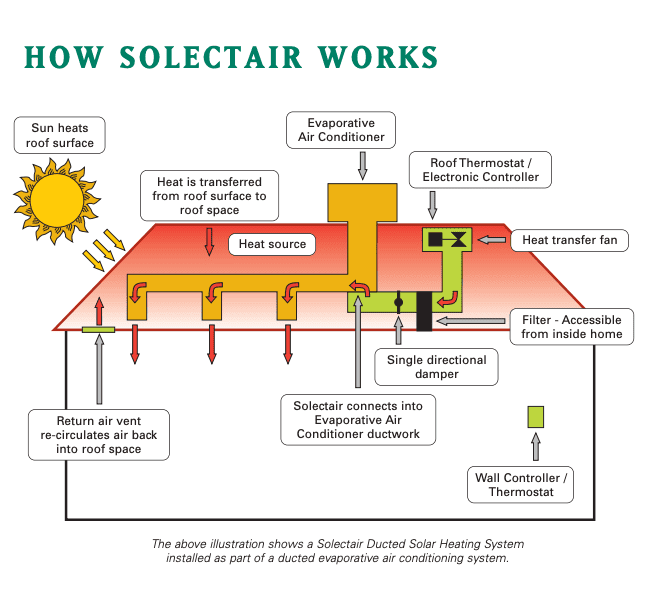
Courtesy: Airgroup.com.au
Insulation: Think Of Your Home As A Battery
Once your home is at the right temperature, insulation determines how long it stays comfortable. Good insulation can keep the warmth or cool for hours, while poor insulation lets it escape quickly.
Think of your home as a big battery. It stores energy as heat. SolarQuotes’ in-house installer, Anthony Bennett advises that in winter-proofing your home, plugging draughts at doors and windows is your first task – this can cut heating bills by up to 25%. A single pane of bare glass loses 10-15% more heat than the same-sized uninsulated wall.
“Getting thermal mass under control is great but if the house leaks it’s a losing battle. I know this because the floor is falling out of my house and it leaks like a sieve … good passive haus design will hold temperature for days, because it’s sealed like a drum and the windows are well positioned to warm it,” Anthony says.
If you’re feeling confident with a little DIY glazing, insulate your French and sliding doors (if you have them). Anthony found that a little ingenuity can measure a 3.5°C rise in temperature.
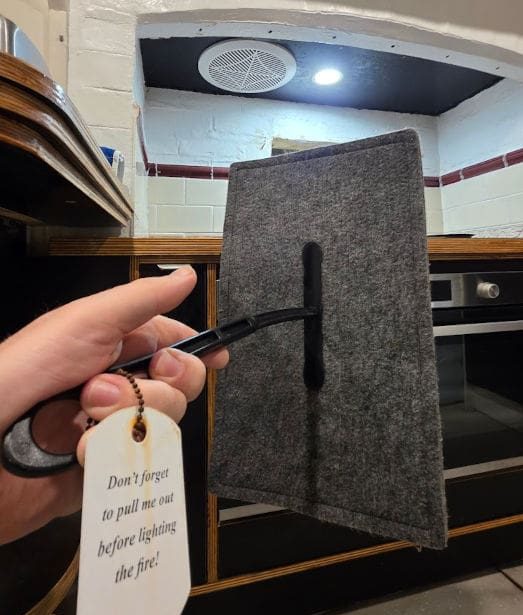
Everyone loves a roaring fire on a cold winter’s night. But chimneys, especially an unused open one, invite draughts into the home. This is one of the fastest ways to lose the temperature you paid to create. Invest in a chimney blocker, as pictured below. They’re flat squares of felt with a handle that wedges right up into your fireplace when you’re not using it. It’s not perfect, but it will help reduce heat loss.
A few years back, Anthony set up a basic fan on a timer in his old double-brick house, which didn’t have any ceiling insulation or smart controls. Before that, he would come home at 6 pm to an empty house and find it colder inside than outside, since no one had turned on the heating.
After he set the fan to run from 10 am to 3 pm, he noticed a change by evening. On cloudy, cold days, the house didn’t feel much warmer. But on sunny days, it was often much warmer by 6 pm, just from moving air through the house while the sun provided the heat.
What to Do Next
See if your reverse-cycle system has a built-in schedule, or if adding something like Sensibo or Solectair makes sense. Then check your home’s weak spots, like doors, windows, or an old fireplace, and insulate where you can. These factors decide if your free period’s benefits last just an hour or all afternoon.
Get the timing and the sealing right together, and a free electricity window becomes genuinely free comfort.
For more about efficient electric heating and cooling, read our guide to reverse cycle air conditioning.
To browse Solar Sharer plans and see if they are right for you, we’ve updated our electricity plan comparison tool – once you’ve entered your postcode, just click ‘features’ and ‘free power periods’ to only compare such plans.
 About Jacob Boyd
 RSS - Posts





Have been doing this for several years already, and including the thermal mass of the home was critical to drastic cuts in energy use.
I don’t even bother with timers, with a well-insulated house with good thermal mass, I found it was much easier and even cheaper to simply run my split systems 24 hours a day. They trickle on and off, through their inverter technology, and the thermal mass and insulation of the house does the rest.
An energy efficiency group I was on said that was mad, and I should just run the splits at times of peak cold and heat, to save energy. Another perfect example how social media is the only true ‘slop’ we need to fear. AI will tell you how stupid that advice was in an instant.
Any thoughts on those old-fashioned storage heaters? There are modern versions made now (eg Heatpac) that have more advanced controls. You could heat them up in the free 3-hour window and they would slowly release heat over the next 21 hours.
For as long as 3-free-hrs lasts, or you have ample roof panels, heatbanks look promising. In hazy cloud, I’m yielding from 2 to 14 kW of PV, from one minute to the next, here today. The peak is partly battery recharge, as loads are only 7 kW, kept down in the spotty sun.
Lacking a heatbank, I have 1 kW of heat lamps making the bathroom floor into one most days through winter. It’s smack in the middle of the building, for maximal heat leakage resistance. Add more lamps?
The heatbanks have to be a fraction of the cost of a battery, and 32 kWh capacity per unit is substantial. (More than the 2-free-hrs energy cap.)
Good advice. Unless you can pig-out on the free lunchtime killerWasps, Solar Sharer quickly becomes Solar Shearer — fleeced by your retailer.
Sadly, I think an opportunity for the renters and those without solar, EVs and batteries has been missed.
Imagine if some smart goverment flipped the script on smart meters, data centres and robodebt and created a high tech PowerParity scheme.
Call me crazy but for both of my IP I put on solar 5 years ago and added battery in the last 10 months. One was a house with granny flay, both has separate solar + battery, one is a single house so I actually have 3 systems to monitor.
Exactly! The Solar Sharer doesn’t start in Victoria until October 1st…and the majority of retailers have introduced Time of use Tariffs…heavily loading the Peak period rate 3pm to 9pm making any likely saving in the 12pm to 3pm free sharer utterly meaningless. And the Distributors have ramped up daily usage fees significantly.
I don’t have a smart meter (yet), so no free hours for me. My daily supply charge still went up by .51 cents a day.
So we are all paying for 3 “free” hours a day. 😡
What about storage heaters (heating up ceramic bricks to a couple of hundred degrees C)? Their very existence is to solve load shifting, originally off-peak night time power. Arguably heating a storage heater in the middle of the day is a better scenario, as less heat is lost between heating and usage.
Now if someone can manufacture a heat pump system that converts middle-of-the-day free [or cheap] electricity into hot water that heats a ceramic mass then I’m in!
When designing my OB, http://www.yourhome.gov.au/passive-design/glazing helped quantify heat loss. A living area minimal 7.8 m² of clear glazed, aluminium framed, windows (U-value: 6.2), would on a winter’s night, 15°C colder outside, have given a heat loss of about: 6.2 x 15 x 7.8 = 725 W for the open living area. But double glazing was mandatory, halving that heat loss.
Compare insulated wall losses for the whole living + bedroom block:
1/2.8 * 15 * (2.7*(8.5*2+9.3*2) – 7.8) = 473 W (U-value = 1/R-value, 2.7m high walls)
That’s 1.5x heat loss from windows, through 9% as much area, i.e. 17 times lossier. Single glazing is about as good as an open hole in the wall. If stuck with ’em, consider honeycomb blinds, even translucent ones.
With double glazing + insulation, it is easier to keep warm. The little 3.5 kW (thermal) aircon suffices, drawing around 300W or so, steady state. That’s around 11c/hr, outside free hours.
Reducing glazing rocks, thermally & economically.
So I put all my PV panels covering the north facing roof, so winter time with low sun and the northerly sun aspect of the sun travelling from ENE to WNW is picked up best, and now it is suggested we should take heat from the roof space?
Time for a big reality check here for my roof cavity is shaded by my panels and does not get hotter than ambient temperatures.
Of course during our colder and cloudy days the roof space does not heat up more than ambient temperature even when not covered in panels.
“Unfortunately” for most of Australia we do not have snow and clear skies during our coldest periods, where the passive heating ideas work during those coldest times.
Stick a thermometer into your winter roof space and ascertain just how much opportunity to heat with roof space air their actually is,… just because it gets stinking hot in the summer roof space is not relevant during winter.