
The fuel excise cut introduced to soften the impact of rising petrol prices finished at midnight on 2 August. From this point, petrol and diesel are taxed at the full rate again, so prices at the pump are climbing higher once again. It comes as new data out this week shows that electric and hybrid vehicles made up nearly half of all cars Australians bought last quarter.
What Was The Fuel Excise Cut, And Why Did It End?
The fuel excise is a tax the government adds to every litre of petrol and diesel sold in Australia. Importers and sellers pay it first, but it gets passed on to you at the pump. The tax goes up automatically twice a year, even if nothing else changes.
In February, the conflict between the United States and Iran closed the Strait of Hormuz, which is a key route for much of the world’s oil. Petrol prices jumped, so the federal government reduced the excise to help ease the impact.
Here’s how the discount shrank before it disappeared entirely:
| Period | Excise rate | Discount at the pump |
|---|---|---|
| Before 1 April | $0.526 | $0 |
| 1 April to 30 June | $0.206 | $0.32 |
| 1 July to 2 August | $0.366 | $0.16 |
| 3 August onward | About $0.537 | $0 |
Take a look at the last row. The restored rate is actually a bit higher than where it started. This is because the rate is indexed twice a year, and the latest increase happened on the same day the cut ended, so the new rate is now just above the previous 52.6 cents.
Speaking in Brisbane, Treasurer Jim Chalmers confirmed the cut would end as planned, despite a fresh escalation in the Middle East.
“It has played a really important role in helping to take some of the sting out of the cost-of-living pressures,” he said. “It was never the government’s intention for that to be permanent.”
Not everyone thinks the cut was a good idea in the first place. University of NSW economics professor Scott French told the ABC that discounting fuel undercuts the very signal that’s supposed to make people drive less when prices rise.
“By lowering the price, they’re interfering with the signal of price increases, which is to tell consumers to use less,” he said.
The cut was expected to cost taxpayers $2.55 billion. So the question is, was it better to get relief now, or would a clearer price signal have been more helpful in the long run?
How Much More Will Australians Pay For Fuel?
The full cost of the changes won’t be felt right away. Additionally, fuel prices vary by state, by suburb, and by the day, so don’t take one figure as gospel. In New South Wales, for example, FuelCheck already showed unleaded prices climbing before the excise even changed hands. The difference is from $1.918 per litre the previous Wednesday to $2.017 per litre the following Tuesday.
The Electric Answer To The Fuel Crisis
With the situation in the Middle East showing no sign of abating, experts say that the case is only growing stronger for electric transport alternatives. Rohan Bowater, Accela Research’s Lead Oil and Gas Analyst, put it plainly in comments this week:
“High fuel prices will continue to plague households now that the excise tax relief has ended. Australia’s reliance on imported refined fuels and fossil fuels leaves the nation vulnerable when global markets tighten. According to the latest news reports, the conflict appears to be spreading to multiple fronts, creating risks for global supply choke points.
“We know the only way to mitigate cost and energy security risk is electrification and domestic alternatives to improve energy security. It’s interesting that the latest numbers show half of car sales in the last quarter to 30 June were EVs or hybrids, a trend indicative of a structural shift in demand away from fossil fuels.”
Record EV Sales As Petrol Gets Pricier
The excise cut began back in March, the same month petrol prices started pushing Australians toward electric vehicles. Five months later, the discount has ended, and that shift has only picked up speed.
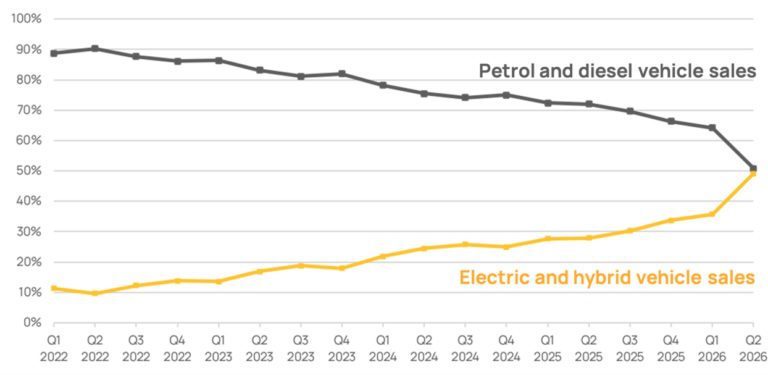
The Australian Automobile Association’s latest EV Index shows that electric, plug-in hybrid, and hybrid vehicles accounted for 49.16% of new car sales in the June quarter. Just under half, and the largest quarterly jump in electric vehicle sales the index has ever recorded.
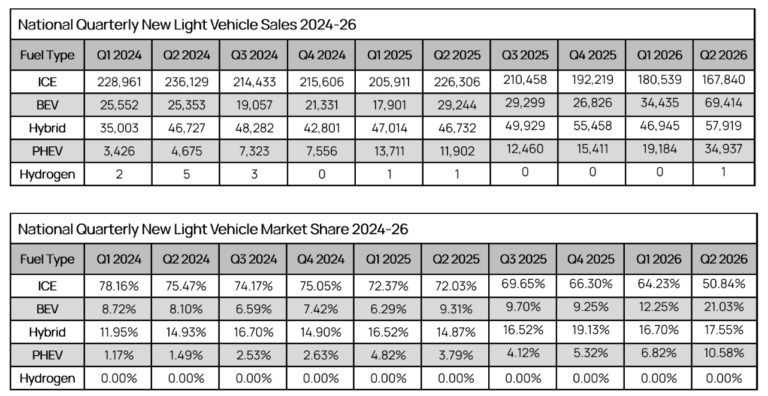
Battery-electric vehicles (BEVs) alone more than doubled quarter on quarter, from 34,435 sales to 69,414. Their market share jumped from 12.25% to 21.03%, a record, and for the first time since 2023, BEVs outsold hybrids outright.
Source: aaa.asn.au
Hybrids weren’t far behind, hitting a second-highest share with 57,919 sales and a 17.55% share. Plug-in hybrid electric vehicles (PHEVs) took 10.58%.
Internal combustion engine (ICE) cars fell to 50.84% of sales, their lowest share on record and the biggest single-quarter drop since the index began in 2022. Back then, ICE cars accounted for nearly 9 in 10 new cars sold. Now it’s about 5 in 10.
None of this came at the expense of a shrinking market, either. Total new light vehicle sales hit an all-time high of 330,111 for the quarter. Buyers didn’t stop buying cars. They changed what they bought.
Source: aaa.asn.au
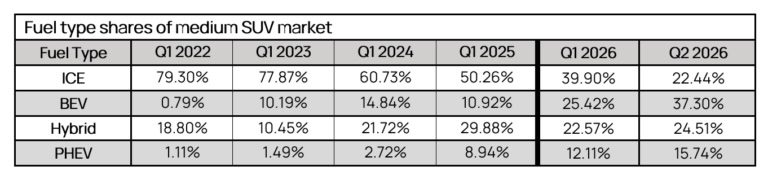
Medium SUVs show this change most clearly. They are the most popular type of vehicle in Australia, and battery-electric vehicles have grown from less than 1% to 37.3% of medium SUV sales in just over four years.
The EV Buying Trend Is Worldwide
The International Energy Agency’s (IEA) latest report found the same pattern playing out well beyond our shores. Global car sales overall fell about 5% year on year in the first half of 2026, dragged down by weaker demand in China and the United States.
Electric car sales tell a different story. After a soft start to the year, global EV sales rebounded 35% in the second quarter compared with the first, hitting record levels in 50 countries.
Australian Vehicle Market Share by Fuel Type. Source: aaa.asn.au
Australia was named specifically, alongside Brazil, India, Korea, and Vietnam, as a market where EV sales roughly doubled in the April to June quarter compared with the same quarter in 2025. More than 90 countries recorded year-on-year growth in EV sales across the first half of the year.
The IEA now expects electric cars to account for 29% of global car sales in 2026, a percentage point higher than it projected in May. China is the one market bucking the trend, with EV sales expected to stall in 2026 even as EVs account for a record 60% share of the country’s new car market.
How To Research Electric Vehicles
Rising petrol prices don’t mean you have to buy a new car right away. But if you’ve been considering an electric vehicle, now is a good time to look at the numbers instead of just guessing. Charging up an EV has recently become potentially even cheaper with the introduction of retail plans offering free daytime electricity.
If you are in the market for an EV, there’s a raft of advantages to getting a home EV charger. Our guide to EV chargers is a good place to do more homework on that.
 About Jacob Boyd
 RSS - Posts






I wonder if the public EV chargers will be passing on the free 3 hrs of electricity when the scheme kicks off in VIC.
Doubt it Eddy, in fact I’d outright so not a chance, as they don’t get that.
It’s just mandated most retailers have at least one SSO offered to consumers.
And they just spread the benefit to other tariff times and daily supply charge to counter this, in fact most users would probably be worse off with a SSO.
“As Age Of The EV Begins” . . . again.
Very interesting to see electric vehicles come full circle after oil intervened for ‘a while’.
Imagine if oil were not discovered when it was, it’s abundance and low cost not taken up, and battery tech was the main focus, we could be 100 years ahead.
Don’t get me wrong, we need oil, imagine a world without plastic, both a modern blessing and a curse (microplastics, general pollution).
We’d be pretty stuffed without plastic, but maybe be healthier long term, along with most ocean species.
So too for a little longer road / rail / air transport, not quite there yet for a big country.
“How Much More Will Australians Pay For Fuel?”
Perhaps we should be asking how much will Australians be paying for EVERYTHING.
EV owner, hybrid, or ICEV, we will all be paying more for anything transported (and what isn’t ?), and flow on costs of doing business.
It’s pretty plain EVs will not be pushed back again as we enter this new era in modern transportation.
Electric transport is going in now, NET trucking with their own charging infrastructure in NSW, a truck charging provider signing up 10 logistics companies for priority access in Melbourne, with two more charging parks in planning. As the higher capex is amortised, low opex eats the lunch of fossil fuel burners. Diesel transport is obsolete uneconomic tech, without a future. Janus is increasing the rate of converting diesel trucks to battery-swapping electric.
Manufacture of electric trucks is viable even here in Australia – it has begun. Will anyone be mad enough to buy a new diesel truck in 2035? No, even 2030 is a path to ruin, unless doing an electric conversion at the 5 year major overhaul. (Could be cheaper than a new BEV truck up front? – Have to do the sums.)
The balance of trade benefit will be very handy indeed. The planet? Nah, we’re still oblivious, heedless, lemmings, intent on a the great courageous experiment – how to make much of the planet a hell. Observe.
Might not be too much longer Erik.
If they can charge the new 43mwh battery Tassie Incat built ferry going to Argentina / Uruguay in about 90 minutes, then trucks should be within reason.
Those chargers are dual 15mw each I think, so a charging capacity of about 40mw.
They must have better grid power availability than we do !
I was initially thinking swappable batteries might be better, like some Chinese truck chargers there now, but range has to be pretty good, especially with weights and highway distances / speeds transport here will require.
Still going to take time to get a fleet like Australia’s going to any sort of % EV.
Maybe they should be looking at ETs, the train system is better usually for long haul / bulk shipping.
Les,
We’re a good decade behind Europe, but diesel scarcity may compel us to catch up, diesel price hikes even faster.
My recollection is that the first NET in-house charging park begins with a 5 MW grid off-take, 50 MWh own battery, and a dozen 2 MW truck chargers. That’s about as much as common BEV trucks can take, charging 700 kWh in about 20 minutes, shorter than the mandatory rest break, so a bit too fast, almost.
Both NET and the Melbourne consortium are each planning sites for several follow-up installations. It boils down to borrowing capacity, I expect, as renewable generation expands faster than truck chargers are built. Lower freight rates than diesel can ever offer will power the transition at an accelerating rate.
The nation benefits through cheaper logistics, a foreign exchange boost, and (food) transport security. It may come soon enough to help us through subsequent climate extremes, though not this super El Niño – a doozy at expected +3.6°C SST @ El Niño 3.4.
Whoops 30mw charging.
https://www.youtube.com/watch?v=o9vxU8P7tx0. This is just one of several videos which PROVES that electric cars were well ahead of the pack over 120 years ago. They even had regenerative braking back then! So we don’t need to imagine it. The only reason that ICE cars took off was because Henry Ford chose internal combustion engines for his Model T. Without that, I have no doubt that cars would have gone down the electric path without a backward glance.
Hi Graham,
I think we can blame Ford for putting the steering wheel on the wrong side, but the availability of electricity outside the cities was I think a deciding factor. There are images of horse drawn drays stacked well past the gunwales with crates, full of petrol tins. They could be sent into the countryside for then wealthy motorists to refuel and come home again.
Once Bosch had made ignition systems reliable with the high tension magneto, and then electric starters appeared, the infernal combustion engine went great guns.
Electrics really are back now.
It was Rockefeller flooding the world with cheap oil that pushed development to the combustion clunkers. Combustion engines were considered an engineering joke in those earliest days.
Because they are.
Petrol was in the early days a volatile and difficult waste product of producing lamp oil.
Great to see EV sales increasing, but let’s hope the rollout of EV chargers can accelerate to match this trend in EV sales. We may be in for some difficult times for EV owners in holiday driving periods over the next couple of years, if we don’t get a lot more chargers soon, especially on highways. I think Neerav Bhatt noted that in a recent video.
Won’t be long before there’s a mileage tax on EVs to recover the lost fossil fuel revenue. And then how will the numbers stack up?
Dave,
The Venezuela & Iran special military operations were designed to fabricate oil scarcity & control, precipitating a last-hurrah fossil fuel price gouging bonanza in the last decade of ICE car manufacture, and the last two decades of high volume ICE vehicles on the roads.
Ukraine’s legitimate offensive-defence drone efforts have incidentally aided that project, by further decreasing oil supply. But China’s 40% reduction in oil imports in recent months shielded the world from the anticipated price spike, ruining fossil fuel’s windfall party.
But the west’s oil tanks are depleted now, so supply dips further. “Demand destruction” is required, and oil companies are willing to jack up prices as high as necessary to achieve that – it’s all automatic now.
Even if alternate-days ICE motoring restrictions are avoided, the cost advantage over $3 – $4 per litre petrol favours BEVs, when it comes.
Cheap oil has gone, with the old climate. A new oil-industry-imposed carbon tax rules!
Cheap Oil,🤣, it gets even more ludicrous with the story of Bowen’s oil tankers arriving in Australia but unable to unload the oil becasue there ain’t the storage space to unload – not only has Minister Bowen / that’s ALL us taxpayers paid a premium for getting the oil in the first instance via Export Finance Australia underwriting, we also pay for demurrage costs for the days / weeks that Minister Bowen’s oil tankers are anchored offshore awaiting for storage space to become available
Joachim: – “…Minister Bowen’s oil tankers are anchored offshore awaiting for storage space to become available…”
Australia’s fuel stocks are on a bumpy plateau of circa 6.4 GL for the last 8 weeks, with no more room to grow.
Australia’s diesel stocks have averaged around 3.6 GL over the same period, having reached safe onshore fill capacity. Australia consumes about 93 ML/day of diesel, providing 39 days of consumption cover for both onshore & Exclusive Economic Zone on-water stocks..
Ships en-route to Australia carrying fuels have declined by 20% to 44, from 55 two weeks ago. Forward fuel orders have declined by 31 % compared with May 9th.
For the last 6 weeks, orders by fuels have not been disclosed, meaning we do not know how many ML of fuels we can expect in the next 4 weeks.
https://crudeoilpeak.info/australian-fuel-supply-update-1-august-2026-tankers-expected-to-arrive-in-next-4-weeks-will-drop-by-20
Meanwhile, global inventories continue draining.
Joachim,
I take your point – our dutiful minister has overcome supply shortages so effectively that our on-shore storages are full, and an additional floating buffer further insulates fossil-burning motorists from transient supply bottlenecks. I join you in congratulating him on maximising our fuel and transport security to the extent possible.
If oil supply continues to dwindle, so additional on-shore storage can not be filled in future, or normal supplies resume, eliminating storage issues, then demurrage is a praise-worthy short-term optimal solution. After all, the fossil fuel is only needed temporarily now, as horribly uneconomic ICE cars go largely extinct over the next two decades.
And think what can be done when we no longer import around $1B of fossils every week, and burn them for negative permanent benefit. It’ll be not just a balance of trade bonanza, but also much needed cost of living relief.
This too shall pass.
Erik Christiansen: – “The Venezuela & Iran special military operations were designed to fabricate oil scarcity & control…”
Diesel fuel scarcity was evident years before the so-called “Venezuela & Iran special military operations”.
Antonio Turiel said in 2025 that diesel production plateaued in 2015-17, and “has experienced some roller coasters” since then, with “global refinery output of diesel is around 15% lower than it was in this period running from 2015 to 2017.”
https://www.solarquotes.com.au/blog/new-vehicle-emissions-data-ev-shift-means-for-solar/#comment-1732675
The effective closure of the SoH, disruptions to shipping through the Bab al-Mandab Strait and Ukraine’s effective attacks on Russian refineries & petroleum export facilities has exacerbated global oil/petroleum production declines.
The world has been rapidly draining petroleum inventories at record pace.
The day of reckoning is fast approaching. Less global crude oil supply is coming soon.
TWO DIMES PER GALLON – I am paying the equivalent of two dimes per gallon for my car in Australia purchasing from the grid. I have an electric car that uses 15 kWh per 100 km. So, for 500 km it uses 15×5=75 kWh. The variable electricity rate gives me a low rate of AU 5 cents per kWh from midnight to 6am when I charge the car. 75xAU$0.05=AU$3.75 (US$2.60) for a range of 500 km (310 miles). Translating that to US numbers and allowing for a 10 litres per 100 km (23.5 miles per galllon) efficiency it works out to 20 cents US per gallon (i.e. US$2.60×23.5/310).
Gudday Tim,
Are you an Australian, living in Australia?
If so, why all the references to US measurements and more particularly the cross conversions? It only makes your post more difficult to comprehend for us dinkum Aussies.
Perhaps just stick to litres, kilometres, and A$ 🙂
Cheers mate.
We don’t need fossil oil for plastic; plant feedstocks already exist, for more biodegradable products, better for the planet.
A $24k small BEV is free after 8 years of $3k pa fuel savings. ICE just costs and costs and costs. Any 2-car family is burning money if not switching one ASAP.
Denmark is 97% BEV sales now, Norway long ago, Oz by 2030, we can foresee. Let’s divert the fuel excise to fast chargers, for max social benefit. They are now essential infrastructure – just like roads. Oil companies are switching to charging infrastructure, Shell overseas, Ampol here. Biofuel for towing may save some petrol stations, but trucks are forced by economics to go electric.
The exponential part of the disruption S-curve is doing the take-off “rotate” now. Here to 2030 is a near-VTOL ascent, with adopters enjoying the view, all the great tech, the much better driving experience, and the cost-of-living pain reduction. (22k km here for one $350 service in 2 yrs, $0.00 for fuel.)
“A $24k small BEV is free after 8 years of $3k pa fuel savings. … Any 2-car family is burning money if not switching one ASAP.”
It’s a nice idea Erik, but not everyone (including me) has a spare $24k lying around.
I’ve noticed that most of the “money-saving” suggestions on this site first require a significant investment.
Alan,
What you say is true – it is easier to save money if you can pay cash up front. When a bit strapped, it is possible to buy with someone else’s money. I’m no accountant, but it seems to me that if the typical $3k annual fuel saving is 12.5% of the purchase price of a cheap BEV, then it can make the interest payments plus, gradually, the debt principal. It takes longer for the car to pay for itself if others are paying for you. Quickest payback is now, without road tax. That boosts adoption rate on lower incomes, favouring equity.
My sister’s family has 2 BEVs, but a brother’s has 5 ICEs, mostly 2nd hand. They do few miles, the students’ very few, so transition must await a bigger future BEV 2nd hand market. That’ll take a few years, but some leasers are on their 3rd BEV now.
Late adopters will definitely get more for less, but burn petrol money all the way there, so a budget one when able, is a good investment. My base model MG4 is great to drive, & 300 km range will do me.
My favourite non-fossil thermoplastic is Arboform, which has been around for years. Its properties are quite good:
Property Arboform Polyethylene Polypropylene Polystyrene
———————————————————————————————–
Tension at break 14–22 8–30 30–40 45–65
(N/mm2)
Modulus of elasticity 2000–7000 50–500 600–1700 1200–3300
(in tension, N/mm2)
Thermal expansion 10–50 170–200 100–200 70
(ppm/°C)
Shrinkage on molding 0.1–0.3 2–3 2–3 1–3
(%)
———
There is no shortage of raw material – it grows on trees.
And PLA (Poly Lactic Acid) 3D printer filament is made from corn starch, sugarcane, cassava, or sugar beet pulp, fermented, then polymerised.
Fossil oil is no more essential than whale oil was.
Habit can be a prison, I suspect.
Seeing a lot of newer EV buyers with not a lot of knowledge made me think maybe SQ needs to add an EV advisory arm to its work too? I know SQ often publishes pieces that include the different aspects of EV adoption, but just as SQ helped steer the solar and battery industry as a whole in productive directions, I fear that unless somebody acts now, some of the transition will be slowed with people having bad experiences.
Every cloud has a silver lining. Great to see the acceleration ( pardon the pun ) of EV sales.
For a slightly different take:
Toyota remains Australia’s favourite brand for July, almost beating the combined sales of the next 3 brands! (BYD, KIA, Mazda). 5th and 6th placed Ford and Hyundai are all very close to the 3rd and 4th placed brands making things quite competitive.
When it comes to specific models, Toyota takes out the top 2 spots – Rav 4 in 1st place, then Hilux just beating out Tesla’s Model Y. Ford Ranger comes in 4th, slightly trailing the Model Y. BYD’s Sealion 7 trails way behind in 5th place.
The google AI confirms ABC and “Electric Viking” reports:
“In the Australian new-car market, Toyota beat BYD by 243 units in June 2026 (selling 19,124 to BYD’s 18,881) and by 12,552 units in July 2026 (selling 20,409 to BYD’s 7,857).”
That looks rather like a BYD July delivery bottleneck giving Toyota one more month of sales leadership, on flat sales, so we can reasonably expect Toyota to be in second place within months, I suspect.
Toyota’s failure to figure out EVs threatens to make it a rebadger of Chinese cars before long. It’ll be a disaster for Japanese auto workers, though. And damage their entire economy. It would have been much better if they had been able to adapt to the 21st century.
Mind you, VW is planning closure of 3 factories and sacking of 100,000 workers, possibly 150,000 before the dust settles. They also missed the disruption, through blind denial. It too could become a Chinese brand, in time.
Those who can’t compete drop out.
Yes, and Toyota YTD is still around 19% down YoY. If that is not a significant decrease I don’t know what is, especially since the RAV4 and Hilux – their best sellers – have plenty in stock, something that hasn’t happened since 7 years ago for the RAV4. People posting about putting in deposit for a RAV4 PHEV and picking it up in a week time. Toyota can no longer blame supply constraints, though they already have thanks to the Earthquake, because their own statement acknowledging increased availability. Even July is still around 6% down YoY.
Why are fuel excise costs indexed twice a year but our income tax brackets keep staying the same?. Why are we paying fuel excise for fuel used to mow lawns and a whipper snip on private property? The government is always putting its hand in our back pocket and using it frivolously.
Fuel excise is simply a revenue raising measure. The whole fuel excise rebate defence falls apart on the very point that liquid fuel for petrol mowers and petrol whippy snippers doesn’t receive any excise rebate but other users such as mining and farming do receive the excise rebate.
Joachim,
Twiggy Forrest has publicly invited removal of the off-road fuel excise rebate from companies with more than $50M turnover, e.g. his own companies. That would seem to substantially transform the levy from a road tax to a carbon tax, in its real-world effect. Let’s do it.
Leaving the off-road rebate for farmers, treating it as the original road tax in that instance, is most beneficial for low income families, battling escalating cost of living. Removal would not much impact farmers, as consumers unavoidably pay the cost – always.
The excise on fuel for a lawnmower & whipper-snipper wouldn’t buy a coffee, so is substantially piffle. It’s not a real issue, is it? And the quiet electric ones can more responsibly be used on Sunday mornings.
When fossil fuel is gone, so are these irritations. Maybe two decades now, except for farmers, unless biofuel goes ballistic. 2046 will amaze us oldies – real 21st century spacey tech, en masse. Quiet fresh-aired streets, as in China now.
Hi Erik,
I might not have expressed my thinking properly. I’m am 100% onboard with Twiggy and his cutting down the ‘Free Money’ fuel excise rebate – it is $’sbillions of dollars each year. The issue / point of the petrol lawnmower and whipper snipper – the ‘Free Money’ recipients claim they have a right to receive fuel excise rebate because their machines don’t drive on public roads. Well petrol mowers and whipper snippers don’t drive on public roads either but they don’t get any fuel excise rebate, hence the collapse of the ‘Free Money’ recipients line of argument. I have an electric mower and it is a joy to push a quieter machine and not inhale the petrol fumes as I march around the yard.
The fuel excise should never have been cut as doing so encouraged people to use more fossil fuels, the very opposite of what the government should be encouraging. Also there should be NO exemptions for mining, farming, and any form of off-road use. Renaming the excise as a carbon/health tax would be appropriate. Additionally, any suggestion of an EV road user charge should be dropped immediately by any government even halfway serious about climate change, public health, or encouraging EV uptake. Tax undesirable things we don’t want not what should be encouraged.
Such measures would, of course, lead to us all paying more in the short term, until electric transport, mining and farming machinery take over. These extra costs though would be a pittance compared to climate and health costs if we don’t change our ways. Perhaps financial support may be necessary in the interim to low income earners who are genuinely struggling, but any such assistance should in no way be tied to fuel usage.