
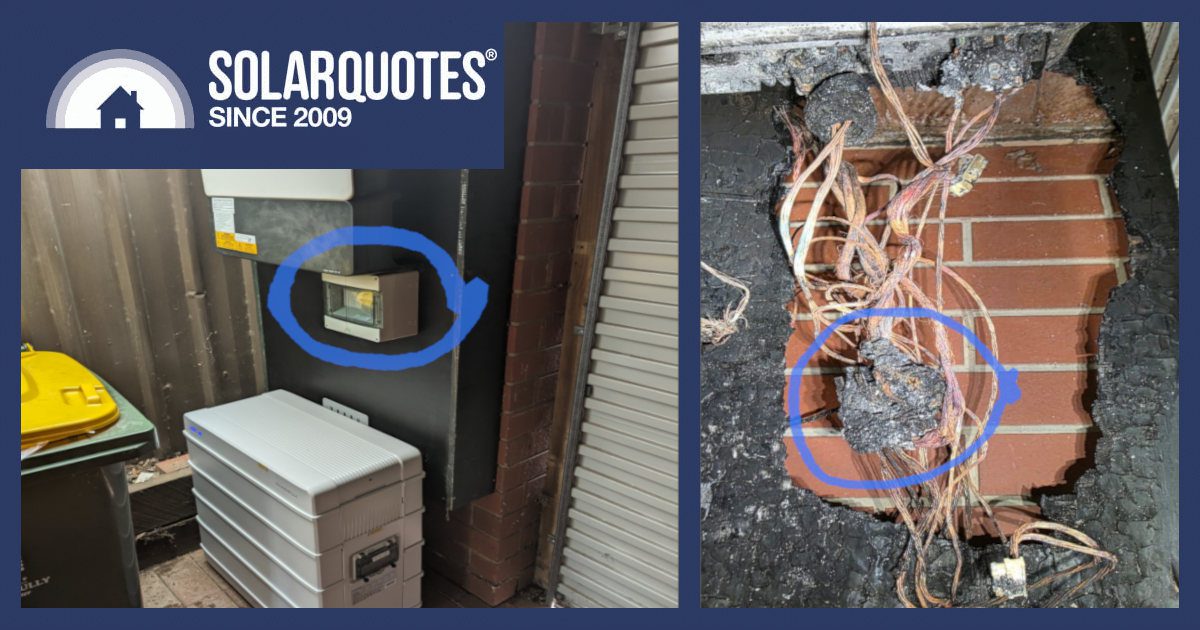
At 12:15 pm on a Monday, my wife Sue rang and told me our home battery was on fire.
When it was clear that Sue and our family dog were safely out of our home, and the firies were on their way. One of my first thoughts was:
“Oh, great. The Murdoch media and my mate Jamie are going to have a field day with this.”
Because when you’ve spent years talking about solar and batteries, having your own battery burst into flames would be just a little embarrassing.
Fortunately, it hadn’t. The short version is that the battery didn’t cause the fire and, as far as we can tell, wasn’t caused by the inverter either. While that was certainly a relief, there was still a fire right next to our solar and battery equipment, and some important lessons to learn from it.
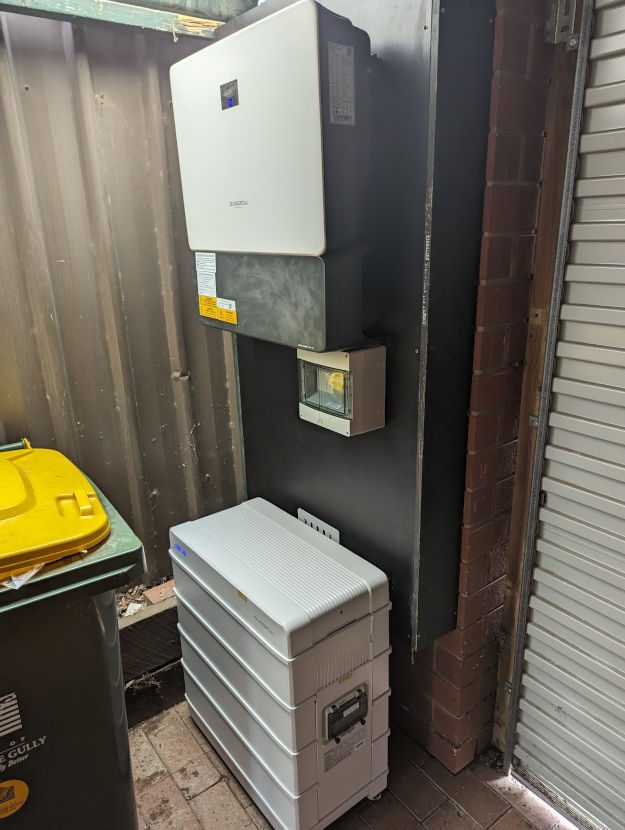
In the beginning, we had a 12.8kWh battery and a very neat installation with all cables concealed behind the industry-standard Formply mounting board.
No, It Probably Wasn’t Arson
After the fire was out and the immediate danger had passed, we started trying to work out what the hell had happened. Our resident fact checker, Ronald Brakels, suggested that, because I’d recently appeared on television criticising a solar retailer, perhaps it was arson. I think he was joking, although with Ronald, you can never be entirely sure.
But no, I don’t seriously think an angry solar installer crept into my garage and set fire to the isolator. The evidence points to an electrical fault. Exactly what failed, we may never know, as it all burst into flames.
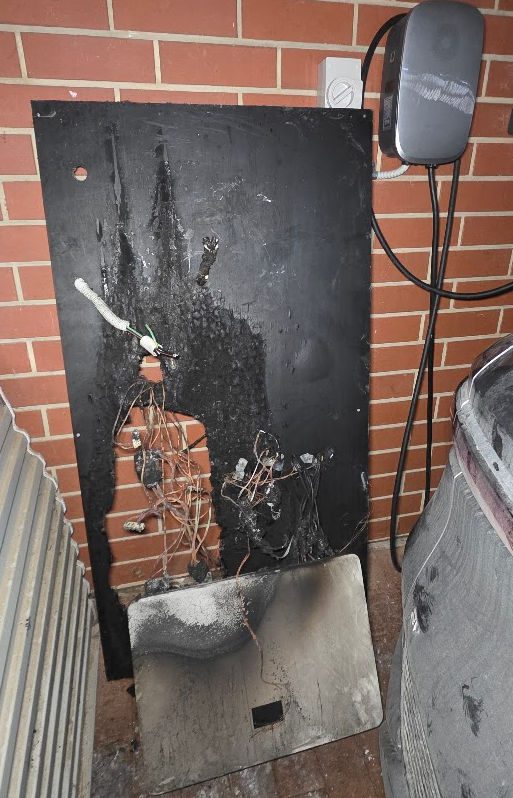
Once the flames were extinguished, the fire service rang for their on-call solar electrician to make safe and restore mains power. The remains were plonked upside down against the wall.
Getting Someone Competent To Look At It
Once I’d finished making insurance calls, I invited our resident installer, Anthony Bennett, to inspect the damage.
In considerably more colourful language, Anthony was quick to point out that he’s more of a farmer than a fire investigator, but he does know solar installations and has set many things on fire as a professional primary producer.
Looking at where the fire began, how it spread and which components survived, it seemed reasonably obvious that the inverter itself wasn’t the source. Despite the heat and flames around it, the inverter was still largely intact.
The AC isolator and breaker at the apparent point of ignition were not. They had been burnt to smithereens, which makes identifying the exact failure rather more difficult.
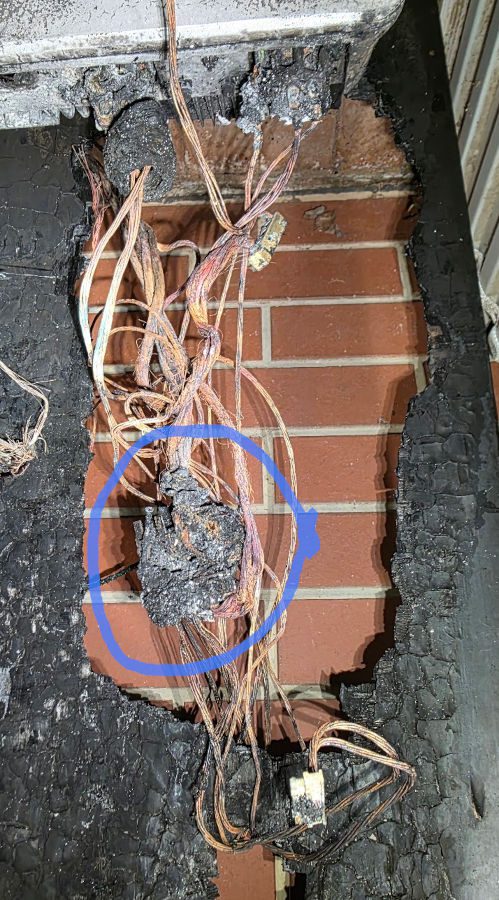
That blue circle used to be a few circuit breakers in an enclosure. This seems to have been the seat of the fire, from where the flames licked up the Formply board and fried the inverter.
As Anthony goes on to detail :
Looking at the remains of Trev’s system was both eye-opening and a bit frustrating. Everything was so thoroughly burnt that there was no telltale, no single point of failure. Often, a bad connection overheats; sometimes it arcs, fizzes, or burns, but it usually fails as an open circuit, so when the lights go out, things cool and the flames self-extinguish.
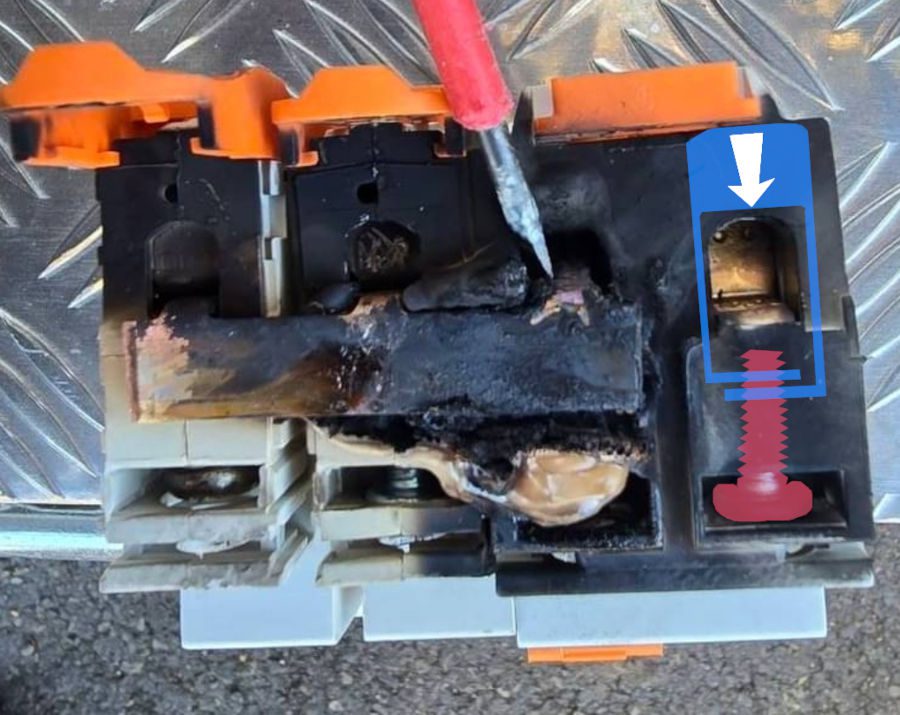
This isn’t Trev’s circuit breaker, but the screwdriver points to the failure, a connection simply left loose. I’ve highlighted the vacant terminal. When you tighten the screw (red), it draws the loop (blue) toward the tinned copper seat, which clamps the cable or bussbar tight.
When the electrician arrived, there was an obvious cause. In this instance, I could see the various cables going in and out of the inverter; the terminations in what remained of the circuit breakers appeared solid. There were ferrules on the flexible cables, and none of them was burnt open. I expect a poor connection would be blown apart, melted, and rounded off like an arc-welding electrode.
When I spoke to the Office of the Technical Regulator, they explained that electrical fires aren’t uncommon, but just don’t make the news much. They pointed out that compliant electrical products are flame-retardant, whereas cheap plastic is basically just fuel.
The best approach to prevent this sort of conflagration is to use quality equipment and to be doubly sure, get a thermographic report from a maintenance electrician every spring. It’s the law for places like nursing homes to do this, but the cost for a homeowner is probably a bit much.
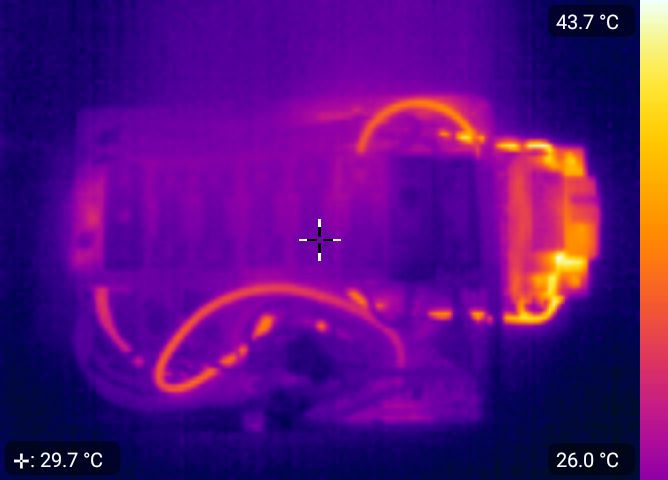
This is a thermal image of a hard-working single-phase solar-powered switchboard. The 63 A main switch on the left is warm, but the 40 A-rated inverter circuit breaker is carrying a continuous 8 kW or 35 A load.
You could buy yourself a thermal camera and have endless fun around the house for a week, but a homeowner can’t legally open the switchboard to get a meaningful image.
There Was A Serious Amount Of Power Going Through It
The fire happened on a sunny early-spring day. The battery was charged, the solar was generating strongly, and the system was exporting close to 10 kW to the grid.
It did that day after day through the previous spring and summer without a problem. But 10 kW is still a serious amount of power moving through cables and electrical equipment. Endless spring sunshine can also mean there’s no diversity. Unlike a simmering stove that cycles on and off, solar goes full steam, soaking everything with heat for hours on end.
The current working theory is that repeated heating and cooling may have caused a terminal to loosen or a contact to deteriorate, eventually resulting in a poor connection, which overheated. That’s my layperson’s understanding, not a confirmed technical finding.
Compliant Doesn’t Mean Nothing Can Go Wrong
To my knowledge, the installation was fully compliant with all the standards and best practices.
It wasn’t in a habitable part of the house. It wasn’t next to a window. It was mounted on a suitable backing board. There was nothing obviously dodgy about the installation.
But Anthony made one observation that has stuck with me; cement sheeting behind the equipment may have prevented the fire from spreading, or at least slowed it down significantly. The coating on the Formply is really tough, but it’s not fireproof, so once it got going, the plywood was fuel for the fire.
That’s one of the biggest lessons I’ve taken from this. Compliance matters, but it doesn’t eliminate every risk. A good installation should also consider what might happen if something fails anyway.
What’s behind the equipment? What’s beside it? Where could a fire spread? How close is the inverter to the battery? Is there anything practical that could contain a fire or buy people more time?
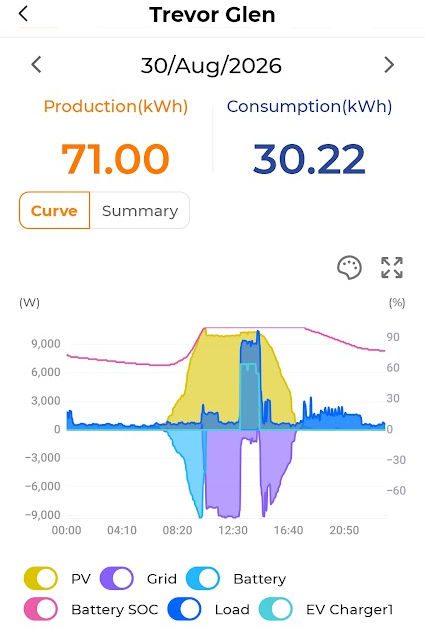
The day before, my system was cracking along. By 10 am, it peaked at 10.7 kW, the battery was charged, and it began exporting 9 kW to the grid for the next 3 hours. The EV harvested 7 kW from 1 to 2:30 pm, then the production tailed off.
We Were Lucky Sue Was Home
This is the part that I just don’t want to think about: what if Sue hadn’t been home?
She realised something was wrong when the power went out and acted very quickly. If the house had been empty, who knows how long the fire might have continued before somebody noticed?
It was close to the batteries and our EV. From there, it could potentially have spread further into the house. I don’t particularly enjoy imagining what that might have looked like. And could you imagine the news stories!
It also made me wonder whether we should have had a smoke alarm in the garage, connected to the alarms inside the house. If Sue had been elsewhere in the house, an alarm might have alerted her before the power failure did. If nobody had been home, perhaps it would have attracted a neighbour’s attention sooner.
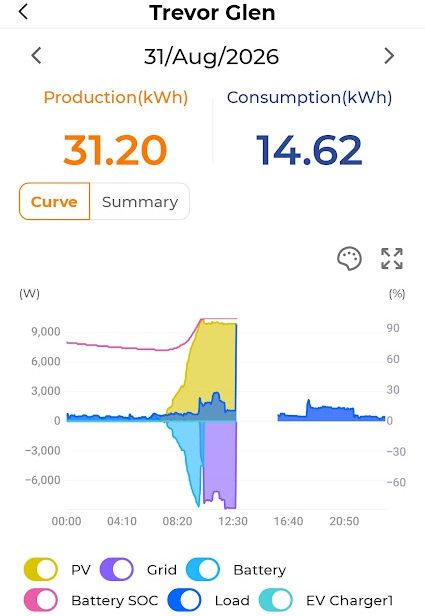
The next day was similarly great for solar. By 10 am, it peaked at 10.4 kW. The battery was charged, and it began exporting 9 kW to the grid for the next 2 hours before a fire caused an abrupt stop.
So, What Should Homeowners Do?
I’m still confident we chose good equipment and used an extremely competent installer. And yet, something still caught fire.
That doesn’t mean solar and battery installations are inherently unsafe. But it is a reminder that solar and battery installations handle serious amounts of energy, and no electrical system is entirely without risk.
Choose your installer carefully. Choose reputable equipment. Have the system inspected and maintained.
But also think about what happens if something goes wrong:
- Where are the inverter, battery and isolators installed?
- Are they accessible, and do you know how to shut them down if needed?
- What materials are behind and around them?
- How easily could a fire spread?
- How quickly would somebody inside the house know?
- Is there an appropriate way to detect a fire earlier?
- Could fire-resistant backing or better separation reduce the consequences?
We were lucky. Sue was home. Everyone got out safely. The fire brigade arrived1, and the flames didn’t reach the batteries, our EV or the house.
The point isn’t to frighten people away from solar or batteries. It’s to learn from a near miss instead of shrugging our shoulders and pretending that compliance means nothing can ever go wrong.
While we might change a few things on the new installation, this event hasn’t changed my opinion of home electrification. I’d have to hand in my resignation letter if it did.
The future is undoubtedly electric, but holy shit, things can still be dangerous.
Footnotes
- A big shout out to the girls and boys from the Golden Grove fire and police stations ↩
 RSS - Posts





It’s curious that your installation had been operating for at least half a year before catching fire. Could something as innocuous as clouds have cycled the temperature a bit lower on previous occasions? Or oxidation slowly increased joint resistance?
Here there was a faint “burning plastic” odour within a week of installation. Called back, the installer found that he hadn’t adequately tightened one of the high current 48V DC terminals on an inverter isolator. The thumb-thick cable’s insulation was the cause of the odour, but the isolator terminal’s plating had oxidised, indicating high temperature. The isolator was replaced.
The installation is indoors, in the workshop between kitchen and garage, trafficked several times daily. Frequent olfactory inspection, with telltale odours contained indoors, did in this case rescue the situation early. The energies involved are substantial, and loose connections are dangerously incendiary, even without arcing. Awareness is safer than luck.
Hey Erik, it was actually closer to 3 years without incident.
Thanks for sharing your story, too. The more we are aware of the risks and scenarios, the safer we’ll all be.
First thing I did after our solar Battery and system was installed underneath our old Qlder home was to buy and install another wi fi linked Smoke Detector connected with the existing house system .
Next time somebody tries to sell me solar I will say have you heard about the solar quotes fire?
Hi Colin, this is why I wanted to share the story. We can’t be too careful with these installations.
Am I getting a new inverter, and would I still recommend getting solar? Absolutely.
Should you go with the absolute cheapest system? I would suggest not.
Trevor,
Apropos “cheapest system”, I take your safety point. Also, today’s gloomy overcast with (extremely welcome) continuous rain, reminds me of the other cost aspect – bad weather yield. OK, only critical off-grid, but grid draw is a cost too. And it could be down in bad weather.
In today’s rain, the yield from 27 kW of panels peaks at 1 kW, but that is enough to run the aircon for warmth, and the microwave & kettle for food & drink. The battery remains at 100% SoC.The HWS will admittedly need a boost from the wood heater if it’s still raining tomorrow, unless I risk drawing down the 46 kWh battery for low-grade energy. (The BEV is close to 100%, so mobility isn’t at risk.)
Battery costs are falling. An expandable system is highly advisable, as our use of electricity will rapidly grow now. (Not least BEVs & aircons)
Niño 3.4, i.e. mid-Pacific SST is now projected to hit +4°C, 160% of previous record. The effects may be educational this summer. Stay tuned.
Colin,
For now, you can have three hours of free solar power daily, without an own installation, thus only the electrical fire risks inherent in the existing AC wiring and appliances. (My SIL had one in the buried supply main, quite expensive to dig up & fix, but insurance paid, happily.) In a few years, as coal burners crumble, you’ll have 98% renewable energy without personal investment, just ongoing purchase cost.
The big solar risk was PV isolators on the roof, due to water ingress. That is now history.
It’s worth remembering that ICE cars suffer 25 times as many fires as BEVs, so quite a lot of high octane reporting is skewed at best. Lacking sufficient sun, Poland is spending billions on nuclear reactors now, hoping for a 10 year build at best. (2 yrs approval elapsed already) It is a long wait compared to China installing a GW of solar in 30 hours or so. And batteries don’t glow in the dark. Recycling is also much safer.
Fusion power, freely distributed, is here now.
If I am not mistaken the usage chart shows part of the story.
Load going to around 10kW (blue line) just before loss of monitoring. I dare say whatever fault did occur the battery was dumping itself into it.
Smoke detector to the garage was one of the first things I added. So far it hasn’t false alarmed but if it proves to be an issue will change to heat detector.
Large lithium rated fire blanket and a 9kg extinguisher.
As an electrician I have attended quite a few failures, getting to that sort of degree is fairly rare. Its more often a few melted parts internally.
Hi Darren, I don’t think it’s the battery, I think it’s all the solar going into that AC isolator (IMHO).
I think we were both very unlucky and very lucky in this case… But I will certainly be taking advice such as yours with the next install.
You’re the first person I’ve seen mention fire blankets. That is my plan (just got an all-in-one battery in garage).
Simple plan: attach blanket to wall just above the battery. Roll up and tie it with string. A fire would burn the string, dropping the blanket over the whole unit.
Low tech but highly reliable , importantly, zero maintenance or batteries required. Might not stop a fire but will at least buy time time to respond/escape.
One thing that’s really important is to tighten all connections to the manufacturer’s specified torque, not just by feel. And to check terminal torque again later. And yes to a interconnected smoke detector in the garage
> It also made me wonder whether we should have had a smoke alarm in the garage,
I considered this too, but wondered if the carbon monoxide from my ICE (second) car would set it off??
Some people have a welder in the garage as well. Was it in In NCC Volume 2 that I read a recommendation to use a heat sensor instead of smoke in the garage? I admit to just having a smoke sensor, and doing the welding in the open roller-door.
Entering a short garage forwards, and immediately switching off the ICE, ought not trigger a smoke alarm, I’m guessing.
Oh-oh! Just remembered that the little Honda backup generator is in the garage, 8m from the smoke alarm. It might be a good thing that I haven’t needed it in 2.7 years of off-grid 100% solar living and driving. A shed is needed for the poor old tractor out in all weather. I could connect the shed, and move the generator out there. (More tempting is another 20 kW of PV and a 3 phase charger. That would be very handy when diesel is sold by the half cup.
Sigenergy is said to not be off-grid rated, so its 25 kW DC charger is probably not an option?
22kw DC after a one-off software unlock. If you need more, public charging is your best bet. The DC bypasses the home entirely, decreases losses and obviates the need for 40A continuous on a consumer circuit breaker
Not finding a 4.5 or 6 tonne electric excavator, I might have to sneak up on an EV conversion of a diesel unit. Electric motor low-end torque lets 40% of engine power to do the job, i.e. 39 kW -> 16 kW. One 20 kW kit uses a 96V battery, which I might be able to charge as two 48V stacks, with nothing more than some Victron MPPTs off a pair of PV arrays on the shed roof.
It’s not so much the efficiency loss of inverters and high power AC chargers, as their cost, which is best avoided.
And putting up to 150A into each 48V stack, via 175A Anderson connectors or better, can approach 15 kW on a sunny day. How much battery can fit where a diesel engine and fuel tank were? Provide battery swapping? Tractor has forks.
An adaptor plate for the hydraulic pump is easier than motor fitting to a car transmission. Hoses allow it to then be stuffed in a corner.
Lots to be sorted out with favourite Chinese supplier. Best to have all the bits when up to armpits in the job. It’ll take some time.
Great thinking, I was wondering about AC charging at 11kW, but continuous through consumer circuit breaker doesnt bode well.
I think you’ve convinced me to go the DC 25kW from the Sigenergy Battery. Its just the cost that sucks but is also future proof when 25kW is really needed.
I’m glad it wasn’t worse, it will cost you a few bucks to put right, but at least you wont be living in a motel for 12 months waiting for your insurer to get around to building you a new house!
I am assuming if you were exporting 10kWh of power you have a 3 phase system? Was it being exported on one leg or across all 3?
Hi Andrew,
This one is single phase with 20kWp of solar to drive it.
So at the time of the fire it would have been push 9+ kW or about 40 Amps AC.
(Trev and I were both impressed last season to see it yield 9kW to AC loads and another 9kW DC to the battery simultaneously)
Thanks for sharing, we all learn from these stories. A simple sheet of FC over the customary Formply is a smart addition. Mounting power electrical equipment directly onto a combustible material seems like a poor choice, whether AS 5139 allows it or not. In fact some manufacturers specify :”a firm, non combustible surface ” Cheers
I can’t think of a WORSE building material than Formply to mount electric equipment. Formply is intended for forming up wet concrete. As such it has a moisture resistant surface. My gut feeling from working with the stuff is that the surface coating is a petrochemical product. When new it’s oily, almost bituminous. As such, I expect highly flammable.
Bring back asbestos! That resists a blow torch 😉
Seriously though, what happened to ‘white zelemite’? I thought that was asbestos-free. Can anyone confirm?
The coating on formply is a phenolic resin-impregnated paper film, like bakelite, which is a great electrical insulator.
It’s so tough, you can clean it with high aromatic solvents like automotive brake cleaner.
Certainly not bitumen.
Bakelite is a rigid, thermosetting plastic created from phenol-formaldehyde resin. Formply’s coating uses the same core chemical family (phenol and formaldehyde), though instead of being a thick, solid moulded plastic like Bakelite, the phenolic resin is impregnated into a paper or fibre layer and hot-pressed onto the wood.
Phenolic resin coating exhibits high thermal stability which can handle moderate and short-term heat, the underlying wood core will still char, burn, or degrade if exposed to open flames or high temperatures for a prolonged period.
While we’re mentioning welding in garages, this clip claims that brake cleaner and welding are a potentially lethal combination: https://www.youtube.com/watch?v=rp6JyEdfjAQ
The full symptoms described might need significant exposure in a closed space, but I’ll avoid it entirely, thanks.
It’s a bit like burning PVC – that generates carcinogenic dioxins, very nasty stuff. Avoiding chlorinated hydrocarbons is one of my hobbies. (He says, while half way through laying PVC stormwater pipe in a ditch niftily dug with the electric excavator, 100% photon powered. Shouldn’t be any fire down there.)
Exactly my take on the description of the backing – not non-combustible, the opposite – and I believe non-complying, certainly in NSW.
What do you techies say?
I was advised by the MFS in Adelaide to install a heat detector and not a smoke detector in my garage where my solar battery is located.
Apparently, a smoke detector is more likely to false alarm in a garage.
My system is mounted in the garage on a fire rated party wall. When the installer was doing the prewire he mentioned the surface of the wall had to be fire rated so I installed Fyrchek gyprock. Easy to incorporate in the build process. Plywood doesn’t sound like a good choice.
I haven’t installed a fire detector, however after reading this I definitely will be. Thanks for the awareness raising article.
Ive installed heat detectors and linked to my smoke alarms. we live across 3 levels and wont know there’s a fire until too late. smoke alarms are useless in a garage.
Im thinking of getting 3 more heat detectors and spread around garage near battery on each side, and one outside the garage.
If your battery and EV caught fire the house could be gone in minutes.
Hi Stuart,
Do you have a weblink for the devices you’re using?
its the Red Smoke Alarms – 10 year Heat Alarm RF Wireless, so i have several interlinked. with remote for those inevitable 2am alarms.
I wouldn’t recommended red smoke alarms, the ones we had installed false alarm consistently in high humidity, usually at 2 or 3 am, and the company just fobbed us off when we tried to get them to fix it.
For high current aplications, getting a corrctly tensioned connection is essential.
One, not so obvious trap is simply to use the wrong tool.
A philips screw and a posidrive screw can supperficially look the same – however using the incorrect driver is likely to result in either an under tightened connection at best or a damaged screw head that can never be probably tensioned.
As a manufacturer of high current motor controllers, the single greatest failure mode was inadequately tensioned customer connections.
While over heated connections were the common result, ocassionally this would result in an ignition.
Interestingly, as a direct consequence of this customer induced failure mode, I used the onboard eectronics to detect and safely shut down the load current.
While this may have annoyed a few customers, it put an end to this type of failure and educated customers to correctly tension all current conducting connectors.
Perhaps this could be incorpoated into the inverters?
Hi John,
Some inverters have optional arc fault detection on the DC side I know, but arc fault detecting circuit breakers in the main switchboard are the next step I imagine.
Though I’m semi retired I worked as a reliability engineer on locomotives (the big things that haul wagons). One of my biggest problems and cause of electrical issues were low voltage elects working on fairly high voltage equipment (DC and AC). A connection not centered properly, torqued properly or lugged properly would eventually fail. If a traction motor or capacitor it would blow the cr*p out of it, if a motor etc. it would burn out the connection and the wire. These connections can run for years building resistance that eventually hardens and breaks down causing even more resistance and heat until one day – it burns or blows.
I worry about auto elects working on electric vehicles and housing elects working on higher Voltage DC solar and batteries without appropriate training and knowledge on how very critical those connections are.
Hi Paul,
I’d love to get a reference for some decent termination training. I’ve done many connections and seen a lot more that are surprising they still work, but I don’t feel it’s well explained in trade schools.
Hi Team,
I have 6k6W PVA + 5kW hybrid inverter + 12k8Whr batt mounted on external brick wall in the open carport and my main concern is that the installer drilled holes and ran all cables through the brick into the cavity (which is open to the roof space) thus rendering any melt-down certain to cause maximum damage by being both hidden and inaccessible.
I also own and use a thermal imaging camera costing <$200 for all manner of investigations including as frontline electronic circuit board diagnosis & servicing – next sunny day I will be checking my solar installation and 24 breaker switchboard.
Heat detectors (aka thermal switches) cost a pittance and can be inserted absolutely anywhere at mains or independently at LV as automatic safety switch or to trigger alarms… auto or manual reset, here is a sample:
product-name
KSD97-145 T/STAT 145 DEG KSD97-145 $1.36
KSD97-135 T/STAT 135 DEG KSD97-135 $1.36
KSD97-125 T/STAT 125 DEG KSD97-125 $1.36
KSD97-115 T/STAT 115 DEG KSD97- 115 $1.36
Thanks Bob,
Cables in the wall cavity are pretty safe, the breakers themselves are the part that’s failed in this article. Your equipment being on a brick wall is also pretty safe. (unless they’ve perhaps removed a whole brick for access to the cavity)
Bob,
When I built a few years ago, a firewall was required between the workshops and living area. Where cables penetrate, fire-resistant caulk was used to seal all openings. I used the same stuff to seal all building envelope gaps down from the required “2mm max” to nothing. It’s available in caulking gun tubes, from hardware stores – Bunnings anyway.
For larger apertures, they also have spray cans of fire resistant foam. A light water spray beforehand is supposed to increase the generated foam volume a bit, but I’m not impressed. It was about $40 per can, and expansion seemed less than the claimed 3:1.
If that IR camera works well, any hints on where to find it?
Here in Victoria I believe smoke detectors are required to be installed above lithium batteries.