

Last week the Australian Competition and Consumer Commission (ACCC) published a 114 page report on the electricity market which uncovered the following insights:
- People bought lots of batteries after the battery rebate came out
- People with batteries have lower bills than people without
- People on VPPs have even lower bills.
And revealed the following problems:
- Complaints about dodgy battery sales and installs went through the roof after the rebate
- VPPs are not taking off like the industry had hoped because folks are reluctant to give up control of their battery
- VPPs are hard to understand and compare, and some consumers are getting dodgy deals.
I hate to think how much money and effort was spent writing that report – but 5 minutes with anyone sensible in the industry could have provided those insights for free.
This week I’ll discuss the first problem identified by our bureaucratic super sleuths – the dud installs – because the diagnosis was never the hard part. The prescription is, and that is where the ACCC has got it wrong.
The ACCC’s Plan For Dodgy Battery Installs
The ACCC wants a mandatory code of conduct for battery sellers offering the rebate, built on the NETCC solar + battery code it already sanctions. Then the same again for VPPs.
Think that’s enough paperwork? Oh no… There’s another wad of rules proposed that all battery sellers offering the rebate must sign in blood – called a ‘consumer duty’.
Finally the energy ombudsman schemes – which currently only cover electricity retailers and networks will be stretched to drag in the battery installers and sellers too. In other words, they propose that installers, good, bad and ugly, will have to pay for yet more memberships – potentially 3 different bastard-sons-of-NETCC, then a ‘consumer duty’ promising to put the consumers’ best interests first and finally membership of an ombudsman in every state or territory they operate in.
Every piece of paper waits for the rules to be broken, the harm to happen and tries to put out the fire afterwards, once the customer has already been burned.
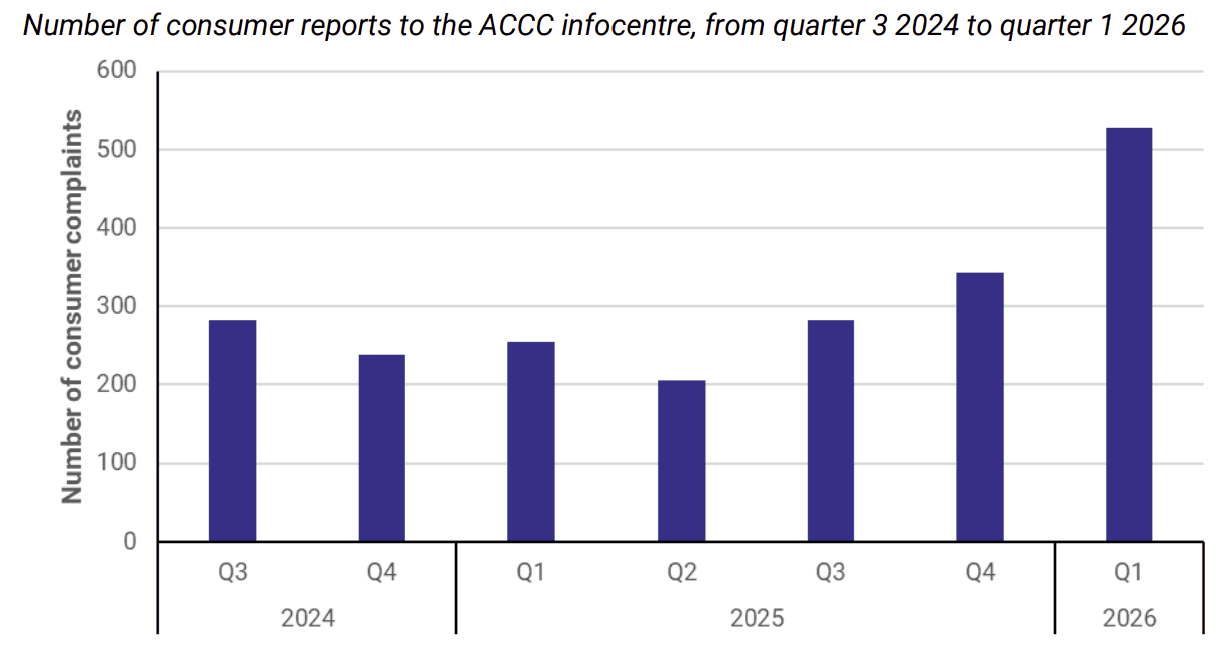
The ACCC report highlighted a 107% increase in consumer reports about consumer energy resources over the past 12 months.
The Problem With The Code Of Conduct
Before we get to the fix, look hard at the tool the ACCC leans on right now to keep solar sellers honest: the New Energy Tech Consumer Code (NETCC), the solar+battery code, administered by the Clean Energy Council. The ACCC assessed it as part of the 114 pages, and its own verdict is savage. This is what an industry-run code looks like once it meets the real world:
- It is voluntary unless tied to a state rebate or other scheme.
- The audits are questionnaires.
- A customer with a complaint gets no recourse to independent external dispute resolution through the code, and no right to appeal the administrator’s decision.
- Most breaches stay secret. Anything short of suspension or expulsion is never made public.
- Signatories can resign while they are under investigation. The code’s ultimate sanction is being thrown out of the club, but the operator about to be thrown out can quit first.
The Problem With The Ombudsman
Right now the ombudsman gets sold as the backstop if sellers breach a code of conduct or the proposed duty-of-care, but the report’s own case studies show it often cannot touch the problem. State schemes like EWOV in Victoria and EWON in New South Wales only have power over electricity retailers and distributors. When the fault sits with the installer or the seller, which is where most of the harm starts, they have no jurisdiction, and the customer gets sent sideways to a fair trading office or a tribunal that warns of a year-long wait.
To its credit, the ACCC wants to close that gap. It proposes new laws to compel battery sellers and installers to join the ombudsman schemes, the same way retailers already must. Fair enough as far as it goes. But look at what it actually is: a plan to make every seller and installer pay into a bigger complaints machine that still only starts working after the customer has been stung, and will only be used by the misbehaving few, mostly paid for by the well-behaved majority.
The Problem With The ACCC And Vetting
It is worth being precise about why the ACCC reaches for codes and duties. It is a competition and consumer law regulator. It does not run licensing schemes or hold a register it can strike people off. Vetting installers is licensing, and that sits with the Clean Energy Regulator, the state electrical licensers, and the National Technical Regulator now being established. Codes and duties are the only tools in its shed.
The trouble is that the body that could vet is standing right there, handing out the money.
Every one of the rebates flows through the Clean Energy Regulator, via the STC mechanism.
Make access to the money conditional on being good. Vet the installer before they get near a switchboard, and most downstream problems go away. When a bad ‘un gets through the Ombudsman needs to share the info back to the regulator so they can continuously improve their vetting.
NETCC RIP?
To be fair, the ACCC is not proposing to copy the NETCC shambles. Its mandatory code would have to fix every leak in the NETCC: an independent administrator in place of the industry body, external dispute resolution, public reporting of breaches and resignations, periodic independent reviews. On paper, a proper watchdog.
But in reality it’s a whole new institution to design, staff and fund.
Vet at the gate and most of it becomes unnecessary. You don’t need a rulebook telling the survivors not to be cowboys. So bin the codes and keep one thing.
A Simple Customer Duty Of Care Could Work
What you keep is the consumer duty. A duty is a single obligation: act in the customer’s best interest. You are judged on whether they ended up with a fair outcome, not on whether you ticked every box.
The ACCC’s version is described as a duty underpinned by supporting principles, with guardrails, designed and distributed in a consumer-centric way. That is a sentence that needs its own consumer duty cuz I sure don’t understand what it means. I suspect it will end up being a really long document that no one reads and everyone signs.
I propose one-pagers. One page each for solar, batteries and VPPs, in plain enough terms that a customer can hold the installer to every line, and so everyone is on a level playing field when quoting. It is what every good installer or salesperson knows they should do – but in the heat of the sale can forget or skip – especially if you know you are up against someone that will skip all these and wing it on the day of install.
Here is a battery one off the top of my head:
The Battery Installer’s Duty Of Care
Do right by the customer. On a battery job, that means:
- Do a site visit before you quote. No exceptions.
- Agree the mission first: self-consumption, energy trading, blackout prevention or all three. Everything else follows from that.
- Talk through tariffs and VPPs so they understand the options.
- Confirm the system design and hardware supports the tariff or VPP they choose, before you quote it.
- Match the battery to the solar array. Only pair a small array with a big battery if the strategy is charging from cheap or free grid power.
- Account for the main breaker. Quote to upgrade it, or add dynamic load control, if the load needs it.
- Explain how backup works, and be honest about what it will not run.
- Raise EV charging. Agree how an existing or new EV charger will work with the battery.
- Factor in temperature. A battery baking in the afternoon sun is a battery that dies young. A battery without a heater in the cold is bad news.
- Agree the battery location before quoting.
- Consider any dynamic or fixed export limits the DNSP imposes, so it can maximise ToU feed-in rates – if that’s a use case.
- Commission it properly. Complete the checklist, share it with the customer, walk them through the app before you leave, and stay reachable after the install.
Not dozens of pages. No detailed explanation of how to do each step – because the good guys don’t need to be hand held. No stupid pyramid diagrams. A sparky and salesperson can work to it, a customer can ask whether each line was done, and a regulator can enforce the spirit of it without a flowchart.
The Catch
Proper vetting is not free. Fewer accredited installers, higher prices, upset rejected battery retailers.
But a rebate that pays for dud installs, then asks the taxpayer to pay again to adjudicate the complaints, is worse in my opinion. Gatekeeping has a body count. So does letting the cowboys in.
Disclosure: I founded SolarQuotes and its core product is vetting installers. So “just vet them” is a conclusion I am rather fond of, because it works. If it didn’t, I’d have been bankrupted by the Good Installer Guarantee many years before I sold to Origin.
Phase Shift is a weekly opinion column by SolarQuotes founder Finn Peacock. Subscribe to SolarQuotes’ free newsletter to get it emailed to your inbox each week along with our other home electrification coverage.
 About Finn Peacock
 RSS - Posts






Good article. Those advertised 50kWh home batteries paired with 5kW inverters, that’s something that needs addressing.
Yes, seeing lots of people on Facebook community groups asking for recommendation on who they can get to come and get their no name battery and solar systems working as dodgy brothers installers have shut up shop and moved onto the next easy racket.
* VPPs are not taking off like the industry had hoped because folks are reluctant to give up control of their battery
* VPPs are hard to understand and compare, and some consumers are getting dodgy deals.
For sure these are tied closely, I for one would not trust a retailer (or wholesaler for that matter) with my battery.
All well and good to help the grid with any excess battery, a win win and easy to drop some Kwh to the grid in peak times yourself.
Through 6-9pm-ish there are some good deals.
My concern is the way govco is after everyone’s $, and looking for energy stability / lower costs as promised, they might well mandate VPP down the track if these are not attractive enough to risk your investment in a battery, on top of the solar cost.
A condition of battery rebate ‘must be compatible with a VPP’ could be construed as being included for the battery owners benefit, through to as far as letting them have access / full control over a whole lot of rooftop power generation.
I would not sign up for a VPP and it took me a long time to accept variable rates. Now, though, I am on the Powercorp Night EV plan and it makes an awful lot of sense with the 5.8 kW solar and Tesla 3 Powerwall. I have handed control over to Elon but I am happy, Powercorp is happy, the environment is, a bit happier, and I can opt out at any time. And I fill my car up with e-petrol at a cost of US twenty cents per gallon.
The Magic Petrol Fairy
I’ve a fairy in my garden
She really is alive
She lives behind the chimney
Halfway up my drive
There is no other fairy
Who ever could be sweeter
She fills my car with magic fuel
At fifty cents a litre
She makes the fuel up on the roof
Just above my yard
No risk of drones or privateers
Or US Coastal Guard
The magic fuel protects my car
And stops all engine wear
The garage scarcely sees me
I’m hardly ever there
The motor gives off lots of power
Thanks to the fairy’s spells
My car drives quietly down the road
And never, ever smells
Yeah Tim, a lot of options open up when one gets a battery . . . I am nearly there taking the leap, having now lost many of the solar only benefits in SA with it’s very high peak TOU tariff over 57c, and now 1c FIT.
We are on the AGL Night Saver EV plan, and with 2 EVs to charge it is the best plan for us at the moment.
It costs slightly under $200 per quarter to keep them charged (no other public charging) and that in itself compares to roughly $200 per month for EACH relatively economical ICE vehicle.
Ok, our power bills have gone up a couple of hundred, but real cost is 5 x less to get around, $1000 a quarter saved from the household costs.
All things considered, we require the grid and 8c for EVs, with a battery we can eliminate all our power needs for the rest, putting avg 50% of our generation into the grid on most winter days, exception is those full on rainy, dark grey cloud days.
I never understood the concept of NETCC that is supposed to bite the hands that feeds them. Yet, the government HEAVILY relies on them to be the cops. Mind-boggling.
In your chart of complaints, it would be interesting to see a breakdown by states. I’m pretty sure it would be single digits in VIC where every installed is checked.
Maybe they should start with this. Everything else is just wasted paper.
Is the “solution” is to introduce new taxes and burdensome paperwork on installers… sigh… It will achieve the complete opposite outcome.
Gudday Finn,
I do like your ‘one page’ approach. Don’t just limit it to solar and battery installs. One for HP HWS, another for ACs. Basically anything where there are government rebates involved.
I do, however, see some drawbacks, especially to your point one. I’m a big fan of pre-quoting site visits for my house due to a complex two-story layout and steep block situation. But for those working at the small-end-of-town it would add $$$ to the quoting process on a straight forward 5 or 10Kwh battery install. Perhaps a threshold of 12Kwh?
Please keep up the thought-provoking posts. I’m looking forward to your next article which will no doubt be on legalising Balcony Solar in Australia.
You have define the problem in the complete system well.
As I see it the authorities sit in cosy jobs with huge tax payer salaries. They see the end users (homeowners) as cash cows that can be milked endlessly instead of analysing it as a complete system and realise that whatever paperwork, no matter how useless or in affective it may be, someone with have to bear the cost and as always it would be the taxpayer.
Hope they will read your article and heed your advice to vet the installers and other people, retailers and wholesalers, before they appoint them. Otherwise they should then resolve the problem that they have created and pay, hopefully out of their own pockets, to fix the problem to a working solution for the homeowner or end user.
The same should go for the authorities that try to solve the grid and retailers. All that has happened is that daily charges have increased, the retailers makes more money even if you do not use power from the grid.
What’s to stop a VPP having a “drink” and then selling it straight back during peak hours?
It is something i have seen a few people complain about on social media – the VPP tapping down their battery and leaving them having to buy power at the end of the expensive period, or shortly after in the shoulder period – costing more than what they got paid.
Been a few people complain that their battery has been force charged for an upcoming event that didn’t eventuate as well – also costing them money.
Does it happen often ? No Idea
Was it just because possible people didn’t understand how they set things up with the VPP company? Maybe.
Should the VPP company actually look at the persons usage patterns when signing them up and say hey – taking that much puts you at risk of … are you prepared for that, or should we lower the number? – Absolutely.
Are they? If you believe that I have a bridge for sale…
On a number of occasions, sufficient enough for me to question why, when I was looking at the Summary Solar, Home, Powerwall , Grid summary against a Home background and as it happened the observations were during Peak periods, there would be an export to the Grid for which were immediately followed by imports from the grid. The duration of theses episodes appeared to be were variable in duration and random during peak periods.Theses were separate from the activities associated with being on a VPPN.