
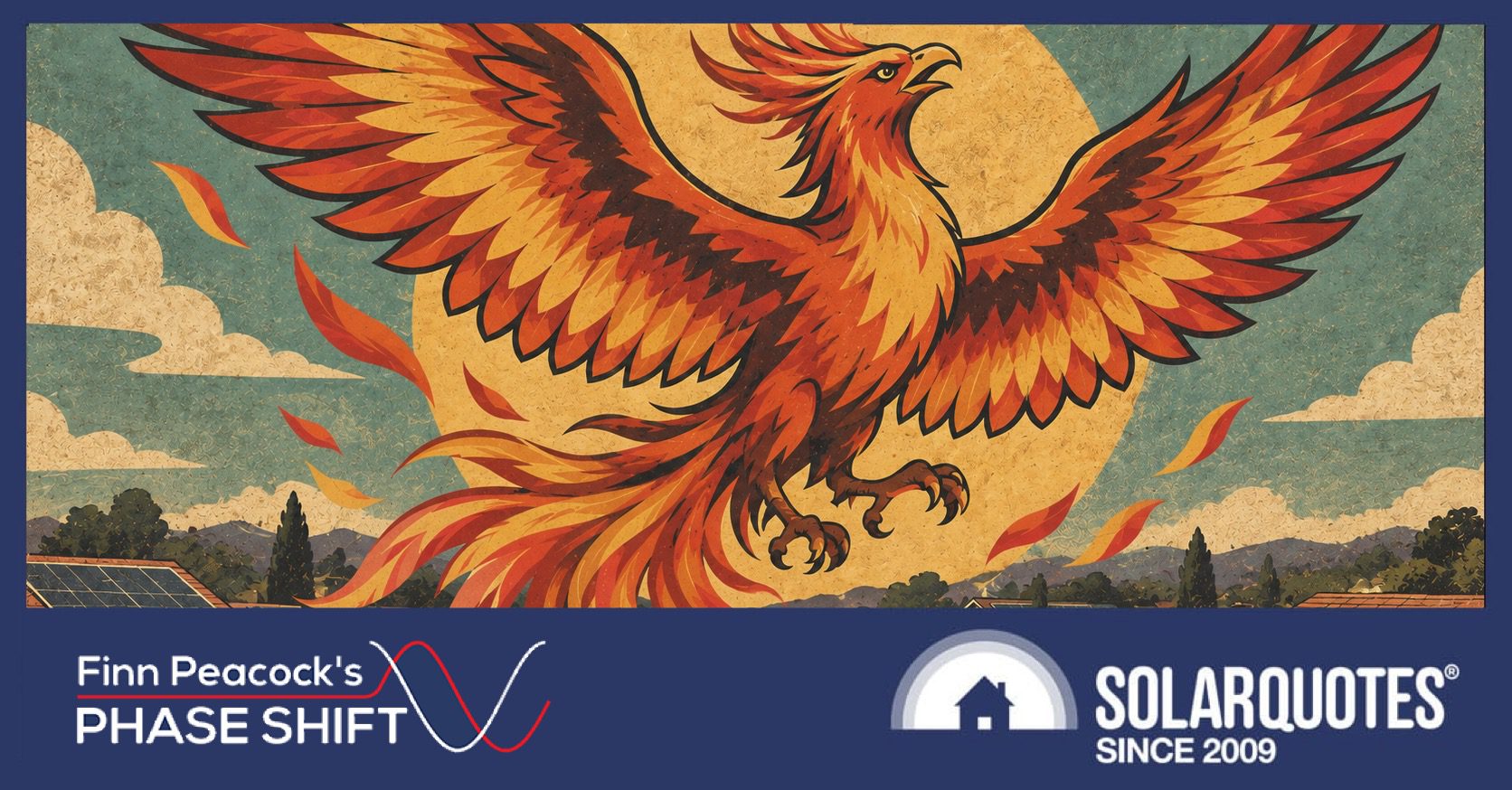
There’s a business model in the solar industry I’d love to see burn to the ground. Trouble is, fire is how it survives.
It’s called phoenixing. A shonky company racks up debts, dies owing everyone, then pops up a week later with the same team, the same phone number and a slightly different name. Like the mythical bird, it rises from its own ashes. Unlike the bird, it sets everyone else on fire first.
If you’re buying solar or a battery, you need to know how to spot these grubs, because when a phoenix rises, your warranty stays in the ashes. It takes five minutes and a free government website.
Phoenixing explained
A company is its own legal “person”. When it goes broke, its debts die with it, and the directors keep their houses. That’s limited liability (the ‘Ltd’ in Pty Ltd), and it’s the reason anyone dares to start a business.
Phoenix operators abuse it on purpose. They run up bills with suppliers, subbies and the tax office, shovel anything worth having (the brand, the website, the phone number, the customer list) into a fresh company for peanuts, then liquidate the old one with an empty bank account. Monday morning, business as usual.
Why solar cowboys love it
Solar is phoenix heaven. Anyone can start a solar retailer with a few hundred bucks in ASIC fees, some bought leads from a dodgy lead-seller and subbies. The customer pays up front. The wholesaler and the subbies wait 30 days or more.
The wholesaler who supplied the panels pays for it1, so does the two-man install crew still chasing 15 invoices, and so does the ATO, which means you and me. A 2018 PwC report put the cost of phoenixing at up to $5.13 billion a year, most of it unpaid bills to other businesses.
And then there’s you. Your workmanship warranty was a promise from a company that no longer exists, and the new outfit with the same logo owes you nothing. Your panel and inverter warranties survive, but good luck finding a decent installer keen to adopt someone else’s dodgy job. The Australian Consumer Law right to compensation I wrote about recently is worth what’s left in the company’s bank account. Nothing.
How they get away with it
Phoenixing is illegal, and laws passed in 2020 tightened the screws. But they usually get away with it anyway, for some depressingly simple reasons:
- Liquidators get paid from what’s left in the company. A phoenix leaves nothing, so often nobody digs.
- Nobody sane spends $100,000 on lawyers to chase a $30,000 debt.
- The director on paper is often a spouse, a brother-in-law or a mate, while the real operator pulls the strings.
- The slick ones put the company into administration with a friendly administrator, who sells the brand to a relative for a pittance “to raise money for creditors”. The 2020 claw-back rules don’t apply to sales made by an administrator.
Even when ASIC nails one, the maximum ban is five years.
The regulators won’t save you.
How to spot a phoenix before you sign
Grab your quote and open ABN Lookup, the free government register.
- Get the ABN. It should be on the quote. If it isn’t, next quote.
- Check when the ABN went active. It’s on the “ABN status” line. If the website says “Proudly serving Aussie families since 2009” and the ABN went live last year, someone has some explaining to do.
- Check the business names and their “from” dates. If the business name only got attached to this ABN recently, the brand has moved ABNs. This also catches the crafty ones who park the business in an old dormant company to make the ABN look respectable. Since November 2025, ABN Lookup only shows registered business names, so if the brand on your quote isn’t there at all, ask why.
- Search the brand name with “Include cancelled ABNs” ticked. A trail like Ronald’s Solar Pty Ltd (cancelled 2021), Ronald’s Solar Group Pty Ltd (cancelled 2024) and Ronald’s Solar Australia Pty Ltd (active since 2024) is a bird that’s been on fire before. So is a dead company renamed to a number, like “ACN 123 456 789 Pty Ltd”, formerly Ronald’s Solar Pty Ltd. That often means the name was flogged off before the company died.
- Look up the dead ones on ASIC’s free company search. It shows their status and the documents they’ve lodged, including any liquidator’s appointment. For a few bucks, an ASIC extract tells you who the directors were.
- Compare the old directors with the new ones. Same names is a red flag. So are matching surnames and home addresses, because the “new owner” is often family.
- Run the directors through ASIC’s free banned and disqualified register.
Alternatively, paste the above into AI and get it to check for you.
A new ABN isn’t always dodgy
Before you write off every installer with a young ABN, a caveat. An ABN belongs to a legal entity, and honest businesses change entities all the time. A sparky who’s been a sole trader for 15 years incorporates. The accountant moves the business into a family trust. The business gets sold. Each of those means a new ABN.
SolarQuotes would trip my own check. When I sold to Origin, I sold the assets, not my company. Peacock Media Group Pty Ltd is still mine, still registered, and it paid every debt from my years of ownership after the sale. Origin acquired the SolarQuotes business assets and incorporated it into a company it already owned, renaming it SolarQuotes Home Electrification Pty Ltd.
So the real test is what happened to the old entity. If it’s still alive, or was wound up with every bill paid, fine. If it went into liquidation owing money and the new mob popped up weeks later wearing its logo, that’s your phoenix.
Give your money to the honest ones
I’ll finish by sticking up for the solar companies that do the right thing. Same ABN for 15 years. They’ve survived feed-in tariff cuts, rebate changes and more market slumps than I can count.
They’re not the cheapest quote because their price includes paying their bills and setting aside money for warranty claims. The phoenix quote is cheaper because someone else is paying for it: the wholesaler’s insurer, the subbie, the taxpayer, and eventually you. And every job the phoenix wins is one that an honest installer lost.
An old ABN isn’t a guarantee, and a young company with a clean record and straight answers deserves a fair go. But do the five-minute check before you sign anything. If the dates don’t match the story, get another quote.
Footnotes
- Technically, their insurer does – who charges 1-2% of the invoice as a premium, which we all pay in increased costs ↩
 About Finn Peacock
 RSS - Posts




Dear Finn
This article applies to every significant purchase a consumer makes. Not just solar. It’s something I have practised for decades now.
Everything from airconditioning, through cars and homes to large water tanks. I would recommended this article to Choice Advocacy group, as I have done to previous articles of yours.
Well done. Keep it up.
Yours sincerely,
Phill M.
A related, though less sinister tactic is renaming the business leaving all those pesky customer reviews behind.
They are the Pinus contorta of companies!
Is this a due diligence test SQ does for its recommended installers? Or should people do that on top of the recommendation?
we do this and so much more. hours of vetting on each applicant, then a vetting council to go through the results – also continuous monitoring
That’s an amazing public (and industry) service. And costs the customer as good as nothing. Brilliant business model because it improves the industry itself, which makes everything more sustainable for everybody, including SQ.
Gudday Finn,
Great article. Thank you for researching, writing and publishing it.
I feel one point needs clarification. You use ABN and ACN interchangeably. Sure they are very similar. However sole traders who operate under an ABN are directly responsible for their business, not hiding behind a two-dollar company name.
Perhaps you could elaborate on the technicalities of dealing with a potentially phoenixed dodgy company, versus a sole trader who goes broke?
BTW, does SQ go through your above process every time when vetting installers for your site?
Rule of thumb is if a Sole trader usually a small business with low turnover.
Basically choose to be a Sole trader only if the operation is genuinely small, profit is modest, you are not employing people, and you are comfortable with personal exposure (and insured). Move to a Pty Ltd before turnover, staff, or contract values grow.
So personally I don’t think picking a Sole trader business wins brownie points as they also have less to answer for with ASIC and far less obligations to ASIC. Barrier for entry for Sole trader is the lowest bar for a registration too.
Paying only 10% deposit up front is another worthwhile precaution. That also helps minimise installation delays, as only delivery gains enough payment to support the business.
Wasnt the directors digital id introduced a couple of years ago supposed to sort this – 15 k fine if you didnt register
There is the other model where the supplier stays in operation and hes too big to be sued. Tesla had a recall on PW2 due to a batch of faulty batteries that coincided with a potential class action by the government. From what I see on socials it has affected more units than they admitted. It looks like they dodged a bullet.
My second PW3 was installed 4 months ago and it worked trouble free until a software lock out shutdown my solar. It says there is an arc fault but it did not trip the dc breaker. I have isolated the array on the roof and at the Powerwall but the fault has not gone away. I have spoken to the installer who says he’s got no idea what the fault could be and he’s not doing Tesla’s fault finding. Tesla are refusing to act.
There appears to be a bias on here to blame smaller operators who may be caught up with companies too big to deal with who provide little to no support. One of these companies is given a lot of cover on this blog because the founder has their batteries.
Hi Neil,
If Tesla were running payola with SolarQuotes it’s a poor investment going by the numbers. If he were bent, you’d expect the founder would be pushing Enphase too.
Tesla and Fronius dominate coverage in recent years, both peaking around 2024–2025.
Sungrow shows strong growth from 2020 onward, especially in 2023–2025, reflecting its “best value” inverter and battery positioning.
GoodWe and Enphase have moderate but consistent presence, with Enphase spiking in 2021 and 2024 around IQ8 launches and financial results.
BYD, Alpha‑ESS, and Fimer have lower but non-trivial coverage, mainly in battery and inverter review contexts, with Fimer spiking in 2024 due to acquisition news.
These are counts of distinct blog/news pages indexed by Google for each year, not total word-count mentions across the entire site.
No one is suggesting that there is a link up with Tesla. I just pointed out the exposure they are getting.
You cannot expect installers to stay in business if they are not supported by the suppliers. The installer Tesla chose to survey my first fault was paid by Tesla. They did not do all the checks stated by Tesla and made up a resistance reading by testing drum of cable in the van. This company has replaced over 1000 PW2. Tesla chose a different installer for my second PW3.He has not installed many PW3 and he does not know anything about them other than the wiring. Why would he because Tesla will only tell you what they want you to know.
My sources for customer feedback is help groups on Facebook is not Google searches. The main problems are PW2 failures but the second is the software. No one knows how it works and it looks like you have to phone them up to change the software to get it to work.
I would never buy a Tesla product again and I would never recommend one to anyone.
The whole company structure system is specifically setup for people to avoid debt and obligations when their business goes broke.
Phoenixing is just the really bad end of the spectrum.
Just ask potential caravan owners and people (who paid deposits to the caravan and housing builders in NSW who recently went broke) – what they think of their lost deposits and inability to chase the company owners / shareholders personally for the debt. No phoenixes there, just the company limited liability system screwing them over.
Poor Ronald
What a valuable article! Now I know why I keep referring your service to new solar players wondering where to start.
Easy money. Government involvement. Zealots saving the planet. Shonky businesses. Who would have guessed?
Thank goodness for solarquotes.com.au.