
If you’ve gone looking for the Solar Sharer Offer with free periods of daytime electricity and come up empty, you haven’t done anything wrong. The Solar Sharer Offer (SSO) only exists in three parts of the country: New South Wales, South Australia and South East Queensland (SEQ).
Everywhere else runs on a different plan, and what you can actually save depends on where you live. Here are some alternatives to the SSO.
Choose Your Own Free-Power Adventure
| Where you live | Solar Sharer status | What’s actually on offer |
|---|---|---|
| NSW, SA, SEQ | Covered | The Solar Sharer Offer itself |
| Victoria | Own scheme, from 1 October 2026 | Midday Power Saver (near-identical terms); several retailer plans already offer a genuine free window |
| Regional Queensland | Covered, different name | Ergon Energy Retail’s own Solar Sharer tariff |
| ACT | Partly covered | evEnergy Saver – EV owners only, weekends only |
| Tasmania | Not covered | Aurora Energy’s Power Hours – irregular free periods, book a slot, no cap |
| Western Australia | Not covered | No free window yet; Synergy’s Midday Saver offers a cheap one |
| Northern Territory | Not covered | Regulated market without competition. Time-of-use tariff offers modestly lower daytime rates. |
What’s The Solar Sharer Offer, Again?
Here’s a quick recap if you’re new: the SSO gives eligible households three hours of free electricity during the middle of the day, up to 24 kilowatt-hours (kWh). You don’t need rooftop solar or to own your home. You just need a smart meter and a retailer that’s required to offer the deal. This doesn’t apply to plans with controlled loads.
We’ve explained the details elsewhere, including why “free” doesn’t mean your whole bill goes away. Here, we’ll focus on the main question many people have: what if you can’t get the offer at all?
Why Doesn’t Everyone Have Solar Sharer?
The SSO is linked to the Default Market Offer (DMO), which sets limits on what retailers can charge households that haven’t looked for a better deal. The DMO only applies in NSW, SA, and SEQ.
Other places, such as Victoria, the ACT, Tasmania, Western Australia, the Northern Territory, and regional Queensland, have their own pricing rules, so the federal government can’t just extend the SSO there. Each area needs its own separate arrangement.
There are two more exclusions, even in NSW, SA, and SEQ. Retailers with fewer than 1,000 customers don’t have to offer the SSO. Also, if you’re on an embedded network—a private electricity setup often found in apartment blocks, retirement villages, caravan parks, and some shopping centres—you’re excluded no matter where you live.
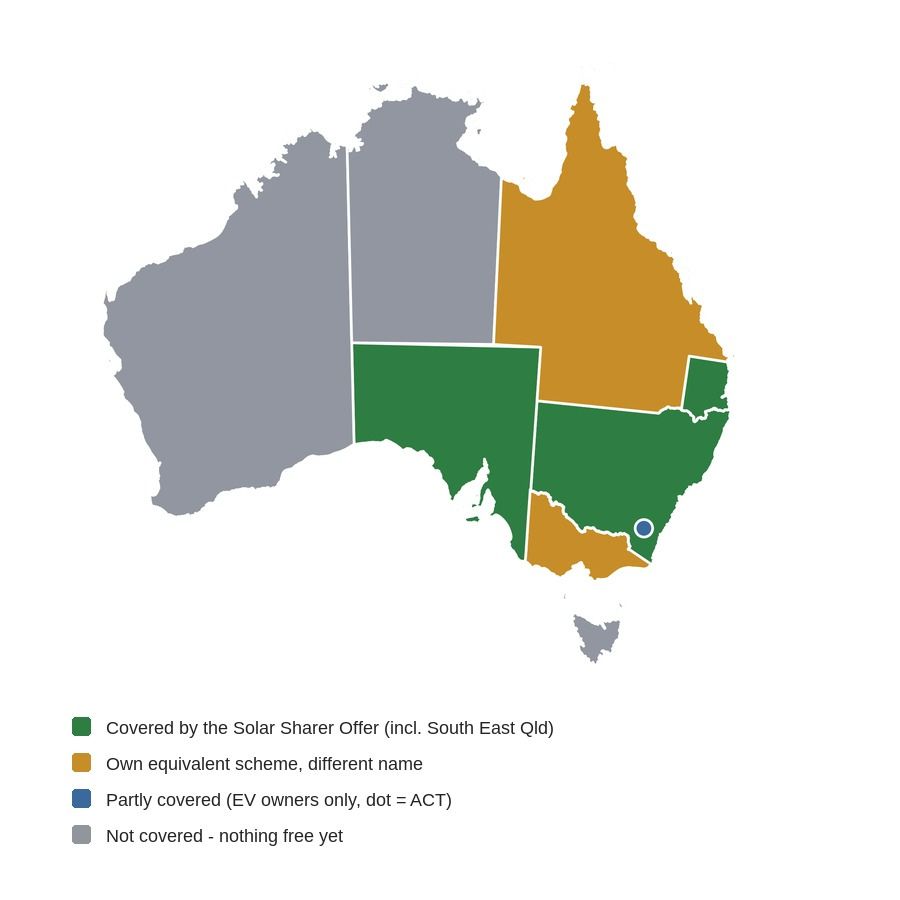
State-by-state breakdown.
South Australia Already Had The Answer
South Australia already has the SSO, so nothing is missing there, but it’s still worth mentioning. AGL introduced its own “Three for Free” plan in SA in 2025, about a year before the regulated SSO started.
In other words, some South Australians got to try this deal before it became a government requirement. This shows that some retailers were already offering similar plans before the rules changed, which is worth remembering for the other “alternative” plans mentioned below.
Victoria, October Is Upon Us
Victoria isn’t part of the SSO, but it wasn’t left out. The Victorian Government’s Midday Power Saver started on 1 October 2026 and is very similar: a free window from 11 am to 2 pm each day, a 24 kWh daily cap, and a smart meter as the main requirement. About 2.6 million Victorian households qualify, which is over 90% of the state’s population.
The state government estimates that households shifting 5% to 30% of their usage into the free window could save between $149 and $428 a year. If you also charge an electric vehicle (EV) during that time, you could save another $674, for a total of up to $1,102 a year.
Keep in mind, the highest savings only apply if you can shift a significant amount of your electricity use to the middle of the day, not just run a single load of laundry.
Victorians didn’t need to wait until October. Some retailers already offer real free-power windows, like GloBird Energy’s Four4Free, which gives you four hours (11 am to 3 pm) without needing a battery or an EV. However, the free rate only applies to your standard circuit, not controlled loads. Several other retailers have similar plans available now.
We checked time-of-use plans available for a Melbourne postcode. Nine plans from four different retailers already offer a true zero-cent free window, even before the Midday Power Saver began.
| Retailer/plan | Peak | Daily charge | Feed-in tariff |
|---|---|---|---|
| Flipped Energy – Freedom Switched On! Midday Power | $0.50/kWh | $0.78/day | $0.02/kWh |
| Flow Power – 4Free | $0.35-$0.36/kWh | $1.55-$1.60/day | $0.00/kWh |
| OVO Energy – The Free 4 Plan / Basic Free 4 Plan | $0.27-$0.41/kWh | $1.26-$1.32/day | $0.01/kWh |
| GloBird Energy – FOUR4FREE | $0.29-$0.39/kWh | $1.25-$1.27/day | $0.00/kWh |
The trade-off is clear. Flipped Energy offers the lowest daily charge, but the highest peak rate. Plans with more stable peak rates have daily charges that are 60% to 100% higher. In other words, there’s always a catch.
If you already have solar panels, check the feed-in tariff before switching. All the plans listed here offer between $0.00 and $0.02 per kWh, which is much lower than a typical Victorian retailer’s feed-in tariff.
These plans are designed for EV owners, battery owners, and people who can shift a lot of their usage. Switching could reduce your export earnings even if it lowers your midday costs.
It’s also worth mentioning that the “4Free” and “Free 4” branding is now used by three different retailers—Flow Power, OVO, and GloBird—with substantially different rates concealed beneath nearly identical names. Make sure you know what you’re getting.
Regional Queensland, You’ve Already Got It
If you are outside the Energex network area that SEQ’s Solar Sharer Offer covers, then there’s good news: Ergon Energy Retail has its own Solar Sharer tariff, which is the solar sharing tariff offered by the government-owned retailer for regional Queensland.
The time window is the same as Southeast Queensland, from 11 am to 2 pm, and the 24 kWh limit is the same as well. The arrangement is managed separately since regional Queensland is not included in the area covered by the national DMO framework, but in practice, it is the same offer.
Many people from regional Queensland think that they’ve been left out just because all the headlines refer to “New South Wales, South Australia and South East Queensland”. If that’s the case, you should speak to Ergon before giving up the idea.
Free Power In The ACT: Terms And Conditions Apply
The Australian Capital Territory (ACT) doesn’t have a general free power scheme for households. Instead, ActewAGL offers the evEnergy Saver plan, designed specifically for EV owners.
The plan’s Terms & Conditions state that you get a free home charging window from 12 noon to 2 pm on both Saturday and Sunday, for a total of 4 hours per week. There’s also a discounted overnight rate of 12c per kWh from midnight to 6 am every day.
This is a useful deal if you charge an EV, but it doesn’t replace a daily three-hour window and won’t help if you don’t own an EV. And there isn’t a Solar Sharer equivalent available right now. If you’re considering an EV because of deals like this, get the hardware you need to take advantage of a short charging window.
When you look at the numbers, the deal is clearer. For the “with controlled load” option, the daily supply charge is $1.34. The general rate is a flat $0.31 per kWh almost all day and night, on both weekdays and weekends. It only drops to $0.12 per kWh from midnight to 5:59 am.
The free window available on this plan is actually quite narrow. It amounts to two hours twice a week, making a total of four hours.
In contrast, the $0.12 per kWh off-peak rate is available for six hours every night, all year round, adding up to 42 hours a week. For most EV batteries, charging overnight at this cheaper rate will meet more of your needs than the free weekend window.
If you’re in the ACT with an EV, the cheap overnight hours may be more useful than the free weekend hours.
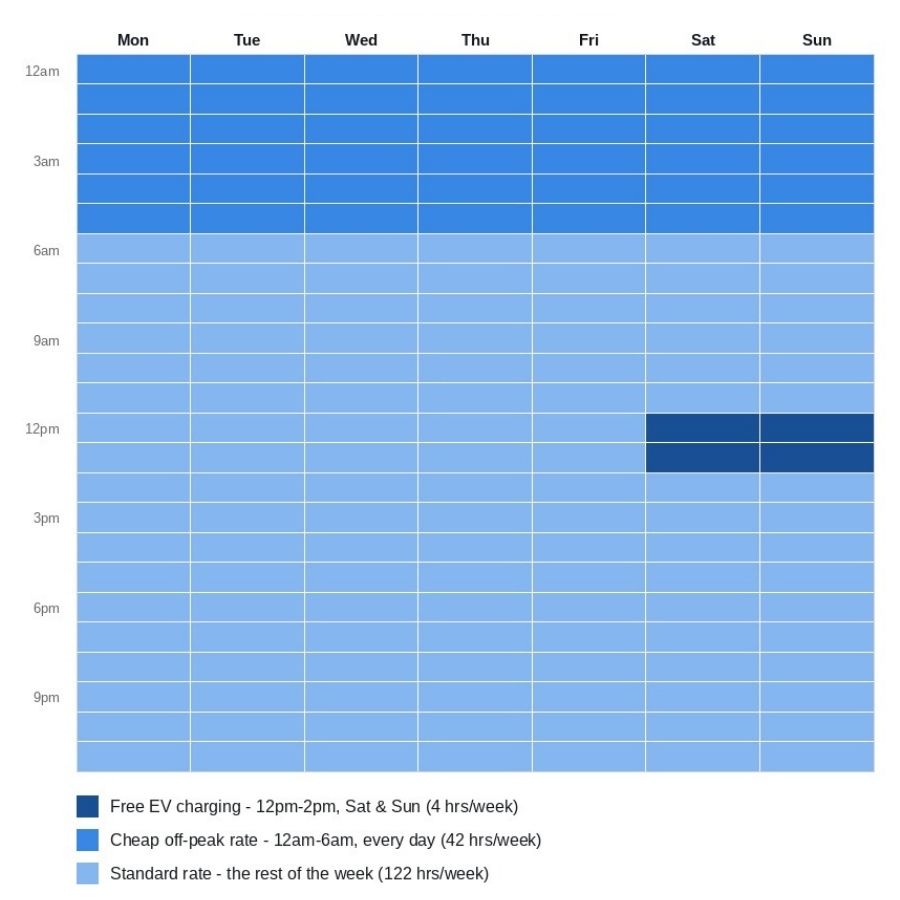
EV charging windows in the ACT.
Tasmania: Free Power By Appointment Only
Tasmania’s version is very different from the SSO, but that’s not a bad thing. Aurora Energy’s Power Hours doesn’t offer a set daily window. Instead, Aurora+ app users choose an hour-long slot from a list of scheduled events, sometimes days or weeks in advance, and can use as much electricity as they want during that hour with no kWh cap.
The trade-off is clear: you don’t get a guaranteed window every day, and you have to check the app and plan around the available slots.
As a result, there is no limit to the amount you can use after you’ve secured a Power Hour. Where a household has a large, infrequent demand, such as running the dryer, charging an electric vehicle, or preparing a large quantity of food, Power Hours can offer a higher value per session than a daily time slot with a cap.
However, if you were looking for a ‘set and forget’ arrangement like Solar Sharer’s, this option doesn’t quite provide that.
Western Australia’s Consolation Prize
No one in WA currently has access to a truly free daytime power window. Neither Synergy, the main retailer in the south-west, nor Horizon Power, which serves regional WA, offers it.
If you see a plan advertised as “free power” in WA, be sure to read the fine print before switching.
All that Synergy provides is the Midday Saver plan, a time-of-use plan with a genuinely low rate of $0.08/kWh from 9 am to 3 pm.
This compares to a peak rate of $0.53 per kWh between 3 pm and 9 pm. The same idea of shifting your usage applies here as with Solar Sharer. It’s not free, but a cheaper rate is still better than nothing, and moving your hot water, laundry, and pool pump to that window can save you money.
The Northern Territory: Monopoly, But Not The Fun Board Game
In most areas, there is no competitive retail electricity market in the NT. Jacana Energy has a retail monopoly in most of the territory, and we could not find any free-power option being offered anywhere. Although the situation might change in the future, there is nothing to sign up for at the moment.
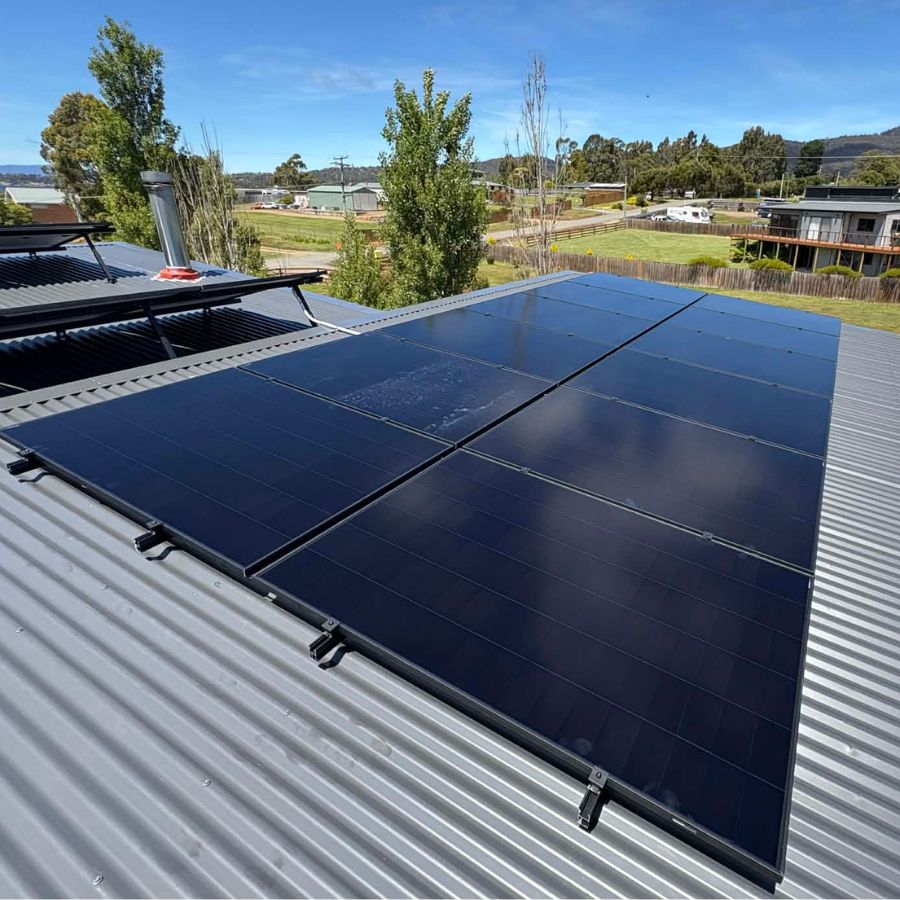
Source: J.E. Electrical and Solar
Free Power Isn’t Free, It’s Just Rearranged
No matter which version of “free” or “cheap” power you get, the basic math stays the same. Retailers don’t give away free electricity out of generosity; they make up the cost elsewhere in the plan, usually with a higher daily supply charge or higher rates outside the free window.
We’ve already seen this happen with the SSO, where some retailers increased their daily supply charges the same week the free window started. If you can’t move much of your usage into the free or cheap period, you might end up paying more overall.
The appliances you should move are the same everywhere: hot water (if it’s not on a separate controlled-load circuit), your washing machine and dishwasher using their delay-start function, your pool pump, and EV charging if you have the right hardware.
The same ideas apply whether you’re shifting usage into Solar Sharer’s midday window, Victoria’s Midday Power Saver, or a Tasmanian Power Hours slot.
What To Do Next
Determine which of the categories listed above corresponds to your address: whether it is part of an existing scheme, part of a scheme that is being introduced soon, based on a completely different model, or nothing having been decided yet. Afterwards, compare the real options available to you rather than supposing that ‘free’ always means ‘cheaper’.
Also, consider how rooftop solar and a home battery could help lower your bill, since that’s something you can control no matter which state gets the next “free power” offer. If you’re ready to get three quotes from trusted installers, even better.
 About Jacob Boyd
 RSS - Posts




We received an email from Origin energy inviting us to sign up for free energy from 12 to 3pm every Sunday in October up to 30 kWh a day,as we have solar panels I won’t be responding to the email,12 hrs of ( free) energy 120 kWh that we can’t store as our batteries are full by this hour,I often sit and watch all the energy and money sent back to the grid once our batteries are full and couldn’t possibly call this free energy,thanks Origin.
I’m in the ACT with ActewAGL i don’t have an EV, and got new supply arrangements from 14th September 2026.
They have actually done away with the overnight ‘off-peak’ rate and it’s now charged as ‘shoulder rate’ 10pm-7am, at $0.29.
They have also extended the ‘Peak rate’ by an extra hour from 5pm to 9pm (was 5pm to 8pm) at $0.43.
What they have allowed us is a new ‘off-peak’ period from 11am to 3pm, at $0.15.
So, no FREE power here like in other states, thanks ActewAGL.
On Ovo’s ‘The Free 4 Plan’ in SEQ with free electricity from 11am to 3pm and 27.973c/kWh the rest of the day with supply charge of 163.2c/day and 1c/kWh Solar. As work from home most days I can shift load to the free period including topping up my PHEV and so far I seem to be getting around 25% of my usage for free. I expect to save around $500 over what my previous Alinta plan for 26-27 would of cost me so I’m happy that I moved. Particularly happy with only 0c or 27.973c/kWh as don’t have to worry about the 40c+/kWh a lot of the other plans charge from 4-8pm. Ovo made it easy to switch from Alinta and was all done in 3 days.