
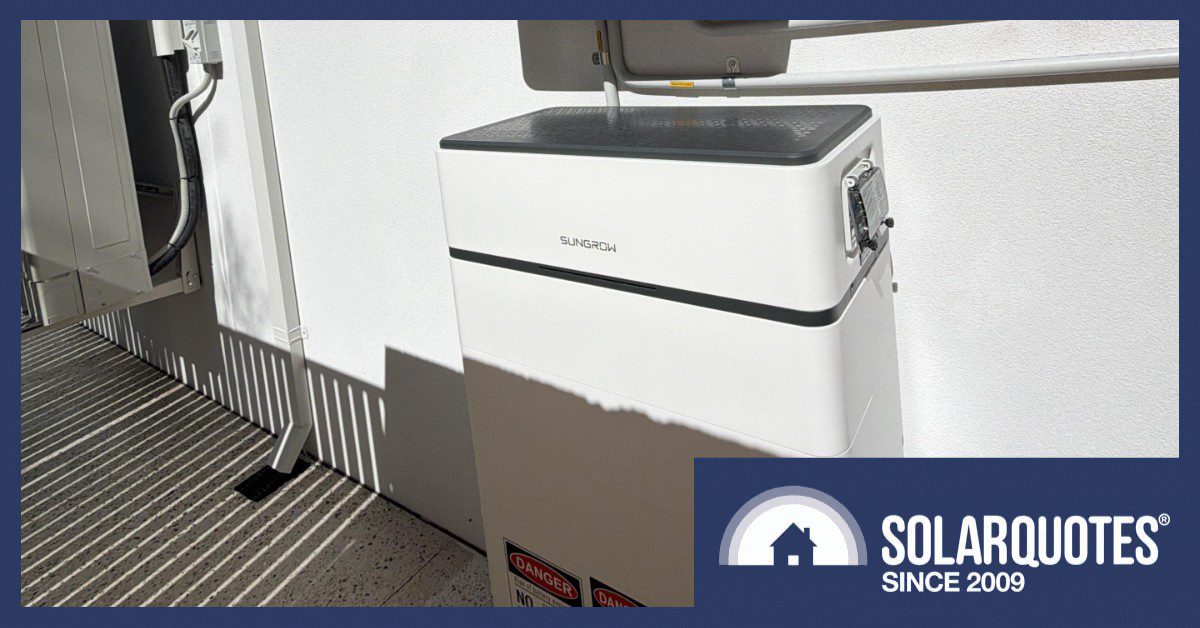
 The good news is, my sister is getting a battery. The bad news is, she says I have to decide how large it should be, and god knows what she’ll do to me if I get it wrong. To find out how I decided what battery capacity to recommend, while taking into account her average electricity consumption, modest 6.6kW solar system, and the fact she’ll be topping up her battery with free daytime electricity — read on. But if you only want to know how I rate my chances of getting out of this unharmed, then also read on.
What Size Battery Do You Actually Need?
These days, if you have solar — or have a roof you can put it on — the odds are getting a home battery will be a good financial decision. It will come down to individual circumstances, but it’s normally now worthwhile thanks to:
- Falling battery prices
- The federal battery rebate
- High electricity prices
- Affordable and reliable solar
But what can really make a battery pay is topping it up with free grid electricity during the day. Free charging can supercharge your savings, and I’ll make sure my sister takes full advantage of it. Nearly all major retailers now offer Solar Sharer plans with free periods in NSW, South East Queensland, and SA. While Victoria’s own version of Solar Sharer only goes live in October, it’s still possible to find plans with a free electricity period, and in WA and rural QLD it’s possible to get plans with cheap, but not free, daytime electricity.
Over the past year, my sister’s household consumed just under 6,500 kWh of grid electricity. Based only on this, my guess was she’d want around 22 kWh of battery capacity, plus maybe some extra to provide reliable backup power. But after estimating the benefits of charging her battery with free electricity, I ended up recommending a little more.
My Sister’s Current Setup
At the moment, my sister currently has:
- A home in rural NSW
- A 6.6kW solar system
- A mean left hook
- A mean right hook
- An entire garden shed full of mean hooks
If I don’t want to be on the hook for her missing out on potential savings by recommending a battery that’s too small, or causing her to pay more than she has to for a battery that’s too large, then I need information on her electricity consumption patterns.
The most accurate way to do this is to get an NEM12.csv file of smart meter data. The problem with this is, it’s a huge file stuffed with numbers that has to be interpreted. Our Battery Calculator can help, but at the moment, it can’t take into account topping up a battery with free grid electricity. Soon, we’ll have a new and improved version of our battery calculator able to do that, but I don’t know exactly when it will be ready. Despite this, you can still get some useful information out of our current battery calculator, and I’ll explain how to do that below.
If you already have solar, and aren’t intending to install more when you get a battery, then — provided you’re certain you’ll top it up with free or cheap grid electricity during the day — you can roughly estimate your required battery capacity by looking at your electricity bills.
Fortunately, I have all my sister’s electricity bills. And if I pay them on time, nothing bad happens.
Battery Sizing Rules Of Thumb
My sister has solar and isn’t planning to expand it anytime soon, so I could look at her bills and use a very basic rule of thumb that says, for those who already have solar, that battery capacity should be equal average daily grid electricity consumption — plus some extra, depending on how important backup power is considered. But there are a couple of problems with this…
- It’s for batteries that are only charged with solar and not topped up from the grid.
- It’s just a rule of thumb, and I’m not sure how well it works anyway.
If I had to guess — and I kind of have to because my mental problems compel me to do so — I would say a better rule of thumb for homes that charge their battery every day with free electricity would be for battery capacity to equal average daily grid consumption + 25%, plus extra for backup as desired.
Dissecting My Sister’s Bills
So my next step was hacking into my sister’s electricity account by cunningly asking for her login details. This let me see her consumption over the past 12 months and work out that her average daily grid consumption was 17.8 kWh. So, using my rule of thumb, she should get a battery of around 22 kWh, plus whatever she wants for backup.
But to find out if that’s right, I’m going to have to dig a lot deeper, and I’ll start by working out her seasonal daily averages:
- Spring: 15.4 kWh
- Summer: 12 kWh
- Autumn: 13.5 kWh
- Winter: 30.1 kWh
Looking at the results, I’m like — Wow! What are you doing in winter, woman? Leaving your wardrobe door open and attempting to heat the whole of Narnia?1
Digging a little deeper to find the months with the highest and lowest daily consumption gives:
- June: 32.8 kWh
- February 8.1 kWh
While this extreme seasonal variation complicates working out how large a battery she should get, it does mean she’s a perfect candidate for charging her battery with free daytime electricity, as there’s no way her 6.6 kW solar system could reliably charge a battery to keep up with her winter consumption.
NEM12 Smart Meter Data
If you’re planning to get solar and a battery at the same time, or you have solar but will expand it when you get a battery, then you can’t just use your electricity bills, as they won’t show the reduction in your consumption from getting solar or expanding it. But if you have a smart meter, you can request a NEM12 file of electricity consumption data. We have a page explaining how to get it here. My sister is with Origin (the owner of SolarQuotes), and with them, you can get it by logging into your account and clicking on usage …

…and then clicking on the red “Request data” towards the bottom of that page:
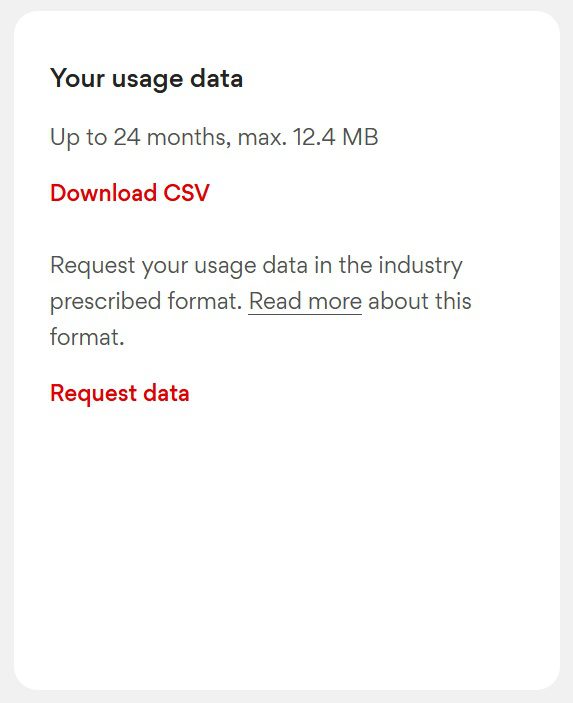
To see what your electricity consumption is like over a full year, you’ll need to have had a smart meter for at least a full year. A NEM12 file covering 12 months or more can be used with our Battery Calculator to estimate how much you would have saved if you’d had a battery over the past year — and soon it should be able to handle topping up for free from the grid.
It only took a few minutes for my sister’s NEM12 file to be emailed to me. Origin also sent along an explainer document containing this graph of my sister’s average grid electricity use by time of day:
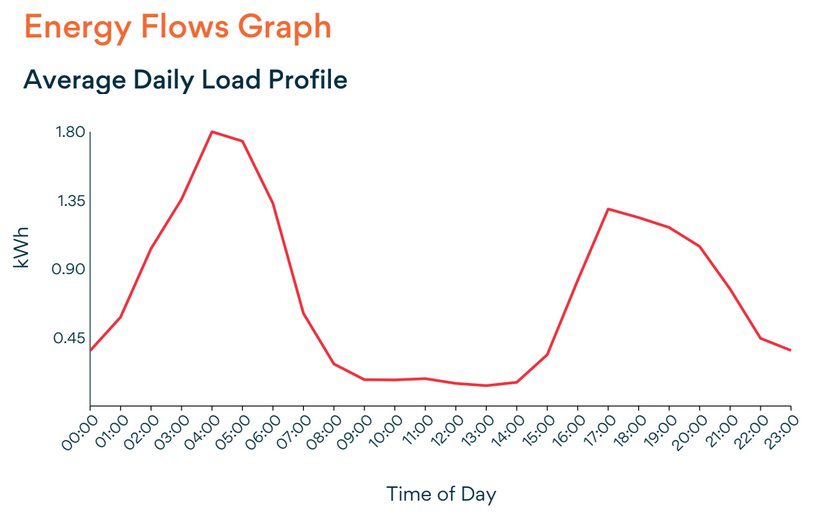
Looking at that, you can see my sister somehow manages to use most of her electricity at 4 o’clock in the morning. But I want to make it absolutely clear that this is not because she’s a vampire, werewolf, undead, or any other mythological creature of the night. Her hideous strength is entirely natural.
While it’s nice to have this graph, if that were all I looked at, I would entirely miss my sister’s outrageous winter consumption. Fortunately, I can get graphs giving a breakdown of my sister’s seasonal consumption by telling our Battery Calculator that she doesn’t have a battery.
Getting ‘No Battery’ Battery Calculator Results
If you want graphs of your seasonal grid electricity consumption and solar generation, you can load an NEM12 file with at least 12 months of smart meter data into our Battery Calculator. But you’ll have to tell it that you don’t have a battery. This is easy, but how to do it is not immediately obvious.
First, enter your postcode at the top of the Battery Calculator page and then enter an electricity plan — any plan will do, it doesn’t matter. Then, where it says “Battery”, click on “My battery isn’t on this list” and tell it the “Usable Battery Capacity” is 0.01 kWh, which is almost the same as no battery at all. Then set your battery reserve to 100% so even that tiny battery capacity won’t have any effect. After that, load up your NEM12 file and hit “Calculate Your Battery Savings & Payback”. Since you told it your battery is tiny, and not being used anyway, you’ll get some nice graphs of your seasonal grid electricity consumption and solar generation.
Here’s the graph of my sister’s average solar generation and grid electricity consumption in Summer:
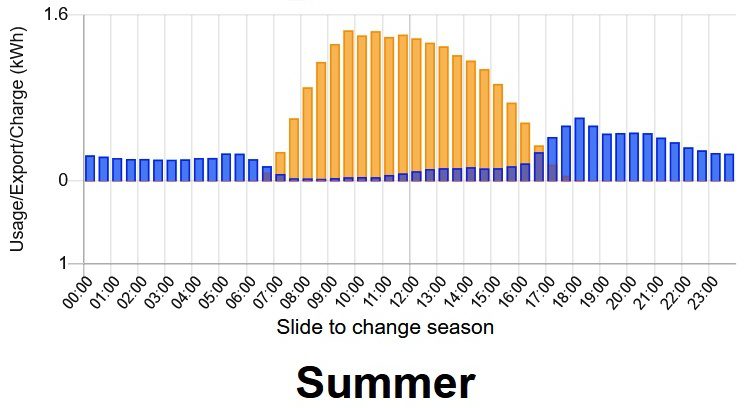
That big orange sail through the day shows her solar system is producing more electric energy in total than she consumes, but it’s nearly all being sent into the grid for a low feed-in tariff. This is because there’s usually no one home during the day except her fearsome hounds, she doesn’t have a battery yet, and she didn’t listen to a word I said about shifting loads to the middle of the day when you get solar. But, to be fair, she’s never listened to me before in her life, so it’s not as though I was expecting her to start.
If she installed a suitably sized battery, she could almost eliminate her grid electricity consumption — in summer.
Here’s a graph of her hefty winter consumption:
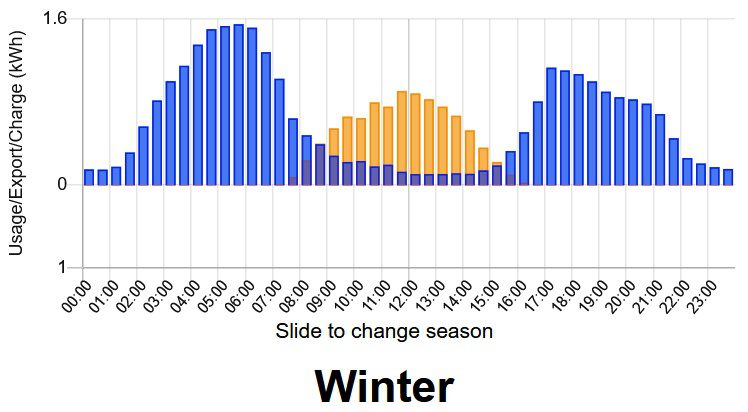
This shows her surplus solar generation is swamped by her winter electricity use, so she’d have no hope of meeting her overnight consumption by storing her surplus solar, no matter what size battery she got, making charging with free daytime electricity ideal.
Battery Savings Without Free Charging
It’s easy enough to work out how much my sister would save with a battery on her current electricity plan — if she didn’t charge from the grid during the day. All I have to do is use our battery calculator. With a 0% battery reserve, it gives the following annual savings:
- 5 kWh battery: $672 ($134 per kWh)
- 8kWh battery: $939 ($117 per kWh)2
- 10 kWh battery: $1,070 ($107 per kWh)
- 16 kWh battery: $1,282 ($80 per kWh)
- 24 kWh battery: $1,385 ($58 per kWh)
This shows that while total savings increase as battery capacity increases, the savings per kWh drop off pretty fast after 10 kWh. With free daytime charging, my sister’s savings will be higher, but she will still see a similar drop off in savings per kWh. However, it will be at a higher battery capacity.
Because small batteries have the highest return per kWh, it can make it look as though getting a small battery is a smart move. But the trick to getting the best financial return is not maximising your savings per kWh. Instead, your goal should be to install the largest reliable battery you can, that still provides a return you consider acceptable. If you get a battery smaller than this, you will miss out on savings you consider worthwhile.
Choosing A Solar Sharer Plan
Before I can work out how much my sister will save, I have to decide which electricity plan she should switch to. This will be whichever will save her the most money once she has a battery. What I definitely shouldn’t do is fall into the trap of choosing a plan with high rates and use that to claim the battery is saving her more money than she would with a more sensible plan. You may laugh, but I’ve seen people do this. Some of them sell batteries.
Because my sister’s consumption is highest in the early hours of the morning, the best plan for her will have a low rate after midnight, along with a free daytime period. The best one I’ve found so far is from the electricity retailer Covau, and they call the plan “SolarMax NSW Essential Residential TOU”. Its charges are:
- Peak 5pm-9pm: 45.3c
- Off-peak 6am-11am, 2pm-5pm, 9pm-12am: 27.48c
- Shoulder 12am-6am: 16.5c
- Free period (Shoulder 1) 11am-2pm: 0c for first 24kWh, then 27.48c
- Daily supply charge: $2.30
Because of the low 16.5c rate early in the morning, my sister would be considerably better off with this plan before even getting a battery. This is despite the hefty $2.30 daily supply charge, which is 50c a day more than what she pays now, or $182.50 more a year. Her supply charge was already high because rural NSW’s Essential network charges like a wounded bull that was wounded in the process of eating a bear full of cocaine.
The Solar Sharer 24 kWh Cap
Not every plan with free daytime electricity is a Solar Sharer plan, but every Solar Sharer plan has a cap of 24 kWh of free electricity per day. Also, if you happen to have a battery that obeys the laws of physics — which is all of them these days — there will be charging and discharging losses. Home batteries typically have a round-trip efficiency of around 90%, which means if you charge a battery with the full 24 kWh of free electricity, you’d only be able to get about 21.6 kWh out of it.
But because my sister’s solar will be able to charge her battery a little before the free period starts on most days, and it can potentially top up the battery after the free period ends, she can still financially benefit from having a battery larger than 21.6 kWh.
One important thing to note is that if your battery can only charge at 5 kW, you’ll never be able to charge it with more than 15 kWh of free electricity in a three hour period. Some Solar Sharer plans offer four hours of free electricity, but if you want to make full use of a three-hour Solar Sharer free period, your battery will need an inverter that can charge it at 7-8 kW or more.
VPP Payments
Joining a Virtual Power Plant (VPP) can provide extra payments, and I say my sister should join one, because I consider the extra money worthwhile — provided you find a VPP that suits you. You can see a table comparing them here. While the payments aren’t high, I’d expect them to be at least $150 a year. Also, NSW offers a payment for joining a VPP, and I think she should definitely take advantage of it.
Calculating Battery Savings
Because our Battery Calculator can’t currently account for topping up your battery for free, working out how much my sister would save based on her past consumption isn’t easy. I tried to use an LLM, or AI as kids call them these days, but the damn thing ended up hallucinating more than I do — and believe me, that’s a lot.
If I wanted a 100% accurate savings estimate based on her past consumption, then my only choice was to examine her electricity consumption on every single one of the past 365 days, calculate the battery savings for each one, and then add them together.
So thank god I didn’t want that! That would be really tedious! I’d be happy with a 99% accurrate estimate. Even 95% would be fine with me. Looking at every day would take forever. Maybe even two forevers stapled together. But if the estimate doesn’t have to be perfect, I can just use a sample of days to estimate her savings.
A brother who loves their sister and wants to be highly confident their estimate is correct would sample a minimum of fifty days. But a scumbag who didn’t respect their sister and just wanted a quick, rough estimate so they could kick back and watch the anime, “Delicious in Dungeon” would sample half that. I’m confident you have no doubt about what I chose to do.
After ensuring my sample of days was representative, I calculated how much a battery could save my sister on each day and used that to calculate what her annual savings would be for battery capacities from 1 to 50 kWh, without setting a battery reserve. Then I made this graph:
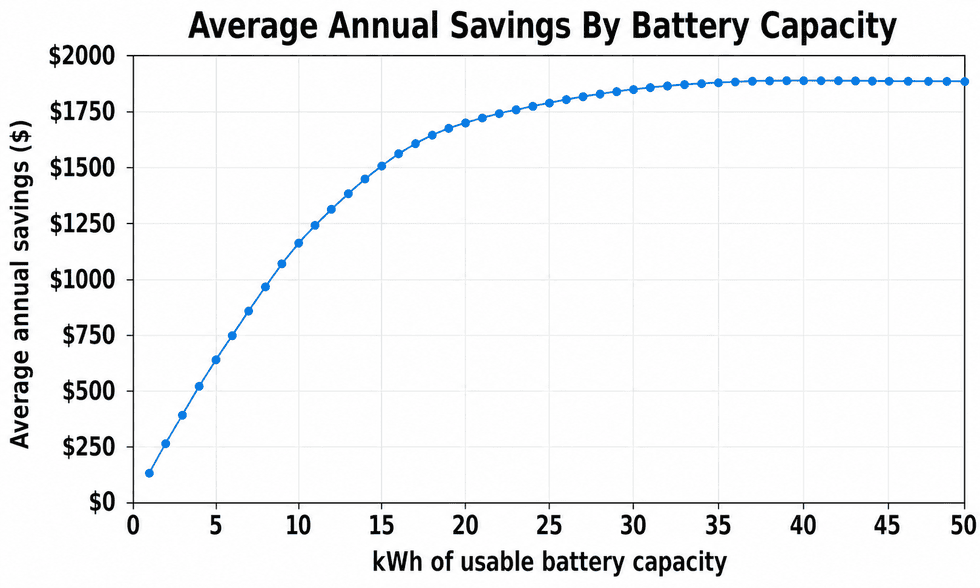
The graph shows savings per kWh falling with increasing battery capacity. This happens gradually at first, becomes more noticeable after 10 kWh, and then after 20 kWh there’s only a small increase in total savings from each additional kWh of capacity. This occurs for two reasons:
- As battery capacity increases, the number of days my sister will use all its stored energy decreases.
- You only get 24 kWh of free electricity per day on a Solar Sharer plan.
This drop in savings per kWh happens for every home battery, but how it happens depends on circumstances. A home with higher electricity consumption, especially during the peak period, will see the falloff occur at a higher battery capacity. A large solar system also helps improve the return from having a battery. If my sister expanded her solar, it would modestly improve the return. But when she gets an EV — which she eventually will, despite her saying she doesn’t want one — then she should definitely increase her solar capacity, unless the cap for free electricity has increased significantly.
While the graph above shows how much you can expect to save per year by battery capacity, it doesn’t tell you how big a battery you should get. In a follow-up article next week, I’ll go into how to work that out, and reveal how much battery capacity I recommend my sister get.
Subscribe to SolarQuotes’ free weekly newsletter to get the concluding part of Ronald’s battery-sizing adventure emailed to your inbox.
Footnotes
- When we were younger, my sister and I discovered that our grandfather’s wardrobe led to a magical kingdom of talking animals, but only if you first ate the fungus that grew in grandad’s boots. ↩
- There is no battery you can select with 8 kWh of capacity. I threw this in for demonstration purposes. But you can get the result for an 8kWh battery by telling the Battery Calculator you have a 10 kWh battery with a 20% reserve. ↩
 About Ronald Brakels
 RSS - Posts





An addition to “the odds are getting a home battery will be a good financial decision. It will come down to individual circumstances, but it’s normally now worthwhile thanks to:”
Daytime FITs falling to virtually nil, or possibly going negative in future.
“At the moment, my sister currently has:
An entire garden shed full of mean hooks”
Thought that was meat hooks for a second.
Timely article, getting a battery is closer now for us, as SA power pricing is crazy for peak tariff cost and FIT now 1c.
A battery opens up a WHOLE new world of options.
The list of must haves is growing, and some might not be achievable without some AI automation.
The idea is to future proof a little against yet more little tweaks that the powers to be can still make to reduce advantages of solar / battery investment even further.
Ensuring that the battery can be expanded later has a lot going for it, not least as petrol & domestic gas supplies approach end of life. Some quibble about a few % efficiency loss when each battery module has an integral DC-DC converter to facilitate paralleling old and new batteries, but my brother had to have 15 kWh of LTO batteries replaced when doubling battery size.
Enough inverter capacity to charge it in 3-free-hrs or a similar gap in clouds, isn’t always there on a legacy system. (Well, maybe no pre-existing charging capability at all?)
Hi Erik,
What happened to the LTOs? They’re pretty tough batteries…
Zenaji discontinued the old model, and the new one must have a different number of cells, as the bulk & float voltages are sufficiently different that the breakers in one set kept tripping annoyingly during heavy charging from his 19 kW array, two Victrons and a couple of MPPTs, perhaps 240A. That’s the risk of simply parallelling battery banks, years apart. Operating compatibility isn’t certain. My understanding is that the old batteries are doing sterling service elsewhere, as a bargain. (I think we set set the charge limit at 280A for the 14 parallel batteries. It’s a while back.)
That’s where Sigenergy’s integral DC-DC converters shine. It should even be possible to mix LFP and Na+ modules, despite the massive incompatibility between their (dis)charge curves.
Here, three parallel LFP banks have cycle counts of 67, 109, and 129, despite carefully making the cabling equal-length, and checking the intercell busbars for warmth, indicating a higher contact resistance.
Hi Eric,
I’d heard Zenarji had added a cell because they were simply a bit low in the DC operating window, even for something as flexible as an SpPro.
Pretty bulletproof though.
Cheers Erik.
Yes, plan to go larger battery/ies than we actually need to be self sufficient, maybe 1.5 x to 2x what we could get by with, so we have the ability to send some to the grid in evening peak, both helping take pressure off the grid and get some extra FIT that seem to be very common from some retailers.
One in SA has a reasonable supply charge of $1.65 a day, 3 hours of 45c FIT, so could easily cover the daily supply charge and a little more.
With no gas ever and EV, we have 8c for 6 hours midnight to 0600, so that would be fine for us on the wintry doldrum days, or some plans have 6 hours for 8c during solar soak too, either way cheap power for winter, and can still send some to the grid evenings.
With 10kw of inverter we could get what we wanted I feel, but maybe we’ll AC couple with another inverter on third phase and use that as the master, even some more panels.
It’s a minefield for both the hardware and eventual supplier / plan, tariffs etc.
Quotes are incoming.
Hi Les,
It’s rare for me to go over 10 kW here, and EV charging can always be throttled, if a birthday cake *has* to be baked, I figure.
It’s good not to forget that the battery inverter has to be at least as high power as the AC coupled inverter, so it can grid-form when you island, when going off-grid during a grid outage. Your generous battery sizing helps there too.
I’d make throwing the grid isolator part of the commissioning testing.
Max system battery charging rate is worth checking – quick recovery in a gap in overcast is nifty to have. A bigger battery takes more at modest C-rate, but the charger needs to be able to deliver. And, yes, more panels reduce the need for speed, through more yield in overcast. Here it’s mostly the big array which has avoided generator starts for 2.5 years so far, as even an ample battery would otherwise struggle in 5 successive overcast days.
Good luck with system choices. Remaining on-grid reduces the risks, though.
Les, what plans have you found that have both cheap EV midnight to 6am, and cheap solar soak pricing? I only found one, and it was limited in daily usage (which doesn’t work for me: heavy usage here).
IMO the free solar will/should last only a couple of years because as per the data in this article, there’s no spare power in winter as least here in Victoria. Free power doesn’t just shift demand, it induces it so gives less incentive for efficiency and puts more pressure on the grid.
It’s currently completely rational for me to set the heater to 26C between 11 and 2 when I’m not at home so that the house is pre-heated for the evening, but what’s good for my bank account isn’t necessarily good for the grid.
Hopefully it will shift to a more sensible approach like the new offer from my provider below (or even seasonal pricing):
11am-4pm – $0.10/kWh
4pm-9pm – $0.29/kWh
Other – $0.16/kWh
Daily charge – $0.85/day
Hi Andrew,
Could you please identify this electricity provider? In NSW, I cannot find any plan near these prices.
Thanks DouglasH
OVO in Vic – (United Energy area).
Many thanks.
Australia is adding 4-5 GW of solar a year. That’s roughly one residential panel per household. So — while next winter in Victoria will be interesting if Solar Sharer uptake is high — the amount of daytime solar power available is only going to increase.
For now, there will be cloudy winter days when coal output is increased, gas is burned, and water is released from hydroelectric dams to supply free daytime electricity, but this will reduce the need to do it during the evening and morning grid demand peaks, which is when the grid is most likely to be under strain.
Ronald, how’s that all perform at night?
Australia is supposed to be decommissioning over 6 GW of baseload power by 2030, and a further 8 GW by 2035. Yes I get SQ don’t really like the term, but either way that’s (generally) stable and reliable power that will be removed from the system even as demand is predicted to spike.
Hope doesn’t replace constant power, especially when there’s cloudy months setting at least local solar records e.g. worst month on record for solar output, 2nd worst on record, trending to set a new worst on record etc.
Something does not compute!!!
Steam engines, nuclear or otherwise, aren’t as reliable as sunrise.
Refer to Calide in Queensland for evidence for repeated, unplanned failures that are far and away the longest in NEM history.
Nor have steam engines or gas burners fallen in price by 99% like solar did in 25 years.
The only othrt thing fell that far, but faster, is lithium batteries.
https://reneweconomy.com.au/near-100-pct-renewable-electricity-for-australias-main-grid-is-achievable-and-affordable-year-4-update/
Solar works by night via batteries, cheaper every year, deployed at an exponentially increasing rate, as coal dies. The millions of tonnes of ’em quickly scale to billions. France relies on nuclear for a lot of grid power, but has had to throttle them down this summer, because their riverwater was too hot to cool them adequately. Now their rivers are drying up. What a choice, low power, or insufficient food, due to no irrigation. Go agrosolar instead!
Baseload power is the load needed for an obsolete coal generator not to shut down. It is not a grid need. The most dispatchable power comes from batteries. “8 GW by 2035” is easy. How many hours of it are needed depends on wind, sun, and hydro availability nationwide. Diesel logistics going electric adds more load, but already with their own batteries!
$Trillions will be spent, but it’s cheaper than failing to compute the cost of failing to act. 90% BEV sales by 2030. Adaptors thrive. Those doing it show those who don’t yet understand.
John, over 13 GWh of home battery capacity was installed last financial year. A lot of it will be set to charge during daytime free periods, resulting in a reliable decrease in evening peak demand. Around 17 GWH of utility scale battery capacity was also installed. If we assume half of home battery power is available to meet demand along with utility scale power, that’s roughly 10 GW of power. In addition, about 4 GW of solar and 2 GW of wind capacity were added. Eraring, Australia’s largest coal power station, is 2.9 GW. While Australia’s electricity consumption is increasing, renewable plus storage additions last financial year are more than adequate to close down a portion of our old fossil fuel generating capacity permanently.
Ronald, wouldn’t doubling electricity consumption by 2035 be a wonderful thing? Replacing petrol for cars, and diesel for trucks needs to speed up, and deploying solar and batteries at increasing rates is increasingly easy.
Better that foreign exchange be spent on life-sustaining investment than on polluting stuff to wastefully burn. The infernal combustion engine has served us well, but now we serve it, well beyond its use-by date, to our fatal detriment. (Tens of thousands heat-killed in Europe in hot years, recently. Food shortage due to drought will not help much either.)
Off-grid consumption here varies from 4.5 to 61.7 kWh/day in winter, with house, excavator, and BEV batteries evening out overcast vs full sun. Ample panels + ample batteries = complete elimination of fossil fuels in daily life.
End of oil shipping eliminates 40% of bulk marine traffic. Direct hydrogen reduction of steel reduces coal burning. A hundred steps at the time will do it, if not in time to save all.
Erik, please tell me you are joking. Generation capability is set for a crash, and you think doubling demand is a good thing for Australia’s grid?
I suspect your life sustaining investment is a euphemism for EVs, batteries, solar and wind. We’ll have to agree to disagree. My region is happy with fuel, they do NOT want a toxic battery farm in the area! Solar panels on rooftops is pretty common, but off-grid is likely higher than average too. EVs are near non-existent, or completely so. I do wonder however whether insurance in the future will either reject houses, or spike prices, for having life imperiling materials on site e.g. lithium batteries.
Europe’s heat deaths are due to government design not weather. I’m unaware of food shortages, indeed last I heard production was soaring, except where fertiliser shortages are a problem. I suspect we’re reading similar facts but attributing causes to vastly different sources e.g. bad design, concrete jungle heat sinks v climate change.
Hi John. Love your concerns about safety re batteries and EVs. But a little bemused by your comments about toxic batteries and “having life imperilling materials on site e.g. lithium batteries”. Hmm. I guess if having 100 litres of (non-toxic!) and explosive fuel in your garage does’t worry your insurance company, then nothing will 🙂 And don’t forget that the ratio per capita of fires in fossil fuel cars to fires in EVs in Australia is more than 20 to 1!
And as for Europe’s heat deaths, I’ve just come back from the UK. They’ve had extraordinary temps in the hight 30s both in the concrete jungle heat sinks cities and rural areas. They can’t believe it. Most have never seen temps in the high 30s except in very recent years! Even made us feel hot!! Something’s going on, methinks.
Anyway, I guess I’m another one with whom we’ll have to agree to disagree! Happy to leave it like that 🙂
Are new homes being taken into account? Some of these will have solar and possibly a battery included in the build but a lot won’t.
On another semi-related note I wonder if solar installations will drop off with the falling FIT?
I did not see any comment on the obvious question, why is the consumption so high at 4am. My guess would be electric hot water is the culprit. If that is the case, move it to coincide with solar production and free or cheap power is the obvious move.
I’m guessing it’s thermostat-controlled heating, working harder as the temp drops during the night. It’s not there in Summer.
It’s hard to see an electric hws in that profile, maybe something going on there 9am to 11am, but otherwise gas?
I could tell you why my sister’s electricity consumption is so high at 4 am at the morning, but then I’d have to go into hiding.
If I didn’t know the true reason, I would guess there is someone in the household who is habitually getting up very early in the morning for work or other reasons and switching the air con onto heat, resulting in high electricity consumption as a cold home is heated up.
The increased usage starts around 1am and slowly declines from 5am, so she either gets up at 1am to go to work but takes 7 hours to get dressed or it’s a thermostat.
Don’t forget that past usage is not likely to represent future usage. Leaving that AC running for longer each day because you can will see your usage increase.
Good point, Luke. It’s definitely true consumption can change when free electricity periods or other price changes are introduced. In my sister’s case, they may end up using even more electricity at 3am since they will be paying less for it than they are now. I doubt there will be any real change in her daytime consumption, but it is possible.
Thanks Ron. I know i bang on about this a bit, but batteries have 2 reserves;
– a “hidden” reserve as Sungrow calls it, to preserve battery longevity and avoid having to use grid to commence recharging, about 5% in Sungrow’s case, and
– a Backup Reserve that can be adjusted, in Sungrow’s case, by the user anywhere from 0% to 100%.
Takes some jiggery pokery to tinker with the former and is not recommended.
I frequently adjust the latter between 0% and 10% usually depending on predicted battery requirements.
So long as it truly is a hidden reserve and the manufacturer doesn’t cheat by claiming the usable capacity is higher than it is, then a non-technical homeowner, like my sister, doesn’t really have to worry about it. But she will have to consider if she wants to set a backup reserve, so I tend to just refer to that as a “reserve”, which might be a bit sloppy of me.
Even off-grid, and using up to 58 kWh on a sunny day, 22 kWh of that into the BEV, I’ve found 46 kWh of battery more than enough to support two households here. Adapting consumption to suit insolation, 30 kWh battery would have been enough, if grey-day BEV top-up were never needed, and the wood heater is then used to boost the HWS. (Or cold showers) On-grid, it’s black-out resilience which would tip me from 20 kWh to a 30 kWh battery choice. But yes, a 5 kW inverter/charger is inadequate. (24/15 kW here.)
Lacking 3-free-hrs, generation beats storage. My 27 kW of panels are generating only 7.3 kW at 9:40 in midwinter, in slight haze. Three E-facing panels are generating 5 times the output of 12 S-tilted @ just 17°, and 12 N-facing panels giving x24 on the 12 S-tilted.
BEV vs ICE sales: 8.4% in Jan, 23.3% in Jun. 50% by Dec, with Hormuz scarcity run amok? Add panels, if possible! Free grid hrs will be eaten by grid batteries & BEV logistics, in time.
Erik Christiansen: – “BEV vs ICE sales: 8.4% in Jan, 23.3% in Jun. 50% by Dec, with Hormuz scarcity run amok?”
By any measure, data indicates the SoH has not resumed to ‘normal’ marine traffic flows, & is unlikely to be for many months. https://youtu.be/r0EvQgLcjMw?t=158
Audited data from the IEA reveals that global inventories suffered an astonishing daily drawdown of 6.3 Mb/d throughout the duration of the conflict. The vast majority of this operational burden was borne by developed economies.
https://www.financialsense.com/blog/21699/running-empty-hidden-oil-crisis
And surprisingly, China imported ~4 Mb/d less crude oil.
Per EIA data, US commercial + SPR crude oil inventories, as at 03 Jul 2026, were at 730,846 kb (-3,168 kb relative to 26 Jun 2026), at the lowest level since May 1984.
https://www.eia.gov/dnav/pet/hist/LeafHandler.ashx?n=PET&s=WCRSTUS1&f=W
The world will need to learn to make do with significantly less global crude oil supply soon.
Geoff,
DW speculates that China saved the global economy when it cut oil imports by 40 – 45% during this Hormuz fiasco: https://www.youtube.com/watch?v=LbT9H6CLFfo
That did rob oil corporates of more massive price gouging profits, to everyone else’s benefit.
My unsophisticated measure of oil supply normalisation prospects is how much USA is bombing the crap out of Iran, i.e. not real soon now. (2027?)
El presidente said two weeks ago that US oil exports may need to end in 4 weeks. China’s 1B bbl reserve should be good for 9 months? But full import resumption, when it happens, will be felt. Yes, best prepare.
Mid-winter solar yield here today: 61.7 kWh, all self-consumed in BEV, excavator, HWS, aircon, etc. Zero CO₂ emissions. BEV travel 132 km yesterday, half towing a trailer. This stuff works, even out of town.
Battery size: To time shift the full 3-free-hr cap, at least a 24 kWh battery is needed. Any less cuts options. And 0.33C (8 kW) charge rate is OK for LFP max life.
Erik Christiansen: – “China’s 1B bbl reserve should be good for 9 months?”
China’s secretive strategic INVENTORIES are difficult to estimate. EIA estimated that as of Dec 2025, China had 1,397 Mb, while USA had only 413 Mb.
https://www.eia.gov/todayinenergy/detail.php?id=67504
China produced 4.49 Mb/d crude oil in Mar 2026.
https://www.eia.gov/international/data/world/petroleum-and-other-liquids/monthly-petroleum-and-other-liquids-production
China’s crude oil imports peaked at 11.6 Mb/d in 2025, but recently averaged 6.5 to 7 Mb/d.
So a drawdown of 1,397 Mb at a rate of 5.1 Mb/d = 274 days (9+ months)
The US SPR volume, as at 26 Jun 2026, was 325,655 kb (change -5,536 kb/week), which represents 45.6% of full SPR capacity. The US SPR is now at a level not seen since May 1983.
https://www.eia.gov/dnav/pet/hist/LeafHandler.ashx?n=PET&s=WCSSTUS1&f=W
At current rate of US SPR drawdown, the 243 Mb floor level will likely be reached by Sep-Oct 2026.
Always love your work Ron. The general idea you touched on midway is extremely solid – “But the trick to getting the best financial return is not maximising your savings per kWh. Instead, your goal should be to install the largest reliable battery you can, that still provides a return you consider acceptable.” This in my opinion is definitely the correct approach, love it.
Great article, and great leg work done for your sister. Hopefully it’s enough to dodge those incoming hooks.
Thank you for saying that. Unfortunately, if I ever do doge one of her hooks, it always turns out to be a feint, and then I get into trouble.
Hilarious Ronald! I can’t wait to read of the further adventures of Ronald. Maybe you can include a few dungeon recipes!
I’ve tried a number of times to justify a battery system but I can’t seem to get the numbers to make financial sense as the price over the life of the battery is always negative. I can’t wait to see if you can get the numbers to make it a positive outlay.
I’m in the same boat. I can’t see the numbers justifying a battery.
In preference, I would increase solar if I didn’t have to scrap a good 8 year old 6kW pv system, to make roof space for one with greater efficiency.
Your analysis methodology is logical and thorough.. However you haven’t mentioned review of the overall electricity consumption and consumption pattern. For example, why is the power consumption peak at 4:00 am? I think this should be investigated first and if possible reduced and/or moved to middle of the daylight hours. Some review of home heating/cooling technology and potential insulation or other efficiency measures should also be included in the battery sizing methodology. .
My parents are very much “A man chooses, a power point obeys!” type people, and my sister takes right after them. So there’s little chance of her changing her consumption patterns. While change is possible, it will definitely only be because she decided to and not at all related to anything I may have suggested.
I only coulf find one Origin Solar sharer, and its other charges were higher.
I’ve found it often takes weeks for energy retailers to make all their new plans available after the first of July, so you may need to wait until towards the end of the month until they are mostly all available.
Hi Ronald.
Thank you for a detailed but easy to understand assessment of choosing the right battery size. I hope your sister will be happy.
With so many home owners having been sold under-sized systems by overly zealous sales people, do you think that there is any chance that the government might offer upgrade subsidies?
Thank you again for your careful analysis and explanation.
Best wishes
Andrew
I doubt people will be allowed upgrade subsidies if they were sold a puny 5 kWh battery after being told it was a big deal, but anything’s possible. One reason I doubt it is because the Cheaper Home Batteries program (federal battery rebate) has been extremely successful, with over 460,000 batteries with around 13 GWh of capacity installed since July 1, 2025. So they probably won’t consider an additional subsidy, even if it’s minor.
This article further proves my point that the complexities of electrification are beyond the capabilities of most. Your sister’s use-case is very similar to my own. I am reasonably well studied on all this. Even using these articles as guidance, I will really struggle to wade through the various offers and make a sound decision.
I reckon there is a business case for someone to offer consultant-type services to “average” homeowners looking to invest in solar/batteries etc. A service that can be the mid-point between an end-users requirements and the complexities of the offers available to meet those requirements.
There are custom system designers out there. My brother had his system designed by a consultant in NSW, and in Victoria, there are a few. The training requirements are quite strict, and they need current copies of a pile of standards (quite an expense), so there is a cost. A good installer is also key – one who can cope with a one-off system, and support it.
A custom system has often been assembled from off-grid-capable system modules, e.g. from Selectronic or Victron, plus a compatible Fronius inverter or two. Such a system is easier to expand later, especially on the DC-coupled side. How well your needs could alternatively be met by a flexible more-or-less-all-in-one, like Sigenergy, depends. And the system monitoring on consumer-style products is generally not as accessible, either.
The big decision for me is whether a solar saver is worth it.
I took Ronald’s advice and downloaded my usage – get 2 years from AGL.
I have 2 x PowerWall II = 27kW.
My current supplier AGL has bumped up the prices for its Single Rate Plan:
General Usage 37.444000 c/kWh
Supply charge: 111.342000 c/day
After running the numbers in all bar 3 months (June, July and August) you’re worse off (roughly $20 a month) on a Solar Sharer Plan because of the high daily supply charge.
Where it’s a good deal is where you might use a lot from the grid – in my case June, July and Aug where you’re better off 30-40 a month.
Actually globird FOUR4FREE Residential (Flexible Rate)-Ausgrid comes pretty close with its 4 hours free solar (capped at 50kWh not 24) and a decent daily rate of $1.342
A big solar system may allow a home to almost always fully charge a battery, even in winter. So, topping up during the day on a Solar Sharer plan may definitely not be worth the extra supply charge for some. I’m guessing you’ve got a hefty amount of solar.
Not especially big – 11kW of panels pointing in all directions. Produces approx 13mW annually.
My grid usage for 2025 was
Jan – 128.4 kWh
Feb – 31.3 kWh
Mar – 51.8 kWh
Apr – 14.5 kWh
May – 127.3 kWh
Jun – 655.7 kWh
Jul – 712.0 kWh
Aug – 501.9 kWh
Sep – 38.5 kWh
Oct – 0.7 kWh
Nov – 0.5 kWh
Dec – 5.5 kWh
So for me June, July and August would lend itself to solar saver but not the rest of the months
Chris, I believe at least one person here has previously said they switch contracts depending if it’s winter or summer, or perhaps winter v rest of year. If you’re not locked in …
Of course it depends if you’re trying to justify getting a battery, or just see if a solar saver plan would offer you a better option with your current battery, assuming you have one.
The current maths for me is a 13 year RoI for a battery, double that if factoring in loss of interest on capital, cost of a new inverter to support a battery system, possibly higher installation costs than SQ assumes, and any additional charges if upgrades are needed because legislative changes mean ‘old’ power boxes need to be brought in line with current legislation if touched.
Looking at those figures, I see you’re used under 2,300 kWh of grid electricity, so you’d get much less benefit from a Solar Sharer style free daytime period than my sister with her current 6,500 kWh of grid consumption. All I can suggest is people check different plans and see if they’d be better off charging their battery during a daytime free period, or avoiding the often much higher daily supply charge. I’ve been told our updated Battery Calculator will be ready soon, so that will make it easier for people.
You’d be forgiven for thinking that a number of retailers are deliberately making it near impossible to calculate what their plan actually will cost you.
.
That is unless you’re proficient in creating your own gee-whiz-you-beaut spreadsheet or even worse database structure.
Take for example, AGL, which has changed the price ranking of the 3 TOU terms – Peak, shoulder, off peak. Shoulder used to cover approx 40% of our usage and range for many hours per day. It also was the mid-ranked cost per kWh.
.
Now Off-peak is the 2nd most expensive cost per kWh.
Previously peak use only covered Mon-Fri, then in Feb 2026 AGL changed it to 7 days. Shoulder (also in Feb) was cut to 3 hours per day. Peak was expanded to 7 hours/day.
Meanwhile on their pricing data sheets/web pages, AGL lists the pricing in a different order to on your (now monthly) bills.
However, are these time periods an industry standard? Not from looking at 6 other retailers. So far I’ve come across 5 different TOUs.
The late June letter from AGL states that my new rates (from 1 July) will now see me paying a 2% PREMIUM to the reference rate.
Hmmm. When I put my data in for the last 12 months adjusting where possible for the changed time periods (by AGL) – it comes out at an actual increase of between 14 to 18% per bill. As AGL changed my billing frequency to monthly I had a good range of ACTUAL usage (since the Feb 20 change) to judge by as well as my backfilling to create the adjusted time periods.
.
I will be paying a weighted average amount of 15% more per month going forward.
Examining other offers, and using some ‘comparison’ sites (give us your details & we’ll contact you…) was soul destroying.
.
The couple of comparison firms ‘results based on your usage’ (after providing NMI) were totally wrong. Either their systems are flawed or they have not adjusted across retailers for their different approaches (M-F vs 7 days, change in length of Pk, shoulder & OP durations & pricing etc).
Hi Ram,
Sadly even Professor of Energy Economics Bruce Mountain, using his own university research spreadsheet has still been stiffed by his choice of retailer.
I use this comparison service. Pay your subscription and they promise they’ll save you more than it costs.
Set up automatic forwarding of your bills, they’ll let you know when better deals crop up.
It must work because at least one retailer has been caught declining customers with an @BillHero address simply because they know you’ll be shopping around. Forward your bill manually and they’ll never know.
https://www.billhero.com.au/
Full disclosure, if somebody signs up using the code below, we both get an additional two months of Bill Hero for free.
bh11811-nmp1668684689
I used BillHero a couple of years ago. It was OK – for someone who hasn’t reviewed plans before it would be pretty good. At the time it had 2 main flaws – are they still present?
First it reviewed one bill – in my case a month – and said in hindsight whether you could have saved money on a different plan. Almost always the answer was yes. But in reality the suggested plan would also make a different part of the year more expensive – eg summer v winter. So it always chases a discount on the past, never for the future and never for a longer period.
Second, the analysis if based on your peak, shoulder and off peak usage from your bill. As noted above these periods differ from plan to plan. And so the calculated cost on a different plan is often wrong. For example, if your current plan has no peak period in spring / autumn then your peak usage may show zero. If the plan being compared to has peak 365 days a year then the calculated bill savings could be way off.
Hi Gareth. Our Cost Analyser might be useful to you especially if you are prepared to enter your own plan rates: https://www.flinderszero.org.au/energy-cost-analyser-app (totally free, not aligned with anyone except our community group: Flinders Zero Carbon Community).
Cheers…Jon
Ronald – you mention analysing the NEM12 format csv files. We have developed a free online app (https://www.flinderszero.org.au/energy-cost-analyser-app) to analyse these files. I belong to a group known as Flinders Zero Carbon Community – trying to head Flinders (Vic) to net zero by 2030. The app lets you see energy use broken down by season, month, day even hour! You can plot graphs, compare prices from different energy retailers (or enter your own data) and even simulate solar and batteries. It’s all part of our encouragement to get folk in Flinders to explore using a Virtual Energy Network.
The app works with Victorian NEM12 data – haven’t been able to test it with files from other states yet. I’d be interested to hear from people in different states as to whether it works for them.
Hopefully others will enjoy using this (esp. if you are a bit nerdy and love data!).
Not working for NSW (Endeavour). When I try to load it just shows the file name and “x Error” in red.
Thanks Alan. Sorry that it’s not working for you. Unfortunately I don’t have access to Endeavour NEM12 files so I can’t modify the program to accept their version of the file format (so many retailers or DSNPs seem to have slightly different ways of constructing the NEM12 ‘standard’!). But if you could send me directly your NEM12 file I will try to fix it. My email is [email protected]. Thanks.
Hi Alan. When you get a chance, please try again. I have done a little fix which might cater for NSW files (thank you Claud!). https://www.flinderszero.org.au/energy-cost-analyser-app
Hi Jon,
No still not working. I have sent you a copy of the file I am trying to load.
Thanks Alan, I received that and replied.
For the benefit of others, the file was not a true NEM12. I have found generally that the energy retailers (like Origin) often get this wrong. It’s more reliable to go to your DNSP (Ausgrid, Endeavour or Essential Energy) as they tend to do a better job. You can often log into them and request the file.
Uploading my NSW (ausgrid) csv file just displayed an error message
Thanks Chris. Sorry that it’s not working for you. As I just replied to Alan, unfortunately I don’t have access to Ausgrid NEM12 files so I can’t modify the program to accept their version of the file format (so many retailers or DSNPs seem to have slightly different ways of constructing the NEM12 ‘standard’!). But if you could send me directly your NEM12 file I will try to fix it. My email is [email protected]. Thanks.
Hi Chris. When you get a chance, please try again. I have done a little fix which might cater for NSW files (thank you Claude!). https://www.flinderszero.org.au/energy-cost-analyser-app
Works with Origin nem12 data. Origin in ACT, Android phone with Chrome. I did download only the most recent 12 months of data.
Thanks for telling me Ian. Good that you got a NEM12 file from Origin. I’ve had trouble with some retailers having an incorrect format (see chat with Alan above)!
Hi Jon
Unfortunately same error result
Sorry to hear that Chris. It’s really hard to fix without a sample NEM12 file, and I can’t get one from down here in Vic. So if someone can send me one … 😉
Thanks for sending your NEM12 file Chris. I have modified the code & I think it works now: https://www.flinderszero.org.au/energy-cost-analyser-app
In Denmark [WA] we need more sun in winter, any chance?
More panels is the cure – 65 of ’em here.
Ample batteries then fix a week of overast, with the big array bringing SoC well up in lighter overcast.
Adjusting consumption, here from 61.7 kWh/day down to 4.5 when BEV & HWS can wait, bridges many a gloomy day or two.
And for winter, tilt at least half of the N-facing arrays up 40° to maximise winter yield. It helps here, at 38° S latitude.
It’s all free – apart from the Capex – that’s a mouthful.
Great article. It was easy to follow and gave clear processes that can be followed for any household.
Thankyou.
PS : It’s not the hooks you need to worry about. It’s when she goes in the shed and comes back with a shovel. 🙂
If she hands me a shovel and tells me to dig a six foot deep hole, then I’ll start worrying.
Hi Ronald.
I think you have the words mixed up. You wrote:
Peak 5pm-9pm: 45.3c
Off-peak 6am-11am, 2pm-5pm, 9pm-12am: 27.48c
Shoulder 12am-6am: 16.5c
I think it should say:
Peak 5pm-9pm: 45.3c
Shoulder 6am-11am, 2pm-5pm, 9pm-12am: 27.48c
Off-peak 12am-6am: 16.5c
Normally Off-peak rates are the cheapest.
Ah, I should have mentioned that the plan labels the different rates in a confusing way. It’s definitely reasonable to expect the “off-peak” rate to be the cheapest, but that’s not the way it goes on many plans. I see the free daytime electricity period often being called “Shoulder 2” which isn’t at all an intuitive name for normal human beings.
Hmm.
Maybe an AI allocated the labels – AI has been known to be incorrect, wrong, mistaken, erroneous, wide of the mark and even make things up. Good thing they didn’t come up with Green, Red, Blue.
(◕‿◕)
its all very complex. I want a battery that will run my reverse cycle aircon and household for at least 5 or 8 hours per day – also a battery that is future expandable – and a replacement solar system that will charge the battery most (sunny) days and/or run the house is the battery is flat and charging – but how much for this luxury system?
Thanks guys for your extreme technical knowledge and understanding of our solar/electrical systems and choices we have to expand and keep our costs low. However, Ronald,…It sounds like you may have a very straught sister, and I am somewhat relieved that my sister wont rip my arms off like Aunty Jack, if I get something wrong!!!! Keep up the good work and thanks again for your posts!!!
Oh, so you know my sister?
https://www.youtube.com/watch?v=xs9ma5oHVbE
Great article. Clear, informative, and laugh out loud funny at times! Thanks for making it informative AND enjoyable.
Hi Ronald, Do you have the (rough) cost of the various capacity batteries on an installed basis?
Would it be worthwhile including a chart showing the return on investment (or IRR) of the various battery capacities based on your assumed annual $ savings?
For an IRR you would need an assumed battery lifetime, but having the rate of return would round out the analysis.
A list of estimated battery prices is coming in part 2. The trouble is, I’m not really sure how much she’ll actually have to pay in her rural area. The prices I use may be a little optimistic, but that will make them more useful to people who don’t have to pay the beyond the black stump premium.
Dang Ronald,
I sure hope you lodged part 2 of this ripping yarn with the editors before enacting what ever cunning plan you came up with.
Because if you didn’t, and you got it wrong, retribution will no doubt be enacted quickly – so we may never know what that cunning plan was!
I also live in regional NSW with Essential Energy my distributor. I also decided the CovaU “SolarMax NSW Essential Residential TOU” was the best plan for me post July 1, 2026, and rang them to confirm my Network Tariff was eligible prior to applying online.
However my application to enter the above plan was rejected by CovaU with no explanation other than my application didn’t meet their “minimum business requirements”. I contacted their customer service line and their representative was unable to elaborate on what that meant. I have never been refused a request to join an electricity retailer before (and I have changed retailers 5 times in the last 3 years since I installed solar, and recently a battery). My electrician friend looked at their Terms & Conditions and suggested it was because my Smart Meter is read remotely rather than manually. Is this really a reason why a retailer can reject an application to join a plan they advertise?
I’m annoyed and disappointed.
“I’m annoyed and disappointed.”
And so you should be. You must not be to “”their”” advantage!!!
Are you “Residential” – That’s the name of their plan!
Ombudsman?
Yes I’m residential. I’m a small user of power & currently export 10kWh during peak times. Thats what this plan is supposed to be for – for people with solar & battery & surplus power to sell 🙄
I’m considering reporting to the Ombudsman.