
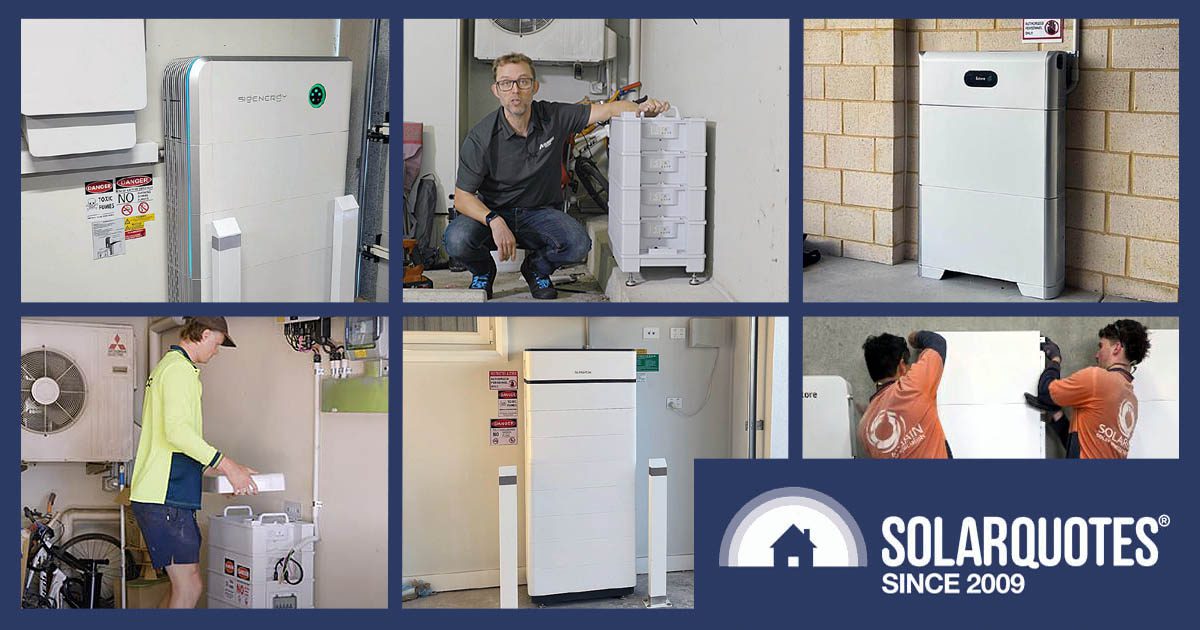
Australia has now installed more than 500,000 batteries under the federal government’s Cheaper Home Batteries Program.
It’s an impressive number for a scheme that’s a little over a year old, and one Energy Minister Chris Bowen was understandably keen to celebrate.
“Every battery installed means another household getting more value from their rooftop solar, and another job for the local installers and small businesses delivering this rollout across the country,” Bowen said.
But half a million batteries later, it’s worth looking beyond the milestone. The program hasn’t just put a lot of batteries on walls. It has changed Australia’s home energy market remarkably quickly.
How Did We Get To 500,000 Batteries So Quickly?
Before the federal rebate arrived, home batteries were growing in popularity but remained a relatively small companion to Australia’s rooftop solar juggernaut.
SunWiz estimates 221,000 residential batteries were installed during 2025 – roughly three times the previous year’s total. The federal rebate only kicked in halfway through the year.
Back in January, SolarQuotes writer Michael Bloch invited readers to place their bets on 2026 battery installations. Seven months later, it’s fair to say this hasn’t been an easy market to predict.
The original rebate also produced an appetite for very large batteries. Because the subsidy increased with eligible battery capacity, bigger batteries attracted bigger discounts.
That changed on 1 May this year.
The rebate was reduced and tiered, with the first 14 kWh receiving the full rate, less support from 14–28 kWh, and a much smaller subsidy above 28 kWh.
The market responded. By July, 20–30 kWh batteries had overtaken 40–50 kWh systems as the largest segment by installed capacity.
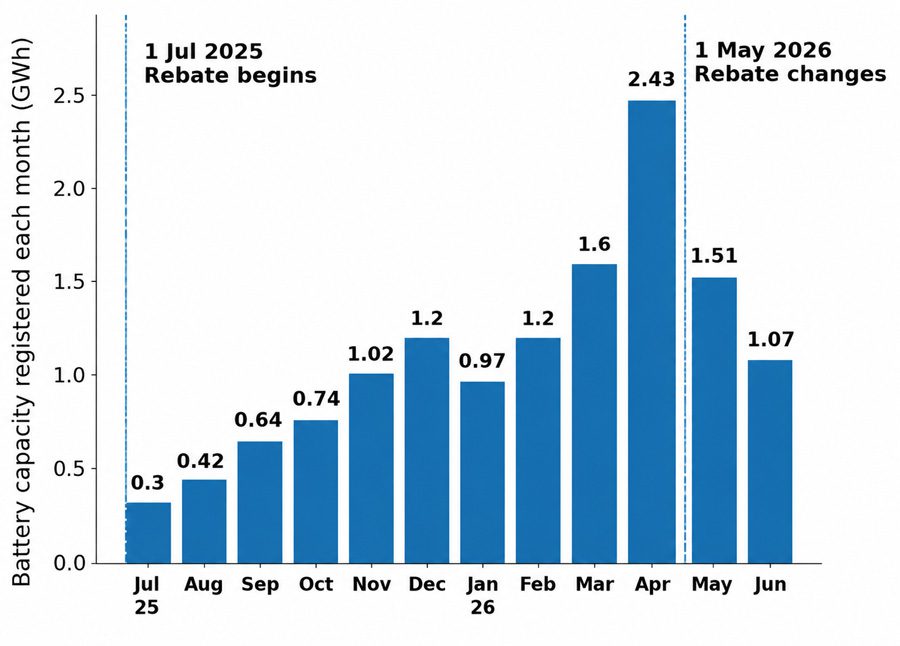
Australia’s battery boom peaked ahead of the May 1 rebate changes before settling back. Source: SunWiz monthly market data.
So the battery market that has reached 500,000 installations already looks quite different from the one that began the scheme.
Batteries Have Given Solar Another Kick
One of the more interesting side effects of the battery boom is what appears to be happening to rooftop solar.
Clean Energy Regulator figures show 52% of subsidised batteries have been retrofitted without changing the home’s existing solar system. But the other 48% have been installed alongside new, upgraded or replacement solar.
The relationship has been getting stronger.
During the first quarter of the battery program, 53% of new rooftop solar installations were accompanied by a battery. By the first quarter of 2026, that had risen to 71%.
The solar systems going in with batteries are bigger too, averaging 11.1 kW compared with 9.1 kW for systems installed without one.
At the same time, rooftop solar has been having a resurgence. Australia installed a record 791 MW of small-scale solar in the first quarter of 2026, up 21% on the same period last year.
The regulator says some of that strength may reflect households installing larger or upgraded solar systems alongside batteries.
So while the rebate was designed to encourage storage, it appears to have given rooftop solar another kick as well.
Batteries Are Starting To Change The Grid
Collectively, the 507,651 subsidised batteries installed by Friday represent around 14 GWh of storage.
That’s a sizeable new energy resource sitting largely in Australian homes and businesses, and AEMO is beginning to see household batteries changing demand patterns.
During the June quarter alone, household battery capacity in the National Electricity Market increased by 3,283 MWh, or 41%.
AEMO says growing battery storage and other consumer energy resources are changing demand patterns and supporting system reliability.
Batteries allow households to shift more of their daytime solar generation into later hours rather than drawing as much electricity from the grid when the sun goes down.
The next challenge is getting more of those batteries working together. Virtual Power Plants (VPPs) can coordinate thousands of household batteries, but ACCC data covering NSW, Victoria, South Australia and south-east Queensland found only around 24% of customers with solar and batteries were participating in a VPP.
Rapid Growth Has Brought Growing Pains
Putting hundreds of thousands of batteries into homes this quickly was never likely to be completely painless.
The ACCC says consumer reports to it about household batteries and new energy services increased 107% over the previous 12 months. Reported problems included systems that didn’t suit customers’ needs, faulty installations, poor battery performance and difficulties getting problems resolved.
The Clean Energy Regulator has also increased its focus on compliance and safety. By February it had completed 1,000 battery inspections and introduced additional evidence requirements for installations.
Meanwhile, the number of accredited battery installers has doubled to 8,846 since the program began, according to the government.
The scale of that expansion gives some idea of how quickly the industry has had to respond.
Where To From Here?
Half a million batteries sounds enormous. But if the government’s projections are right, Australia’s battery boom still has a long way to run.
The expanded program is expected to see more than two million Australians install batteries by 2030, adding around 40 GWh of storage. By comparison, the batteries already installed under the scheme represent around 14 GWh.
The rebate will continue to step down, which means the next few years will test how much of the extraordinary demand survives as government support reduces.
For more on how it works, read our detailed guide to the federal battery rebate.
 About Kim Wainwright
 RSS - Posts





I’ve been saying for a good while govco subsidies are best spent on smaller scale rooftop solar and storage.
Even better now with expansion top the larger commercial / industry rooftops with recent changes . . .
https://www.solarquotes.com.au/blog/government-expands-solar-rebates-for-commercial-rooftops/
There has to be battery storage as well though, so the power takes one more home or business off (or almost off) the grid, and put something into the grid to help out.
The power is right where it’s needed (both location and local grid), and is available when it’s needed.
Big wind and solar are really sucking up great amounts of subsidies, I can guess the scale is far less beneficial with wastage and productivity in a commercial aspect, profit driven, and high salary base.
This on top of huge (!) environmental damage, with both site needs and transmission over sometimes hundreds of KM, losses associated with moving the power where it is needed.
Roof area is the obvious answer.
Les,
Along your lines, I figure the battery subsidy is planned to be cheaper than the massive grid upgrades needed without these DERs. It will certainly be more climate resilient.
And rather than fret about AI data centres adding 10% of energy hogging load to the grid, I like to think we can just shut them all down on any day that electric trucks must distribute food, after the nation’s diesel stores run down, as Donny’s Special Military Operation continues its splendid success.
Ample home battery will insulate against what is coming, minimising inconvenience in straitened conditions. Yes, there’s ample sun when all the nation’s aircons are hammering on a 48°C day at decade’s end, but will the grid supply that and BEV & truck charging, peaking in the drivers’ lunch break? Their station batteries will be essential, minimally 50 MWh each.
This El Niño summer will help motivate the transition. It’s promising to be a doozy. Check your aircon and sunblinds.
A good article, and thanks for your insights Kim.
Don’t get crossed up though into thinking the 14 GWh of storage you mentioned, should be considered as a new power generation source input, for reticulating to Australian power consumers.
It is a storage input, not a generation input.
That is an important consideration for the mathematically inclined to mull over, particularly as Australia’s key issue right now, is to focus on a massive increase of clean power generation to enable powering of critical new age technologies and industries; businesses, communities, and families, at low cost, whilst simultaneously eliminating GHG emissions to insignificant levels.
Lawrence Coomber
So it’s basically about reducing demand, not meeting demand i.e. those in battery supported houses won’t generally need grid power – unless their demand spikes high, but otherwise the situation is the same as usual.
Actually Australia’s power issue isn’t massively increasing clean power generation, it’s supplying cheap and reliable energy. Australia is set to lose over 26% of coal power by 2029, 44% by 2033, and coal provides 70% or more of power at times each day, and the majority of power each day, to the NEM. The blackout risks are thus huge!!!
While I’m unsure what new age technologies you’re thinking of, the fact AI is relying on nuclear and gas over solar and wind (in America), suggests that at least some industries consider unreliable energy to be categorically unsuitable.
If wind and solar aren’t fit, coal is being shut down, gas expensive and also in the firing line, and nuclear refused, what options are there?
John from a scientific standpoint, scientific and known technological options are immutable and locked in science alone. There are no rules, regulations or restrictions on known scientific principles.
Technical options therefore are endless in all subjects. And outcomes are only limited by the immutable laws of physics and the creative imaginations of scientists.
They are always there for use if and when required and by whomever wants to and has the requisite capabilities to exploit them for specific purposes.
They are non-discriminatory and are there for all. Just look around yourself and you will see a massive range of new scientific endeavour unfolding everywhere. Some countries are more active in this scientific space than others. Australia is notably lagging behind most other countries in understanding the role of ENERGY INTENSIVE new age technologies revolution.
And in particular new age food production science as the planet population expands.
Lawrence Coomber
Read AEMO’s latest ISP John, it’s all outlined there:
https://www.aemo.com.au/energy-systems/major-publications/integrated-system-plan-isp/2026-integrated-system-plan-isp
If the grid energy supply world is coming to an end, as you fear, then it might be an idea to become off-grid capable, so as to ride out any grid wibbles, wobbles, or end of days. I’ve been off-grid here for 2.5 years, with 100% rooftop-powered rural motoring on top. My brother is on-grid, but exports up around 50 kWh on a sunny summer’s day when the battery is full. He’s still being paid to stay connected, so why not?
AI data centres are required to provide their own power, and we can just shut them down, if they burden the grid. The productive loss is zero, after all. For the first 5 years, they’ll likely lie derelict anyway, as the AI bubble bursts.Water use is a bigger problem, killing nuclear in Europe now.
LFP battery cost limited battery grid support to 4 hrs, but now 8 makes money. Na+ will soon boost that to 16 hrs, leaving only NEM-wide dunkelflaute to solve. For a decade, we’ll be stuck with some gas peaker plants, rarely used, 98% idle. Flip or drown & boil. Choose.
I certainly won’t be giving up control of my system to a VPP ever. 76% of us know it’s a terrible deal.
I’m one of the 24%, and am very happy with Globird VPP. First time a power company has paid me! My bills in winter have been very small ($3-25), against $371 in credit from September 2025 to May 2026. I’m not sure I could get there with a non-VPP plan.
But are all VPPs good? Absolutely not. These numbers will hopefully push retailers to have better offers.
Good for you Timothy! Sounds like you have a good deal… at the moment. Unfortunately these companies are not in the business of giving away money. Once the energy companies realise there is money to be clawed back from prosumers, you will find that plan “upgraded” for a new one that puts that cash firmly back into the energy companies’ coffers and their hand firmly in your back pocket.
The fascinating thing will be how the energy retail sector adapts. They’ve been on a good wicket for a lot of years, but now homeowners are increasingly looking to cut them out of the loop entirely because of the greater functionality of their own home energy systems.
Hi Nick,
The retail sector already starting the adaption by hiking Daily Supply Charges – what they might lose from the sending of electrons down the wire they claw back with the higher charge of being connected to the Grid. Then there is something that I saw from AGL, a ‘Controlled Load Service Charge’, at $2.20 per day, just for AGL hitting the switch sending the ripple down the wire.
Yep, am still waiting to see what the response to the Minister about that will be.
That is a great result, and I have one of those batteries. However, what happens in 10 to 12 years time when those 500,000 batteries are approaching, or have arrived at the point where they have degraded and aren’t worth keeping? Add to this all the ev batteries that will be ready for a change as well. Is government reviewing or planning for this major ewaste problem?
Yes of course Ken.
The government have an excellent and very well thought through plan for exactly the scenario you have described.
And why on earth would you think that they wouldn’t?
Lawrence Coomber
Lithium batteries are highly recyclable, they will be used as raw materials for the next generation of batteries.
Batteries are fast becoming just another commodity home appliance, with costs over the next decade or so approaching that of other major household appliances. That’s what comes with high manufacturing volumes.
The next generation of batteries are Sodium
Those lithium cathodes in those 500,000 batteries might be recycled after 15 years use but what for when sodium takes over?
Drew, I feel both battery technologies will be around for some time. Of course, there will be more developments & the Chinese Engineers are patenting developments continually. I feel on the current horizon, Li will power most cars, & Sodium will be used for cheaper, low Km vehicles as well as I feel Na will dominate fixed storage due to safety, long life, but heavier for Kw/Kg.
Currently I have an NMC EV, & Lipo. The NMC seems to be better in low temperatures. I have fixed batteries: Lithium Deye, & 12 kw of Zenaji Li Titanate. We flatten the Zenaji every day. It will easily see me out at 25K cycles+. The LiTi Supercaps are great, but expensive.
For more than a century, we have largely approached electrical energy from two separate directions: generate it when we can, and store some of it for when we cannot.
It is time to challenge that boundary, and many are doing just that.
A conventional battery is fundamentally a finite energy reserve. Whether lithium-ion, lead-acid or another electrochemical technology, it performs an enormously useful function – but once discharged, it must ultimately be replenished from another energy source.
So instead of asking only: “How do we build a better battery?” we should also be asking: “How do we engineer systems that reduce the need for the battery in the first place?”
That leads to a broader proposition: “Generation is the NEW Battery Storage Technology.”
That distinction opens an important engineering frontier. A case in point might be “Solid State Thorium 232 Scalable Battery Generation” and being widely studied in labs globally now, including in Oz.
Lawrence Coomber
Lawrence Coomber: – “A case in point might be “Solid State Thorium 232 Scalable Battery Generation” and being widely studied in labs globally now, including in Oz.”
Where are these “Solid State Thorium 232 Scalable Battery Generation” examples? Are they commercially deployable at large-scale? No?
Meanwhile, per the Climate Brink dashboard (using Copernicus ERA5 dataset):
* This year is on track for +1.60 ± 0.06 °C above preindustrial;
* Latest day (20 Aug 2026) was at +1.67 °C (record hottest for this calendar day);
* Where year-2026 likely ranks so far: 49.7% chance to be warmest on record, 50.3% chance 2nd warmest.
https://dashboard.theclimatebrink.com/#global
Either we/humanity act rapidly & effectively NOW or reap the consequences of a planet incompatible for human civilisation well before the end of this century.
Technologies that haven’t already DEMONSTRATED that they can be deployed commercially at large-scale & within short timeframes cannot save us!
Very good points Geoff.
I like to ask where are they? All the cheap nukes?
In 75 years they built 420GW.
In 67yrs the world deployed 1 Terrawatt of solar.
The next Terrawatt took 2 years.
The third Terrawatt took 18 months.
Solar now out *yields* nuclear and only one of them is the cheapest electricity ever generated; and getting cheaper.
Lawrence,
If batteries were expensive or slow to deploy, and radioactive ironmongery were cheap and ready, then you’d have a real-world point. Only then.
In reality, only insolation and its free consequence, wind, can provide boundless cheap energy, with zero fuel cost, and much reduced distribution cost. (Waves are still too energetic for our machines to last.)
The sun outputs more energy in a second than all nations do in 650,000 years. For free. The bit falling on Australia in 3 minutes can power our grid for a year. Nuke’s lunch is eaten.
What we need is distribution – a better nation-wide grid, for energy flow from sunny to shady, so batteries just for the night is about right. As battery production ramps exponentially, prices fall. 0.5M households can handle intermittency now, including nights. Truck chargers too, each with own 50 MWh battery. A full-time grid will not be essential for many.
Nukes are the problem. Batteries are the solution. No dirty radioactive waste.
Lawrence,
Nuclear physics is not my strongest suit, but here’s my take on the glow-in-the-dark Thorium stuff.
In every tech reference I read that, ²³²Th is “fertile”, not fissile. It needs to be irradiated with slow neutrons, giving ²³³Th, then decaying to ²³³Pa in 22 minutes (half-life). That decays in 27 days to ²³³U, and that is fissile. So, in operation, it’s actually a Uranium reactor, not Thorium, then. And ²³³U is also suitable bomb-making material.
OK, Thorium can be combined with a starter fuel like uranium or plutonium, so there is Thorium in the reactor, but it’s the bomb material doing all the work, innit?
So there’s no non-proliferation benefit, just some economy from the fact that there’s three times as much Thorium as Uranium to be dug up? And the radioactive waste products have half-lives of centuries, not tens of millennia? It’s still crazy crap to hide away, hoping it won’t pollute – when all that crap is done for free in the sun. Safely.
We clearly need to further develop Zero Point Energy Modules for long lasting power generation and storage. I wonder who is working on that?
Our free fusion reactor, spilling more energy in a second than the world generates in 650,000 years, makes it pointless loss-making failed rent-seeking to build reactors on a planet. Solar is generated AND distributed for FREE, so forget the rent-seeking business model – it’s last-century cruft, crumbling into obsolete coal dust before our eyes. But OK, fossil fuels must go first.
Low income countries are now skipping the west’s costly fossil fuel detour on the path from primitive biomass energy to a fully electric world:
https://www.youtube.com/watch?v=qoNr6hjy7aE
Substantial European industry relocation to sunny sub-Saharan Africa is projected for later this century. It seems an obvious global development. There’s room for the battery mountains there too. And if the South Australian ZnI₂ batteries with 60,000 cycles pan out, that’s 160 years of daily cycles before recycling.
“It’ll never fly!” the doubters cry. But observe, the wheels are up. Just look.
No disrespect Erik I have known you for a long time. You have passion. I admire that. My professional suggestion – be content to stay in your lane mate.
A bit extra for you: The SSG1 is just one example of innovation that moves technology UP the periodic table as the basis of the next innovative step in practical energy science.
These sorts of discussions are only meaningful though between global engineers who are focussed on the science rather than the hype, and are both qualified and experienced enough to be included in the discussion. These sort of concepts are grounded in science, and are not thrown out there for normal everyday unqualified people bogged down by ideology and fantasy talk in the mass media for example. It is all about genuine science. Complicated outcomes can only be produced from what we have in nature, in some combination, and some form. There are no smoke and mirror moments. It is always – just pure science.
Lawrence Coomber