
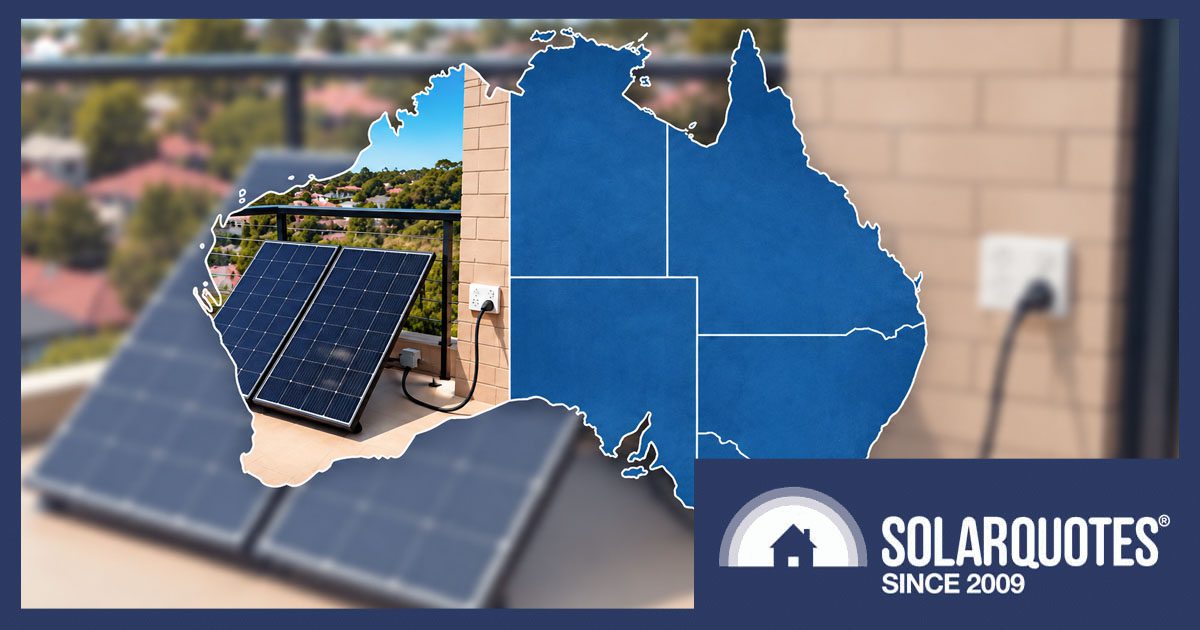
Western Australia is moving to become the first state in Australia to legalise plug-in solar panels and batteries, potentially giving renters and apartment residents a way to generate their own electricity without installing a conventional rooftop solar system.
The Cook Government says households could save around $240 a year with plug-in solar, rising to $500 if they add a battery. But the systems aren’t legal yet. The government has released a draft technical standard for consultation, and questions remain about safety, installation restrictions and whether the promised savings will justify the cost.
How Is WA Going To Legalise Plug-In Solar?
Unlike conventional rooftop solar, plug-in systems are designed to connect to an ordinary household power point. Electricity generated by the panels is fed into the home’s electrical circuits, reducing the amount drawn from the grid.
Their appeal is simplicity and portability. A renter could potentially take a system with them when they move, while an apartment resident might be able to install panels on a balcony or in a courtyard.
The WA Government has published a draft Technical Bridging Standard, based largely on German requirements but modified for Australian electrical standards and conditions.
Among the proposed rules:
- Inverter output would be limited to 800 VA, with a maximum current of 3.5 amps.
- The government proposes allowing up to 2 kW of solar panels, although the draft standard describes a 2 kW combined DC power limit for solar and battery modules.
- Only one plug-in system would be permitted per household, and it couldn’t be used alongside conventional rooftop solar.
- Batteries would be permitted, without a specified maximum storage capacity in kWh. Only lithium iron phosphate and sodium-ion chemistries would be allowed.
- Extension leads, power boards and travel adaptors would be prohibited.
- Inverters would require grid-disconnection and electric-shock protection, while users would need to notify their network operator and label their switchboard.
The government is also developing the certification and regulatory changes needed before compliant systems can be legally connected.
The Potential Savings
The government’s headline estimates are $240 a year for plug-in solar and $500 with a battery. But those figures need some context.
At the current Synergy A1 electricity rate of 33.26 cents per kilowatt-hour, saving $240 would require a household to avoid buying about 722 kWh of grid electricity annually, or almost 2 kWh a day. Reaching $500 would require approximately 1,503 kWh a year in avoided grid purchases, equivalent to 4.1 kWh a day.
Those figures aren’t necessarily unrealistic, but they depend on solar generation, household consumption patterns and, in the battery case, how much energy can be stored and used later. The government’s published information doesn’t provide enough detail to reproduce its estimates, including the assumed system sizes, self-consumption rates or battery capacity.
Then there’s the purchase price. A solar-only system costing $1,200 would take five years to recover its cost at $240 in annual savings. A $3,000 solar-and-battery package saving $500 annually would take six years. These are illustrative examples, not Australian retail prices, and exclude degradation, maintenance and other costs.
Until compliant systems reach the Australian market, their actual prices and payback periods remain uncertain.
A Better Fit For Apartment Households?
Australian research published in 2019 found that apartments and units consumed a median 8.9 kWh of electricity per day, compared with 17.7 kWh for detached and semi-detached houses. Although the study wasn’t specific to WA, it suggests even a modest solar system could make a meaningful contribution to an apartment household’s electricity needs.
However, financial returns depend on how much electricity is used while the panels are generating, rather than total daily consumption. An apartment occupied during the day could benefit considerably more than one left empty until evening. Panel orientation, shading from neighbouring buildings and limited balcony space could further reduce the savings.
Safety Questions Remain
The draft standard includes requirements covering inverter protection, electrical connections, mounting arrangements and battery safety. However, the government’s consultation paper acknowledges an outstanding concern about DC leakage potentially interfering with older residual current devices (RCDs), reducing their ability to detect electrical faults. Further laboratory testing is being considered to establish whether the proposed safeguards are adequate.
Another concern is overcurrent protection. A plug-in generator can supply electricity to a household circuit in addition to the grid, potentially allowing more current to flow through sections of wiring than the circuit breaker is designed to protect against. Although the draft limits inverter output to 3.5 amps, it’s not clear whether this adequately addresses the risk in all existing installations.
Renters May Still Face Obstacles
Legalising the equipment won’t necessarily remove every obstacle facing the households the government hopes to help. Renters may still require landlord approval, while apartment residents could face strata restrictions on mounting panels to balconies, railings or other common property. The government acknowledges that further work may be needed to address rental arrangements.
Homeowners should also consider their longer-term plans. Under the draft standard, plug-in solar couldn’t operate alongside conventional rooftop solar. That doesn’t prevent a homeowner from upgrading later, but it could leave them with a plug-in system they can no longer use at that property.
The Road To Legalisation
Public consultation on the proposed rules closes on 9 December 2026. The government must then consider submissions, settle the technical requirements and make the necessary regulatory changes. No firm commencement date has been announced.
There’s a genuine opportunity here to extend solar’s benefits to households that have largely missed out on the rooftop solar boom. But whether plug-in systems deliver worthwhile savings will depend on the final safety requirements, installation permissions and, perhaps most importantly, what compliant equipment actually costs.
In the meantime, there are other solutions available – read our guide to apartment solar for more.
 About Kim Wainwright
 RSS - Posts






Speak Your Mind