
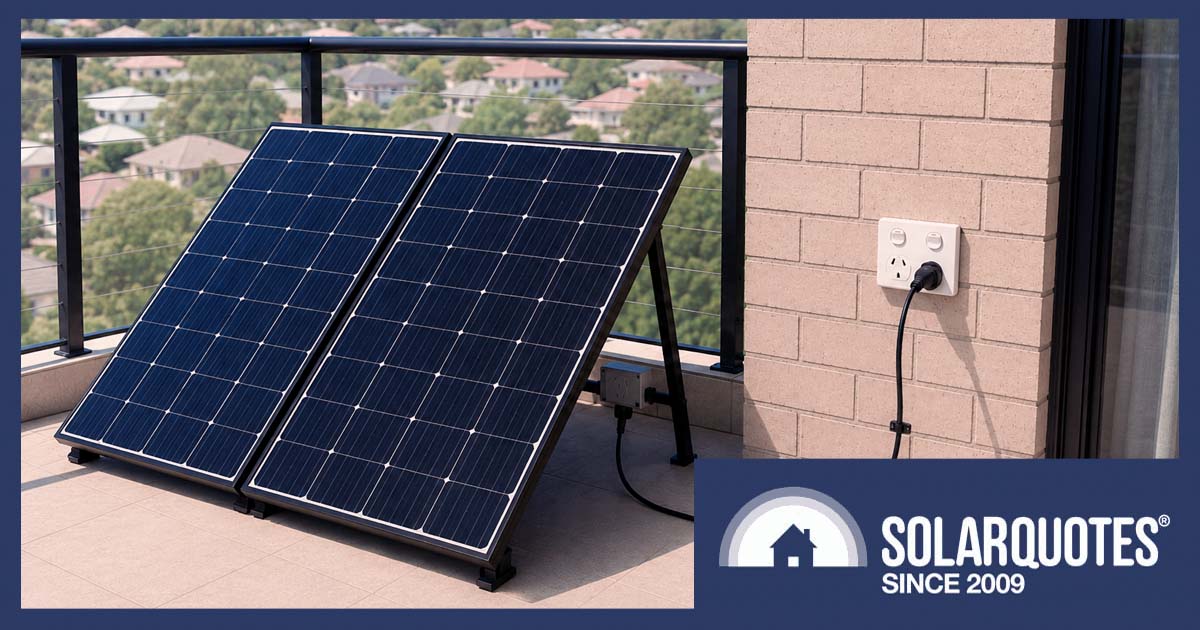
Plug-in solar has moved a step closer in Australia, with federal, state and territory energy ministers agreeing to explore pathways for its safe deployment. The UK now allows approved systems, while New Zealand is also moving towards legalisation.
But there’s an electrical safety problem SolarQuotes raised when we looked at balcony solar in 2024. Two years later, we finally have a much better answer.
Can Plug-In Solar Overload A Power Circuit?
Yes, in theory. But that doesn’t necessarily make it unsafe.
The problem is where the solar power enters the circuit.
Imagine a normal Australian power circuit protected by a 20 amp circuit breaker. Plug an 800 watt solar inverter into a powerpoint, and it can supply roughly another 3.5 amps downstream of that breaker.
Under the right circumstances, a section of cable could therefore carry around 23.5 amps while the circuit breaker sees only 20 amps.
That was the problem SolarQuotes couldn’t satisfactorily resolve in 2024. If the breaker can’t see all the current flowing through the cable, how can it protect that cable from overload?
Solar and battery engineer Glen Morris, who sits on the Standards Australia committee responsible for grid-connected inverter standards, confirmed the problem:
“The extra current does not disappear. Your 23.5 A worst case on a 20 A circuit is arithmetically correct.”
But that’s not the end of the story.
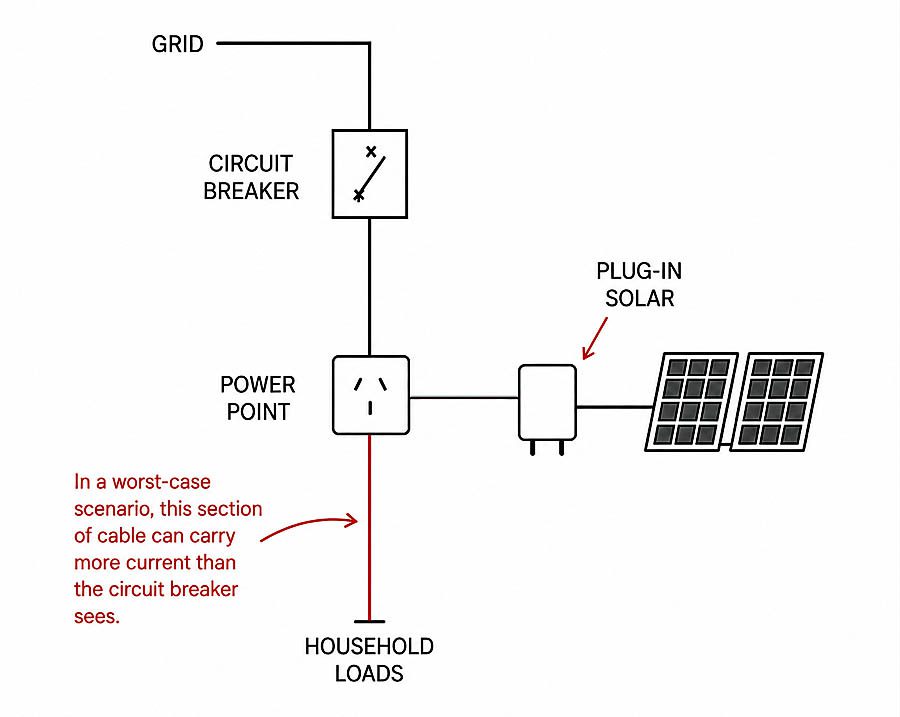
Plug-in solar can add current downstream of the circuit breaker, allowing part of the final sub-circuit to carry more current than the breaker sees.
The Overload Risk In Context
A 20 amp circuit breaker doesn’t mean the cable becomes unsafe the instant its current reaches 20.1 amps.
Australian power circuits commonly use 2.5 mm² cable protected by a 20 amp breaker (depending on how it is installed). That cable has a current-carrying capacity above the breaker’s rating.
There’s also a time factor. Overloading damages the cable through heat, so brief periods above the breaker rating are very different from sustained overload.
Circuit breakers reflect that. Morris points out that a standard breaker must carry 1.13 times its rated current without tripping, while at 1.45 times its rating, it can take up to an hour to trip.
For that worst-case scenario to actually occur, several things need to happen together:
- The panels need to be producing strongly.
- The inverter needs to be near maximum output.
- Loads on the circuit need to be high.
- Those loads need to be positioned so the same section of cable carries both the grid and solar current.
Why Did Germany Set The Limit At 800 Watts?
Germany limits inverter output to 800 VA, with up to 960 watts of panels when connected through an ordinary household plug. The panel limit matters too: substantially oversizing the array could keep the inverter pumping out its full output for longer, increasing the risk of overheating.
Morris says the German analysis was based on a typical 16 amp circuit using 1.5 mm² cable. He compared that with the heavier 2.5 mm² cable commonly used on Australian 20 amp power circuits:
“Our standard circuit uses heavier cable with a proportionally similar breaker, so 800 W here is, if anything, more conservative than the German case.”
So 800 watts isn’t a magic number that prevents an overload. It limits the inverter’s contribution to around 3.5 amps, with Germany concluding that this was low enough to keep cable heating within acceptable limits.
The UK Put Plug-In Solar To The Test
Britain went a step further.
Before allowing approved plug-in solar systems, the UK Government commissioned electrical safety testing using representative domestic circuits and a range of operating and fault conditions.
The testing included what happens when solar adds current to a household circuit downstream of its circuit breaker. It found plug-in systems could operate safely under the conditions tested, with no unacceptable thermal effects.
But overload isn’t the only concern. The UK work also examined protective-device operation and shock risks when a system is unplugged or the grid goes down. Those risks can be managed with appropriate inverter and product protections.
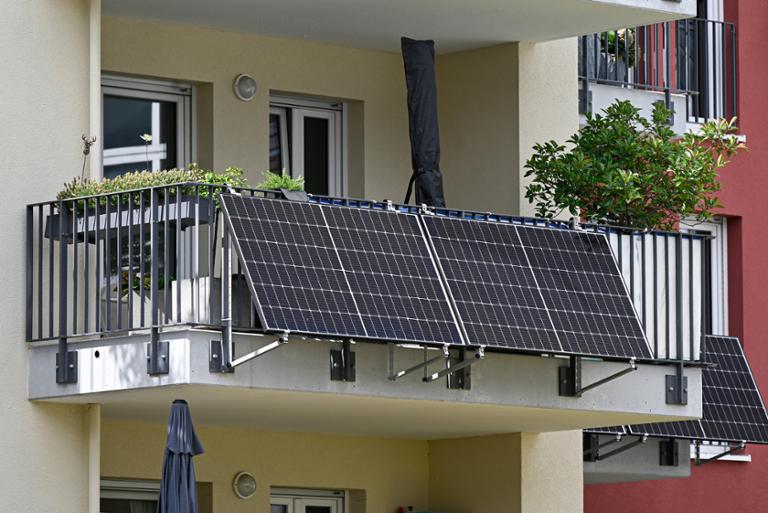
Source: Sun Gold Solar
But What About An Old Australian House?
This is where things get less tidy.
The thermal headroom argument assumes the existing circuit has enough headroom to begin with.
“The honest caveat is old installations and cables buried in ceiling insulation, where derating eats into that margin,” Morris told SolarQuotes.
That matters because plug-in solar could be particularly useful for renters. They can take a system with them when they move, but have little control over the electrical installation they’re plugging it into.
An older installation, or cable affected by thermal insulation or other derating factors, may not have the same margin as an ideal installation.
This is one of the questions Australian testing should help answer. Morris is involved in a RACE for 2030 research project with RMIT, UNSW and CSIRO, with trials planned to investigate circuit loading, RCD behaviour and related safety issues under Australian conditions.
What Would Australia Have To Change?
Australians can’t legally wander into a shop tomorrow, buy an 800 watt balcony solar kit and plug it into a powerpoint.
According to Morris, the main standards barrier is AS/NZS 4777.1, which governs the installation of grid-connected inverter systems. Current arrangements require the inverter to be permanently connected on a dedicated circuit rather than plugged into an ordinary socket.
Legalising plug-in solar would require changes to that standard or a separate installation pathway, along with appropriate product requirements, state electrical safety rules, and a way for distribution networks to know the systems are connected.
Victoria is already looking at what would be needed. A parliamentary inquiry tabled in August recommended investigating technical standards, safety regulations and a registration scheme for plug-in solar and batteries.
New Zealand is also moving ahead. Its government has decided to progress regulatory changes to enable plug-in solar, although the detailed technical requirements still need to be worked through.
Australia has now taken a national step in the same direction. On 11 September, federal, state, and territory energy ministers agreed to explore pathways for the safe deployment of plug-in solar and other plug-in consumer energy devices. The Commonwealth will work with the states and territories to identify what measures are needed and report back to energy ministers by the end of the year.
That doesn’t mean plug-in solar has been given the green light. Morris says there is currently no Standards Australia project underway to amend AS/NZS 4777.1 for plug-and-socket connections.
So, Is Plug-In Solar Safe Enough For Australia?
The electrical problem SolarQuotes raised in 2024 hasn’t disappeared. What’s changed is how that risk can be managed.
Germany and Britain have shown that tightly limiting plug-in solar and applying the right technical safeguards can reduce the risk to an acceptable level. The remaining question is whether Australia can apply a similar approach across our own electrical installations, including older and less-than-ideal ones.
Australian testing should help answer that. Energy ministers are now looking at a national pathway, but standards and regulatory work will still be needed before plug-in solar becomes a reality here.
Morris did offer one possible shortcut:
“Then again, the Energy Minister might just wave his magic wand and say ‘Just Do It!’”
Want to keep up with where plug-in solar goes from here? Sign up for the SolarQuotes newsletter for the latest solar, battery and energy news.
 About Kim Wainwright
 RSS - Posts





Permanent solar/battery systems have a gateway to prevent electricity flowing into the grid in the event of a grid outage. This is partly to reduce risk to repair crews.
Is the portable solar wattage low enough that this is not an issue? Or will these systems need a device (near the main switch) to prevent feed in to the grid?
Michael, the low wattage doesn’t remove that risk. A compliant plug-in solar inverter needs anti-islanding protection, just like a conventional grid-connected solar inverter. It must detect a grid outage and stop supplying power so it doesn’t feed electricity back into the grid.
There are other safety issues with plug-in solar, but I couldn’t cover the whole lot in one article. I’ve deliberately focused on one problem SolarQuotes raised back in 2024 that we couldn’t satisfactorily resolve at the time: the possibility of overloading part of an existing power circuit without the circuit breaker seeing all the current.
Surely then it would no longer be plug and play – defeating the whole purpose?
To me this issue is all about an inverters inability to see the circuit breakers point in time current load. The inverter and the circuit breaker that is the point of concern must be on the same segment and we have, circuit breakers that report sensed load over network connection and we also have effective ethernet over power. So if the inverter can see circuit breaker load and as that rises up to derate it’s own output back so that overload isn’t a thing, and if set so that network failure is treated as a max circuit breaker load event then the need to artificially limit to an arbitrary limit of 800w disappears. A circuit breaker containing ethernet over power and load sensing and reporting is needed and must be installed. It’s not totally just plug in but a single breaker change is never going to need a personal loan to achieve and may result in an inverter technically capable of providing up to a full 20A of output ( albeit that the balcony.would be huge to have sufficient PV space)
At the end of the rental the circuit breaker can be just left. It’s main job remains being a breaker. At the new house plug in immediate, no corresponding circuit breaker present limit inverter to 800w. At a point down track install new circuit breaker, and pair the inverter and the breaker, limit removed.
The inverter like all other inverters just has to sample the circuit for mains voltage, in the event that the grid drops off, or your main l, or segment breaker blows the inverter immediately goes off line
OK – I guess 800W is not enough for backup during grid outages so having the inverter disconnect is not a major issue.
Actually in thinking some more, to keep DC voltages safe this has to be.limited to small numbers of panels and the safest way to do that is for the inverter and panel to the one thing so that DC is effectively hidden away…… This means that the 800w limitation isnt actually the issue, to me how do you prevent “better idiot” buying 4 of these cause “I want moreee”and plugging all 4 into the same segment….
Sounds like some positive baby steps but we will see I guess. As you detail, a modern setup is most likely fine but safety with older (or even ancient) wiring may be a problem. I know the rentals I lived in during my student days were likely prime candidates for problems with something like this.
Is there potentially a battery option in between the solar and power plug that could limit any amperage going into the system but still make the most of alot of the solar being generated. I’m sure that has been thought of and must have other problems (maybe just too expensive?).
Are there problems with multiple 800w systems being plugged in or ways to prevent it?
I realise it wouldn’t be legal but people being people may think that Bob has 10kw on his roof, so adding a second or third 800w to my wall sound fine. Either not realising the safety issue or be misled by dodgy salespeople and just go ahead with the dangerous setup.
Hopefully something safe can be worked out.
Kim, I wonder about the billing meter and usage and have a few what if questions.
What if there is an old spinning disc meter. Will it just spin backwards when there is more production than usage? Yes there are strata properties in NSW and ACT with them. Assume the answer to this will be “yes”.
Are these systems compatible if used on a dwelling with fixed solar and battery? I can imagine if available at ALDI prices people may consider using them as a small upgrade to capacity. Stick a few up on the shed which has a higher capacity circuit anyway?
“Ingenious” Australians have a significant capacity for repurposing, hopefully these don’t become a source of house fires. Are there any stats available on issues encountered in the countries that have adopted them?
Does Australia have worse wiring and more older houses than the UK? If not, and I doubt it, why not just cut and paste the UK standard rathervthan reinvent the wheel. The industry has had ten years since Germany allowed them to leisurely get its act together. We allow power points in bathrooms which the UK thinks are killers, so the onus should be on the industry to demonstrate why the UK standard would be dangerous in Australia
The UK also has ring circuits and individually fused plugs for appliances.
It’s not as simple as just saying they do it over there.
Forgetting downstream power consumption overloadinf circuits for a minute.
Isn’t there an equal issue with crappy circuit breakers/RCDs at the switch board not designed to have (to them anyway) power flowing backwards up the circuit to the circuit breaker/RCD and to the rest of the house or even out of the house to the wide world.
I have read a lot of older Rcds don’t handle that backwardmcurrent flow situation well or reliably.
Newer ones do.
So surely we need a plug in solar system on a circuit that supports the current flowing in reverse through it and the Circuit breaker/Rcd as well as the plug in solar.
And if so there is zero chance of anyone caring about those niceties. And just whacking the plug in solar into any old circuit handy to the window the cord Co es in via.
My concern are the solar panels on a balcony. Who is installing them? Can they fall to the ground? Can they blow off in strong winds?
Hi Drew,
The caravan industry has already looked at this because accidents were caused and people died after a panel flew off a van on the highway.
The engineering is going to be a mess.
And people shading each other’s balcony.
What happens if a child unplugs the solar panel and touches the LIVE 240V PRONGS from the Solar Panel? HE GETS ELETRACUTED. NO GOOD AT ALL!
Hi Charles,
It can’t happen unless the inverter itself malfunctions.
Without having an electricity grid to synchronise with, AS4777 compliant hardware simply shuts down.
It’s called anti islanding, but balcony solar has other problems.
“Real life use in Europe finally dismisses the naysayers” there you go – I fixed the tittle for you…
If 2 or more separate plug-in systems are operating when the grid goes down, could one plug -in interpret the voltage produced by the other(s) as a still -present grid voltage and so they all continue to function without the grid? How to prevent this?
Just like normal solar inverters, as soon as it detects the grid is no longer there it turns off. They’re not grid forming so it will drop within 20ms of the grid dropping. The grid dropping could be a breaker tripping (i.e. RCD) or upstream grid outage.
its 800w max in most places. On the smallest breakers, 800w wont be unsafe
There are no safety issues here just gate keeping. SolarQuotes doesn’t make money from balcony solar, so of course they are against it. Same old bias running deep
Hi Ben,
You’re correct about balcony solar inverters being grid following. I’m curious to know if you have a 16A/3.6kW rated circuit and then just plug in another 21% supply, just how do you protect the cable from overload, melting and potential fire?
What stops people loading 4 x balcony batteries onto a double power point and trying to run the air conditioner?