
Australia’s electricity market operator has been warned that an overly cautious approach to planning the grid could leave consumers paying more than necessary.
That’s one of the findings of an independent review of the Australian Energy Market Operator (AEMO), which has also raised concerns about potential conflicts between some of the organisation’s expanding responsibilities.
Energy ministers have agreed to reforms aimed at addressing both issues.
Why Could Caution Cost Consumers?
Keeping the lights on is AEMO’s day job, so being cautious about the future electricity system might sound like a good thing.
The problem is that caution can be expensive.
AEMO develops the Integrated System Plan (ISP), which maps out the generation, storage and transmission infrastructure needed as Australia’s electricity system changes.
The review, led by former senior Treasury official Nigel Ray, found AEMO’s responsibility for maintaining system reliability and security gives it a naturally conservative approach to risk.
But it warned:
“This approach has cost consequences for consumers if that caution brings forward investment or overstates required intervention.”
That matters because the ISP can identify major transmission projects as “actionable”. The review says that status is difficult to unwind and can commit consumers to significant, long-lived regulated expenditure.
Those network costs are ultimately recovered from electricity consumers.
The review does not conclude AEMO has been unnecessarily building infrastructure or wasting consumers’ money. Instead, it identifies a risk in the way planning decisions are made.
Could Solar And Batteries Help Keep Grid Costs Down?
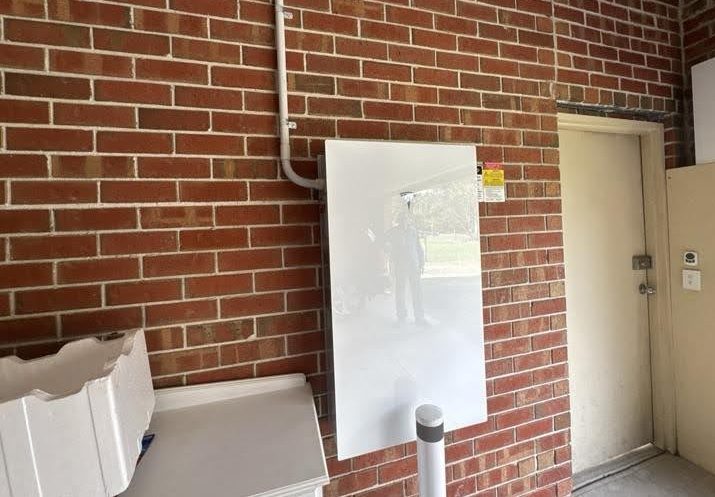
Regulators are looking at how home batteries can better support the grid.
Rather than taking long-term planning away from AEMO, the review wants changes to the rules governing the ISP.
Among them is greater consideration of the demand side – how electricity consumers and resources connected to distribution networks can help meet the needs of the system.
The review says greater innovation, including on the demand side and at distribution level, could reduce reliance on costly and time-consuming grid-scale infrastructure and minimise the overall cost of the energy transition.
That potentially includes the growing fleet of rooftop solar systems, home and community batteries, electric vehicles and flexible loads.
Energy ministers have agreed, with the ISP rules now under review.
And Then There’s A Potential Conflict Of Interest
Consumer costs weren’t the only concern to emerge from the review.
AEMO also controls AusEnergy Services Limited (ASL), which carries out energy investment procurement work for governments.
That creates an unusual arrangement. AEMO operates the electricity system and helps determine through its planning what the future system needs, while its subsidiary is involved in procuring energy investment.
The review found ASL’s investment procurement role did not align with AEMO’s core functions, creating differing mandates and “perceived conflicts of interest”.
The proposed solution is simple: separate them.
Energy ministers have agreed ASL should be spun out as a standalone organisation.
That hasn’t happened yet. Senior officials still need to work out the implementation and timing, in consultation with ASL, its existing members and potential future members.
Who’s Watching AEMO’s Own Spending?
The review also turned its attention to what AEMO itself costs to run.
Its budget has nearly tripled over five years, although AEMO estimates its NEM functions currently add only around $16 a year to an average residential electricity bill.
The bigger governance problem identified by the review is the lack of binding independent external scrutiny of whether AEMO’s expenditure is efficient.
Energy ministers have agreed in principle to give the Australian Energy Regulator a new role overseeing AEMO’s annual budget.
AEMO has welcomed the review and begun work on the recommendations that fall within its control.
For households, however, the more consequential reform may be changes to the way AEMO decides what future grid infrastructure is needed.
Australia needs enormous investment in its electricity system over the coming decades. The review isn’t arguing against that investment. It’s asking whether consumers can be better protected from paying for infrastructure earlier than necessary – or when a cheaper solution could do the job.
And with more solar, batteries and flexible loads appearing behind the meter, what consumers can contribute to the grid may increasingly matter just as much as what gets built in front of it. AEMO’s recent analysis of 20,000 Australian homes shows just how much difference home batteries are already making to when households rely on the grid.
 About Kim Wainwright
 RSS - Posts




Yes here in Australia always a lot of talk and not much action !! Too much red tape !!
Hi Peter,
The Government can move at lightning speed when they’re a wholly owned subsidiary of Santos.
We must remember that if protest was useless, they wouldn’t lift the fines by 6000% and promise 3 years gaol for disturbing the peace in front of a fossil fuel conference.
Too true, and it transpires that the populace conspires beyond all other players to maximise our cost. We pay $1B per week to foreign corporate rent-seekers, for fossil fuels, for which we have no long-term need. (And the long-term costs of emissions consequences will exceed that for our children.)
Ditch the obsolete stinking wheeled money-burners, as so many are doing, driving for freeeeeeeee!
Trucks have begun the money saving – only a few hundred so far, but ten years will transform the roads.
If we spent that $1B per week on the energy transition, we could build such a mountain of batteries, that pushing Tomago off the edge into the sea might suffice for a fossil-free grid in reasonable time. (Let other countries’ provide cheaper aluminium, as we now do with petrol.)
Home energy & transport freedom have been granted. Continued enslavement is purely voluntary. Why complain when (mostly) you’re the jailer?
Hefty fuel price hikes are only months away, as reserves dry up. Wake up.
Peter Johnston: – “Too much red tape !!”
The Laws of Physics ‘don’t care’! Either we/humanity act rapidly & effectively NOW or reap the consequences of a planet incompatible for human civilisation well before the end of this century.
Meanwhile, per the Climate Brink dashboard (using Copernicus ERA5 dataset):
* This year is on track for +1.60 ± 0.06 °C above preindustrial;
* Latest day (17 Aug 2026) was at +1.63 °C (record hottest for this calendar day);
* Aug 2026 projection: +1.62 °C (+1.52 to +1.71), 17 days in, estimated to be hottest in instrumental record so far;
* 365-day running mean: +1.47 °C, relative to 1850-1900 baseline
* ENSO state: El Niño: +2.57 °C;
* Where year-2026 likely ranks so far: 45.4% chance to be warmest on record, 54.6% chance 2nd warmest.
https://dashboard.theclimatebrink.com/#global
Global warming is already disrupting ecosystems.
https://www.solarquotes.com.au/blog/supply-charges-rising-offgrid-doesnt-make-cents/#comment-1736415
Geoff,
Peoples’ eyes glaze over at your quantification of the status quo, and even more so at predictions of a Niño 3.4 peak of +3.6°C, for a +1.76°C global temperature rise in 2027. The English are worrying about food prices, as they import 42%, but European harvests are down 7% in the least hit regions, much worse elsewhere. And water is scarce, for farmers and reactors.
I’m glad that I removed 10 trailerloads of fallen branches & treetops from the forest edge 55m from the kitchen window, last year. Another 2 done today. Low fuel load will be absolutely critical this summer.
It is not all bad that a little bit more of the 91% global heating absorbed by the oceans will bite us in the bum in the next few months. The destruction will not educate us adequately to the remaining lurking heat debt, piling up to civilisational mayhem, but ought to spur us on toward a more survivable level of effort. The lemming herd is turned very slowly. There will be more losses. Act now? Why not?
Could AEMO’s Cautious Grid Planning Be Costing You Money?
Of course, and you can bet retailers are pushing for slow and steady, even though things are looking pretty good for them.
Some quick figures found on a few majors, slightly varying profit stages for financial year 25/26, AGL npat $631m, Origin ebitda $1.16b, Energy Aust np $40m fist half 2026.
We are probably to expect the horse before the cart on renewables saturation, what it means for retailers, and end benefits.
At the moment, it’s every solar and battery owner for themselves, and the rest sweating it out.
Nobody seems to want these 1000’s of Km of landscape destroying HV towers, solar farms and turbines so would it not be cheaper for the grid for govt to cut the demand considerably by increasing the subsidy greatly for rooftop solar and batteries, means tested of course for houses and industry.
Far more chance of getting a result that will avoid blackouts with this idea with the increasing proliferation of high consumption items like cars, trucks and data centres than dragging farmers and other dissenters through the courts for years before even existing infrastructure can be connected up.