
Australia’s federal battery rebate is changing from May 1, 2026 — and if you’re considering a home battery, you’ll want to understand what’s changed and what it means for you.
Why Is The Battery Rebate Changing?
In 2025 alone, more than 180,000 home batteries were installed, as households rushed to take advantage of generous upfront discounts available through the federal government’s Cheaper Home Batteries Program. Your installer applies it directly to your quote — no paperwork, no waiting for cashback.
It’s effectively an extension of the long-running solar panel rebate, and like that scheme, it’s not means-tested. If your system meets the requirements, you’re eligible.
But that success has come at a cost: the scheme has been burning through its budget far faster than planned.
The government has now committed $7.2 billion to the program — up from the original $2.3 billion — to keep pace with demand.

That’s $7.2 billion with a “B” for batteries. Enough for us… and Dr Evil. Mwah-ha-ha…
How Is The Battery Rebate Changing In May?
Right now (as of April 2026), the rebate sits at about $300 per kilowatt-hour (kWh) of battery capacity. From May 1, that drops to roughly $244 per kWh — and more importantly, it becomes tiered.
Here’s how it will work:
- First 14kWh: Full rebate (about $3,400 total)
- 15–28kWh: 60% of the rebate
- 29–50kWh: Just 15%
- Over 50kWh: No rebate
This is a significant shift. Under the old system, larger batteries attracted proportionally larger rebates. From May, that incentive is sharply reduced.
For example:
- A typical ~10kWh battery will still receive around $2,400
- A ~14kWh system (think Tesla Powerwall size) gets the full-rate benefit
- But a large ~48kWh system could see its rebate drop from roughly $16,000 to around $7,000
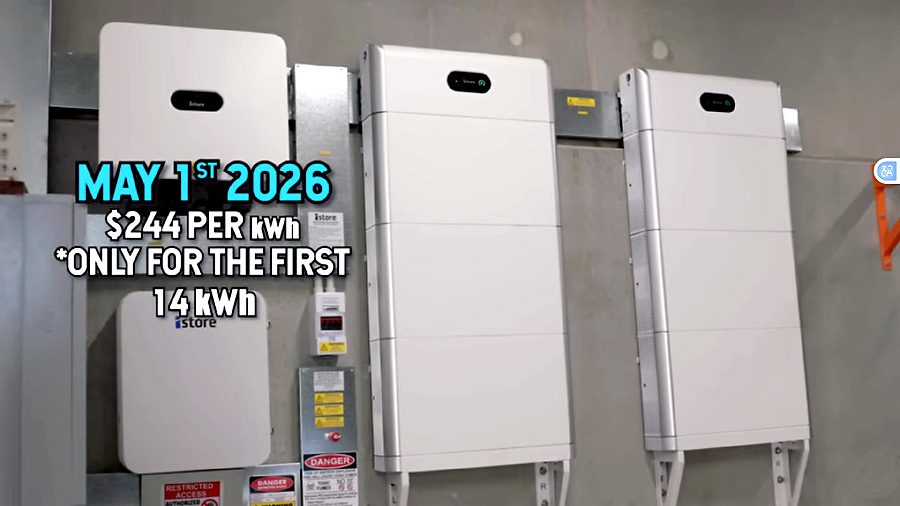
From May 1, it’s $244/kWh — but only for the first 14kWh. After that, the rebate tapers fast.
Why The Government Changed It
In short: people were installing much bigger batteries than expected. Because the original rebate paid a flat rate per kWh, it encouraged upsizing. More capacity meant more subsidy — and households responded accordingly.
The new tiered structure is designed to rein that in and steer buyers toward more modest system sizes. For most homes, that’s not necessarily a bad thing. Batteries in the 10–20kWh range are typically enough to capture the bulk of solar savings.

SolarQuotes founder Finn Peacock says 14kWh is the sweet spot to maximise returns with the new rebate.
What Hasn’t Changed
Despite the overhaul, the core eligibility rules remain the same:
- Battery and inverter must be Clean Energy Council approved
- Minimum size is 5kWh
- Grid-connected systems must be VPP-capable (but you don’t have to join one)
- Off-grid systems can qualify under certain conditions
- The battery must be paired with solar
- The rebate isn’t means-tested
- You can only claim it once per property
State-based battery incentives can still be stacked on top.
The Installer Bottleneck
If you’re hoping to lock in the higher pre-May rebate, there’s a catch: installers are slammed.
Across the country, reputable installers have been booked out for months, with many already at capacity before the May deadline. That makes last-minute installs highly unlikely unless you’ve already secured a spot. You won’t get a pre-May install through SolarQuotes at this point so don’t even submit a request if that’s your goal.
Be cautious of any company promising a guaranteed pre-May installation without clear conditions — especially if they seem unusually available.
Protect Yourself Before You Sign
Whether you install before or after May, a few simple checks can save you a lot of grief:
- Get installation timelines in writing
- Confirm the battery is actually in stock
- Clarify what counts as “installed” (it’s when compliance paperwork is issued)
- Be wary of large or non-refundable deposits
- Read the fine print — even if it’s tedious
Should You Buy Now Or Wait?
If you haven’t already locked in an installer, your chances of getting a pre-May install with a reputable company are close to zero — so be wary of anyone promising otherwise.
But if you miss the deadline, don’t panic!
The rebate still offers meaningful savings after May — especially for well-sized systems — and falling battery prices are helping offset the reduction.
What you shouldn’t do is rush into a poor-quality installation just to chase a higher rebate. That’s a false economy.
Are Batteries Still Worth It?
For many households, yes.
With the right solar setup and usage patterns, battery payback periods are still typically in the 6–9 year range in states like WA, NSW, QLD and SA — longer elsewhere, but often still viable.
The key is sizing the system properly and understanding your energy use.
The Bottom Line
The main takeaway is simple: the rebate is shrinking and becoming more targeted.
With the rebate stepping down and installers already booked out, timing matters — but not at the expense of quality.
If you’re battery-curious, the smart move is to start getting quotes now, even if your installation happens later. The scheme continues to step down every six months, so earlier is generally better.
And above all: buy the battery you need, not the one that looks cheapest after incentives.
For a guide to battery prices post-May, our battery comparison table has already been updated with prices based on the new rebate value.
 About Kim Wainwright
 RSS - Posts






The only real question left now is
Will the correct analogy on May 1 be that battery installs have -fallen off a cliff or – hit a brick wall?
I’d have to disagree with the comment that 14kWh is the sweet spot. I put in just shy of 27kWh and over the last weeks of overcast and cooler days, we have run out of battery a couple of nights because there hasn’t been enough solar generation during the day – on a 7kW solar array. I probably would’ve gone bigger on the battery capacity had I known what I now know. Too late now and these are the things that the sellers/installers don’t give you enough advice on during the quoting stage.
Doesn’t that mean you need more panels, not a bigger battery?
Don’t have the roof space for many more panels, but with what I have I can generate plenty of excess electricity to supply the grid on a good day whilst still filling the batteries. It means I could store more of that generated solar if I had more battery capacity and utilise that on poorer solar days.
Damian, where you are can you charge your battery from the grid at the best tariff during those slow solar days, and have that stored to use when solar drops off late PM then through the night ?
All depends on tariffs available during the day where you are.
Eg. here in SA we have 13 hours of peak tariff TOU, but from 1000-1500 the shoulder rate is about half the peak rate, so even if charging the battery for 5 hours from the grid (at whatever excess inverter rating you have spare), it’s a saving on the night tariff.
It doesn’t matter how big a battery you have if you haven’t got enough panels. On poor solar days your battery isn’t going to be adequately charged with a 7kw array. And even if you had a 50kwh battery, that would still run out after 2-3 poor solar days anyway. I have a 16.3 kw array matched with a 32kwh battery and I still have to import a few kWh of electricity on those poor solar days so I don’t think the size of your battery is the problem here. You simply have not got enough solar on your roof.
I assume you live outside of Australia? Here many (most?) of us have access to electricity plans that offer very low cost or even free electricity imports during the solar peak in the middle of the day, so 11AM-2PM generally.
Many batteries owners set a ‘Charge From Grid’ schedule in the battery software to fill their battery during the solar soak hours, myself included. I have 26kW of PV and a 42kWh battery, but even that amount of PV isn’t enough right now because of shading issues so I pull 20kWh/day from the grid during that period to charge the battery.
So yeah, bigger batteries are more useful than more PV in most situations in Australia.
Yes, they do their best, but generally they give advice based on getting you through a night and the early morning peak hour, with a little bit to spare.
That gives the best “return on investment”. They do not consider extended poor weather over even one day, let alone multiple days when giving advise, and most newbies dont know to say that is what they want to allow for (if indeed that is what they want).
If you never want to run out of battery, you need a giant one. If you want to maximise returns with the new, tiered rebate, 14kWh is the optimum due to the precipitous rebate drop over 14kWh. Both approaches are valid.
Hey Finn,
If I get a battery bigger than 14kWh (say 24), does the full rebate apply to the first 14, then the reduced amount to the next 10, or do I get the reduced amount on the whole 24kWh?
Sign up to one of the tariffs that has free rate between 11 and 2pm and then you can top up the battery. If you have a 10kw inverter then you can get ~ 30kw into the battery. Then your solar keeps it topped up as best it can for the rest of the afternoon so your batter only needs to keep your split system(s) running overnight.
Why not move to something like Ovo or Globird and take advantage of their 3 free hour time slots? That’s what I do and it charges the battery when cloudy without relying on excess silar
If you never want to run out of battery, you need a giant one. If you want to maximise returns with the new, tiered rebate, 14kWh is the optimum due to the precipitous rebate drop over 14kWh.
How good are our respective crystal balls?
I expect soon after the beginning of May installers’ workloads are going to drop off. Some will take a well earned break. Maybe a few weeks overseas to recharge [sorry!].
Who is betting by the end of May battery install quoting will become more ‘competetive’? Hardware likewise as the warehouses catch up with restocking and want to move gear?
Here’s hoping.
Hi Clive,
I understand better installers are booked until September.
Hopefully we lose some of the shonks though.
hi Les,
no, don’t have that ability here in Vic where I am yet.
cheers.
Damian,
You sond like you’d benefit from a supplier like Amber. I’m in Victoria and they are certainly a good deal for me. Right now [middle of the day] I’m paying 10 cents / kWh.
Can you use a second hand 1 year old inverter for 20 Kw battery system and still claim the full government grant.