
 Every second battery brochure that crosses my desk now has “AI-powered” stamped on it somewhere. Enphase has “AI-based energy management software.” Sigenergy promises “AI optimisation.” Even no-name brands are getting in on the act.
But what does “AI” actually mean when it’s printed on a battery spec sheet? In most cases, a lot less than you’d think.
Three Flavours of ‘AI’
When you read “AI-powered” on a battery brochure, your brain probably pictures something like ChatGPT. A system that understands your home. Something that reasons about your energy the way you’d chat with a clever mate who happens to be an electrical engineer.
The reality is more of a spectrum, and it helps to break it into three buckets.
Bucket #1: Rules-Based Logic (Most Systems)
The majority of battery controllers on the market run what’s really just a priority list. If the sun is shining and the battery is below 80%, charge the battery. If the electricity rate is above 30c/kWh, discharge. If a storm warning is active, charge to 100%.
Calling it AI is like calling your dishwasher’s delay-start timer a “predictive scheduling algorithm.” The installer (or you) punches in your tariff schedule, the system reads your solar production and house consumption in real time, and it follows a fixed set of priority rules. Deterministic. Predictable. No learning involved.
A lot of batteries sit squarely in this bucket. The smarts are in the rules, not in any intelligence. And that’s fine. Just don’t call it AI.
Bucket #2: Rules + Machine Learning Forecasting (The Better Systems)
Some systems genuinely do go further. Enphase‘s IQ Energy Management is a good example. It learns your home’s consumption patterns over time, pulls in weather data to forecast solar production, monitors real-time tariff rates, and recalculates optimal charge and discharge timing on an ongoing basis.
It’s forecasting, predicting how much solar you’ll generate tomorrow, how much power you’ll likely use, and when rates will peak. The decision-making, the part that tells the battery what to do right now, is still a rules engine acting on those forecasts.
That’s not a criticism. You want deterministic control logic managing a big battery wired into your house. You don’t want a language model getting creative. But it means the “AI” is more like a very good weather forecaster feeding information to conventional, programmed rules.
This is genuinely useful and a real step up from Bucket 1. It just isn’t the kind of AI most people picture when they hear the term in 2026.
Bucket #3: Actual LLM-Style AI
A small number of companies are now using large language model AI, the ChatGPT-style technology, in their battery systems. But not for what you’d expect.
Tesla recently rolled out a “System Status” feature in the Tesla app. It generates plain-English explanations of why your Powerwall is doing what it’s doing right now.
It carries the standard disclaimer that “AI can make mistakes,” which is a strong hint there’s a language model generating those summaries rather than templated text.
Sigenergy is playing a similar game. Their mySigen app integrates GPT-4o (AKA ChatGPT) as a smart assistant that interprets your energy data and generates recommendations. It’ll suggest the best times to charge your EV from solar, or flag inefficiencies in how your home is drawing from the grid.
But even within Bucket 3, there’s a big gap in how well the AI is being used. Compare these two real examples.
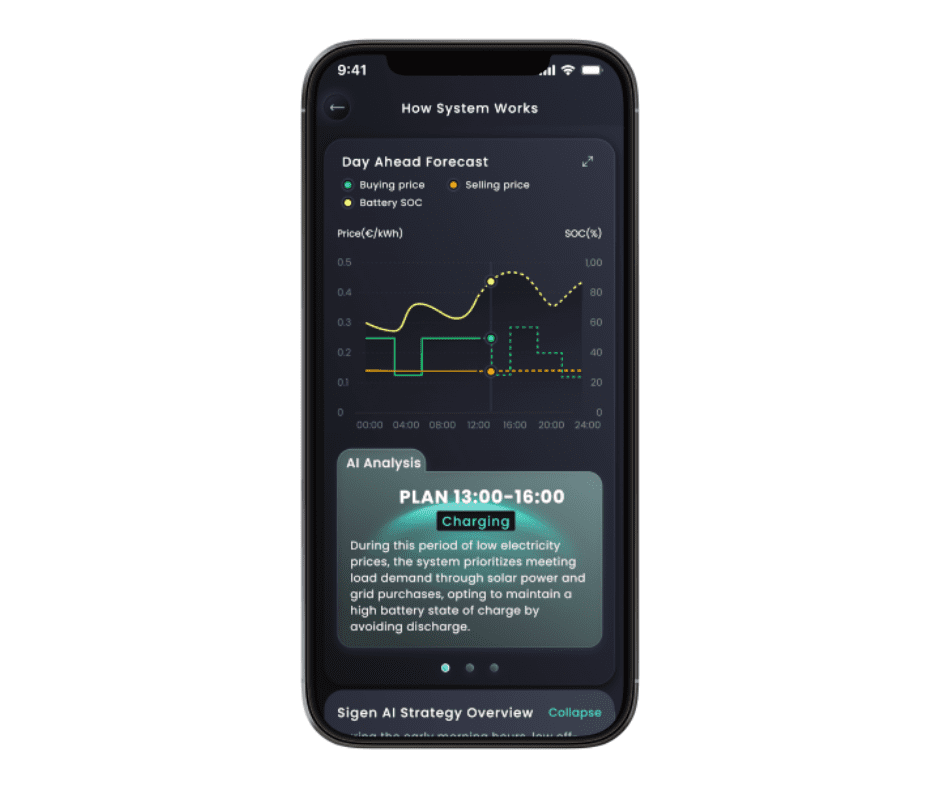 As you can see in the image above, here’s what Sigenergy’s GPT-4o assistant produces:
“During this period of low electricity prices, the system prioritizes meeting load demand through solar power and grid purchases, opting to maintain a high battery state of charge by avoiding discharge.”
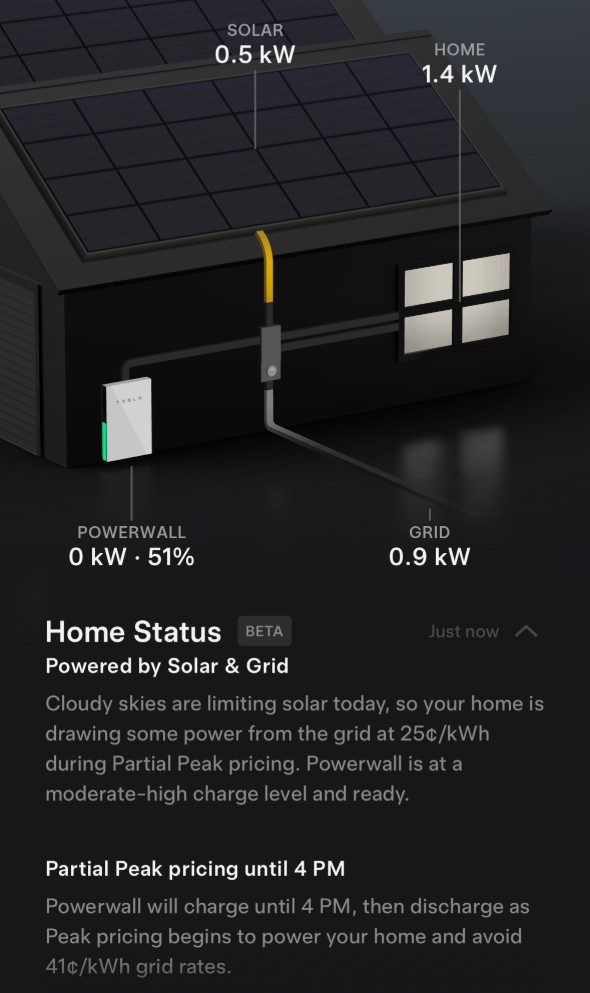
And here’s Tesla’s System Status from my house today:
“Cloudy skies are limiting solar today, so your home is drawing some power from the grid at 25¢/kWh during Partial Peak pricing. Powerwall is at a moderate-high charge level and ready. Partial Peak pricing until 4 PM. Powerwall will charge until 4 PM, then discharge as Peak pricing begins to power your home and avoid 41¢/kWh grid rates.”
Sigenergy’s version reads like someone ran the rules engine’s status codes through a thesaurus. It tells you what the system is doing in slightly dressed-up technical language.
Tesla’s version connects cause and effect across time. It tells you why (cloudy skies), gives you the dollar figures you’re paying, names the tariff period, describes the battery state in human terms, and then, crucially, tells you what’s going to happen next and why.
In both cases, the important thing to notice is where the AI sits. The battery control logic, the bit that actually tells the battery to charge or discharge, is still rules-based (with ML-assisted forecasting in some modes). The LLM sits on top as a communication layer. But Tesla is using it to solve a real UX problem: helping you understand a complex system. Sigenergy is using it to restate what the dashboard already shows in fancier words.
The black-box problem has always been one of the biggest frustrations with home batteries. Your battery does something weird at 3pm and you’ve got no idea why. A system that can explain itself in plain language, accounting for your tariff, the weather, and your predicted usage, and then tell you what it plans to do next, is genuinely valuable. A system that just paraphrases its own status screen is not.
What I’d Like to See
I’d love it if the industry got specific.
If a system uses machine learning to forecast consumption and solar generation, manufacturers should say that. “ML-assisted energy forecasting” is a perfectly good selling point and it’s accurate.
If your system uses an LLM to explain its behaviour in plain English, say that too.
And if your system runs a rules-based optimisation engine, call it what it is: smart energy management software. That’s valuable. You don’t need to borrow credibility from ChatGPT to make it sound worthwhile.
In the meantime, if a salesperson tells you their battery has “AI-powered optimisation,” ask them to be specific. Is the AI making the decisions? Forecasting your usage? Or explaining what the system is doing? Those are three very different things, and only one of them is what most people imagine when they hear “AI” in 2026.
Phase Shift is a weekly opinion column by SolarQuotes founder Finn Peacock. Subscribe to SolarQuotes’ free newsletter to get it emailed to your inbox each week along with our other home electrification coverage.
 About Finn Peacock
 RSS - Posts




Morning Finn,
Firstly thanks for your great content.
What do you think about the Amber smart shift comparing to what the batteries LLM such as SignEnergy offer. In other words,would it be a good idea to let the Amber smart shift controls the battery behaviour or SignEnergy built-in AI does the job?
Thanks,
Ali
This is a list of retailer-specific tariffs that vary by retailer and/or State.
SingleRate/FlatRate
Time of Use (TOU)
Controlled Load
Demand Tariff
Solar Sponge
Dynamic/Wholesale Tariff
Block Tariff
Seasonal Tariff
EV Tariff
Battery/VPP Tariff
Feed-in-Tariff (Export Tariff)
TimeVarying Feed-in-Tariff
DynamicExport Tariff
Premium/Legacy Feed-in-Tariff
The question then becomes: can the [user-configurable] battery operating system, with or without AI intervention, that affects consumption, minimise the cost based on any of the tariffs subscribed?
In my case, the battery I purchased is pretty much plain vanilla, with a set-and-forget operational profile as to how it processes solar power in excess of consumption and battery discharge when solar is less than consumption.
Okay! For a start, this site is a must-have! I would still be struggling and losing money if it weren’t for Finn.
We have 13.2 kW of solar panels and a 10 kW SUNGROW battery, and as Finn pointed out, it has a fantastic backup system that kicks in so fast the computers don’t go off!
What really got me, and I have said this before, is how complex and idiotic the SUNGROW manual is in its wording.
You would need a lawyer and electronics technician to sort it out.
After weeks of mucking around, I found that programming your battery is like driving a manual car through the hills; it isn’t like an automatic car that you just put into drive.
I had to programme when the battery would be charged from the grid, during off-peak times, and when it would switch on in the morning for the coffee machine. It would then run for up to 3 hours when the dish and clothes washers were working. If you are lazy, try AMBER, but it costs $23 for them to do the work for you. I do it better.
Eeek!
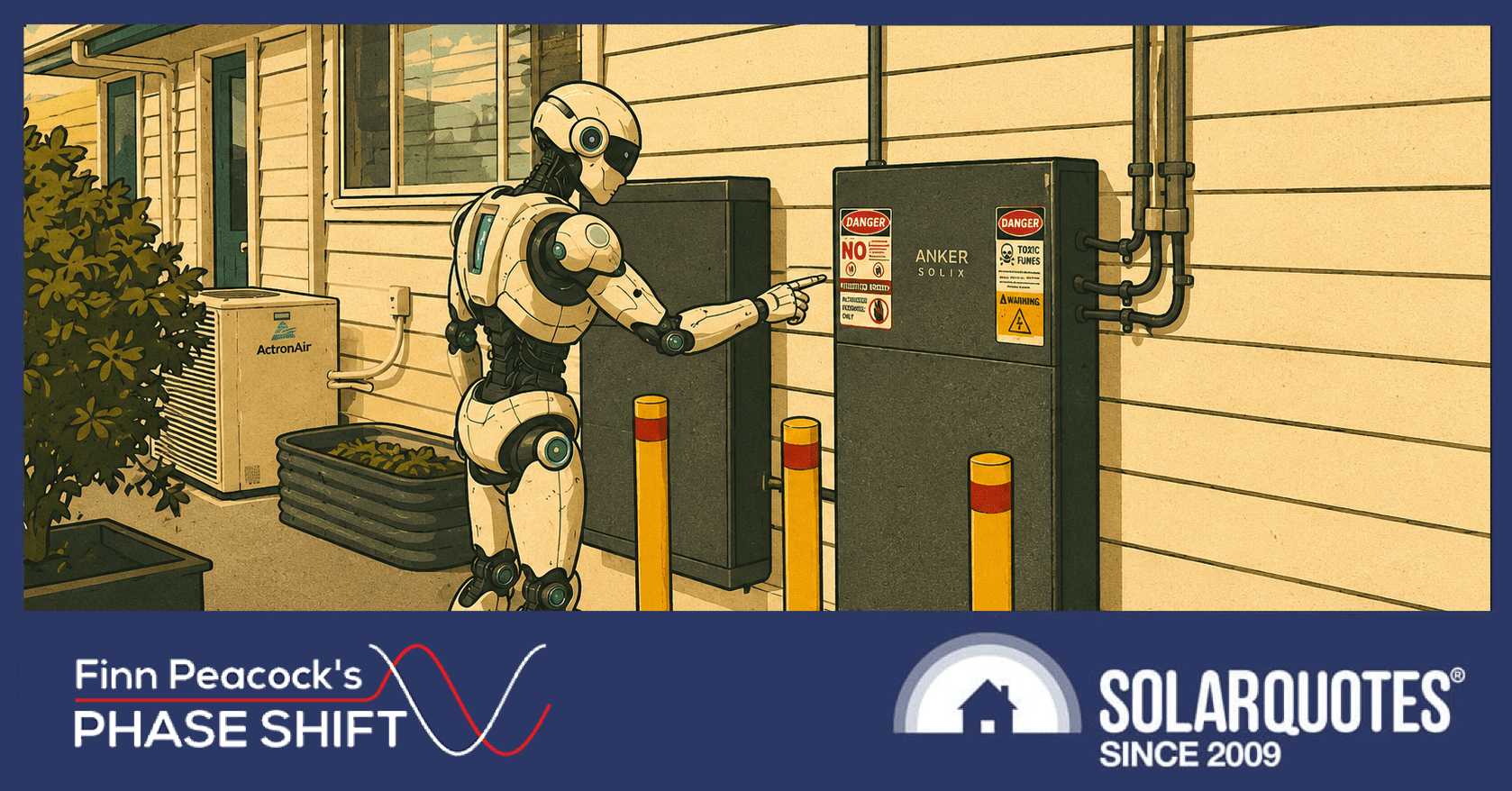
Is that AI robot attempting to press the ‘button’ on the warning label?
I choose to believe that it is carefully reading and considering all of the information on the sticker.
Humans don’t want to deal with the tedium and potential cognitive overload of battery warning labels. We can let robots do that.
I have a SolarEdge system including battery, inverter, panels, and car charger. I have had it for about a year, and for most of that time it works really well on a Time Of Use setting. Whichallowed the battery to charge using solar and always just topped up at the last minute before the peak rate started.
Then, about a month ago, it stopped doing that and only charged to 20-30% with no obvious pattern or reason for it. The installer seemed to be having no success with SolarEdge getting the problem fixed. So two weeks ago I started contacting SolarEdge directly.
Since then I have been on almost daily fight with them to try to get them to fix the problem. It appears to be something to do with their server, and they say they have escalated it to the highest level. I am not sure if I believe them, and they just seem to be incapable of getting it fixed.
My installer tells me they have other customers with the same problem. I have completely lost confidence with SolarEdge as a company.
Well from my experience with the weather “forecasting accurately”.
In the morning, I just look out the window , and set my Sungrow system if theres no Sun to charge for a couple of hours, while the TOU is lower.
Option 2 is what Home Assistant does with my Sungrow Inverter/Battery Setup.
Weather for the day, predicts possible charge and then sets in motion, the automation trigger running 3 times a day to adjust and keep an eye on things.
Honestly, it’s nice these companies to adopt this stuff but when it comes to sharing stuff with AI, who knows what they are collecting and sending off, so privacy is a big concern when a company adopts the AI branding.
Honestly, A reasonable step for the many I guess.
But no doubt per the label, AI can and will make mistakes, so some people will end up with some funky situations as a result of the growing reliance on AI making the choice to do things, rather than a human.
Thanks Finn, for another clearly-presented explanation and recommendation.
I have 13.2kw PV, Fronius inverters, very low demand (2 people in the house) and the wiring is ready for a battery and an EV, sometime in the future.
This problem is not just batteries, all manner of products are having an AI stamp included in the marketing. My guess this is a marketing department driven decision to follow a fashion trend that has failed to consult industry.
But I wonder, if these companies actually did their market research, they might find that putting AI on the label actually turns customers away!?
Stop assuming we all want AI in everything!
I can verify Jeremy’s Solaredge TOU experience. It used to work well, and now it doesn’t. With the overcast conditions in Sydney this last week I’ve resorted to “Manual” battery mode in order to put enough charge at the off-peak rate to see us through the day. Not expecting a fix from Solaredge anytime soon – perhaps they could respond on this forum if I’m wrong.