
Despite showing up at All Energy conference with a perfectly swank and expensive trade stand, it appears SMA Australia has quietly withdrawn from the Australian market.
Surely SMA haven’t gone broke? No, they’ll maintain a presence in the large scale commercial sector for solar farms.
Why Is SMA Leaving Australia?
It’s been a couple weeks since I saw a grainy photo of a PC screen which put a ripple of disbelief through solar circles, however the PDF copy obtained since is clear enough. What was once the undisputed Australian market leader in solar inverters, SMA have packed up their sales operation completely.
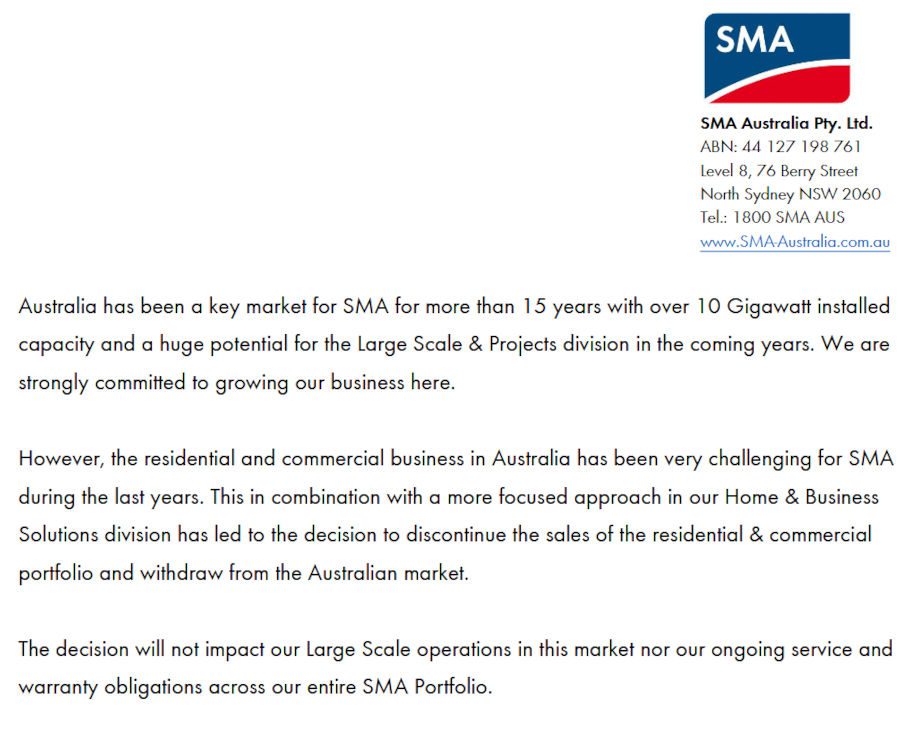
This is all the confirmation we have at the moment.
Stood The Test Of Time
A foundational part of mass market solar and ongoing part of the industry furniture, SMA will be missed by the kind of people who prioritised quality and longevity.
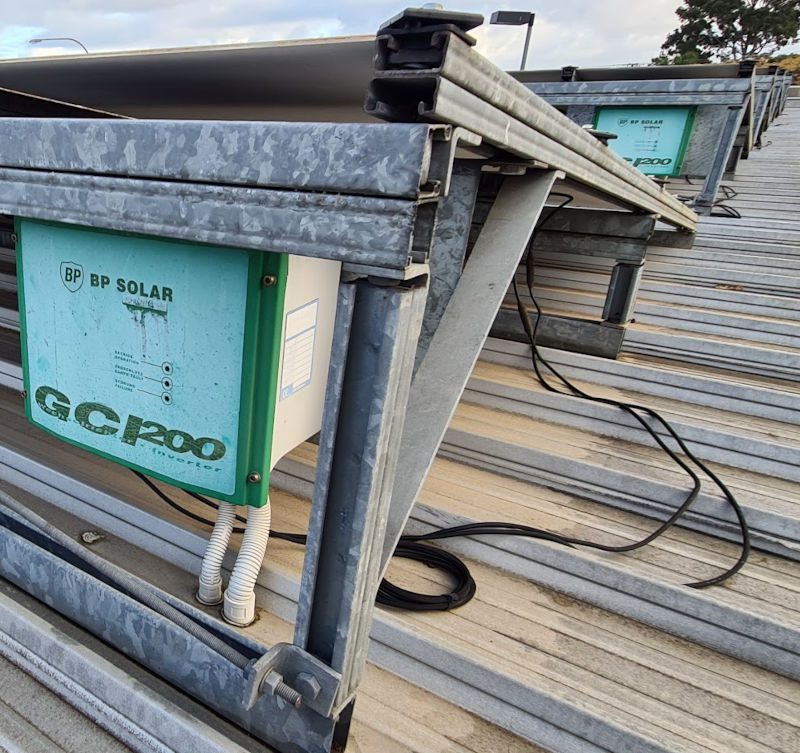
Probably the oldest SMA I encountered – a BP Solar branded GCI200 coupled to Australian made, 75 watt frameless BP Solar panels.
Thankfully SMA are honourable enough to honour their warranties – they’re apparently maintaining a local office so everyone with a SunnyBoy/Sunny Island/Sunny Storage can still enjoy a bright outlook. Although I don’t know how “smart connected” services will work going forward.
It’s a stark contrast to Hanwha effectively abandoning Australia when they pulled the pin on Qcells. Not to throw any shade at Zeco, who are covering Qcells warranty nationally. As a Solar Quotes gold rated installer, we’re assured nobody is being left behind.
I Loved SMA
As a sole trader I never advertised. Either I got to yarning with people or my phone simply rang because someone had recommended me. For years I simply installed SMA Sunny Boy TL5000 inverters with 20 plus panels on the roof, and they were rock solid.
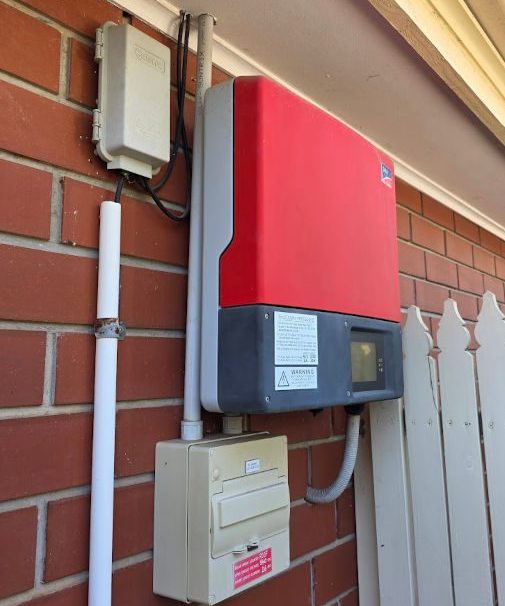
Reliability personified.
The only time I weakened, a customer talked me into a cheap piece of junk, which taught me a great lesson. You should never compromise your standards because replacing a Growatt 5 times over doesn’t pay.
However none of my customers have ever rang back to complain about the stout red box on the wall, but sadly the sands of time have caught up with some of the Simax panels I’d installed with SMA inverters. The guys at Suntrix said Simax were excellent quality, but in retrospect I should have been selling REC panels.
When your panels turn out to be rubbish and the water leaks into the edges, you end up with earth faults which knobble output until they possibly dry out. The problem will only get worse and your SMA inverter will protest with a red light and an isolation error on the screen.
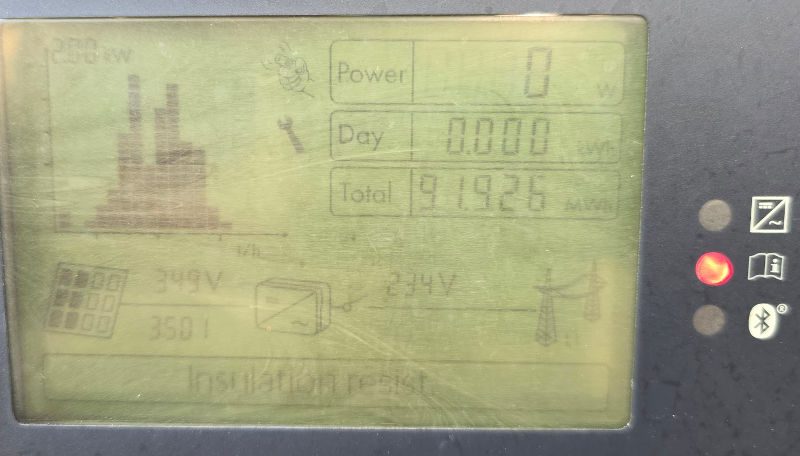
“Insulation resist” and the dreaded red light have brough production to a stop after 91.926MWh and 11yrs 4 days – roughly 22.85kWh/day. About the only flaw to report was an occasional screen failure simply due to age.
There’s Only One Way When You’re #1
As SolarQuotes founder Finn Peacock commented to me about SMA recently: “they did it to themselves”. It’s a shame really, but when you’re leading the market there’s always a possibility of falling off the wheel.
As I recall, there were a few factors which may have brought SMA undone. A 2008 world economic crisis was dodged by Australia, but the German company didn’t maintain production enough to satisfy the burgeoning market here. My own house ended up with an Australian made Latronics PVE2500 because we couldn’t buy anything else.
The incredibly heavy and robust SunnyBoy 1100, 1700 & 2500, or SMC series were the industry standard for many years, but when SMA moved to transformerless topology the TL 3000, 4000 & 5000 took over everywhere. Then came the HF units for a short while.
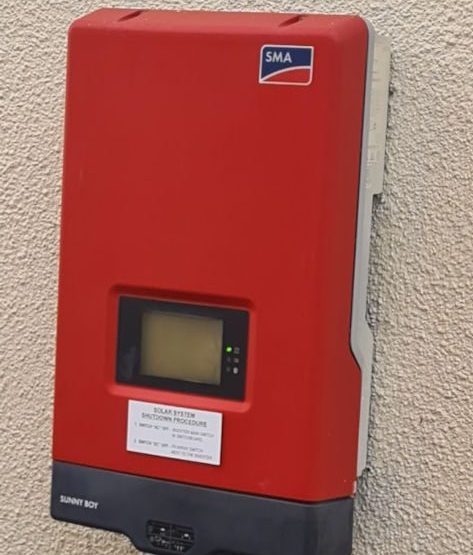
The SMA HF3000 solar inverter.
However the real defining moment was when the German-manufactured Sunny Boy TL was superseded around 2016 by the AV 40. All of a sudden we had “premium” products that were dead on arrival. Installers were already upset that the screen had gone missing, but a ludicrous quality control failure that delivered brand new but broken inverters just torched SMA’s reputation.
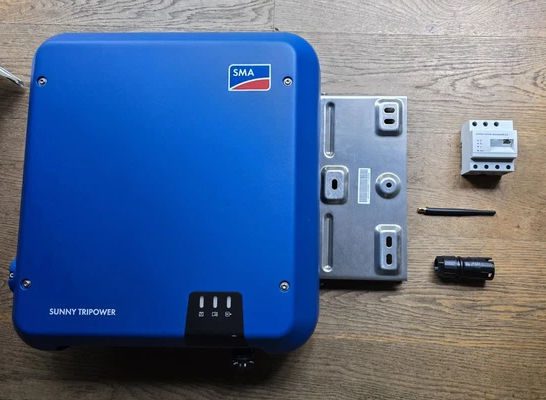
I’ve never seen an AV40 catch fire but they certainly incinerated SMA’s reputation.
Everyone said screw you and your move to Chinese manufacture. Especially when there was a separate cheap brand brought out with SMA support. ZeverSolar had a short life and I’m thankful I only ever dirtied my hands on one of them.
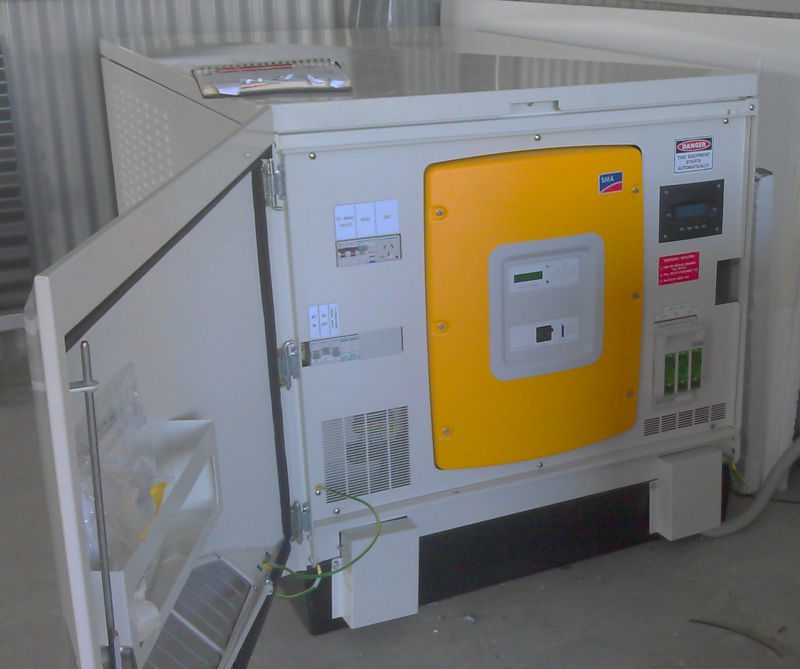
SMA Sunny Island 48V battery inverters turned up everywhere, including this Redfow off grid system with a tonne of lead batteries in the back end.
The Nice Germans Were Waiting
When Fronius came out with the snapinverter range, the rest was history. While SMA had replaced the trusty and infomative LCD screen with 3 LEDs and a newfangled monitoring app, they found people just don’t like change.
Fronius had an equally good Austrian reputation and they had a better screen. With the right code installers had probably a hundred menus accessible via 4 buttons. Solarweb online monitoring available via WiFi and no pesky bluetooth interface, it was a real winner.
More Recently
It seems SMA have just lost interest in Australia. Even with the release of the new hybrid battery systems in October 2023, the EV charger wasn’t part of the Australian lineup, Though we have at least one 5 star review of it being installed.
As recently as March 2025 they were talking up a recovery after some pretty ordinary results, but it seems Australia just isn’t part of the plan.
Please leave us some comments, or better still, write a review if you have a good yarn to tell about SMA. You never know, they might come back one day.
 About Anthony Bennett
 RSS - Posts





They sound like the “Nokia” of the solar industry. There are plenty of old time installers who wax lyrical about the sunny boys, never heard one talk up anything newer from the company.
Surprised they stayed 10 years after effectively killing their product.
Sort of. Nokia had the market but didn’t innovate enough and were caught flat footed selling the same thing when the iPhone was released. A better product in every metric.
This is an example of a good product that can’t compete with the influx of cheap Chinese inverters. A trend repeating through most industries. It’s up to us,
as consumers, to research and make the best decision with an eye on the long term.
To be clear, there is nothing wrong with Chinese inverters but the issue is when all the manufacturing and IP is concentrated with one entity. The same thing applies to Bunnings (with distribution) as an example.
With the passing of the king of inverters, it begs the questions,
1. who is the successor or has the kingdom been divided between the Lords of Europe and Asia.
2. how long will they reign, hopefully much longer than the warranty period?
3. what can be learned from the king’s passing so that history does not repeat itself. SMA removed its inverter screen. What brilliant but ill-conceived idea will poison the new reign. Will it be something to do with AI, bluetooth, ethernet or VPP connection? Or is the writing on the wall for lithium?
4. what is happening to the courtiers (employees) of Australia’s SMA empire? Is SMA looking after its staff who liased with us solar peasants in the sale and maintenance of the ubiquitos red and blue boxes? Did they arrive at work to find their front door entry code no longer worked and a sign saying “the personals from your desk will be posted to your home address.”
Feel free to weigh-in. Probably, only the last question is the most pressing.
The three basic rules that apply to any business entity are the cost to get in, the cost to stay in, and the cost to get out.
Today, it is less about the hardware and more about the functionality and the interface, which can be accessed [reporting] and/or configured by the user.
I can access my solar and storage systems on my iPhone from any location with internet access. If you are not in the cloud you have nothing to offer.
Also data reliability. If you get garbage output every day\month\year you have a blackout then the information you see will be useless, unless you actually believe your house managed GWh output one day of the year, or achieved negative output on another!
My data recorded by the retailer, inverter solar and battery are all within acceptable tolerances of each other.
I get multiple powercuts a year so my data average is about 4 garbage months a year, and every year is garbage. The data is somewhat useful, but not totally reliable. Thankfully my retailer also provides data so I can look at that too, though there is a slight discrepancy between what I export, and what they record as receiving – efficiency loss.
More likely timing
Your new-fangled cloud-whatever system will suffer from its own form of technology rot way way faster than a sheet of unpainted mild steel if left on the tidal zone on a beach in a tropical area.
Still, enjoy it while you have it.
I guess SMA cost-cut themselves out of contention a long time ago.
The days of anything stamped “.. In Germany” with its implied good product design and whatever standing are long gone especially when everything is a hodge podge of bits and pieces from half a dozen or more places with dubious QC.
And then consider your shiny new Internet everywhere connected kit is only ever as good as the weakest link. And so much of these weak links are often software – usually in the form of crappy software locked inside Bluetooth or wifi modules or other embedded components that simply can’t be updated in the field. That’s the start of the rot right there.
In top of that add the cloud based systems needed to make all that work cost a ton of money to build and run.
the cloud can we be easily hosted by the inverter itself for local acces, actual cloud can be side by sde etc to that, this just so you can use you phone to see your system
I have an SMA Sunnyboy SB1100 Inverter, quietly doing the business since March 2008 without problems, producing some 20,066kWh worth of green electrons and STILL going strong, a testament to ‘Made in Germany’ quality.
Their greed was a contributor as well. No more Primo’s. In stead, you had to buy an expensive GEN 24 with fan failures. Deye was such a cheaper option and with SMA staying power.
I have 3.3Kw of REC Solar Panels paired with SMA TL4000 which ahs been running flawlessly since April 2011. Over 65,000Kwh produced in that time in Geelong VIC
Staff probably saw the recent industry growth and left leaving SMA with fewer staff and they found it hard to attract people. A dying star.
This is like the former car industry. And it will be what happens to the US car giants. Chinese supply with lower costs and improved tech will kill the noble. Cost competition destroys originators and those that sell at high prices by selling fear. Just as japanese cars were surpassed by korean cars and now china dominates. No us car giant can recover. They wind back and collapse. Not just in production scale but with tech development and improvements.
All things solar are headed that way. Fight it or flight it ! So many sales pitches for anything solar start and end with fear of cheap chinese quality. A few years ago you couldn’t give away some cars made in china. I see the solar industry heading this way..
I had a great run with an SMA TL5000 inverter. The company went quietly belly up in 2016 or 2017, which wasn’t surprising considering the abysmal initial install job. Something caused all 14 panels to get hot spots in the middle going into bypass and robbing the system of much needed voltage output. But it soldiered on until a few years ago when something fell out of the sky and totaled one panel, which tried to catch fire and burn my shed. It is current off line until I can find one or more panels and get it going again. I was glad that I insisted on the SMA Inverter which still should be capable of going back into service. One right choice out of 3 with the Hyundai panels with no warranty as the dodgy company direct imported them, and the crap install finally fixed a month after the initial switch on. approved by an electrical inspector who never visited the property and a supervising electrician who was never on site for the installation..
Sounds like you had a crappy time for the original install – a good example of the reasons we have the current regime of daily limits and photographic proof for the current process for installing systems!
I got 20 Les of solar installed in 2012(10 on the house and shed) using SMA inverters here in Melbourne.Still going strong
sam, mine installed in 2010 – going well
The end was nigh when SMA handed production to the Chinese. An inevitable result is my opinion,as they put profit over good performance.
Tried a couple of times about wanting to buy and connect a 20kwh sodium ion battery. Found the battery they don’t call back of even reply via email. Try and find a company to install a sodium ion battery, yeah I get they are not up to that technology. Sorry, but it is already here and CATL the largest battery producer in China has already developed Sodium Ion batteries for EV’s. Many installers say they are also booked till September. What I also want is to add an additional 4kw of solar panels to my existing array. So here we are at a dead end with an additional 4kw of solar panels and a 20kwh sodium ion battery and not an installer to be had. So much for the green dream.
There are no sodium batteries approved for residential use as yet in Australia – to the best of my knowledge.
So you might have to wait a while if that’s what you want. Unless you are an “early adopter” willing to deal with any teething problems, it might also be wise to wait a while even after they are approved.
There are sodium batteries available just look on the internet (example powersafe.com.au).
Bob,
The double cycle life of Na+ is ripping them straight off the production lines into gridscale batteries, in gridscale quantities, as equal price up front is half cost long term. And much higher cell capacity at (very) low temperature makes them highly attractive for BEVs in cold countries. That volume is ramping up too.
Domestic storage is a piffly market, not worth fussing with at the moment. A lot of money has been spent bringing Na+ to volume production, and recouping that cost must take priority in a rational world. (In a rapidly developing technology market, the big returns accrue in the first 12 – 18 months, then margins decline as prices drop due to competition. That’s what pays for the R&D for the next product generation – miss out, and the competitors will eat you.)
All the “Na+ battery boxes” I’ve seen on e.g. AliExpress are in fact LFP, when examined. Just marketing BS.
My 46 kWh LFP battery will likely outlast me. It does the job. Much safer than NMC.
SMA is still alive, but it has evolved into a new generation under the name Solplanet.
A real shame but I agree they did it to themselves through offshoring, lack of differentiation, lack of innovation and inflexible and overpriced addons.
Certainly was solid gear, but SMA failed to keep up with the market. With only 6 and 8kW Sunny Island models and 5-6kW hybrids, they simply missed out on what the market demanded. 10, 15, 20, 30 and 50kW full hybrid with seamless back-up and full data/information feature set. Sigenergy is meeting exactly that. Sungrow has just released its 110-125kW commercial range, but they too need to develop the above sizes with the full feature set or will miss a chunk of market too.
Anthony, you know I don’t install Solar but I educate it with my team around Australia nearly every day. I see the changes in the market. The lack of support from SMA was deafening – throughout they showed no respect while their signage hung in all my locations for nearly 8 years…. No phone calls returned, no emails, no representation nothing. Arrogance and hot air in the modern era. Goodbye. #solartrainingcentre
William,
We had our (Yellow) SMA 5kW Inverter and 20 REC Panels installed back in 2012 and they are still going strong.
Sounds like Fronius, might, be, the previous, SMA buyer’s, new, ‘Heir-Apparent’, then, for all of us who want to install a Good Quality and Long-Term, Trouble Free System, and do it, once. only..!
I have always been a fan of SMA – I even have a WindyBoy that still produces power if the wind blows. In 2022 We decided to upgrade with a second lot of panels on the roof. The 5000 seemed like the ticket given its 2 channel inputs. Minor issues right from the start, but no showstopper – mainly it was never able to communicate with the Mothership and no tech support. No worries, I just did all firmware upgrades myself and kept an eye on things. All fine, until a few weeks ago when one solarpanel developed a slight ground leakage and the whole system shut down ! I was surprised to say the least – I thought the 2 MPPT channels were independant ! Apparrently not. Well, for me that was a massive engineering fail and decided it was time to move on. Now looking at Fronius – but Fronius datasheets are dismal to say the least – obviously concocted by salesmen. From an engineering perspective there is almost no useful information. I now have to resort to communicating with Austria for help.
Hi Pieter,
I’ve played with a few remote area systems with wind, but usually they’re 3ph AC running to a controller with 48VDC output & resistive dump load.
I recall seeing the manual but never a real live example of a windy boy.
What sort of turbine powers it?
Fronius are excellent in my experience and have significant technical support in Australia.
I’m gutted, I was just about to take the plunge and install a Sunny Island X and batteries for my own system but couldn’t get one and was wondering why they weren’t being released here, I’ve been installing SMA for about 10 years and was always impressed by the quality – only that short period where they went off shore to China for manufacturing for some of their gear, was a low point.
Hi Jez,
Fronius would be your answer now. Made in Austria and always have been.
Excellent local support tool.
Vale SMA.
Is anyone sitting on a stack of spare parts for these SMA inverters? It would be a shame to replace such a good design with Chinese rubbish.
Hi Brian,
Presently I think the best approach is to shop for used inverters that match what you already have.
Keep them out of the e-waste stream and simply hang a whole replacement on the wall if yours gives up.
They’re generally very very reliable though…