
Solar has a bit of a waste issue presently. With extraordinary growth in both installations and system size, millions of panels are set to come off the roof in the next few years.
So, can we solve the problem? Yes, with just one word, pricing.
Word is that a lot of solar panels are languishing out of service, literally stacked behind suburban sheds or piling up on pallets around your installer’s yard. At best, they are not doing anyone much good, and at worst, they pose an injury and pollution risk.
Despite a few false starts, solar recycling really needs some direction. We have to get on with it because throwing them into shipping containers to Afghanistan to grow poppies for heroin isn’t a sustainable answer.
Why Are Used Solar Panels Worthless?
The value of used solar is down for a few reasons. Firstly, solar has just been getting cheaper forever. I remember first-hand when solar was $5/Watt, a Sunpower 215W module cost $1075 plus tax & freight. This afternoon I can buy a Jinko 440W on runout for 21cents/Watt. That’s a module with more than double the output, for $94 apiece.
Just bear in mind that while solar has just about always fallen in price, word around the traps is that China is winding back a 9% export incentive, and the price of solar panels may soon go up a little as a result.
This also means the secondary market for used solar panels sent overseas is evaporating. If freight costs are equal, developing countries might buy new panels for 10c/Watt, so a used SunPower 215 is hardly worth $5 here – in fact, salvage buyers won’t touch them unless they’re 250W or more.
The RET Puts A Premium On New Solar
The renewable energy target incentivises new panels. The 200 largest polluters in the country are obliged to buy the environmental goodness created by installing solar, and thus not burning coal. The subsidy makes new panels very cheap, but tapers off about 7% per year out to 2030. We should be proud of the scheme’s success – but it does put a premium on new solar over reused panels.
Solar Installers Are Risk Averse
1, 2 and 3kW arrays are now routinely being replaced with systems ten times the size. While newer panels are fine, older arrays and wiring aren’t always compliant, and installers don’t want to offer a warranty on some rubbish they didn’t install. The reputational and financial risk is too great – besides, the space on the roof is coveted.
Solar Recycling Logistics Are Expensive
Government-funded trials have already identified that logistics are the costly part of the problem. I know this because I’ve stripped old systems and packaged the panels for transport. We did it properly, so the modules weren’t damaged in transit because a school roof would yield a lot of domestic warranty repairs. However, it’s expensive with first-world labour rates, especially if they’re all different sizes and sources.
Tossing them into a skip and tipping it into a hopper isn’t cheap either, but time is money, so pragmatically this will be the way a majority(?) of panels will go in our incredibly wasteful first-world economies.
Valuable Resources To Recover From Solar
- Older panels are said to have a teaspoon of silver in each one, something we have a real deficit of
- Copper is in high demand
- Aluminium recycling saves so much energy, it’s often called solidified electricity
- Low iron glass will save tonnes of sand
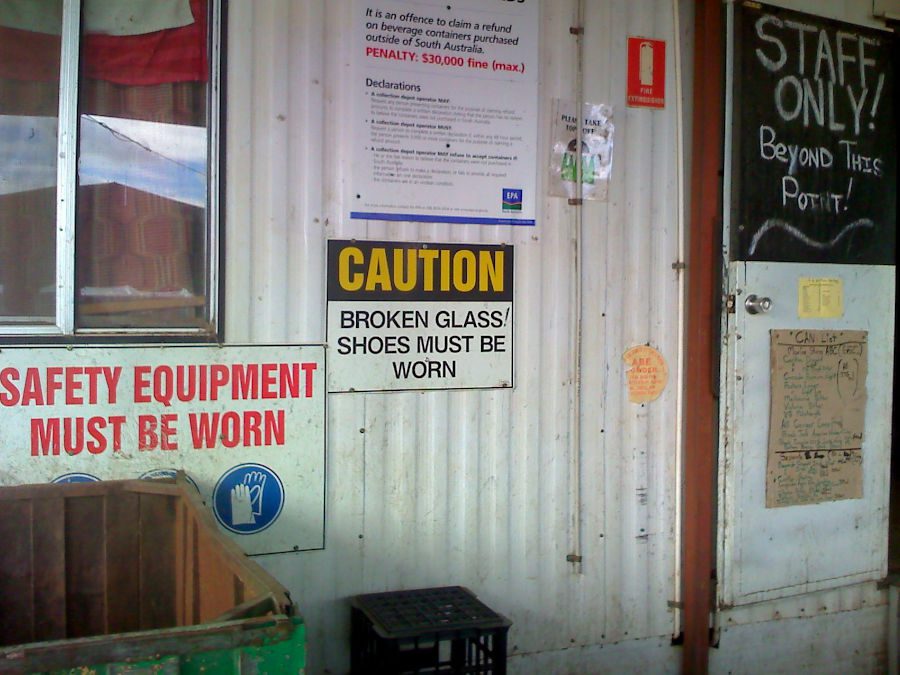
Remember, kids, punctuation saves lives – or at least heinous injuries to your feet.
Solar Reuse Means Certifying For Sale
Anything damaged or pre 2013 fire standards would simply be recycled, but with so much energy invested in manufacturing solar panels, it makes most sense to reuse them instead of just grinding them up.
Again, first-world labour rates are our enemy. Even if they were given away, stewardship means panels must be physically inspected and electrically tested. It wouldn’t be hard to run a “tag ‘n test” training program and test machine to make it simple, but I’d hate to see the idea die in the hands of standards committees.
I’d expect good quality panels could go well for testing and reuse locally. Even at a decade old, you could stack usable panels in containers and electrify remote villages in PNG, for instance.
We Should Copy SA’s Container Deposit Scheme
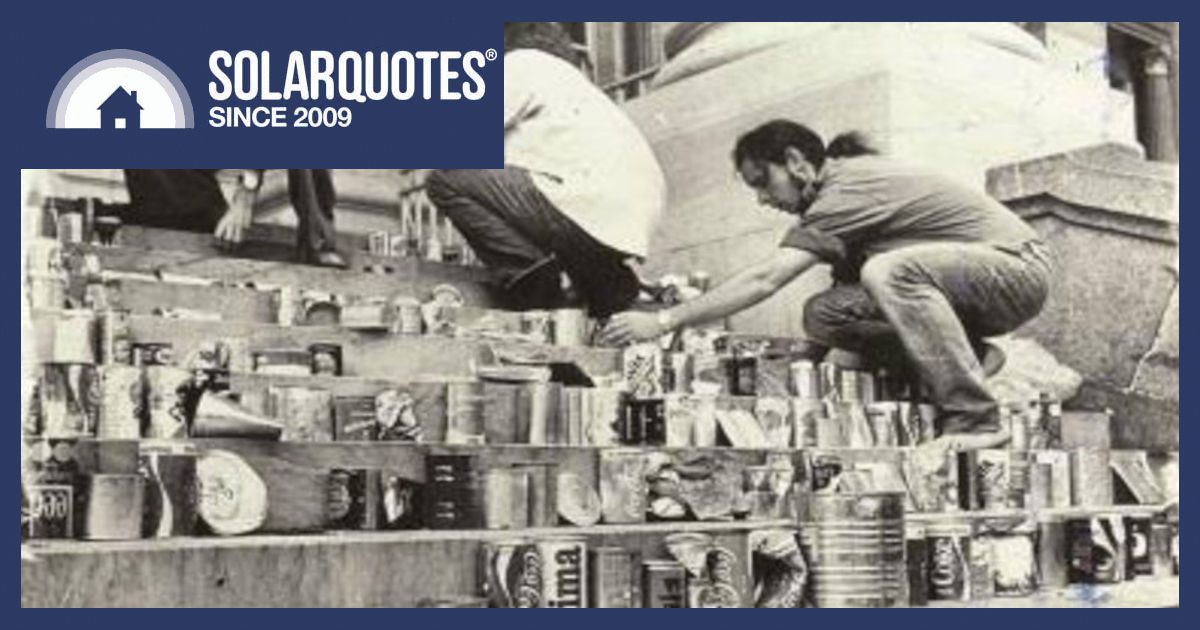
Half a century ago, South Australia basically ended beverage container waste after university protesters successfully pressured the state government into a deposit scheme. For decades, collecting cans has put money into the hands of kids or the homeless. Making waste worth something gave the Scouts & other community groups a reliable way to raise cash from households and hospitality by donating containers.
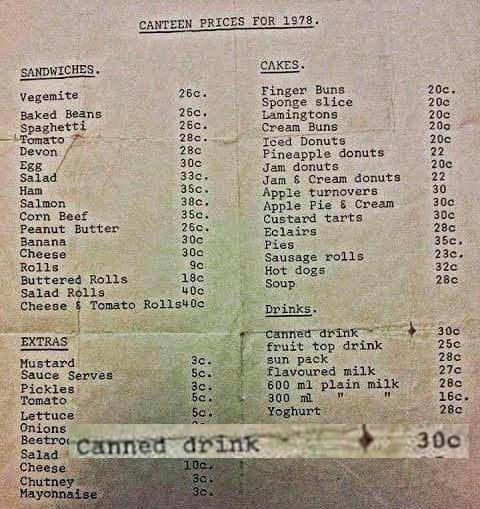
I recall firsthand when 40c soft drinks had a 5c deposit, which doubled in 2008. Keeping pace these days would mean a $3 can should attract 37.5c?
South Australia has a sustainable system because the waste stream is sorted. It’s not kerbside recycling full of co-mingled rubbish, so there is real demand. People pay for a clean supply of plastic, cardboard & glass.
The same scrap yard, bottle depot or marine store operation we already have just needs a bay for solar gear. Framing, stainless hardware, inverters and eventually batteries too – though they’ll be tougher to handle properly.
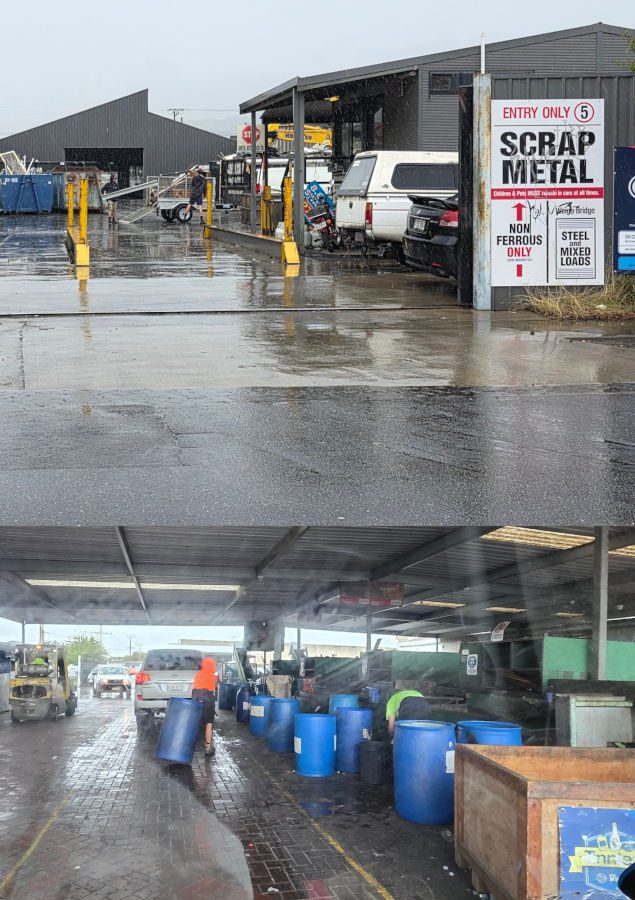
Drive in here, empty your bags, boxes & bins and let the sorting begin.
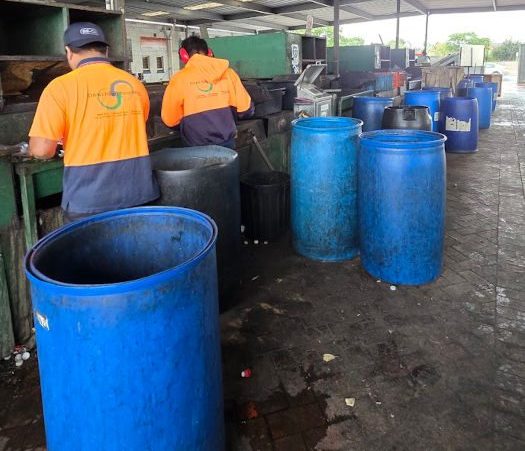
These guys count, sort, remove lids & pitch containers left, right and center to land in bins, bags & conveyors.
$10 A Pop Would Do It
At the moment, secondhand solar is pretty worthless, but giving something a dollar value means people will take an interest in what happens to them. Nobody collects drink cans for the scrap aluminium value of 1 cent each, but the meth heads will strip copper plumbing and wiring from your community hall for $8/kilo, so we need to pick a number in between.
The value must be enough that country folk will throw a load on when they come to town, but not lucrative enough to make theft attractive.
Like old car batteries, used solar panels will come out of the woodwork if we simply put a reasonable bounty on them, which probably needs to be built into the initial purchase price going forward. Scouts, Guides, Rotary Clubs, Men’s Sheds could all play a part in rounding up, reusing and recycling this hardware; we just need some realistic rules to work to.
For more, read about the national inquiry into solar panel recycling and the pilot scheme for recycled panels.
 About Anthony Bennett
 RSS - Posts





Anthony, I feel what is required is a way of re-using these old panels & hardware. One way, I feel would be for solar generation on farms. If we can generate & safely store energy economically on-farm, there is a bigger argument for diesel replacement.
I feel that what is needed is some thought on system design where a failure is easily identified & replaced. The fact that the panels are less efficient than
newer panels is inconsequential if there is sufficient space. If panels are mounted high enough, the area underneath can be used for animal shading if the design is rugged enough to withstand animals rubbing the structure. A small fenced off area could house the storage inverters & control hardware. Recycled automotive EV batteries could store the power.
If this could be accomplished at a competitive price, it could mean the generation could be distributed over the farm so equipment could be charged closer to the use. Excess generation would be sold back to the grid.
Tie this into a bigger program – enable the local TAFEs to run a solar accreditatio scheme where those wanting to get into the industry get involved in the sorting, testing and labelling of the panels. As part of their graduation process they could be involved in the on-farm installation (under supervision) of a reasonably sized solar farm and learn about everything involved in the deployment.
This could then be followed up with additional courses as the participants go to work for solar companies with them eventually earning a Solar Electrician certificate – which would act as some form of credit towards a full electrical license if they wanted to go down that path – if not they could remain working in the solar industry but not allowed at the switchboard level
Craig
Doug,
I’ll second the motion to cheaply expand farm solar with newish but superseded panels. But I also sympathise with your sparky and his integration concerns. Expanding an existing system can be problematic.
For example, here off-grid, there’s 12 kW of PV inverters (2) and 12 kW of VIctron battery inverters (2), which are gridforming. They can’t handle more arrays with PV inverters, as 1:1 gridforming power ratio is the limit for Victron. So I’d have to add MPPTs instead, and maybe then another battery inverter.
To help keep costs down, I’d probably cut some Stringybark poles out of the forest for the groundmount frame’s major structure. (The pergola made that way is still good after more than 30 years, mounted on gal stirrups to keep the termites out.)
The 27 kW of panels is just OK for winter, with two BEVs. (Yield today: 22.8 kWh, 10.5 kW peak) If the nearly incessant overcast worsens, a doubling of panels would do no harm, especially if adding more EV farm vehicles.
Erik, have you ever looked at Mega-Anchors? Designed in Australia & Wholesaler is in Melbourne. Great mount for ground-mount systems.
I feel what is needed is panel mounted micro-Inverter, AC coupled to the Battery system. An inverter like the Deye could control a 48v (or HV) battery with BMS i/f, where the battery is constructed from recycled EV batteries. By using Micro-inverters, one can easily track faults & shading is not such an issue. The battery would need to be factory-remanufactured for liability reasons.
If a simple system can be designed, the system was eligible for (re-issued) certificates, & a robotic system assembly was designed, I feel there could be an agricultural revolution where diesel is largely replaced. However, the costs must be contained (most farmers are cheapskates!).
Doug,
I’ve seen galvanised screw-in footing products – maybe Mega-Anchor. I’d have to check the price, as I have a 30 cm auger for the little electric excavator, and ample sand mounds beside the wombat burrows, so concrete footings are OK.
Off-grid, the grid-forming inverter(s) must have more grunt than the sum of any PV inverters, and grid-forming has to come from the battery inverter(s), else the system shuts down at night. I use Victron, Anthony prefers Selectronic, and they are more solid – but pricey. My 46 kWh battery is 48 x 304 AH LFP cells in 3 nominally 48v banks, each with a Jikong 300 Amp BMS, off the Victrons.
Trucking goes electric first – that’s unavoidable now – pure economics & availability – already bog standard in Europe and China. Big electric tractors with multiple battery packs are still far too expensive, and big farm battery charging awaits tractor & battery cost drops. It will come, so we can eat – after diesel hits “demand destruction” prices.
Doug,
Farmers buy retail, but sell wholesale – it’s a rigged playing field designed to feed cheap agricultural products to the big boys, who then also screw the consumers. So farmers generally can’t pay top dollar.
This cheapskate, on 308 Ha of mostly unproductive land, could accept suitable panels without charging to take them – thus avoiding recycling costs. There’s no need for double dipping on certificates -there’s more than enough taxpayer burden theses days, already, I think.
Once the fencing is done, and the tractor shed, a DIY EV conversion on the old 75 hp John Deere tractor might be my diesel escape plan. (Better $50k – $80k for that than $500k – $1M for new.) My brother, a marine engineer, did an EV conversion on a little farm side-by-side. (And he doesn’t trust electrons.) This electrical engineer can then manage a beefier one – when time permits.
This transition is just like eating an elephant – same method applies.
Doug,
Apropos PV panels on farms: At 8:20 in this “Just Have a Think” episode:
https://www.youtube.com/watch?v=3MaOu7I2oPc
panels are replacing plastic growing tunnels.
Here, some good panels above, to intermittently pump a bit of groundwater for food growing, and a fence of dud panels at ground level, to keep the rabbits and kangaroos out of the cabbages, could work rather well. A bit of recycled racking could complete the structure of the fence panels, with rabbit mesh on the ground to stop burrowing under.
Heck, a rockbank in the middle could be electrically heated on clear winter days, for some frost protection on the clear nights. No batteries needed.
The Third Pole (Tibetan Plateu) is now a tipping point, potentially emitting 90 Mt CO₂ p.a.: https://www.youtube.com/watch?v=-GYtjX900jo
So global heating *acceleration* is increasing. Whoops!!
Let’s hope the super El Niño educates. We need more batteries faster:
https://www.youtube.com/watch?v=veUrvuYVvMA
Good morning Anthony
As a retired Environmental Health Officer I say: hear, hear! to this article.
Maybe we need an organisation like Choice or Getup to get behind this issue. Otherwise the pollies won’t act.
I cannot imagine Pauline sees this as an issue. Likely have to be the Greens to do so.
Yours fraternally,
Phill
Great point. The cost of recycling needs to be built into the purchase price. This system needs to be applied to every household item that has the potential for recycling, washing machines, computers, ect ect. This would allow items to be dismantled and the raw materials recovered. Would reduce the impacts on our environment.
Whilst the volume of used solar panels is an issue worth discussing, I believe early focus needs to be on planning and implementing what happens to home battery storage at end of life.
Solar panels are being replaced for larger at about 10-15 years currently. With a 20-25 year warranty on these modules most aren’t even at end of usable life yet.
If we apply the same to battery storage with a 10 year warranty you are looking at 5-7 years before they start failing/being replaced.
With solar panels there are options, some local scrap yards will take them for free, you could pay a small fee at the dump to drop them off.
Currently dumps are limited by their EPA agreements as to how much lithium they can take in.. I know my local dump is limited to 20kG and must be for household use. This eliminates installers dropping them & I believe all home batteries are going to weigh more then 20kG, maybe the older Enphase 1.2kWh modules.
We already have about 6 old batteries sitting here.
Jake, I understand your concern, but feel you are wrong about the Solar Panels. In my case, my panels were installed in 2018, so already approaching end of life. I have just installed a new battery, & the sparky complained about integrating the old system with the new AC coupled battery. Now have 6 inverters! (on 2 phase rural system).
PV panels definitely need disassembly to components to reclaim resources. There is now Australian technology designed by the wonderful Australian engineer (whose name I cannot remember ) that is a low-energy process.
Batteries also need an economical recycling process. There are inherent dangers with batteries, but these must be overcome. There will also be a re-use market for batteries, particularly big packs such as home & EV batteries.
Tesla already has a battery pack repair facility in South Australia, because the packs in the cars & the ones in the big batteries were the same (still?). At least they can replace individual cells.
I just have to ask the question, how can your panels that you say were installed in 2018 already be approaching end of life?
Microcracks mainly. We had a hailstorm that caused cracks in some panels. These panels are still working at a reduced output (due to SolarEdge Optimisers). When I fall over some 250W panels, I will swap those out.
Most systems seem to get upgraded when the system is upgraded, & due to changes in regulation, it is more economical to upgrade the total system. If one of my inverters fails, that may trigger an upgrade.
Problem with building into the purchase price is we have 600,000+ homes with solar and inverters already. 400,000+ of those are under a year old. The batteries may have a life of say 15 years and then we will have at least 16,000 tonnes of lithium composites to recycle or dispose of..Solar panels on top.
Australia needs to find a tax subsidised solution.Charge it upfront plus at end of life. Force recycling onto all use. A installler cant remove without it being lawfully recycled and it cannot be stored. Recyclers will find ways to keep it clean. EPA monitoring. Aluminium frames, glass, silver, copper wiring….Plastics.
Who exactly is supposed to pay this $10?
Consider, there are roughly 4.4 million solar systems currently installed in Australia. Assuming 20 panels per installation that’s 88 million panels. This would equate to $880 million required for funding.
The government is already broke and rapidly approaching the trillion dollar debt mark.
Why not instead look to a (private) charitable or minimum profit model?
I recall a number of years back a guy in (far north) America picking up a (large!) trailerload of solar panels and then custom rigging his own solar farm – he wangled a decent (commercial?) export contract with his retailer or state supplier – I’m fuzzy on the details now. Is this viable in Australia?
Why about wiring up state schools with old panels? Could panels be used instead of fencing, or as shade roofing? Or are solar panels and little fingers, or balls, a bad combo? Is there a viable legitimate pathway for second use? Or anything not cutting edge is pure garbage?
Pls refer to my first email. Rural power systems could be built using recycled panels. I feel it should be possible to get certificates for panel re-use (even at a discounted rate). This access to subsidy would assist with the economics.
As far as the Govt going broke, I feel they are not accessing the tax base they could: the Gas Tax! I really think the Govt could have taxed the gas at a low rate initially (10%), then ramped it up over say 10 years. I feel it is time for Gina & others to pay their share of tax, after all they are taking our irreplaceable resources. Also the Fuel rebate should be wound back, particularly for miners. At the moment with the subsidies, it is not financially viable to reduce diesel use even at the elevated current diesel costs.
Australia’s mineral exports are actually at risk of collapse. Proposing a gas tax might actually kill that industry, which of course would win applause with the Greens and Teals.
You might be better off proposing an iron ore tax. The Communist China purchasing cartel is strong arming ‘local’ companies, in conjunction with state security or intelligence to do industrial espionage, so as to get preferred profit models. If Beijing can demand their fat share of the pie, then Canberra and the state capitals definitely should.
Gina already pays her tax. I’m more concerned by the foreign companies exporting their billions out of Australia to avoid taxation.
Actually the fuel rebate needs to continue. It’s recognition the tax is not supposed to be paid in certain contexts.
Farmers mostly don’t want to muck around with useless solar – they rely on diesel powered tractors, harvesters etc. From what I understand alternatives remain non-viable in Australia, and cost ineffective.
Hi John,
Fuel tax has nothing to do with roads.
It drives efficiency, drops air pollution & improves the foreign accounts.
In 1959 Road funding was no longer hypothecated; excise became general revenue, shifting rationale for tax credits.
1982 Diesel Fuel Rebate: all offroad users paid excise but could claim partial/full rebates; scheme narrowed to mining, primary industries and “care” industries while rail, marine, construction, manufacturing lost exemptions.
1992 road funding was set purely through budget, no link to excise thereafter
From $8 – $9 billion pa, 45% goes mining & only 15% goes farming
Perhaps Linfox would know? https://www.linfox.com/linfox-receives-landmark-australian-order-of-electric-prime-movers/
https://7news.com.au/news/electric-vehicle-truck-conversions-surge-as-fuel-crisis-pushes-freight-industry-to-reinvent-itself-c-22188995
The excise tax has nothing to do with efficiency, or air pollution, and I’m not quite sure what you mean by foreign accounts. Sounds like you’re pushing a sin tax notion.
30 EVs amongst Linfox’s 5,000 trucks (according to a quick Duck search), isn’t particularly convincing as anything other than PR.
As for ICEV to EV truck conversions, sounds expensive and economically suspect, but that’s just me. The conversion that I’m more curious about is a diesel to gas conversion given that’s what Australia exports. Also performance but …
Hi John,
Why would you advocate for sending billions upon billions, year after year, to sponsor extremist theocracies in the middle east?
Why would anyone think spending on aged care, health & education should be sacrificed here; so the Saudis can build indoor ski slopes in the desert or Qatar can build grand prix & world cup soccer venues.
Electricity is sovereignty, it’s domestic fuel security. EVs lower the burden on the health budget because they reduce air pollution, like PM2.5 which are particles so small they cross into your brain.
EVs improve the foreign accounts because they run on secure, domestically produced, increasingly clean energy, not reliant on boats from Hormuz or refineries in Singapore & China.
Importing 90% of our transport fuel does is repeatedly setting fire to billion$$ every year.
If it was at all viable here i would go for a large setup of used panels ground mounted with victron inverters and just add batteries as able and eventually go fully off-grid.
The problem is both the terrain (compacted volcanic ash with little to no topsoil) and unlike over the road (next suburb) which has no restrictions my suburb requires everything be build to a high cyclone rating.
Meaning theres no sitting it on the ground it has to be anchored firmly (costly on terrain at best) and properly rated so i cant just have home made frames.
Sadly i even got offered not long ago i think it was a 20KW+ systems worth of rather new solar panels (apparently removed because of the addition of battery systems had installers who refused to use existing systems)
Hope they at least got dc-coupled for the cost.
If anyones somewhere its both viable and they can get a solar installer to do the wiring/checks/etc ask local installers about what they’re trying to dispose of.
If you can lay your hands on some second hand steel from a decommissioned structure, whether bridge-like or tower, and have a local civil engineer whip up some calculations using mostly that stuff, something might be possible. Admittedly, it is decades since I had an ordinary design – now they’re usually gold plated, to cover their derrieres. Oversized recycled stuff might defeat that. Oh, yeah, the concrete footings were mad too. I should perhaps have taken the risk, and skipped the paperwork.
Indeed, the hardest part of the solution is presently the economics, as we actually only have modest volumes. Once the volume ramps up and land-fill and storage simply become untenable, we all will be forced to pay for our old panels to be recycled for use or materials.
Once the volume is there, the ideal is a volume plant that combines testing, reuse and recycling. I’m minded of the 5B mounting system as a potential way of adding value to reused panels with great logistics, easy scaling and appropriate for solar farms. I presume the 5B system is as easily rolled back up at end-of-life and put back through the same process with superior logistics to rooftop PV. Sounds ideal for farms, mines etc.
Panels that fail the tests go to recycling instead of reuse. If we can’t get our own materials recycling companies up properly, check out companies like SolarCycle US.
The Return & Earn model now in action across much of Australia pays 10c per item for each deposited (1c aluminium can and every other container on the system). The Reverse Vending machine companies are also paid as is the trucking contractor and in NSW (at least) the Government is still making money from the licencing of the producers. At 10 billion receptacles and counting across the 8 years of operation, littering is down and the scheme generally considered a raging success (though the return hasn’t increased to consumers in those 8 years).
I run a small environmental charity and we are also paid around $40K pa for hosting 2 machines that currently are on track to deliver 2 million items this year ($200K in returns for our customers). We pay for the electricity and cleaning in the vicinity of the RVMs location.
Solar panels are far less numerous but a small area could probably benefit many community groups and act as a triage and storage area and bring in very useful $ and employme
Perhaps I missed it but I did not see any discussion around the thousands of second hand solar inverters that I see on Facebook Market and /or just sitting in garages gathering dust that are still perfectly good. Yes many of these are non hybrid but also plenty of hybrids as well where people wanted to upgrade to larger capacity kit. I expect only a handful of these second hand inverters are ever sold and represent huge waste / missed economic value.
Very hard to sell for two main reasons:
1. No STCs or other government incentives on second hand inverters
2. Very few electricians prepared to install them for fear of liability not to mention missing out on their mark up profit margins.
Surely the government or others can design schemes to overcome these problems to give these very expensive components another life and reduce enormous waste.