
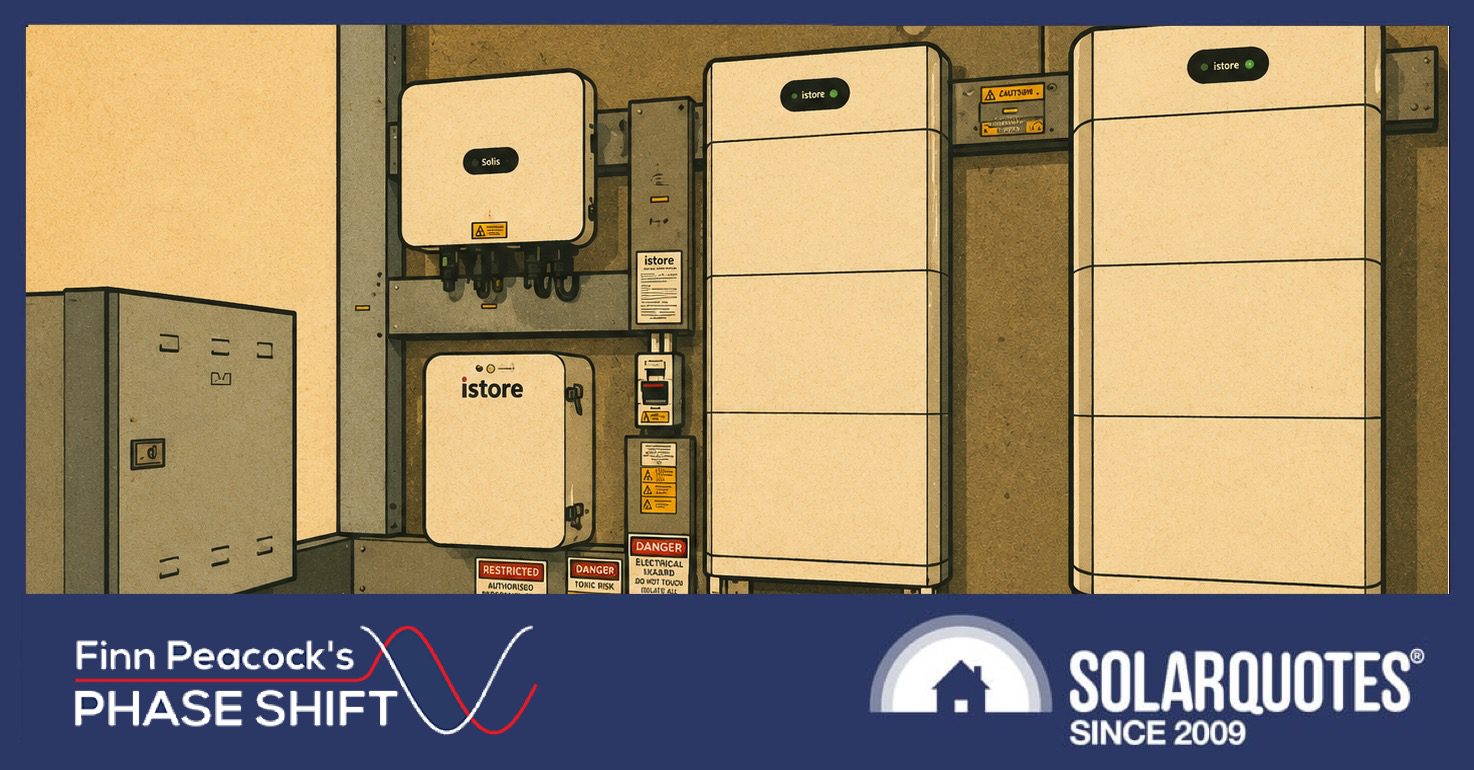
Only 24% of Australian battery owners have joined a Virtual Power Plant (VPP). That’s from the ACCC’s latest electricity market report, and the reaction has been fairly uniform: this is a problem, and the fix is to make VPPs more appealing. Better consumer protections. Simpler products. Minimum technical standards. Probably more VPP rebates.
But there’s another way to read a number like that.
Three-quarters of battery owners looked at what VPPs were selling and said no thanks. That’s several hundred thousand people, making the same call. When that many customers walk past your product, the usual response is to take the hint and find a different product. Not to spend years and a pile of regulations making the same product slightly less objectionable.
A different product already exists. It’s growing fast, it asks nothing of the customer beyond a decent inverter app, and it doesn’t appear anywhere in the report’s participation figures.
To be counted as a VPP participant, the ACCC told me, a customer must have signed up with a VPP operator and given that operator a degree of control over the operation of their battery.
A customer on a battery-focused retail tariff with a high evening feed-in tariff, exporting into the grid every evening, would not be captured as a VPP participant in the report.
The Alternative Nobody’s Counting
Many large battery owners are happily exporting at least 10 kWh per day into the grid during the evening peak, covering their daily supply charge and zeroing out their bill. Some owners are exporting 20kWh+ and running a nice surplus every year (but be careful – some plans don’t let you cash out). There is no VPP operator forcing their battery to do this; they are using local control to export every day on a timer in response to evening feed-in tariffs of ~20-35c per kWh.
Neither of these groups is in the 24%. Nor is anyone on Flow Power’s 35c FiT1,with customer numbers up 196% in nine months. Nor the bloke on Whirlpool running Node-RED against live AEMO prices. Nor the growing pile of households on GloBird’s ZEROHERO with “Super Export Credits” who didn’t tick the box allowing remote control.
From the grid’s point of view, all these folks are helping soak up the solar glut at noon, pushing it back out at six, flattening the evening ramp.
The ACCC’s number isn’t wrong. It answers the question it was built to answer: how many people have signed a control agreement. My complaint is that everyone seems to treat that as the only measure of how many batteries are helping the grid through well-timed exports.
What Remote Control Delivers: 1 kWh Per Day
Table 3.7 in the ACCC’s supplementary data gives total electricity dispatched through coordination in 2024-25: 12,631 MWh across the four regions studied. Table 3.4 puts VPP customers growing from 25,703 to 37,753 from 30 June 2024 to 30 June 2025: giving an average of 31,728 customers over the 12 months.
That works out at 398 kWh per customer for the year: an average of 1.09 kWh dispatched per customer per day.
One kilowatt hour. Most folks on high evening FiTs I know of are moving 10 to 15 kWh per day2.
‘But a VPP Kilowatt Hour Is Worth More’
It is. A kilowatt hour dispatched into a genuine scarcity is worth way more than a kWh on an evening schedule.
But my guesstimate is that the volume of kWh exported on a timer beats the volume dispatched by VPP by at least 10-to-1. So a VPP kilowatt-hour has to be worth more than 10 ordinary ones before orchestration comes out ahead, and that only holds if most VPP dispatch lands on fairly extreme scarcity events. That’s not happening. And as more batteries are deployed, these scarcity events get even less frequent.
Meanwhile, Batteries Got Enormous
Between July 2025 and January 2026, the report shows people buying batteries between 30 and 50kWh went from 6.7% to 47.6%.
A 30kWh battery covers the evening peak with room to spare. A price, a working internet connection, and an app that allows timed export are all you need to offset your daily charge or more.
Count Them Properly Before Panicking
Before anyone panics about VPP uptake or pumps money into VPP rebates, we should publish how many households are on battery-focused retail plans, counted separately from orchestrated VPPs. Then publish exports from each fleet by time (and, ideally, wholesale dollar value) for both, because volume alone tells you nothing about how much a kWh is helping.
NSW pays up to about $1,100 for a battery whose control is demonstrably handed to an aggregator, and nothing at all for the household doing a similar thing off a price signal. So we’re paying for enrolment, measuring enrolment, and then worrying about the enrolment numbers, while the batteries charging at noon and discharging at 6pm go uncounted.
Count them both. Then we’ll know whether 76% of Australians are refusing to help the grid with battery exports, or whether we’ve been measuring the wrong thing for three years. There’s nothing original here: Geoff Eldridge made a version of this argument back in May.
Disclosure: I founded SolarQuotes. Origin Energy owns it now. Origin runs a VPP called Loop and a plan called Battery Maximiser.
Phase Shift is a weekly opinion column by SolarQuotes founder Finn Peacock. Subscribe to SolarQuotes’ free newsletter to get it emailed to your inbox each week along with our other home electrification coverage.
Footnotes
- It appears Flow have just reduced their generous FiTs so I suspect that growth will reverse ↩
- Two caveats, because I want this argued honestly. Table 3.7 counts only operator-initiated coordinated events, which is the right thing to measure, but means it ignores whatever those batteries did on their own. And the table describes a sample of retailer-operated VPPs. If the sample is narrower than the customer count, the per-customer number is understated. ↩
 About Finn Peacock
 RSS - Posts






It’s hard to get excited about a VPP or self-initiated evening exports when its usually only worth around 10c/kWh now on the spot market. Eighteen months ago, you could occasionally earn $15.
Bowen’s Big Battery Bonanza has flattened that duck under thousands of tonnes of home-garage lithium. It’s a ChrisB duck pancake for now, but it’s not dead; just resting. When Eraring and Loy Yang close, Snowy2 gets a few more delays and the aptly named Callide C4 explodes again, the duck will be back.
I couldn’t agree more. I’m pretty happy to pump out an average of 18kWh every night at 27c/kWh on AGL’s Battery Rewards. The ~6.6c import rate from 11am–4pm still gives ~20c arbitrage even on bad-weather days. The 24c shoulder import rate still gives a couple of cents’ arbitrage if my battery program leaves me with an empty battery on a cloudy morning — no biggie, given the convenience of a completely set-and-forget system.
I think it’s win/win/win: I make some money, AGL gets its cut, and the grid/general consumer benefits from increased supply during peak hours.
I’ve been looking at AGL as well. That sweet, sweet 6.6c import rate appears to be a QLD only thing. On Ausgrid in NSW the best we’re offered is a 21.6c “off peak” rate. It’s still a decent offer though if you have enough PV to meet your household needs, fill the battery and have some left over to export most days.
The party’s over in Qld. Now just a flat 26.565 cents usage all day. 27 cents feed in at evening peak, 2 cents all other times. Sadly. 🙁
So, does that mean Amber is not counted as a VPP? Amber claim a high proportion of battery owners are signing up, so presumably not?
Amber cusromers who use Smartshift are considered as unsing a VPP according to the ACCC.
Hi Finn
I am a QLD VPP with Amber on smart shift experiencing minimal exports to the grid even though the 32KW battery and 13KW solar array are performing well . Battery storage is maxed out most days providing weather is sunny.
My home usage is low given only 2 adults in resedence and my previous 3 bills have been small positive charges.
Any thoughts : would I be better off scheduling exports at peak evening times.
Suffice to say I am a novice trying to better manage my solar package?
I was one of the Node Red bunch using Home assistant to chase those now missing peak events..but local volts cut me off from their portal and I couldn’t find a human anywhere to reconnect…so over to AGL and I’m now paying my daily access charges with afternoon/night exports (as they are now, but unable in the future due growth of the daily charge) so as always in this space you have to keep one eye always on the next move because it’s nothing if not dynamic…..
The electrical companies are always looking for where the profits are. If consumers are making money, they’ll change the rules so THEY are the ones making the money.
Kala, yes indeed, as we see with those horrendous increases in Daily Supply Charge and that other gem that I spotted, ‘Controlled Load Service Charge’.
I was trying to figure out why people don’t trust VPPs.
And though I’ve never used Charge HQ, why its cancellation was rubbing up the wrong way: https://www.solarquotes.com.au/blog/amber-pulls-plug-charge-hq/
And now I think they’re related.
People would trust a VPP if they had transparency into how they work, and a guarantee that the VPP had their best interests at heart. People also don’t have a great insight into how their home solar/battery/EV systems are working together.
If a VPP offered Charge HQ behaviour, they could achieve all of that. Show their customers how their home energy is performing, where it’s coming from, where it’s going, and (when in “VPP remote control mode”) what effect it’s having. Give them some control over their energy system. Give them a genuine value-add and build some trust.
Anyhow that’s my unsolicited strategy advice for the day.
Good advice, T.
Extending a little, what do you think of the VPP having exactly *one* remote control: FiT. Want more energy supply? Pay more. Simple direct control, via a payment app. (Market forces are so popular with big corporates in other scenarios, after all.)
Direct domestic energy supply, without the grid, is made complete by PV and batteries. In a year there’ll be little reason not to have 100 kWh of ’em, if you’re far enough out, or have enough BEVs, to warrant. Grid operators are not in control any more, and 76% of us are no longer fooled.
Heading into town now, fully photon-propelled, zero Hormuz anxiety.
The big house battery can recharge the BEV after dark, if desired.
Energy & mobility resilience – just flick the fossils, for freedom.
All those batteries may be needed in our summer, as the record breaking Super El Niño now driving 1/4 million evacuees, & ten thousand deaths, in Europe ramps up to SSTs of +3.6°C in December, punching untold energy back into the atmosphere. @ 6:38 in https://www.youtube.com/watch?v=aErvUF2PHew
If global temp doesn’t top +2°C for 2027, then it’s not for want of trying. (It’s not permanent before 2035, we fervently hope. Yup, that’s the optimistic outlook. 🙂
We’re about to learn how our PV arrays perform under smoke clouds, I guess. Gridscale batteries are vital in emergencies, as prosumer exports plummet.
My firehoses & smoke gear are on a rack just inside the garage door. On-site firefighting tanks are well full, a spare 10,000 L for the CFA. Petrol & electric firefighting pumps checked. Fuel to hand. The grass is short already. I’ll install a domestic smoke filter.
We can’t manage to learn … so we must adapt. Caution advised.
Hope for the best…prepare for the worst, which is what you have done. A pity our ‘elected leaders’ willingly disregard it all, the punters don’t learn either and keep voting the ‘elected leaders’ to deliver more of the same old same old. No point crying anymore after the event/s.😱
TWO DIMES PER GALLON – I am paying the equivalent of two dimes per gallon for my car in Australia purchasing from the grid. I have an electric car that uses 15 kWh per 100 km. So, for 500 km it uses 15×5=75 kWh. The variable electricity rate gives me a low rate of AU 5 cents per kWh from midnight to 6am when I charge the car. 75xAU$0.05=AU$3.75 (US$2.60) for a range of 500 km (310 miles). Translating that to US numbers and allowing for a 10 litres per 100 km (23.5 miles per galllon) efficiency it works out to 20 cents US per gallon (i.e. US$2.60×23.5/310).
You are classing all VPPs the same way. Amber is a different kind of VPP with solid take up. Important this distinction isnt used ro convey VPPs as evil
This is misleading to many who may not know better
1) Who said VPPs are evil?
2) The ACCC’s 24% figure includes Amber customers who use Smartshift.
Of the 24%, do you know what proportion use Amber? Amber claim 20% of home battery installations are their customers(vpp and non vpp), which would imply they are the dominant provider of vpp services with smartshift.
Hi Finn,
apart from Amber that I am with, who will let you “cash out”, i have found most merely reduce your next bill.
My inverter of 20 kW has proved to be an exclusion from several retailers that looked able to allow cash out. (I have 26kw system and 30kWh Battery)
I wish 10kwh covered the daily supply charge, i need to send 20 just to break even at the measely 4c/kwh, sure 18c during high demand is nice but that’s when I use my battery power. I don’t know what will happen when we are forced to pay to send electricity to the grid, might have to get run the AC with the windows open.
At the moment everyone is guessing.
Once better reporting is rolled out in the coming years by DNSPs we can make better decisions.
https://www.aemc.gov.au/news-centre/media-releases/new-rule-make-invisible-visible-across-distribution-network
IMHO are using the energy generation market (i.e. usage) as a signal to support grid reliability; it’s the wrong tool for the job.
Making FCAS more exposed to retail customers whilst introducing a true capacity market to the NEM, like in Great Britain, PJM (US), ISO-NE and several other overseas electricity markets, however extending it to consumer DER in addition to the traditional large generators, would be the right move.
Essentially, introducing a “Capacity Services” credit item on a retail electricity bill reflecting firm capacity offered, rather than based upon usage.
You could even get DNSPs to provide dynamic nodal capacity pricing multipliers in their metering data depending upon your local feeder’s utilisation.
Err, what language is this in? I tried Google translate but it couldn’t recognise it either. 🙂
Rather than relying mainly on electricity consumption and generation prices to maintain grid reliability, we should pay customers and generators for making reliable capacity available when it is needed. In other words, separate the value of energy from the value of reliability.
As distribution networks gain better visibility of rooftop solar, batteries, EVs and other distributed energy resources through improved DNSP reporting, they will be able to accurately determine where firm capacity is most valuable. That would allow a true capacity market but expanded to include households and businesses alongside traditional generators.
Instead of rewarding customers based primarily on how much electricity they use or export, retailers could include a “Capacity Services” credit on electricity bills, paying consumers for offering reliable capacity to support the grid.
Patrick,
Without your comment, I wouldn’t have read the link. Having spent years working in a corporate environment, a bit of combing with fine-tuned BS filters suggests they’re claiming they have no idea how to monitor line voltage to discern “where community batteries [ ] would deliver the greatest benefit”, or (at this pioneer stage) just whack in EV fast chargers at every small town along every road ASAP, ‘cos they’ll all be needed. There is little risk of oversupply, here at the bottom of the exponential surge of the S-curve. And if the local grid is a bit thin, slap in a community battery while you’re there.
Moaning about behind-the-meter invisibility or prosumer free will is a sign of bureaucratic incompetence and lack of planning for a grid load shift from domestic load to transport, cars and logistics. The truck chargers will have own 50 MWh batteries, needing only a 5 MW connection, so plan for that, I figure.
Would that be a fair interpretation of the fatuous waffle?
Try joining a VPP in Ergon land, that’s a huge chunk of people that can’t even try to see if it’s for them.
I was on Amber but could not get it to work for me. I have mini inverters and Amber could only VPP one. I am now on the three hour free power programme with OVO and accept daily charge during the winter. Is there a better scheme for me? I have 15 Kw Batteries and 15 panels.
Michael, if your battery inverter is big enough to make sure you don’t draw from the grid during the evening peak, globird’s zero hero plan credits $1 per day without needing any exports. And you get a decent fit for any exports in that window. Plus you have access to 3 hours of free power during the day even if the sun doesn’t shine. For me (Melbourne), that means a cost of <$0.50 per day in winter (when I generally don't export the battery in the evenings) and a profit of about $1 per day in summer (with evening battery export). That's in an all electric house with an ev. So all my house and car power now costs basically nothing over a year (average grid import is ~15 kWh per day in the depths of winter, and closer to zero in summer).
The government have to force VPP to only charge the daily rate that they pay if they are going to charge monthly subscriptions. Its double dipping. The lowest daily charge I found was $0.96 per day. VPPs are charging $1.20 + per day.
VPP is in essence a way for the power companies to invest nothing in the grid, then gaslight people into the greater good, fancy jargon (VPP) and tempting FiT’s, to hand over control of their battery.
The majority of people spend their own hard earned money on battery storage, so their household is less reliant on the grid and to shield themselves from the increasing number of outages.
Empty nesters and vacant holiday rentals are not the target of such ‘programs’.
Wow, I am truly amazed that 24% of battery owners are mugs, that’s all i can say to that number.
Let us sell our power to someone other than the company providing us our power, that will shake things up.
Hi Andrew,
Have you heard of LocalVolts?
Given a more user friendly interface it would utterly rearrange power use.
looked them up, it does look a promising system, but they are pretty vague about costs, they have a daily charge they do list, but – plus ” networks costs passed on” what ever that means.
I’m more of a mind to have one supplier i pay for my connection and any power i might need to buy, and being able to chose another i can sell to, so you can pick the best combination.
Thats pretty much what LocalVolts provide. You are buying whatever you need at the AEMO wholesale price and you can either sell on the Wholesale spot market and/or via Peer to Peer trades, or even to neighbours. Its almost entirely up to you. Once you get the hang of it Peer to Peer trades can return significantly higher rates than selling on the spot market, although the spot market provides a necessary backup since the trades dont always go through. Once you have exported it has go somewhere so the spot market provides a fall back.
LocalVolts are a little vague about costs since these vary depending on a range of factors, including which state buyers of your exported electricity are in, and are set by the regulator. I am not with LocalVolts anymore but to give you an idea, on my last bill I paid $2.35 per day in costs on average, $1.10 of which was the LocalVolts daily service fee so the remaining $1.25 per day was various network charges.
Thanks Keith, that is good info!