
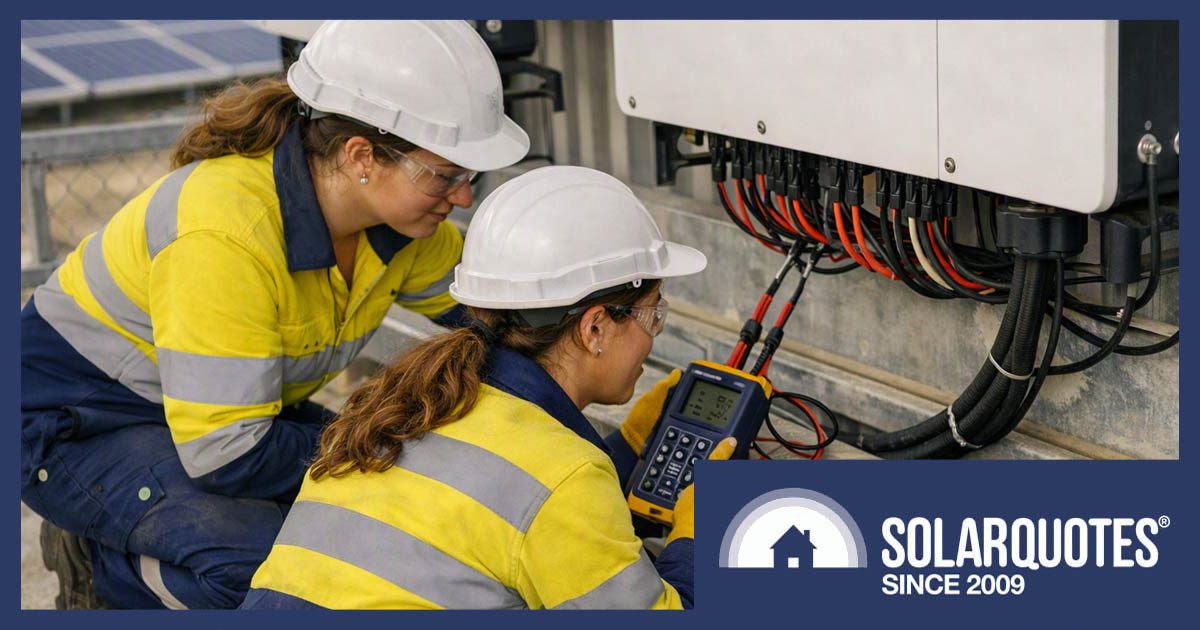
 Australia needs more electricians, and one organisation believes helping more women complete their apprenticeships is part of the answer.
Big Sister is working with apprentices, employers and training providers to improve the number of women entering electrical trades and, just as importantly, staying long enough to become qualified.
The work comes as demand grows for electricians capable of installing solar, home batteries, EV chargers and the other equipment needed to electrify Australian homes.
Why Aren’t There More Female Electricians?
Women currently account for only 2.6% of Australian electricians. Increasing that share would give the industry access to a much larger pool of potential apprentices.
The organisation Big Sister provides mentoring and support for women entering traditionally male-dominated trades, including electrical work and clean energy apprenticeships.
Research into the challenges facing female electricians has highlighted:
- Families and schools discouraging young women from pursuing electrical apprenticeships, and a lack of female mentors within training programs and the industry;
- Employers pursuing informal hiring practices that favour men, perceiving women as a waste of resources because they might have children, and offering a lack of support for caregiving responsibilities;
- Inadequate workplace facilities such as limited toilets and sanitary facilities, as well as uniforms and protective equipment designed for men;
- Worksites grappling with incidents of harassment and intimidation.
What’s The Answer?
Rather than simply encouraging women to sign up, Big Sister focuses on what happens after they enter the workplace.
Its work includes connecting apprentices with experienced tradeswomen, helping them build professional networks and giving them somewhere to seek advice when problems arise.
It also works with employers to examine whether workplaces are properly set up to recruit and retain women. This can include practical matters such as suitable amenities, correctly fitting protective equipment and having clear processes for dealing with workplace problems.
Big Sister also visits schools and promotes trade careers to girls who may not have previously considered becoming electricians.
Not every female apprentice will experience these problems, and some employers are trying to make their workplaces more supportive. But Big Sister says the same issues appear often enough to discourage some women from entering the trade or completing their training.
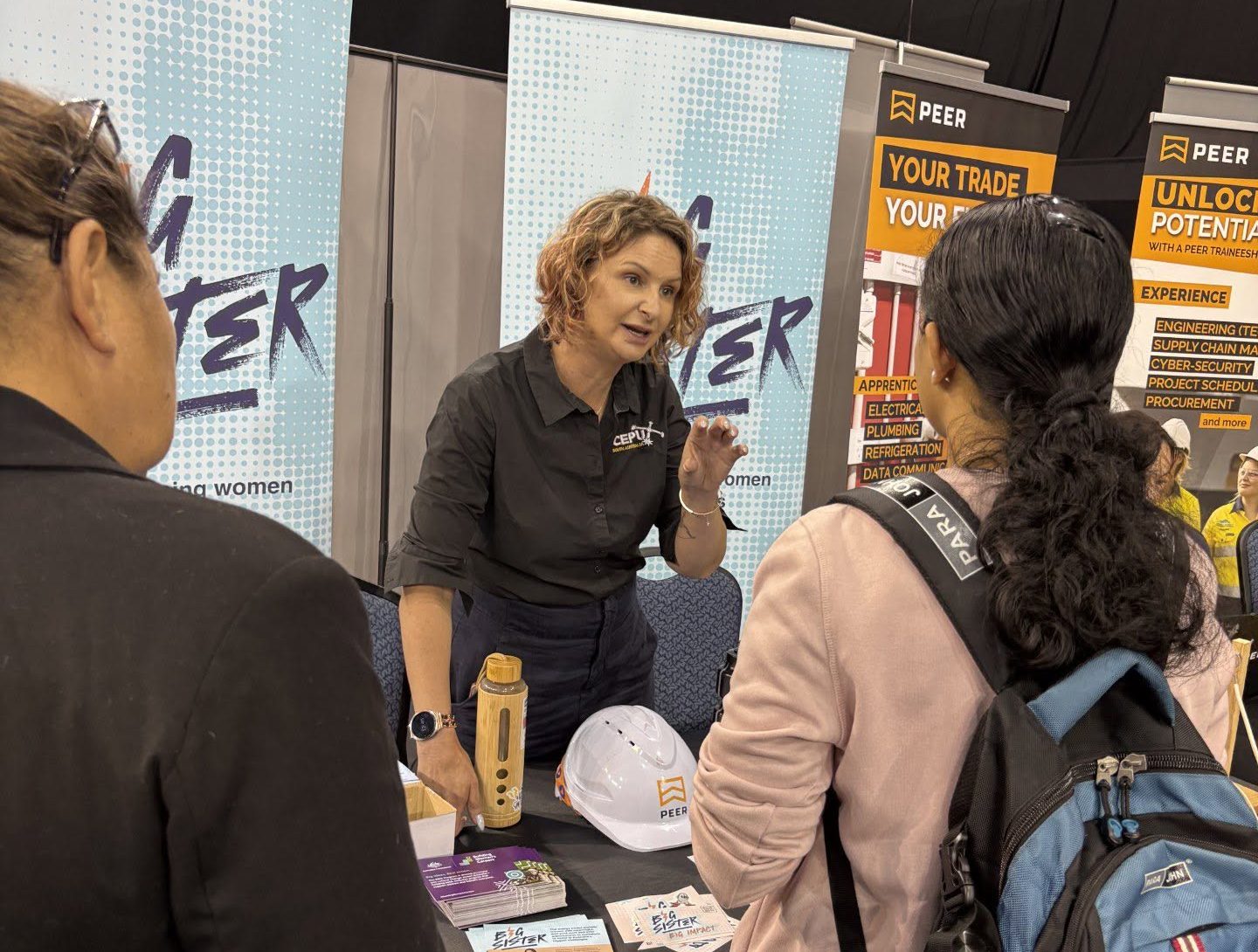
Big Sister Mentor Lead Gaynor Maree at the Western Adelaide Jobs Expo 2026 at Adelaide Entertainment Centre.
Support Before Problems Become Resignations
One theme running through Big Sister’s research is the value of early support.
As one industry participant put it:
“Early warning signs are not being picked up early enough and the early warning signs are there before they drop out.”
An apprentice who is struggling may not initially raise a formal complaint. They may simply leave, leaving the employer to recruit again and the industry with one fewer potential tradesperson.
A mentor outside the apprentice’s immediate workplace can provide practical advice before a manageable problem becomes the reason someone abandons the trade.
Employer support is also important. Retention is unlikely to improve if programs concentrate entirely on preparing women for trade workplaces without also helping workplaces prepare for a more varied workforce.
More Electricians For An Electric Future
No single initiative will solve Australia’s electrician shortage.
But with women making up such a small share of electricians, they represent an obvious source of potential workers at a time when the industry needs more of them.
Australia’s shift towards electric homes will depend on more than solar panels, home batteries and new technology. It will also require enough qualified people to install and maintain them.
Programs like Big Sister won’t be the only answer to Australia’s growing demand for electricians. But if they help more apprentices qualify and remain in the industry, homeowners looking to electrify their homes stand to benefit too.
To find out more, visit the Big Sister program website.
 About Kim Wainwright
 RSS - Posts






I can tell everyone that when someone says that we need more tradies, teachers, nurses or any other trade or professional workers, it all falls apart, not longer after that statement. I still remember in 1972, when BHP was pushing many year 12 students into becoming geologists because there was supposedly a growing need for them in the mining industry. Two years later, I heard that BHP were making their geologists redundant because they decided to use consultants when they needed them. Who can remember when we decided to bring in skilled British shipbuilders, welders and boilermakers? They came over on subsidised boat fares. It took so long to organise it that when they got here, the Whyalla shipyards closed down, and they sent the workers down to Elizabeth for jobs at Holden, but there were none.
We ended up with generations of these workers on the dole.
Unless you have definite jobs or a crystal ball, never plan too far into the future.
Sorry, off topic of Female Electrical apprentices, but a valid comment.
My solar installer was asking clients if they knew of any electrical apprentices who would be interested in changing employers to work in the Solar industry.
I asked my neighbour, retired Electrical Senior Head Teacher in TAFE, who now does some part time teaching, as his reply was, NO WAY, their training is too specific and not wide enough to ever be able to pass their rigorous Electical Capstone test.
If ever there’s a trade that’s unlikely to EVER have an over-supply in the short OR long term, it’s got to be sparkies.
So many people go to university- earning a big HECS debt, and never work in their chosen field. Sadly many people look down on apprentices but it’s the apprentices who follow right through and earn their trade qualification who will have the last laugh.
Yes, I can’t see sparkies being short of work for a very long time.
But if you know anyone looking to get into gas fitting as a trade, I would have a quiet word in their ear.
Having done two owner-builds over the decades, I’ll never look down on plumbers – not after receiving their invoices, that’s for sure. They put a solid dent in my university-educated electrical engineer’s income. Mind you, the pipework of one of them was pure artwork, a pity to cover up.
Supervising the electrician’s apprentice gained a bit of a discount, and teaching him how to do a 3-way light switch was a highlight. And fitting big ceiling fans 5m up is no joke, as you get older.
Check everything, though. On the last build, the brickies bricked hard up under the middle of a truss span, risking breaking its back on outer wall settling. Hearing the “Clunk” saved a lot of later pain, but you have to be there.
There’s a lot of work in building a house, more now with 7-stars, solar, and batteries. Make yourself a good tradie, and all that AI hoo-ha in no threat, even as it topples paper-pushing bureaucrats.
Building site EV chargers needed in ten years? (Like porta-dunny?)
I did my apprenticeship in 84-87. 3 girls 117 boys. Sad to think things haven’t changed much. I spent 28 years working fulltime in my trade. I could cope with the doorless site dunnies, mouthy males, filth, confined space, working at heights, hard physical work, long hours and driving from one end of the state to the other. What annoyed me: people assumed my TA was my boss. Some women treated me as second class or defective because I did a trade that didn’t involve hair & scissors. I started aged 20 which helped me cope in the early days. Don’t assume mentors for women tradies should only be women. Some of those who made my job worth doing were the tradies around me prepared to work with me & not make it about gender. I loved doing the impossible for the ungrateful & spent several years just fixing bad jobs done by the blokes. My boss decided I was ok at pacifying angry customers and so I spent my time fixing rough enough good enough work done by men. Somewhat ironic considering.
While this will be an unpopular opinion.
I’ve worked at several sites that used to turn out multiple apprentices per year, in trades inc electricians.
For the last decade they have been following internal policies that that majority of new apprentices have been female.
The actual rate that finish their time and don’t quit is dismal. On sites with full facilities, changerooms etc, not backyard operations.
These policies have only contributed to a greater shortage when the hiring is based on gender and not suitability.
“For the last decade they have been following internal policies that that majority of new apprentices have been female.”
Can you give us more details about these policies, Darren. All I can find is this from 2024:
“Boosting women’s participation in apprenticeships and trades
The policy also includes specific targets for women. This includes an overarching apprentice target and a trade-specific target, both increasing year-on-year. The overarching apprentice target set for women is 6% for FY24-25, increasing each year to 12% from FY30-31 onwards. Trade-specific targets for women start at 4% in FY24-25 increasing to 10% from 2030-31 onwards.”
Hardly a majority. But maybe you have some other policy in mind?
Hi Julie. Thanks for sharing your lived experience. Reading your comment, I found myself wishing I’d met you before I wrote the article.
Your point about mentors not necessarily needing to be women really struck me. It’s just as much about having good people around you who treat you as a fellow tradie.
Yeah, nah, pay apprentices a living wage would be the biggest thing they could do to improve numbers. My son was getting less than half the minimum wage when he started, how was he supposed to pay rent and feed himself on that?
So Darren I’m yet to work on a building site with a majority of female apprentices. Employing women or men who then drop out is annoying? In the first year a large copy of our group photo was on display & everytime someone left their picture was blacked out on the photo. There were lots. We 3 women all made it through & qualified, worked in the trade and held onto our jobs for a while. The first left after being assaulted by a fellow worker while others looked on & laughed. I think that employing women just to make up numbers is as stupid as training blokes who are not going to be any good in the trade. We had to do a couple of simple tasks at our interviews to prove we had manual dexterity. Despite this, a guy in my year struggled with simple tasks like changing light globes. He ended up in sales. I was told that the final reason I got my job was that I was “old” & less likely to leave. A majority of the 15/16 year old guys that had started the year before me had already quit.