
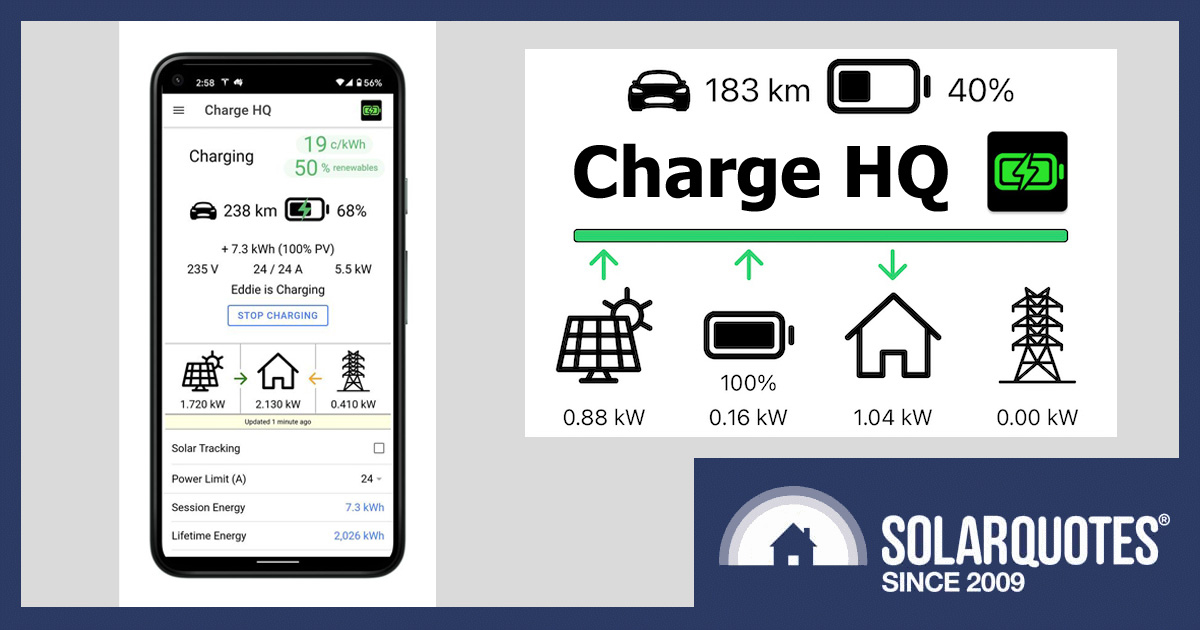
Amber is shutting down Charge HQ, just 18 months after acquiring one of Australia’s best-known solar EV charging services.
Why Is Charge HQ Shutting Down?
Charge HQ announced the closure in an email to customers, confirming it will stop charging subscription fees immediately while continuing to operate until September 7, 2026. Existing users should download their charging history before then, as they won’t be able to retrieve it once the service closes.
Although the standalone app is closing, Charge HQ co-founder Jay Banyer says its smart charging technology will continue through Amber as the company focuses on Vehicle-to-Grid (V2G) charging and whole-home energy management.
According to Banyer, the decision reflects Amber’s changing priorities rather than a problem with Charge HQ itself.
In his email to customers, he explained:
“Amber’s business focus has shifted towards Vehicle-to-Grid charging, whole-of-site optimisation across solar, batteries and EVs, and support for more EV and charger brands. It no longer makes sense to run Charge HQ as a separate product alongside that.”
That marks the final stage of a transition that began in early 2025 when Amber acquired Charge HQ.
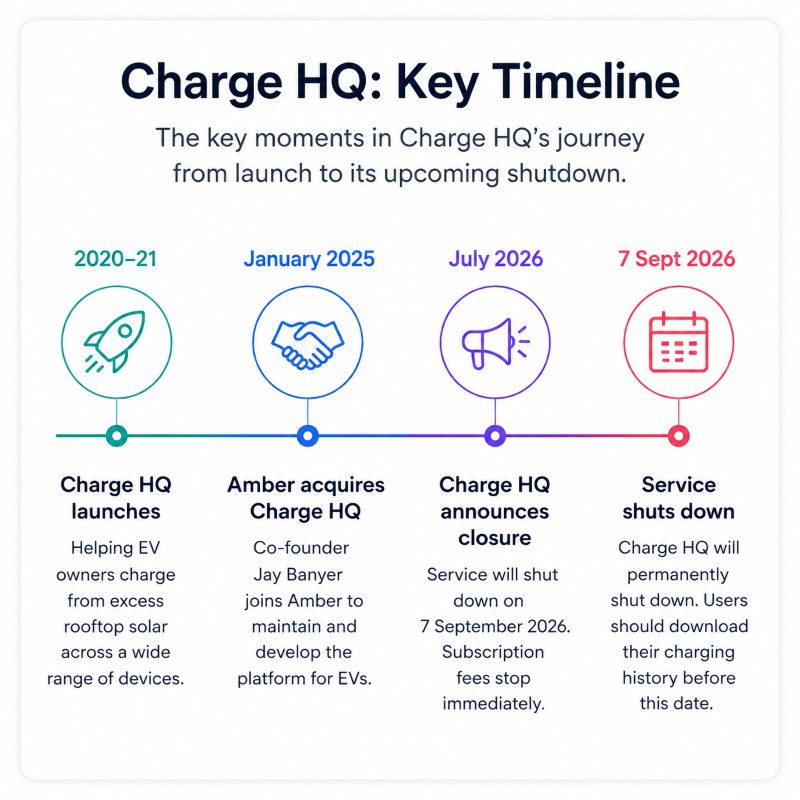
At the time, Amber said the acquisition would help it deliver smarter EV charging to more customers while expanding support for different EVs and chargers. SolarQuotes also noted that combining Charge HQ’s software with Amber’s wholesale electricity expertise had the potential to simplify EV charging for customers using dynamic electricity pricing.
Today, Amber’s focus extends well beyond smart EV charging. The company is investing in software that coordinates:
- rooftop solar
- home batteries
- electric vehicles
- dynamic electricity pricing
- future Vehicle-to-Grid services.
Against that backdrop, operating two products with similar capabilities no longer made commercial sense, Amber claimed.
The news provoked dismay among ChargeHQ users on social media, one of whom called it a “massive kick in the guts”.
Multiple people on social media expressed concern that Amber for EVs is only available to Amber customers with Teslas (although trials are underway to expand to other EV brands). Several pointed to EVCC as an alternative, although cautioned that it requires more technical knowledge.
What Charge HQ Users Need To Do
If you already use Charge HQ, you don’t need to make any immediate changes. The service will continue operating until September, giving you time to prepare.
Before the shutdown, you should:
- Download your charging history, as you won’t be able to retrieve it after the service closes.
- Continue using Charge HQ as normal until 7 September.
- Choose another charging solution if you rely on Charge HQ to automate your charging.
- Restore your vehicle’s or charger’s default charging behaviour after the service closes, if required.
Charge HQ has also confirmed it will:
- stop subscription billing immediately
- permanently delete personal data, payment details and equipment credentials within 30 days of closure
- contact eligible Australian customers separately about an Amber for EVs offer.
Banyer acknowledged that the shutdown is personal as well as practical:
“I will miss the app when it’s gone. I use it every day, and I’m sure that is true for many others.”
If you have questions about your account or the transition, Charge HQ says its Closure FAQ should answer most common questions. The company will continue providing support until the service closes.
For its part, Amber offered an apology to Charge HQ users in a statement on its website, and noted that those who are not currently Amber customers would be offered six months’ worth of Amber subscription fees for free should users decide to join the energy retailer.
Why Did Charge HQ Matter?
Charge HQ succeeded because it solved a problem many EV owners still face.
A typical Australian home might have a solar inverter, EV charger, battery and electric vehicle from four different manufacturers. Most companies build software for their own hardware ecosystem. Charge HQ took a different approach by bringing compatible products together through software.
Instead of asking homeowners to replace working equipment, it adjusted EV charging to match excess solar generation, respond to electricity prices and integrate with a growing range of devices.
That flexibility made Charge HQ particularly attractive to homeowners who had gradually built their energy systems over time.
SolarQuotes first highlighted the potential of Charge HQ while it was still in beta, and later interviewed Banyer about the platform’s development.
Reflecting on the company’s original goal, Banyer wrote:
“Charge HQ was built to solve a problem – helping EV drivers charge from their rooftop solar, across a wide range of inverters, chargers and battery brands, without having to think about it.”
That problem hasn’t disappeared. If anything, it has become more relevant as more Australians add EVs, batteries and smart energy devices to their homes.
Wrapping Up
Although the standalone app is coming to an end, Banyer says its ideas will continue through Amber’s EV platform.
He closed his email with a simple message to the community that helped build Charge HQ:
“I’d like to thank everyone who tried the app and especially those who provided feedback. I hope that you enjoyed using the app and found value in it.”
For tips on how to take EV charging from solar into your own hands, read our guide on how to charge your car on sunshine only.
 About Jacob Boyd
 RSS - Posts






The thing I can’t forgive Amber for is that they’re shutting ChargeHQ down before they reach feature parity, let alone adding any new capabilities! That’s customer hostile, obnoxious behaviour.
Too right!
Not to mention leaving WA customers high and dry. Looks like I either need to set up Home Automation or buy a Zappi to charge my EV with excess solar.
totally agree too!!
You can put me in the category of totally peeved about this!! This was a masterful app, so flexible in its options to control the EV charging from solar/battery/grid, what day/time and how much.
It was also very responsive and intuitive, with an excellent community as well.
A loss for many of us.
Before I got my BoP (Battery on Plinth), I charged my BoW using a Zappi smart-charger which simply sensed grid export current to control its activities. It had 3 settings ranging from zero-grid draw to 7kW flat-out and took my self-utilisation from 35% to 70% with near zero-bill charging. Pretty simple, but the car was out and about 3-4 days a week, so some weeks I just had to suck up some grid at then 30c/kWh.
With the BoP connected the house is now responsible for soaking up 100% of the spare PV and Amber provides access to those cheaper greener grid electrons. I blast-charge the BoW at 11kW in the cheapest and greenest price windows outside the Ausgrid Demon Charge Window of 3pm-9pm, while manually orchestrating the BoP – either charging in parallel or idling. Rules are, never double handle the electrons and suck up the cheapest, greenest electrons possible. Not hard – green electrons are almost always cheaper!
Amber’s good, but I wish they’d factor in Solar LCOE and battery LCOS
Sounds like a good product has been bought up by a bigger player just to close it down. Probably to small a market for the ACCC to be interested in the behaviour unfortunately.
Maybe. I have no inside information, but ChargeHQ were in a spot of bother before Amber. See here: https://community.chargehq.net/t/an-uncertain-future/249
They seemed happy to partner with Amber at the time.
I think it’s just that the landscape has changed.
Look, maybe I really have no idea and speaking rubbish, but this appears to follow the normally big business model. Buy a competitor, grab their consumers/subscribers, shut down the business & integrate with the buyers business, state or imply it’s after a review, and this is the next step where this is either good or bad, offer an inferior service & charge more. Time will tell.
Amber write as if vehicle to grid is now here. I think it is still vapourware for most users. Amber are doing trials with only one car brand – BYD.
Amber for EVs supports Tesla. So perhaps by serving the two biggest brands they think they cover enough of the market.
If they do not support OCPP equipment before ChargeHQ shuts down that really sucks.
It’s really disappointing as ChargeHQ was a really well executed product that suited my needs perfectly. I’m very cross with Amber!
ChargeHQ have published a list of alternatives: https://chargehq.net/kb/alternatives-to-charge-hq
I’ve tried EVCC and Home Assistant, but am currently using ChargeHA as it seems like the closest thing to equivalent functionality, albeit you have to host it yourself.
It doesn’t support Sigenergy (yet!) but I have a PR and the author of ChargeHA looks like he’ll merge it soon. It should then be pretty easy to get running if you have a computer somewhere to host it on.
Vale ChargeHQ!