
 Getting off gas is a multi-year process for many households – replacing hot water, heating and cooking appliances can be an expensive initial outlay to get done all at once. But as I found with my first gas bill after getting a hot water heat pump, even getting just one appliance upgraded can make a big difference.
How Much Does A Heat Pump Cut Gas Bills?
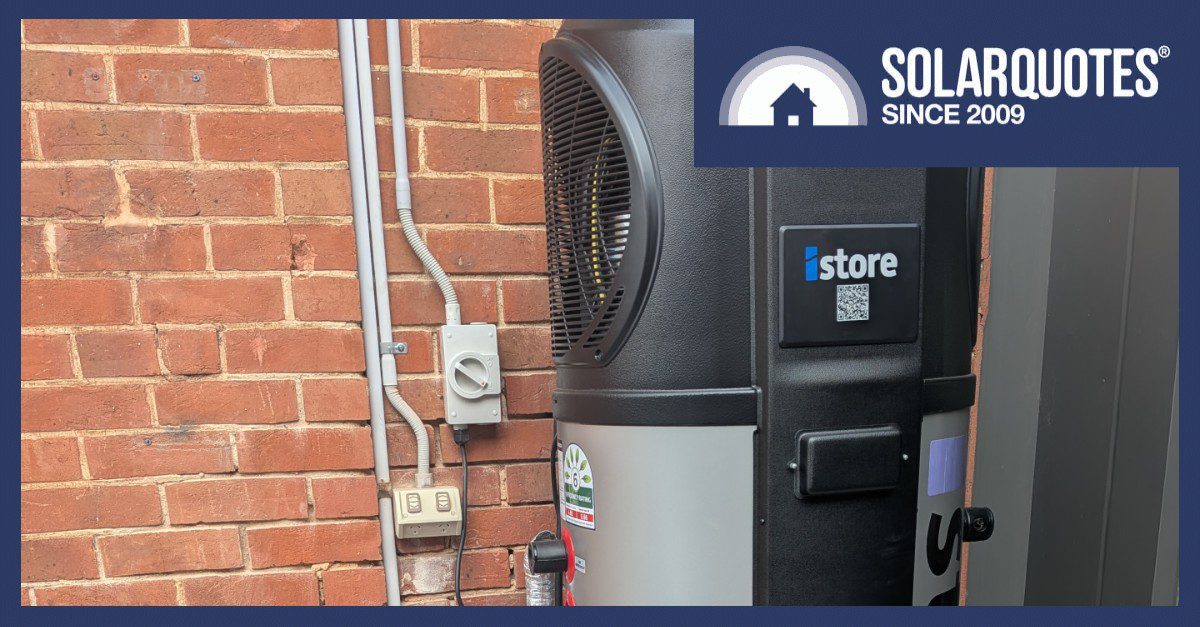
I took a big step towards quitting gas earlier this year, ripping out our gas hot water system and replacing it with an iStore hot water heat pump.
We’ve still got the gas cooktop and stove to replace before our home can disconnect from the gas network entirely, but there’s been an immediate impact on our bills already.
The heat pump was installed roughly 3 months ago – exactly aligning with my gas billing period, giving a stark before-and-after picture.
I got my first gas bill since the install earlier this week, and saw that it had plummeted to just $84, down from $172 the previous quarter (and $213 the quarter before that).
The overwhelming majority of what remains is the supply charge, as you can see from the chart below that came with my gas bill. Our actual gas consumption has almost completely evaporated, as much more gas is used by hot water systems than by cooktops and ovens.
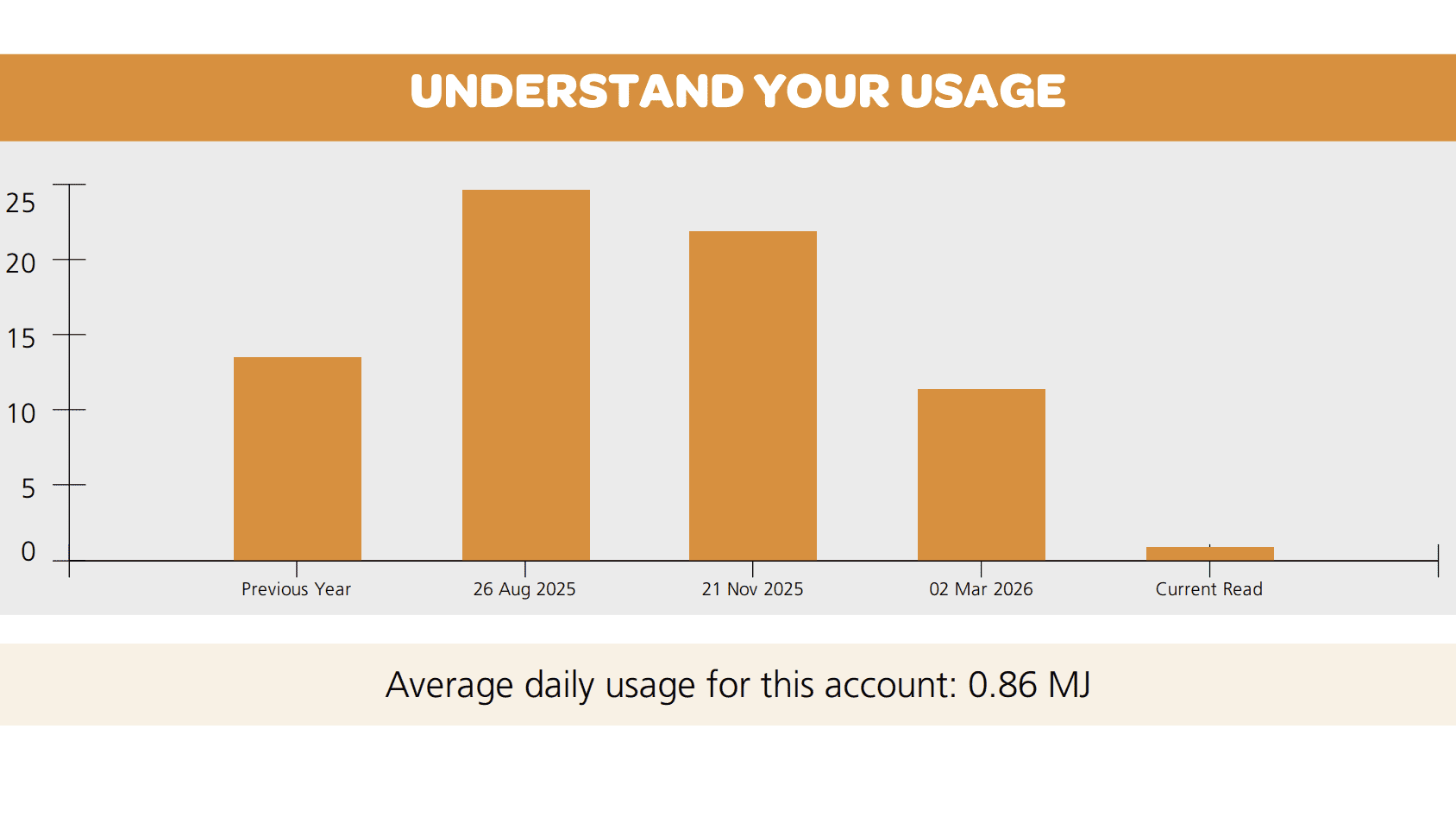
Our hot water heat pump was installed on March 2 – the same day as a gas meter read, giving a clear picture of our home’s gas consumption pre and post install. The ‘current read’ date was May 29. Gas use dropped from 11.37 MJ a day on average before the heat pump upgrade, down to 0.86 MJ afterwards.
What To Do About The Supply Charge
It is great to get a start on recouping the cost of the hot water heat pump (for us, it was roughly $2,100, after rebates secured through the Energy Masters program), but to further shorten the payback period, we’ll still want to completely disconnect from gas and stop paying the supply charge. We are planning a kitchen renovation in the near term that will involve replacing our gas oven and cooktop with induction, leaving us gas-free.
It’s part of the messy reality of home electrification: upgrades won’t all get done at once, particularly with the initial investments required for each appliance.
In our case, we’re deciding between a couple of stopgap solutions on what to do in this interim period before the kitchen reno gets underway:
- Buy a plug-in induction cooktop and an air fryer, so we can disconnect from gas immediately and not have to pay supply charges anymore (plus reap the health benefits of not burning gas inside our home);
- Alternatively, switch to a gas retailer with cheaper connection fees and higher gas usage costs – in our area, gas connection fees vary from roughly 69c a day up to $1.08, depending on the retailer (we would still have to factor in fees for changing retailer).
What About Our Electricity Bill?
The gas savings aren’t just getting transferred over to our electricity bill either. Hot water heat pumps are extremely energy efficient, and we’ve configured ours to ramp up during the middle of the day when our solar has it covered – the hot water stays hot in the storage tank through the rest of the day, so we haven’t had to use electricity during peak periods to reheat water in the evening or early morning.
Our electricity bill was $10 last month – and that effectively covered our petrol and heating expenses as well, with an EV in the driveway and a sizable ducted reverse-cycle system in the house, together eliminating our energy expenses and carbon emissions at the same time.
Australian Homes Are Reducing Gas Use Well Before Quitting It
A new Grattan Institute report that landed in my inbox the same day as that gas bill confirms that many Australians are on a similar trajectory off gas as us – first reducing consumption before quitting gas completely.
Household gas use in Australia has been on the decline since its peak in 2022, dropping 16% over that period, but the total number of homes connected to gas only fell (marginally) for the first time in 2025.
 Getting Off Gas Heating Offers Even Bigger Savings
 Getting Off Gas Heating Offers Even Bigger Savings
Our home didn’t have gas heating, but if it had, our top priority might have been to replace it with reverse-cycle air conditioning. The potential savings of switching gas heaters over is even greater than for hot water.
On the chart below, the number on the left shows the typical savings from quitting gas for homes without gas heating, while the number on the right shows the much larger savings for those with gas heating.
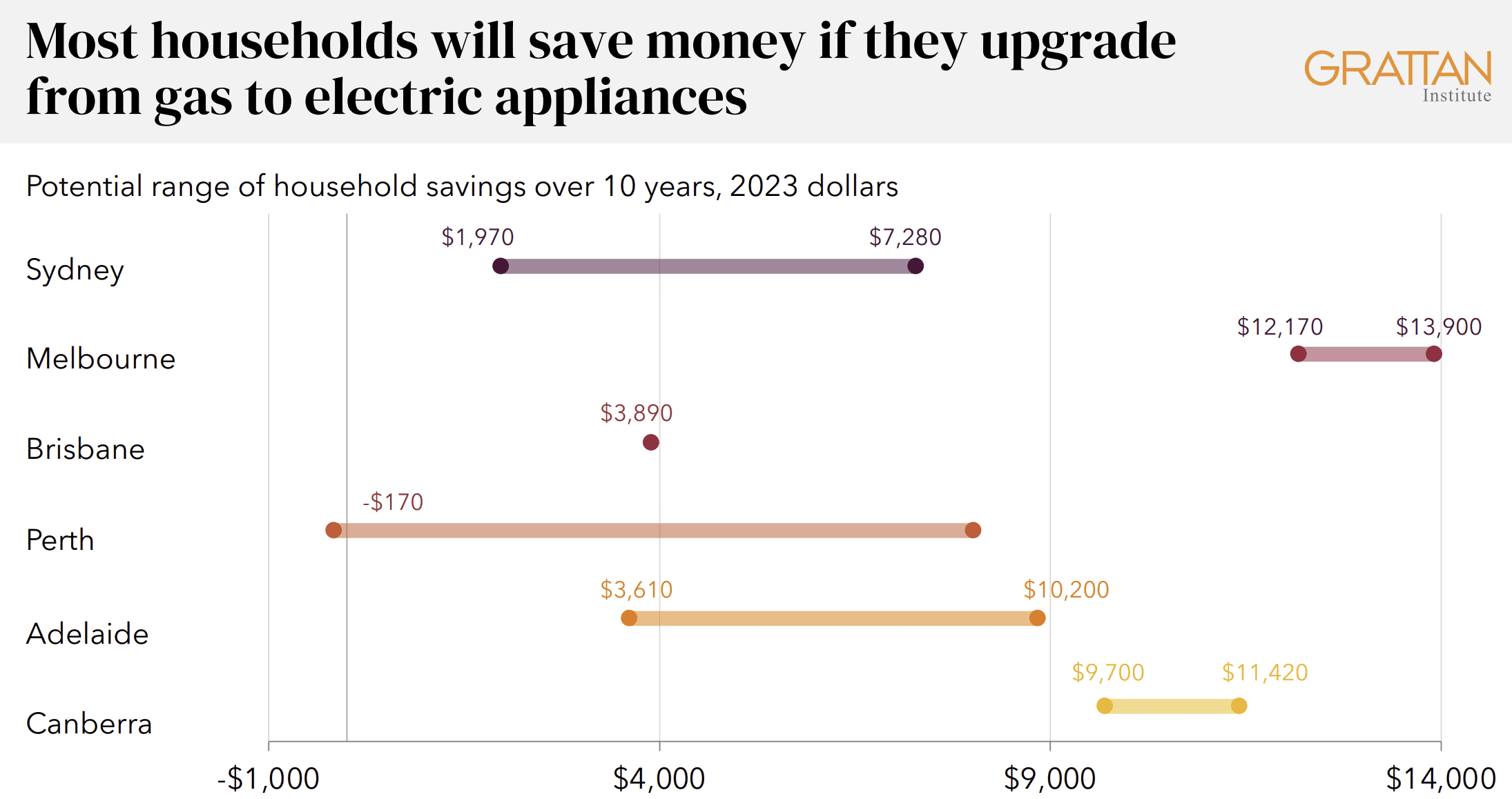
These savings factor in the upfront cost of buying new appliances.
Many Australians Are Quitting Gas Without Realising It
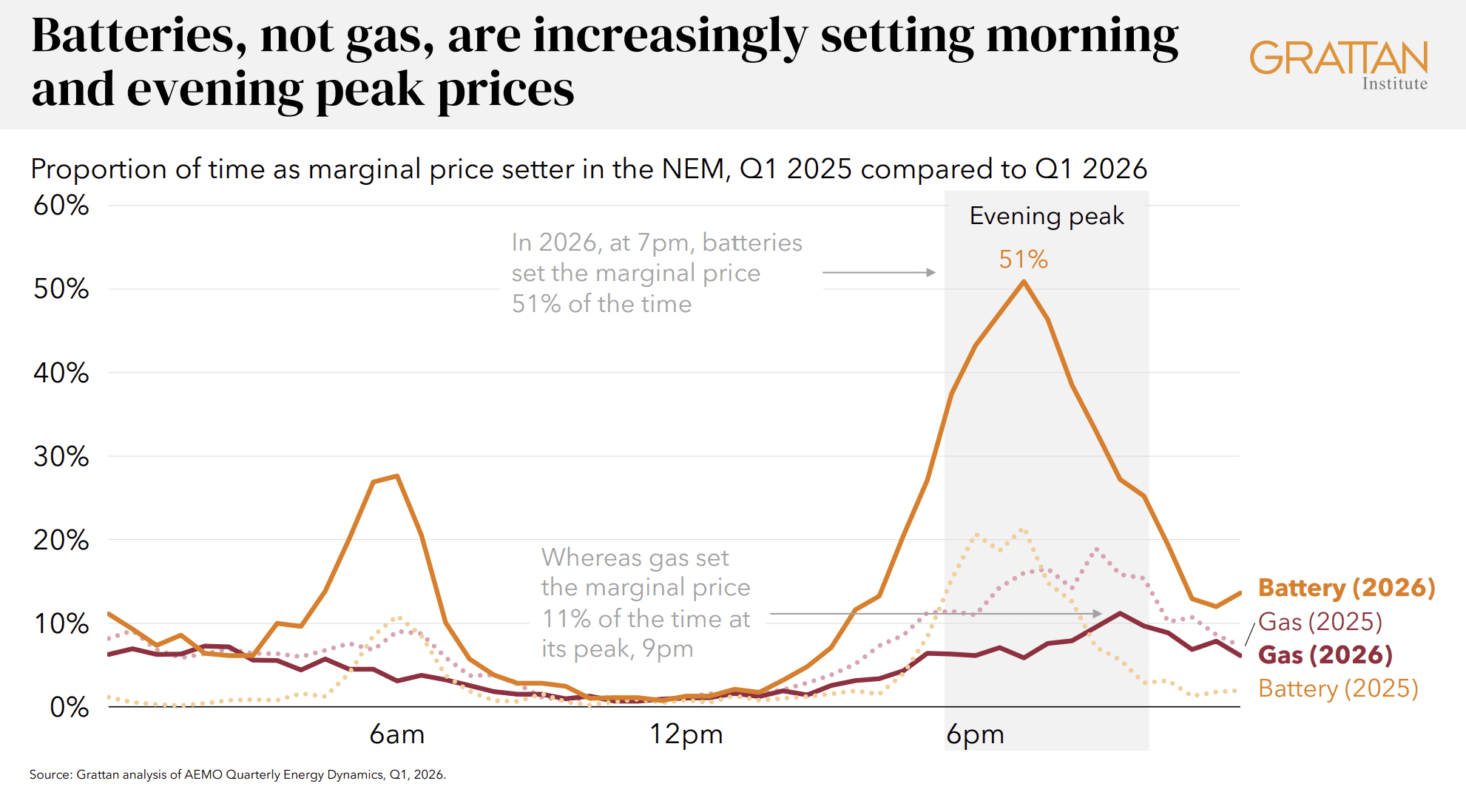
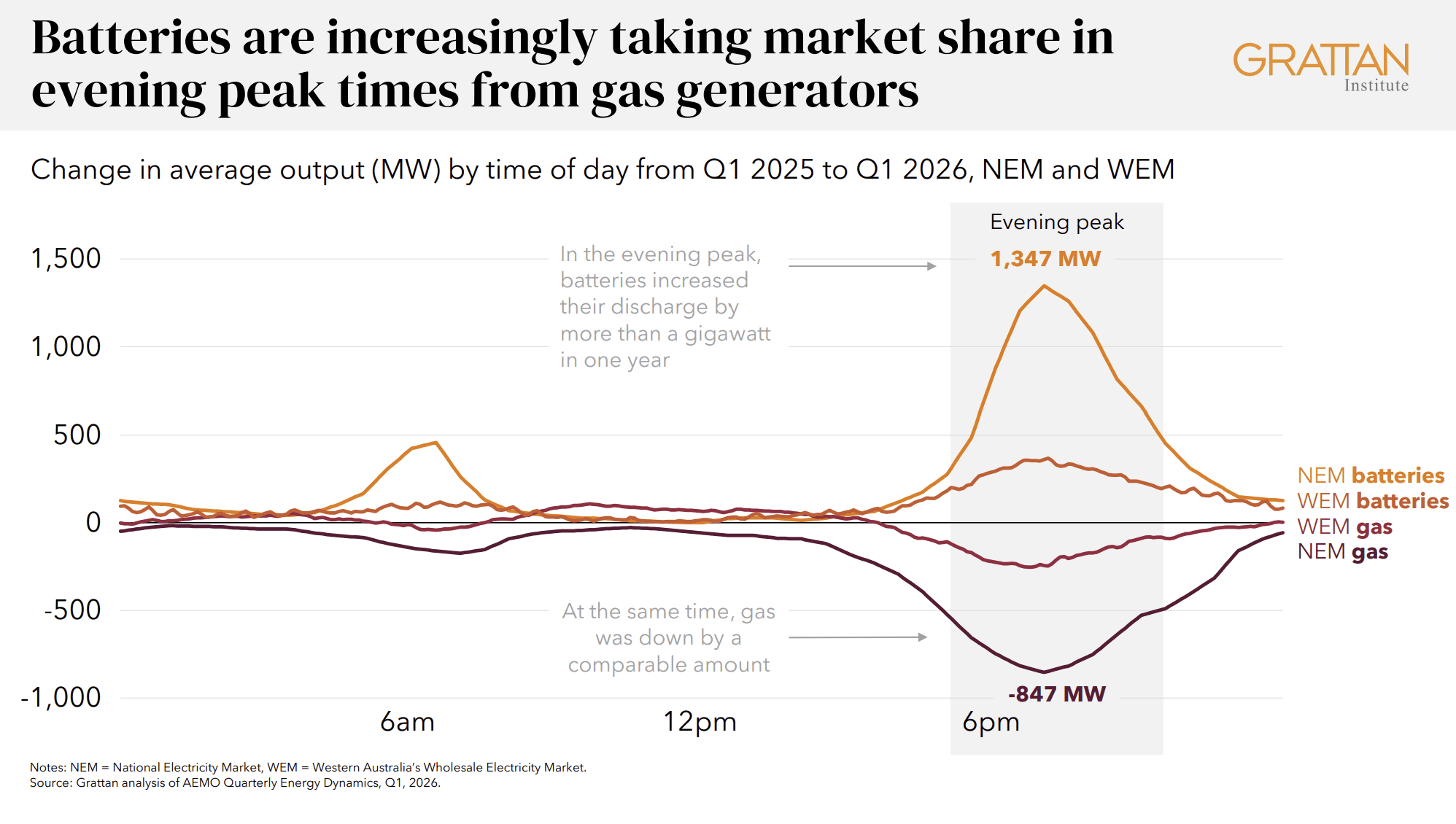
The report found that even households not actively engaged in getting off gas are, well, getting off gas anyway. Gas plants are carrying the load for less of Australia’s peak electricity period as energy exported from batteries takes centre stage – whether that is big grid-scale battery storage systems, or the home batteries that have proliferated since the introduction of the federal rebate.
Batteries are now primarily setting morning and evening peak prices instead of gas, which is part of the reason electricity prices are set to fall by up to 10% from July.
Don’t Get Caught In The Gas Grid Death Spiral
As home electrification continues to gather pace, the report warns that the decline of gas in Australia needs to be better managed to achieve an orderly transition and avoid leaving some homes behind, stranded in an ever-more-expensive gas grid death spiral.
The Grattan Institute recommends measures such as the government setting an end date for household gas use, banning new gas connections, removing gas appliances from social housing, and providing landlords with incentives to replace gas appliances with electric ones for renters.
Gas looks to only be getting more expensive going into the future, so it makes sense to start replacing your gas appliances without delay.
Going full home electrification all at once so you can stop paying the gas supply charge is ideal, but even if you aren’t in a position to shut it off entirely straight away, you’ll start saving from the first gas appliance you replace.
For more on the financial savings from ditching gas, read our explainer on how getting off gas saves you money.
 About Max Opray
 RSS - Posts






Get Off home gas – healthier for family, healthier for planet, healthier for the wallet.
The last thing we did to get off gas was to replace our gas cooktop with an induction cooktop. We had quotes of $1800 and $1900 for the installation, the first quote relied on the new cooktop fitting exactly in the space and the second quote was for minimal widening. We purchased a larger induction cooktop than we needed to minimise the installation cost — overall cost close to $5,000!
Re Induction cooktops, in the US (where the voltage is 110v for most installations, or less common 220v) there is a battery-backed cooktop available that plugs into a standard 110v outlet (the Copper). I am surprised that a similar battery-backed induction cooktop is not available in Australia. If there was, it would be possible to run the cooktop from the oven outlet, because the current draw can be controlled to the 10A draw. This would be especially useful in installations that would be difficult to run a 10mm sq cable back to the board (such as units, or old buildings).
I feel it might be possible to emulate this idea if a plug-in battery was used with a normal induction cooktop. (It would need possibly 2Kw storage, that could be installed in a cupboard).
The Impulse induction cooktop you reference comes with an inbuilt 3kWh battery but it costs more than a whopping AUD9,800.
A new circuit and Bosch induction cooktop install cost me about $1,800.
Wow, I am glad I didn’t get you quotes. I purchased an induction cooktop from Aldi when it was on special for $120, plugged it into the outlet used for the gas cooktop and it has worked perfectly for the past 12 months. Same size so no mods required. If you are lucky and shop around, things can be done at reasonable cost.
You will have to pay significantly more for installation and an induction cooktop as well that replaces a typical gas cooktop. You can do things cheaply just leaving your gas cooktop in place, disconnect the gas and just connect a single induction point to a standard electrical outlet. First of all cook your steak then cook your veges?
Hi Alan,
You can buy two burner plug in induction tops.
A lot of people microwave veggies 😉
Many people wouldn’t like to leave their gas cooktops in place even with gas disconnected. A cheap induction cooktop won’t give the same power as a standard induction cooktop and wouldn’t give you the same heating as the gas you are replacing. I admit it would work but it won’t be equivalent to what you are replacing and I suspect that is what most people would want.
Hi Max,
to your knowledge, is gas abolishment in NSW still likely to have a “sweet spot” in the final 6 months of 2026?
My understanding is that at present, abolishment is $1200+. From January 2027 it will be similar. From July-Dec 2026 abolishment will be <$300.
When I queried AGL on this they said they hadn't heard anything and I should ask again after July. I then did some searching and found some suggestion that this "sweet spot" isn't absolutely locked in yet, and many retailers are disputing it.
Like you, we'd finally move off gas at this point should the sweet spot eventuate.
On a different note, if any readers had any insight into solar HWS vs heat pump, I'd appreciate it. Context is we're a North facing home, roof space to spare, 14.4kw solar panels, 40kwh battery, noise sensitive neighbours, 1 EV with a second likely soon. A plumber friend recommended solar HWS over heat pump (longevity the main reason, but also noise). Should solar HWS be seriously considered?
Abolishment costs do indeed drop from July, but I believe that lower price will be in place until the end of existing regulatory period in NSW (2030). We will likely revisit this around July 1 in a new article.
As for solar HWS vs heat pump, our advice is that although solar HWS was a fantastic option for many years, these days the latter is best for most homes – here’s our comparison.
I have not had a gas connection since the 1970s. I was wondering if one told the gas supplier that you were vacating, so wanted the gas supply suspended, if that would enable disconnection? Of course, circumstances may change & one remains in the property! Then the Gas is effectively disconnected. The plumber can cap off the meter. Eventually, the gas will be disconnected anyway, so the meter will disappear.
I suspect that the gas network will be taken over by a fibre cable company, as was done with the old High water pressure Lift service in Sydney some years ago (valuable real estate!).
Dan,
Especially in winter, could the second EV decide whether the 4x load of resistive water heating, over a heat pump, works out? If the EVs are charged on alternate days, and there’s less overcast there than here, it might almost have a chance? Maybe.
I’ve had a resistive HWS on 27 kW of off-grid solar for 2.5 years now. The 3.6 kW element was replaced with 2.4 kW, on installation. In light winter overcast, that’s right now using much of 3.6 kW of yield, 800W going into the battery at 99% SoC. Frequency is 49.9 Hz, indicating there’s nothing more to give – every incident photon used.
An in-flue heat exchanger on the wood heater is my backup, using time-shifted photsynthesis for zero net CO₂ emissions. Lacking that, a heat pump would be rather attractive, as it quadruples battery utility when water heating in murk. Else maybe 50 kW of panels for a silent solution with the load of a second EV?
Congratulations on the increased mobility resilience, cost saving, & climate action!
We stopped using the gas stove some years ago as it was the last gas appliance so then cut off the gas. Bought a portable induction stove to tide us over until the kitchen was refreshed with a proper induction cooktop.
It’s a compromise (modern induction stoves have better heating coverage etc) but we cook every night and any loss of utility has become unnoticeable so the kitchen upgrade has just never occurred.
A true life hack.
Water heating summer
Heat 20-40degC for a hot shower +20degC
Water heating winter
Heat 10-50 for a hot shower
+40degC
3.5x less energy is falling out of the sky for you to capture to heat water = 6 months of the year in the southern states where its next to useless and you are thus buying energy to top it up in the same period when it’s toughest to generate your own and most expensive time of the year to buy it.
I work for iStore.net.au
Many thanks Max, Doug, Erik, Adam and Karl.
Appreciate it.
One further consideration (in Victoria at least – possibly other cooler climes too) is that several electricity providers are now already offering the free 3 hours of electricity that the government will be enforcing throughout the nation in the coming years. We swapped over to such an electricity plan and so now literally all our hot water is free because I’ve set the heat pump to heat only during the free usage hours. This typically also coincides with the maximum daily temperature being reached and so is also the most efficient time to run and which places the least stress on the system.
We have a relatively small kitchen and, to conserve bench space, we decided to only have plug-in induction cook tops. One hangs on the splashback ready for use every day and another is in a cupboard for use when there is a need for two. We also keep one in our caravan but have never needed to use it in the house.
It takes a little thought planning cooking complex meals but otherwise we don’t miss a built-in cooktop.
In warmer weather we often cook outside with one of the plug-in cooktops.
Paying s supply charge for a cooktop seems nuts.
I would rather grill snd fry, and roast,on a BBQ.
Thankfully, here in SE Qld, a 9kg gas refill costs about $25 and lasts almost 6 months.
Unfortunately not all of us can make the transition. I wish I could get rid of my gas ducted heating unit, however it’s a roof space mounted one in the roof of a double story house. I’m told that it can’t be replaced and the duct work with 12 outlets is not compatible with electrified options.
A staged approach, adding modest sized split system airconditioners to one or two areas initially, may be easier on the pocket – definitely easier to implement. Giving up to 4 kW of heating/cooling for each kW of electricity, it’s unbeatable economy. (The problem here might be a focus on a legacy central system?)
Even in two storey, ducting can be a dreadful energy (& cost) waste. Local split system reverse cycle aircons are nifty, I find, with three of them here, spread over 35m linear distance, 9m outdoors. Try ducting that. 😉
Engineer here: “Can’t” is just a word – not always reality.
Find a good split system aircon installer – he’ll have a different vocabulary.
Hopefully there’s a few spare slots in the switchboard – else a subboard fixes that, perhaps.
It is best done before the gas grid shuts down. Which side of 2040? New gas installs banned in Victoria since start of 2024, some gas replacement subsidised. It’s good to be ready – as funds permit.
Thanks for the advice Erik. Unfortunately the boss hates the look of split system units hanging off the wall all over the house. Plus the potential of external units obstructing footpaths around the house; pipe work hanging from the walls etc. So not an option for us I’m afraid. I would prefer an electric replacement option that would utilise existing infrastructure.
Check out cassette splits
Thanks Karl,
Might be ok for upper story but ground floor might be a problem getting electricity to the units and pipe work to the compressor outside. I’ll keep looking : )
Hi Kala,
Have a rummage through this article and see what you can find 😉
Cheers
Years ago we removed our instant gas hot water system, and added AC capacity so we could stop using our plug-in gas heater, so the only gas appliance we have left is the stove-top (over an electric oven). Our gas bill is now 90% supply charge with only a few dollars per quarter for consumption!
I bought a plug-in induction cooktop to experiment with before committing to full-scale replacement of the built-in gas cooktop, but the main challenge I now have is to build some sort of flat platform over the top of the gas cooktop so I can use the induction cooktop under the rangehood… a small project for another day!
Permanent replacement would be preferred but I’ve already gone through a few switchboard upgrades to accommodate solar, battery, 3-phase outlet and new AC units… all slots full so vanquishing the last part of my gas bill would be a big step up!
But… it feels right…!
Hi Scott,
Have a look at “My Efficient Electric Home” on Fakebook and you’ll find a few examples of people who have decommissioned, disassembled or just removed trivets/burners on a gas stove.
A cabinet maker or DIY person can often knock up a timber frame to carry a new induction top.
a big wooden cutting board does the trick.
Having eschewed gas since 1976, I too can heartily recommend induction cooktops.
Fossil fuel burning abatement is kinda urgent too, now. The (not yet peer reviewed) paper discussed here: https://www.youtube.com/watch?v=SPSsKhNQ_8c correlates 3 agencies’ satellite data to deduce global heating has not recently risen from 0.18°C/decade to 0.36, but is now 0.48, i.e. crossing half a °C/decade, and *accelerating* at 0.049 °C/decade².
Their (too linear) projection is +2°C by 2035 – my money is still on 2032, latest. (Don’t forget the increasing water vapour’s greenhouse feedback, & CH₄.)
Measurement method is @ 14:00
Measurements by three agencies converging is @ 21:00
Money saving is important now, as recession looms (not just AI job cuts), and inflation makes upgrades costlier later, but energy & transport resilience will be increasingly vital, and solar, BEV, and (often) batteries, yield that like nothing else can.
Adaptation beats the alternative, I figure. We are it.
As I’ve said before and I’ll say it again, change to a Solar Hot Water System eg Apricus and you won’t be paying for any power cost (if you have to solar power to feed the smal electrical consumption of the control system and the little water pump.)
And you don’t get any noise or air blast from a fan either.
It took a few years to pay off the installation cost – less the government rebate. Every month now, summer and winter we’re laughing at the no cost hot water.
I have 20 tubes at the family farm and it’s not enough hot water for my old man and he only lives there half the time ie week on week off.
They are north facing.
There simply is not enough solar irradiation to heat water in Melbourne in winter.
Heat pump is on the ground, not susceptible to hail damage doesn’t need roof work or unsightly pipes running up the wall.
Solar hot water works in Perth 9-10 months of the year – their cold water is warmer and they simply don’t get 180 overcast days a year like Victoria does.
Solar hot water simply doesn’t stack up in this day and age.
I would argue the cheapest form of hot water if you have adequate solar or a cheap tariff (eg 2hrs free plus a reasonable daytime or even overnight tariff) would be well sized time-switched resistive hot water which has none of the potential downsides of solar hot water at low cost. Cheaper than heat pump too without its potential noise and maintenance costs as well as high capital cost.
It is certainly worth a look. I will be installing two units in the large house I am currently building for the reasons I cited.
Hi Patrick,
Close coupled solar thermal hot water is still a pretty good option in terms of simplicity provided you have the roof designed for it.
However the ability to heat water cheaply in winter using a heat pump is unparalleled.
Simplicity is great but the overbuild of solar required, especially in a place like Melbourne, is pretty ludicrous.
We’ll have better things to do with grid energy mid winter too, that’s when power will likely be most expensive.
My 2c worth: It might be economical to upgrade a solar-thermal HWS if it is a replacement. However for a new build, it is cheaper to use a Heat Pump HWS, both installation & on-going costs. Also the area a HWS sits can then be used for even more PV panels!
In my case, I have a 400L Solar Edwards on a double storey section of roof. The tank has now got a rusted outer covering, so looks awful. This system was cleaned when the roof was replaced abt 10 years ago (system now ~25yo). Most likely get a 360L CO@ heat pump to replace it. (7 persons household, 3 living spaces). I may distribute the heatpump into 2 systems to reduce the pipe runs.
Good points Doug.
Getting a plumber out of the drains and onto the roof to fiddle with a close coupled unit can be difficult, but if the plumbing is already there, it often gives shorter pipe runs across the house.
Now that you (we) are down to a gas cooktop +/- oven, the supply charge can easily be avoided by using 9kg LPG tanks (ie, BBQ style). I have twoo attached to my supply line, allowing me to switch when the first tank is empty, and have 3/12 to refill it so that I can cook whenever I like – no supply charges, and that more than covers the cost of the new cylinders. My local gas supplier is way cheaper than Swap and Go suppliers, and cheaper than piped to home gas even beyond the supply charges.
If I was to renovate my kitchen, electric induction cooking – stove tops – may even beat gas, but the gas tanks are cheap as can be … this is the way to go, short term. No need for new (induction friendly) pans.
We used BBQ bottles for our gas cooktop – cheap as chips. It works well.
The only problem was that our 2 year old Siemans hob blew up blowing me off my feet, luckily only causing concussion and horrible bruising. I avoided serious burns by being 6 feet away at the time.
Our insurance paid out for a new AEG (not going to Siemans again) induction hob once I had got over the horrible nightmares and fear of walking into the kitchen! We used a plug in induction hob for some time but don’t fool yourself it is nothing like the real thing.
I would advise anyone who has gas appliances to think again. Breathing in fumes is bad for your health, but being blown up is worse!
I have photographs of what happened to the kitchen if anyone is interested – Siemans weren’t, but they still sell the same hobs.
Hello Hilary,
Was this caused by using LPG [BBQ bottle gas] in a cooktop designed for natural gas [reticulated gas]?
These two gasses require different gas/air ratios for correct operation.
Hi Clive
No. We don’t have natural gas in our neighbourhood.
We took the huge tanks of gas away and swopped for the BBQ ones at the suggestion of the supplier who could not deliver when we were empty.
The BBQ bottle worked so well that we never filled up the big ones again – saving a lot of money for fees.
Good question though.
PS Surprisingly the induction works a lot faster than the gas ever did.
Induction: not surprising with speed! The only problem I have is my partner uses too high a setting, so tends to get hot spots. This is mainly a problem with simmering.
It is more efficient to boil water on the Induction than to use any other method to boil water (such as jug or gas), as well as being faster.
Karl,
I may have found the difference; I thought we had a standard setup of tubes, but I see on the quote it is THIRTY (30) not Twenty like yours.
Is your Temperature regulator set too low?
Is your pump controller set to the correct temperatures?
Our system is great and works as we need it.
Our gas connection fee is 49c a day. With the age pension rebate our bill for the gas cooktop is around $60 a quarter (we have an electric oven),
Given that someone above said that their induction cooktop with installation came to almost $5,000, I don’t think we will be switching any time soon.
Hi Alan,
You might consider just getting a couple of plug in the wall induction plates. Cheap ones are about $60 each and expensive ones are maybe double that?
If you look into what the gas industry has been failing to tell us for the last 50 odd years, you might want to get rid of gas on health grounds.
I think we should all take them to task to be honest, certainly don’t want to give them any money.
https://reneweconomy.com.au/gas-industry-knew-about-air-pollution-problems-from-stoves-in-early-1970s/
Alan: – “Given that someone above said that their induction cooktop with installation came to almost $5,000, I don’t think we will be switching any time soon.”
IKEA offer a portable single induction hob currently for circa $50. Specifications include:
* Hob with induction cooking zone: 1×175 mm
* Unit dimensions: 270 mm(W) x 305 mm(D) x 62 mm(H)
* 1x 2,000 W induction zone
* Connection rating: 2,000 W
* Voltage: 220-240V
* 10 amp plug & Cord/cable included
* 2-year guarantee
https://www.ikea.com/au/en/p/tillreda-portable-induction-hob-1-zone-white-40493509/
SolarQuotes founder Finn Peacock did a gas cooktop vs induction cooktop comparison test 5 years ago. https://www.youtube.com/watch?v=S9cVF3OXTVc
Check that your pots/pans are compatible for induction. If you are unsure about your existing pots and pans, a simple fridge magnet is your best tool:
https://www.house.com.au/blog/everything-you-need-to-know-about-induction-cookware
Alan,
My plug-in benchtop induction cooktop was $50 at Aldi. No electrician needed. It’s a ripper, though only single hotplate. The 4-plate one I bought on-line for the renovation prior to sale of my previous home in town was maybe $600, plus a bit for a semi-retired electrician mate to drop in and wire it up.
I had to glue & screw a 12mm batten each side of the bench cutout, as the new unit was a squidge narrow. Some flat black rubber self-adhesive tape from Bunnings, laid on top, with mitred corners for neatness, finished off the job, with the cooktop neatly dropping in, edges black on black – smicko. (Cut one tape end, lay it over the other, use its new edge to guide the matching mitre cut, made with a sharp knife – virtually seamless.)
“Use the web, Luke.” this stuff needn’t cost a mozza. (E.g. electric fence insulators for steel pickets: 95c ea in-store, 33c on-line. Makes a difference @ 3,000 off.)
Alan,
P.S. I cut 25 mm off the top of the two cupboard doors under the new induction cooktop, level and directly in line with the unit’s ventilation exhaust. That was essentially invisible under the countertop front overhang. A similar strip cut off the front edge of the cupboard bottom remained invisible behind the doors, and admitted air intake from in front of the kickboard. The middle shelf’s front edge was already set back, so all good for airflow.
Both the real-estate agent and the buyers were happy with the offering.
Well done. More thought needs to go into keeping costs as low as possible in getting out of gas.
Induction cooktops: I carry a single one in my BYD to boil water when I am charging! (Boil then charge).
I have bought Induction cooktops on-line. Try to get one from a reputable seller, & the type with a linked burner is much better for big pots (Small, med, & 2 linked) Ikea also sell a reasonably priced linked plate Induction.
It is also possible to buy an Induction cooktop with built-in downdraft Exhaust fan (Name brands ~$3k, Lesser known from abt $1500.) With a ceramic filter, these can be connected to an MVHR for fully sealed houses air exchange systems.
There is a certain Swedish flat pack company that sells induction cooktops at reasonable prices
Hi Alan
if you bought a couple of 9 kg gas cylinders and installed them on a simple bracket, you would save $100 in your first year, without any pension rebates!
($60/qtr x4 = $240 per year. 2 x $70 for filled 9 kg cylinders = $140 in first year, perhaps $50 per year thereafter).
You may need an adapter if you are swapping from natural gas to LPG, but these are well within the above budget.
Gas may have some ill effects, but I doubt these are so significant that we need to worry – not much said about them, compared to the motor air pollution we all breathe all day, for example.
Induction cooktops sound great, but not until I renovate my kitchen again in another 10 years!
steve
Hi Steve,
Plug in induction plates are under $100 in most cases.
The gas industry want you to make an emotional decision about food, not a rational decision about cost, they know all electric houses are cheaper and people are disconnecting gas.
They’re not talking about the glass induction cooktop that’s easy to clean, superbly controllable and won’t set your house on fire.
And there’s zero mention of indoor air quality, that gas will poison you with NOx, Benzine & carbon monoxide.
The historic evidence in the hyperlinks of this article should make everyone angry.
https://reneweconomy.com.au/gas-industry-knew-about-air-pollution-problems-from-stoves-in-early-1970s/
steve: – “Gas may have some ill effects, but I doubt these are so significant that we need to worry…”
Burning more carbon-based substances is civilisation suicide!
https://www.ipcn.nsw.gov.au/sites/default/files/2026-02/Geoff_Miell-PresentationSlides-ChainValleyCollieryConsolidationProject%28SSD-17017460%29-20260216.pdf
As of Jun 2026, Dr. James Hansen projects that 2026 is on track to be the hottest year on record, exceeding 2024 temperatures due to accelerating global warming (0.31 °C/decade) and a strong El Niño. Global temperatures are projected to reach +1.7 °C above 1880–1920 levels by 2027, with +2 °C likely in the 2030s.
http://www.columbia.edu/~jeh1/mailings/2026/2026GlobalTemperature.2026.06.12.pdf
steve: – “Induction cooktops sound great, but not until I renovate my kitchen again in another 10 years!”
Why would gas remain affordable/available for next decade?
https://grattan.edu.au/report/out-of-gas-managing-the-decline-of-gas-in-australia/
Like others here – that last gas cost (the cooktop) is a doosey!
I really think this is an area that government at all levels needs to work on. I think something like a low interest loan for switchboard, supply and wiring upgrades would ease the up front cost, get safer houses and really support changeovers.
Set loan repayments for fixed incomes at about the gas supply charge…..
Well said.
Agreed Peter! Our stove top conversion from gas to induction stung us about $4000 and also meant we had to get owner’s corporation permission to run a cable/conduit through and along an outdoor wall that’s visible to the neighbours. It couldn’t be run in a more concealed way due to being a retrofit. Quite a lot of pain with that one! I certainly don’t regret it though and getting off gas completely has given us an annual saving of just shy of $600 (based on the price of gas per unit and supply charge at 2024 prices). We’re also a healthier household for it and satisfied with doing our bit to reduce climate destruction.
Get the portable induction hot plate, you wont regret it. They are cheap as chips. The wife and I bought one last year to try out to see if we liked induction (we have an old school electric hot plate).
We certainly did like it.
So when i got the electrician in to do an air conditioner I asked him how we go about replacing the current unit with an induction hot plate system. He said we would have to upgrade the cable from the power board to the kitchen at a cost of about $700 before we could install an induction system.
We weren’t doing that, so we are still using that portable induction hot plate to this day, we haven’t had to use a hot plate on the old system since. In fact we have turned it off at the switch and use it for extra bench space.
I might sound unbelievable, but there are still councils in NSW (such as Shellharbour) that approve gas installations in newly built homes.
One would have thought that even councils have entered the not so new era of renewable power.
But I wasn’t talking about an Edwards style Solar HW service. I was talking about an evacuated glass tube type like Apricus, whichis a totaly different system.
find them on the internet!
Evacuated glass tube collectors are amazing things.
I think you missed the point. I was not talking about efficiency, I was more alluding to the safety aspect. To install a roof-mounted HWS, (even just pumped tubes) one requires scaffolding, a plumber & probably a sparky. compare that to working on the ground, where everything is more accessible & much safer. New installs: definitely now Heat Pump! Replacement: check the requirements & costs.
When I built my disability units 15 years ago, I used resistance HWS with timeswitch (powered by PV). Now, I would use a Heat Pump HWS.
Bryan,
Your problems upgrading the service is one reason I feel a battery backed Induction cooktop if cheaper would be a good option, because then, existing wiring can be used.
Come on, manufacturers, offer a reasonable priced battery backed retrofit induction cooktop! Its not rocket science! An alternative is for a small pluggable battery that can be charged off-peak, & supply power to the Induction cooktop, as well as other high current draw appliances in the kitchen. If one can have such a cooktop installed for $3>4K, it would be worthwhile. With the battery, the demand time can be moved too for even more savings.
Can a battery supply the peak power for a standard induction cooktop? I doubt it and that is why you need special wiring.
These units are already available in the US (called Copper). There, they run off a 110v/10a power outlet.
The peak power of an Induction cooktop is only ~7.2Kw. That power is easily delivered by a battery. Also it is only peak power, not continuous.
The issue with the wiring is likely to be a problem where there is old wiring in the building, & the power board was some distance from the Kitchen, such as in a block of flats. As was stated, there was a need to run conduit in common property, & not all body corporates would allow that. A system that can be charged from a 10A outlet, then be available for peak power demand gets around the issue. It will be a fix in some circumstances.
Our solar battery was originally 10kWh (now 15kWh), the maximum draw is 5kW. How much does your battery cost that it can draw 7.2kW? Our battery would have cost of the order of $10k. The limitation is presumably related to the inverter converting DC to AC.
My gas hot water has a second circuit we use to circulate through the slab for hydronic heating. (water goes out, through floor pipes and back into the HWS) We only heat the water to 40 degrees or so. Are there any electric systems that have this capability?
Hi David,
There certainly are heat pumps available for hydronic heating in Australia I but I’d expect they’re a dedicated machine.
What you have would be called a combi boiler in the UK, where they’re quite common. Perhaps do some searches over there?
Thats a good idea, will do, thankyou