
Australia has become a rooftop solar powerhouse, but millions of renters are still missing out on the technologies helping homeowners slash their energy bills — a gap which a new report says could be closed through mandatory minimum energy-efficiency standards for rental properties.
The Institute for Energy Economics and Financial Analysis (IEEFA) estimates most rental homes could cut energy bills by up to 50% through insulation, efficient electric appliances and rooftop solar, generating about $107 billion in energy bill savings by 2050.
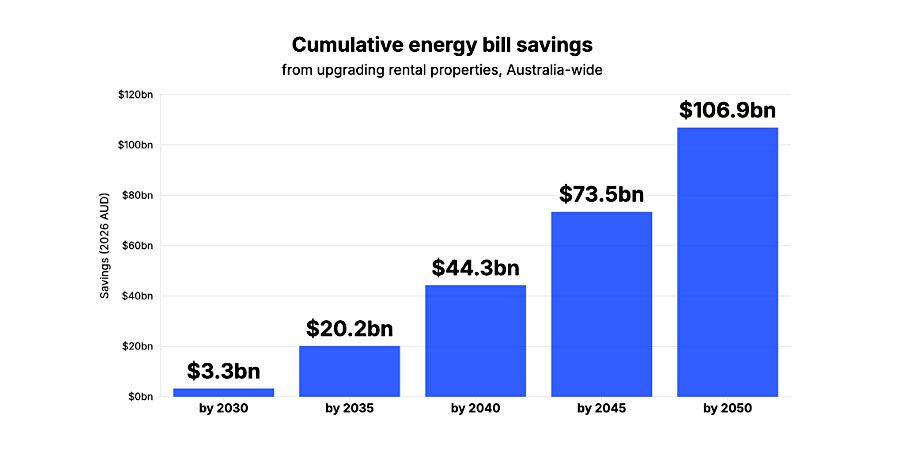
Cumulative energy bill savings from rental property upgrades, 2030–2050 (IEEFA modelling) Source: Institute for Energy Economics and Financial Analysis (IEEFA).
Why Are Renters Missing Out On Solar?
A long-running structural problem in the rental market known as the “split incentive” means landlords pay for upgrades, while tenants pay the energy bills.
That mismatch has left rental homes consistently lagging behind owner-occupied homes on insulation, efficient appliances and rooftop solar.
“More than 30% of Australian households rent, and are generally locked out of home energy upgrades,” said IEEFA energy finance analyst Jay Gordon.
Solar Incentives Deliver Limited Impact
Governments have spent years offering rebates and subsidy-style programs to encourage landlords to upgrade rental properties, but uptake has remained patchy.
According to IEEFA, this is not surprising because lowering upfront costs does not change who benefits from lower energy bills.
In short, carrots alone haven’t been enough.
Is It Time For The Stick Instead?
IEEFA argues that rebates and subsidies have failed to drive widespread upgrades in rental homes.
Instead, governments may need to consider a stronger lever: minimum energy-efficiency standards that require rental properties to meet basic performance levels.
Rather than relying on voluntary uptake, those standards would mandate improvements, while still allowing flexibility in how landlords comply.
That could include insulation, draught sealing, rooftop solar, batteries, or replacing gas and inefficient electric appliances with efficient electric alternatives.
Some jurisdictions have already begun introducing rental energy-efficiency standards. The ACT has adopted minimum insulation requirements for rental properties, while Victoria is rolling out new standards covering measures such as heating, cooling, insulation and draughtproofing. New South Wales is currently consulting on similar proposals.
Could Renters Benefit Even If Costs Pass Through?
The analysis also addresses concerns that landlords could pass upgrade costs on through higher rents.
It finds that if upgrades are financed over 15 years at typical investor loan rates, energy bill savings could still outweigh repayment costs from day one.
Nationally, the modelling shows a positive net present value of $24.8 billion to 2050 across the rental sector.
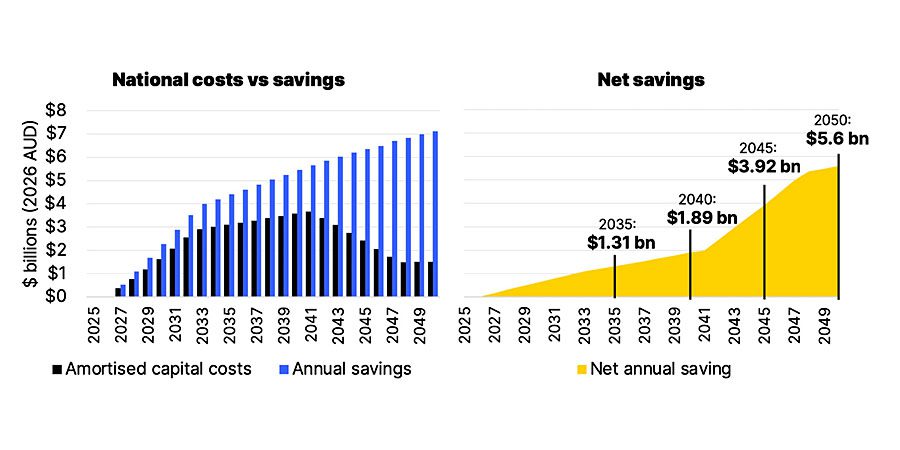
Costs vs savings of rental property upgrades under a 15-year financing model (IEEFA modelling) Source: Institute for Energy Economics and Financial Analysis (IEEFA).
Cutting Energy Bills For Everyone
Beyond household savings, upgrading rental properties could also deliver system-wide benefits.
Most regions would see reduced peak electricity demand in both summer and winter, while replacing gas appliances with efficient electric alternatives would significantly cut gas use.
In Victoria, electrification could slightly increase winter peak demand, but this would be offset by much larger reductions in gas consumption.
Requiring Solar Upgrades For Renters
IEEFA says the findings highlight growing pressure on governments to find a more effective way of upgrading Australia’s rental housing stock.
With renters making up a growing share of households, Australia’s rental energy gap is unlikely to close without minimum standards, according to the analysis — shifting policy from encouraging upgrades to requiring them.
For more on insulation, efficient electric appliances and rooftop solar, see SolarQuotes’ guide to energy efficiency.
 About Kim Wainwright
 RSS - Posts





In my experience rental owners often use these properties as stepping stones or money builders to renovate later,no one wants to pour money into something their going to replace or rebuild,this idea may add to the housing build problem by taking workers off new builds prematurely before the landlord is ready to renovate,this could also produce rich landlords only and drive little investors out of the market.
Owners of rentals can claim depreciation on improvements including solar through their tax. If on the highest tax rate is almost half the cost – however is depreciated over 20 long years (in much the same way as a new pergola etc).
With an improvement that would help us Nationally, I think if the depreciation period for assets such as solar was reduced to 10 years, there would be a big uptake. The proviso should however be that if renting was subsequently discontinued, then depreciation benefits would be cancelled.
A win for rental owners and their property value, for renters, for our energy transotion and for the economy.
Plus one!
Although I feel five years depreciation on selected ‘energy saving’ improvements.
Agree that five years would be great but maybe too quick. Maybe 7 years a good compromise. Need to assess what is the tipping point – to have the same great response as for the battery subsidy. This would be aimed at helping renters that comprise 30% of residences (35% are owned and with solar with balance of 35% owned and without solar). Politically this would be a winner – at a much lower cost than the battery summary. Bring it in before the next election!
Depreciation on solar and battery is 13 years. However the way the rate works halves this. And this adds to neg gearing which may no.longer be permitted for newly acquired assets. Further if the owner uses the property at all the depreciation is no longer available.
The owner must fund the purchase and installation. Many cant afford $20000 or more. Or the property is unsuited.
Why dont renters buy themself a property? Thats the real issue. Wht should a landlord have this burden….will the renter pay more? I bet if asked the answer is “not much” or no.
Then device management will fall on the landlord so if its overcast wet etc the system may underperform. Tenants will make tribunal claims for their imagined losses
Hi Paul,
Perhaps if a landlord can’t afford to make the place amenable they should wind back on the coffee & smashed avo?
In a competitive market, the annualised capital gain means some pick up an average Australian wage each year. Not only do landlords have serfs to pay the mortgage, their unproductive investment in existing housing will extract the value of an additional worker from the broader economy.
If they really can’t afford such a burden, they could offload the place to the tenants perhaps?
Except many can’t afford ludicrous rent and the eye watering deposit required, so they have no choice.
Under Howard the average wage would no longer buy the average house.
Now it’s unaffordable for TWO wages.
I don’t know why they don’t develop a system that allows owners the ability to sell the electricity they generate from the solar they install on the roof to the renters. That would incentivise the owners to install solar.
Hi Kevin,
Electricity retailing is a pain. Legally you can’t make a profit, as a landlord electricity has to be passed through at cost. ie caravan park owners can’t put a margin onto power.
However if you’re generating & want to sell power, the retail rules mean you have to have a hardship policy, payment plans, ombudsman service, translation service etc etc. It’s onerous.
Most people come to an amicable agreement and just pay a certain rate accumulated by a dumb downstream meter.
Or they simply charge a bit more rent.
The dilemma would arise for houses that the owner intends to knock down —where it doesn’t make sense to spend large amounts of money for a short-term benefit.
In an ideal world, the owner would either bring forward their knock-down or sell to someone who can afford the rebuild straight away. But here the evil of stamp duty enters, because the costs of selling and later re-buying are uneconomic.
This is yet another reason to abandon state-based stamp duties, and shift (as every economist in the country advocates) to an annual land tax. Yes: you would exempt people who have recently paid stamp duty from the annual tax.
Hello
You should dedicate an article to solar owners who have lost money on solar.
In my case spent thousands on solar and it is an investment loss. Landlords who have to comply with mandatory rules should be compensated by government on the losses, of complying with rules.
Solar installation rules keep changing. I read on SolarQuotes from time to time if your system is like this, it is best to have it all removed and redo another installation, even if the previous system has not paid for itself.
SMA have quit the Australian domestic market, so if you have SMA installed when it is required to replace the inverter, another brand will have to be installed and the whole system upgraded. In my case I will switch it off and give away solar due to the losses mounting up. A long term loss making investment. I am sorry I even bothered with solar, I would have been better off making a diferent investment choice.
Hi Neil,
“Landlords who have to comply with mandatory rules should be compensated…”
I’d like to say the entitlement astounds me, but sadly it doesn’t. It’s the reason that we, as a society, can’t have nice things.
Whingers seem to think the govenrment should guarantee they can get rich without risk.
They bray like donkeys… what about ME! and my unproductive speculation. How can I ever build a “portfolio” of serfs without tax breaks to drive the ponzi scheme…
Screw the 17% of kids living in poverty & women over 50 (fastest growing cohort of homeless) Raise the rent from awful to extortionate because f#ckem I’m alright Jack?
Serves ’em right for being poor, rent increases & powe bills will teach them a lesson.
Hello
I think mandatory insulation is a good thing, since it is a passive good thing. Solar is dynamic and expensive and needs regulating. In my case the solar has become a bottomless money pit forever throwing money down a hole never to be recovered, and to mandate that kind of outcome is wrong. I am not a landlord, and I part agree in what you say, but forcing landlords to put in solar is wrong since it is continually needs replacing and updating, and suppliers are not always going to be there, as noted in some articles on SolarQuotes.
From my experience, I have come to the conclusion renters are better off putting some money into an investment and use the return on that to pay for their power bill, instead of bothering with solar.
If a landlord has to spend $10,000 to get a government mandated solar system installed, that translates to about an extra $20 rent per week to cover the expenditure, plus another $10 per week for lost bank interest.
While an extra $30 a week isn’t a lot perhaps in the grand scheme of things, given how high rents already are, could that $30 be the straw that breaks the camel’s backs?
And of course if the landlord charges for the free power provided i.e. shifting costs off the tenant’s power bill and into the landlord’s pocket, that figure could double.
Tell us John
Do house hoarders charge extra for safety switches? smoke detectors? fly screens? kitchen exhaust fan? air conditioning/heating?
These are also legally mandated minimum standards.
It’s illegal to put a margin on electricity. Eg caravan park owners are obliged to simply pass through the rates they pay.
Retailing electricity requires proper administration, not just a bill but hardship policy, translation service, ombudsman access.
It’s about time the investor class realised that government isn’t here to help them accumulate wealth on the back of serfs who have no other option but to rent.
We’d all be better off with post WW2 policy if we’re being honest.
By house hoarding do you mean those who operate rental properties, or those who follow the Oriental, and maybe Russian, model of stockpiling multiple unused, even never lived in or used, houses or other properties?
If the latter then there’s nobody to charge. If the former … then maybe – I vaguely recall AC being pay 2 use whilst overseas some years back.
Who said anything about putting a margin on the electricity tenants buy from the grid? I’m talking about the electricity the landlord’s solar system supplies to the tenant. If they don’t pay for it, then they’re getting free power for nothing while the landlord is getting zero return on capital. Worse arguably, is that any exported power would be credited to the tenant’s account as they’re the bill holders.
Government is mostly comprised of members of the investor class, and they’re most likely to rub shoulders with other members of the investor class, or elites, not serfs. My own MP is a good example of the closeted type!!!
Hi John,
I sometimes wonder if people who miss the point are willfully ignorant or just a bit dim? If you want to sell power you generate, you have to be a retailer, and meet the obligations other retailers do. However if you pass the energy through at cost, the rules aren’t onerous.
As a landlord who’s begrudging that tenants might get the benefit of “give away free power” have you imagined I could rent your house, then get myself an account with Amber, and give you the bill for energy exported during negative pricing?
Maybe you could put in a rainwater tank and charge for the free water? Like medieval landlords used to charge the serfs, that were attached to his estate, for living there.
How do you “lose”?
Since we went solar and battery our bills have ended..But we chose to invest to do that. It was a literal investment in our cost savings. We get payback. We benefit long term….Just as we chose to buy our home. Rebters choose to rent and forego these things.
Hi Paul,
Nice position to be in really. 30% of Australians rent so they’re not as lucky.
My first 3kW of solar cost $12k just for the panels & inverter.
When did you buy your house?
Hello Paul
How do you lose? Easy. Buy solar and inverter, add an AC coupled battery. The plan is if anything breaks down you change like for like, but then your original inverters are not available anymore, so you need to get another brand of inverter, so that requires rewiring plus making everything comply with the latest rules. The problem the solar does not comply with the latest rules, so even though the system has not paid for itself, it looks like most of the old system goes to the tip, before it pays for itself.
I bought a good quality solar panel that should have lasted 30 years, that may not work out due to rules. I am expecting a loss of some $25000.00.
Have you considered that folk who miss your point are actually brighter than average, neurodiverse, and\or simply operating off a different paradigm to you?
For instance take your margin comment:
margin
n
8. (Commerce) the profit on a transaction
9. (Economics) the minimum return below which an enterprise becomes unprofitable
In the above it’s clear that commerce margins and economic margins are fundamentally opposite paradigms.
Your point about selling power, and rules not being onerous if sold at cost, implies there are rules which still may be a hassle. Is selling solar to a tenant retail?
I’ve never had the hassle of being a landlord, but no I don’t believe you could setup an electricity account, then seek to pass on the cost.
Yes probably. If landlords can charge for AC (past experience), why not tank water?
Serfs – debt bondage or indentured servitude, they owed their lords service, were bound to particular land, and the practice variously outlawed 16th-early 20th century.