
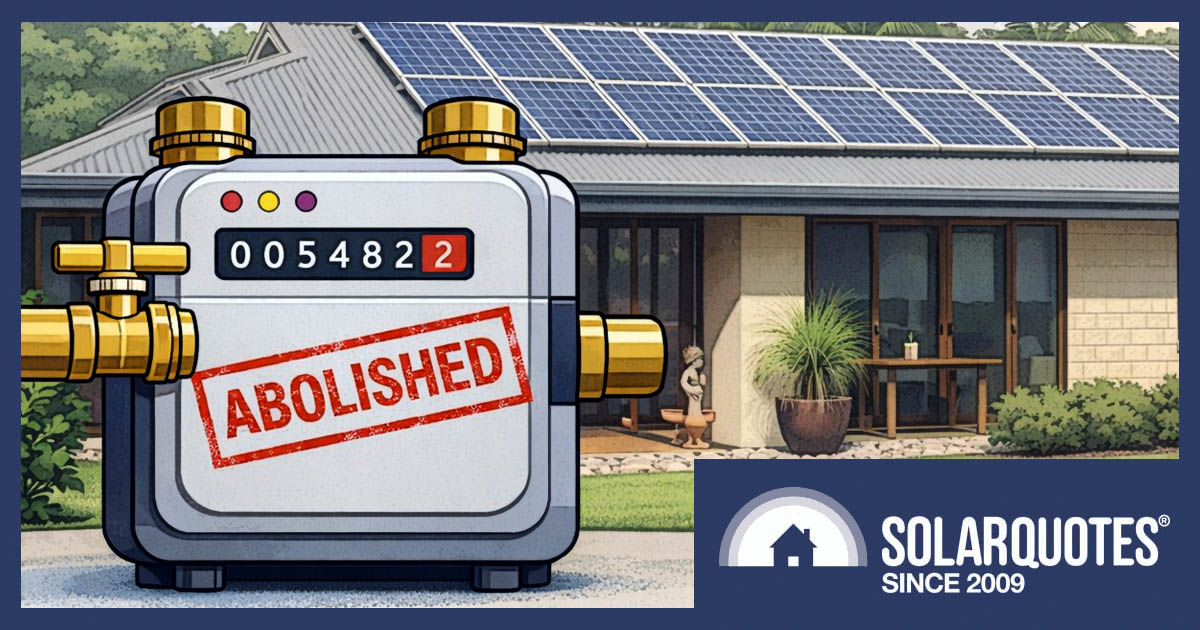
Households looking to disconnect from gas — and switch to electric alternatives — will soon have a clearer and more consistent pathway, following a final determination from the Australian Energy Market Commission (AEMC).
The changes introduce a formal system for “gas abolishment” — the permanent removal of a gas connection — to improve transparency, define responsibilities, and better manage charges as more households consider electrifying their homes.
What Has Actually Changed?
Leaving the gas network is now recognised as a service. Previously, regulations focused primarily on connecting homes to gas, with little guidance on permanent disconnection.
Under the new rules, gas distributors must offer abolishment alongside connection and disconnection, giving residents a consistent process when deciding to exit the network. Formal recognition of abolishment also clarifies responsibilities for providers and consumers, reducing confusion and helping prevent unexpected fees.
“Importantly, these rules do not create a barrier for customers who want to switch away from gas. Customers can make the switch and then decide whether to disconnect or abolish their gas connection based on what is right for their circumstances,” AEMC Chair Anna Collyer said.
A Clearer Approach To Costs
The determination reinforces a “user pays” approach: households requesting a service — including abolishment — cover the efficient cost of that service.
For homeowners, this improves understanding when seeking quotes and reduces uncertainty about what’s involved. It also addresses an underlying challenge for the gas system: as demand declines, fixed infrastructure costs risk being spread across a shrinking customer base. By linking charges directly to customers who trigger them, the Australian Energy Market Commission aims to limit cross-subsidies and ensure fairer cost allocation.
Currently, costs for abolishment vary by state and network. Some jurisdictions have price caps that keep fees low, while others may involve higher amounts. Permanently abolishing a connection can also be significantly more expensive than a standard disconnection, making it important for households to check with their local distributor for the latest pricing.
In states where caps apply, including Victoria and New South Wales, current arrangements are expected to remain in place until the end of existing regulatory periods later this decade, although future pricing will depend on state government decisions.
Guidance For Gas Customers
The new rules introduce obligations for both distributors and retailers to provide better guidance:
- Distributors — must provide quotes, outline expected timeframes, and explain what each service (disconnection or abolishment) involves.
- Retailers — must provide general information and direct customers to their distributor for detailed costs and timelines.
These obligations take effect on 1 October 2026 for distributors and January 2027 for retailers.
Homeowners will benefit from clear, upfront information on costs and processes, making it easier to decide whether to stay connected, disconnect temporarily, or fully abolish their gas connection. While fees aren’t directly reduced, improved transparency and guidance help homeowners plan their transition to electrification with confidence.
Adapting To Declining Gas Use
Beyond immediate consumer impacts, the determination reflects a shift in how the gas network is managed. Regulatory rules have traditionally assumed stable or growing demand, but increasing numbers of households are now leaving the network.
The AEMC emphasises that residents should be able to exit gas while ensuring charges are allocated efficiently and fairly (these rules apply to east coast gas markets; Western Australia operates under a separate regulatory framework).
For more on getting off gas, read our explainer on the costs of gas abolishment versus disconnection, and our deep dive on how much getting off gas can save you.
 About Kim Wainwright
 RSS - Posts






Which will probably lead to more people just cancelling their service and leaving the redundant infrastructure in place.
I don’t see that as a problem, the main service will probably be decommissioned in less than a decade, so why pay to have it physically removed now.
A good move. However, while it doesn’t affect me directly as I am bottled gas with low use and will change soon, I have two issues to raise.
Firstly, what is likely to be the end user cost effect of the government’s proposed gas reservation policy on prices. As more people shift off gas one would expect price competition to increase and therefore gas to fall in price. That may then reduce the incentive for people to get off gas which we need to achieve for health and environmental reasons.
Secondly as more people do get off gas regardless of whether they disconnect or remove the supply the fixed price of maintaining the network should start to increase and later spiral upwards rapidly until it is completely unaffordable for most who remain. Then government price controls may need to be implemented so gas distributors will lose money and need financial support. Also for those who still can’t afford to change, changeover costs may need to be paid in full.
Problems ahead.
The final step in making our house electric was to get rid of the gas stove and replace it with an induction cooktop. The surprising thing to me was the cost of installation apart from the cost of the cooktop. We had two quotes of $1,800 and $1,900. It seems to me that the $140 potential rebate is not worth the trouble of pursuing.
Unfortunately for me my last gas appliance is a Brivis Wombat ducted heating unit in the roof of my 2 story house. I’ve been told multiple times there is no practical alternative as a heat pump unit can’t be retrofitted in the roof, the ductwork is not suitable, or alternatively, cannot be connected to a new external unit outside the house. So no heat pump for me.
That’s one way to spin in it. Another way is that a ‘cost reflective approach’ means it’s about to get a lot more expensive for an abolishment in the places where it is currently cheap because it’s subsidised by the gas company.
For a low use (cooktop only) household, the spiralling daily supply cost makes it uneconomical. A simple switch to bottled gas is one answer. And, for those who say that is still bad for the environment, I suppose gas barbecues should also be banned.
I found it to be more of a health issue so your I suppose is a weird comment.
Gas in the home is just crazy. We have removed gas from the home and after years of my family having health issues they just went away. We had been slowely killing ourselves. A friend asked how we seem a lot bette rnow with him just having your kids and I explained when we did and he removed from the house to find his young ones are a lot happier now.
We both still have gas BBQ and charcoal grills outside where they belong
Some premises are not amenable to going all or even ‘more’ electric because they do not have the electrical capacity in the walls ($$$ to rectify) and sometimes not at all ($$$$$$$$$$$$). It is getting really tiring how ‘we’ are being constantly marginalised for not being on the bandwagon.
EVs? household grade chargers are not available to everyone for various reasons from apartments to strata problems to ‘what is the cost and how does one pay’?
This ‘saving money’ seems mostly for those those who might not need to?
CF: – “Some premises are not amenable to going all or even ‘more’ electric because they do not have the electrical capacity in the walls ($$$ to rectify) and sometimes not at all ($$$$$$$$$$$$).”
Gas will only get scarcer and more expensive.
https://www.solarquotes.com.au/blog/how-to-protect-your-home-from-the-oil-gas-crisis/#comment-1733358
Electrification is the cheaper long-term option for households.
CF: – “EVs? household grade chargers are not available to everyone for various reasons from apartments to strata problems to ‘what is the cost and how does one pay’?”
Excuses, excuses! I’d suggest for most people, a nearby 10 A (or 15 A) GPO is probably adequate for EV home charging. For the few occasions when faster charging is required then go to a nearby public faster charger.
https://www.solarquotes.com.au/blog/quitting-petrol-for-electric-home-ev-charger/
Our ongoing dependence on oil/gas is a risk to our climate, energy security & cost-of-living.
Geoff Miel -> Excuses, excuses!
You confuse reasons and reality with excuses. Dismissal (dare I add ridicule?) of some people’s situations is not a good look.
Nobody here is denying electrification is a necessary goal. Some think it is easy and others have impediments. With payback sometimes still in the 8-20 year range, even with rising prices some can manage that incremental cost better than an all-at-once expenditure, government programs or not.
CF: – “You confuse reasons and reality with excuses.”
Here’s reality for you: Burning more carbon-based substances is ‘civilisation suicide’!
https://www.ipcn.nsw.gov.au/sites/default/files/2026-02/Geoff_Miell-PresentationSlides-ChainValleyCollieryConsolidationProject%28SSD-17017460%29-20260216.pdf
https://www.ipcn.nsw.gov.au/sites/default/files/webform/make_a_submission_chain_valley_c/26506/Geoff_Miell%27s_Additional_Submission-Chain_Valley_Colliery_Consolidation_Project_SSD-17017460.pdf
The Laws of Physics are not negotiable! Either we/humanity rapidly reduce our GHG emissions, perform large-scale atmospheric carbon drawdown, and use solar radiation management methods to protect people and nature, or we won’t have a planet compatible with our civilisation well before the end of this century.
What price do you put on preserving your (and your family’s) lives & livelihoods into the future?
https://www.climatecodered.org/p/what-scientists-say-about-societal.html
Geoff Miell -> Here’s reality for you:
Since you struggle with some people’s reality (seems you are one of the “I am OK so everyone must be OK’ types?) and prefer flogging a dead horse I’ll pose the simple question. Assume you have $1,000 saved and no credit available. Converting your gas to all-electric costs $10,000.
Your Bunnings reference, the meaning of life, climate change, entreating whichever god you choose to worship or not, or government, have not yet stepped in to bridge the gap of $9,000. Handle it.
Please take your soap box elsewhere since all or at least most of us here are not arguing the point, just pointing out issues with the economics of getting there. I you want to continue preaching to the choir maybe send your CV to Finn.
I could reasonably argue that your proposition is not fit for my purpose because it is beyond the scope of what I am capable of doing. Don’t tell me what I have to do tell me what I can do.
CF: – “Since you struggle with some people’s reality (seems you are one of the “I am OK so everyone must be OK’ types?) and prefer flogging a dead horse…”
It seems to me you presume things about me.
What “flogging a dead horse” do you mean? Climate science? Are you a denier of climate science/reality, CF?
CF: – “Converting your gas to all-electric costs $10,000.”
Evidence/data?
https://www.climatecouncil.org.au/resources/free-from-fuel-chaos/
Has the world now entered into a permanent post-peak oil/gas supply paradigm? We’ll see…
https://www.solarquotes.com.au/blog/why-petrol-is-so-hard-to-quit/#comment-1733827
Stay with petroleum/gas & cost-of-living will only get worse!
Seems to me getting off gas just got a whole lot more expensive. I fail to se3 how you can spin this as a “good thing”. It should be free. There is no “real cost” to turning off a tap.
The cost is for removing the physical infrastructure to deliver gas into a property.
If I understand correctly, the discounted (socialised) cost will continue to apply in VIC and (from July 2026) NSW until 2030 and only after then will it get expensive.
Yep and it is still ridiculous. Why should we pay to turn off the supply of a product? It’s a business and like every other business if the product doesn’t sell that is their problem, not the consumers. People keep talking about social cost when the majority of Australia’s gas networks are privately owned.
Gas disconnection hack….. tell Gas retailer that you are moving and want your final read and then close account. The infrastructure can just sit there for all I care…. No more Gas Bills…
The cost of getting out of gas and going electric? The figures I am using are approximate and allow for rebates in Victoria. Replacing gas ducted heating with reverse cycle ducted electric air conditioning — $16k, gas stove replaced with induction cooktop — $4k, gas hot water heater replaced with electric heat pump system — $2.5k. Ideally 13.2kW solar panels and 10kWh battery with inverter and backup box would be a good addition — $20+k. This is obviously a substantial outlay, in our case the gas ducted heater and hot water system were near the end of their lives so we have saved that expense. A good start would be to replace gas in heating water, especially if you have an old system at present.
I’m a Victorian, and have fully electrified by 60’s gas unit last July. My figures were slightly less than yours, but just as a comparison, it cost me:
* Gas hot water (tank) -> heat pump: $3k (mid range)
* Ducted gas heating -> multihead RCAC $8k (my family, especially my children love this system! High end system)
* Gas stove -> Ikea induction cooktop $2k (mid range)
* 15A socket for charging my EV $500
So that is $13,500 to get off gas completely. Still a lot of money for sure, but a fair bit less than what you are suggesting, and with decent appliances. Another benefit is that because the running costs are so low, the family feels free to use what they want, when they want, so we are overall much more comfortable in the home. I think this is an important part of the transition that is worth mentioning.
These costs are still significant. Part or full pensioners who own their own homes can access the Home Equity Access Scheme loans through Centrelink. It is possible to borrow half a years full pension at 3.95% interest, loan and interest only repayable when the house is sold.
One gets the impression that gas is naturally on the way out, we are just dotting the i’s and crossing the t’s.
Brand new houses and units built where I live, have gas meters. The developers didn’t get the memo?
Hi Magy,
Sadly builders are conservative in that they just like doing what they know makes money. Few give a toss about the occupants.
The worst are the developers for places like Mount Barker in South Australia.
I don’t know who is paying who, but the people buying the housing blocks are being forced to connect gas under an encumbrance.
They are compelled to have a gas HWS or space heater.
Worse still, the whole system is running LPG from large bottles at the end of the street, as mains methane needs 35km of pipe to reach the town.
It costs residents twice as much and the gas industry hasn’t committed to sinking the money on the transmission pipeline.