

Australia’s push to expand EV charging in apartment buildings has received a boost, with ARENA awarding $1.51 million for a lower-cost charging-as-a-service rollout across strata apartment buildings.
How Can Apartments Share Power Points For EV Charging?
The project, developed by EV charging provider ReadySteadyPlug, combines standard power outlets with dedicated EV distribution boards, modular metering, dynamic load management, and cloud-based billing systems designed specifically for multi-residential buildings.
Over three years, the rollout will target at least 64 apartment sites, including installation of up to 428 charging outlets and supporting infrastructure.
ARENA says the project will test the technical and commercial viability of low-power apartment charging, while also examining whether a charging-as-a-service model can help reduce barriers such as high upfront costs, landlord hesitation, and slow strata approval processes.
In practice, this may provide an early entry point for apartment EV charging.
An Early-Stage Solution For Apartment EV Charging
Slow charging from a standard household outlet is already common in detached homes, where vehicles often remain parked overnight long enough for a full recharge.
Apartments are more complex, with residents parking and charging at different times and for varying durations, all within the limits of existing electrical capacity.
ReadySteadyPlug’s system combines low-power charging with central load management, individual metering, and automated billing so residents are charged only for the energy they use.
The company says this can avoid the need for major electrical upgrades, helping lower upfront costs for owners corporations and residents.
For apartment complexes that would otherwise struggle to justify dedicated EV charging infrastructure, this may make early-stage rollout more achievable.
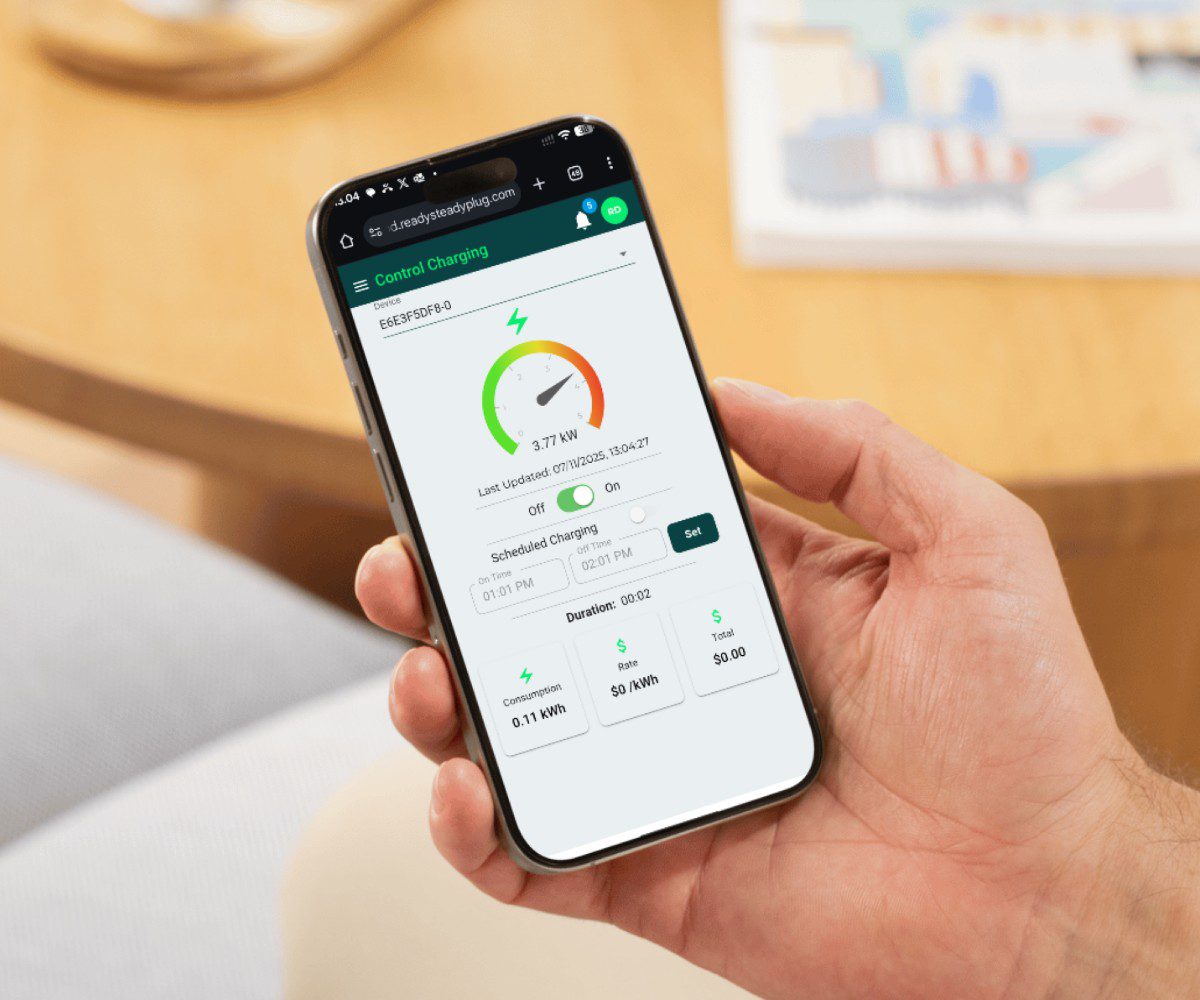
ReadySteadyPlug’s app provides key information and the ability to schedule charging.
Can EV Charging Be Added Without Major Upgrades?
Claims that these systems avoid electrical upgrades need context. Whether upgrades are required depends heavily on a building’s existing electrical capacity and configuration.
Factors can include:
- available spare capacity in the switchboard
- condition and age of existing wiring
- whether parking areas already have suitable electrical supply
- overall electrical demand across the building
Importantly, ReadySteadyPlug’s system includes dedicated EV distribution boards and supporting control infrastructure. It is not simply a case of adding outlets to existing circuits without modification.
In some buildings, EV charging can be introduced with relatively minor changes. In others, additional work such as new circuits, protection equipment, or switchboard upgrades may still be required — though often less extensive than a full high-capacity charger rollout.
When EV Uptake Grows
The key question is how well shared low-power charging holds up as EV ownership increases within a single building.
A system based on standard outlets can work effectively when EV uptake is low and demand is manageable. However, as more residents adopt EVs, overnight charging demand increases.
Even with dynamic load management, a building’s total electrical capacity doesn’t increase — it is simply shared across more users.
At higher levels of adoption, many apartment buildings are still likely to require higher-capacity charging infrastructure to reliably meet demand.
A Stepping Stone To Full Scale EV Charging
This funding doesn’t solve apartment EV charging on its own, but it supports a pathway for buildings that might otherwise delay installation.
Systems like the one developed by ReadySteadyPlug may help enable earlier EV adoption in strata buildings where spare electrical capacity is limited or major upgrades are difficult to justify upfront. However, as EV uptake increases within apartment buildings, many complexes are likely to eventually require more substantial electrical upgrades to meet demand.
For existing strata buildings, this ARENA-backed rollout of lower-cost managed charging systems may still offer a stepping stone to full-scale EV charging infrastructure.
If, however, you’re more interested in faster EV charging for apartments, read our explainer on how to convince your strata to approve EV charger installs.
 About Kim Wainwright
 RSS - Posts






Great idea. As there are 4 or 5 or more car spaces between pillars, I wonder how this will work out in the future without extension leads as EVs become more popular and drivers rush for the pillar positions to charge.
Also, if the idea catches on it could be extended to shopping centre underground parks.
The ap billing, from I assume, identified and labeled outlets that you will have to enter into your ap to start the charge is sure to be a winner.
Hopefully any additional wiring they install is sized for future charging speeds. Otherwise we’ll end up with a rip‑and‑replace job later and a much bigger bill than doing it properly the first time.
Picking favourites using tax payers funds is not fair for the rest of us who pay our taxes and pay for our own home charging infrastructure.
Yes indeed an issue but I also understand the individual in a strata complex cant convince the majority to subsidise their installation infrastructure uogrades. So what to do to get to the next level?
If your home switchboard faced the same issue you to should be entitled to an upgrade rebate.
These endless rebates are blowing out our national debt which we and our kids and their kids will be paying for in more and more taxes.
Hi Bruce,
Debt isn’t a bad thing, especially when the government never dies and also prints it’s own money. You can’t compare a household or personal budget to the government. Those who ask you to are deliberately trying to obscure the way the economy works.
When debt buys productive assets, like the Sydney Harbour Bridge for instance, everyone who uses it saves money every day. Even though it wasn’t paid off until 1985(?) it’s an incredible asset for those who weren’t even born when the loans were drawn up.
Same goes for shorter lived assets, EVs cut air pollution, which makes the whole population healthier and lowers health care costs. If you grow up with asthma it can be a curse for your whole life. SO paying a rebate to get rid of gas stoves and diesel trucks would in fact be a massive boon for everyone over the next 80 years.
We could perhaps stop giving the mining industry cheap diesel, and thus make it economically attractive for them to invest in electrification.
Mining companies pay full price for diesel they just dont pay the road user tax as their vehicles/machines run on mining owned roads. They do, however, pay royalties for mining extraction which the rest of do not pay even though we use the land for housing, farming etc.
Hi Critic,
If you reckon that all the fuel excise raised goes into roads, and not just general revenue, I have a bridge to sell you, along with mining rights for the moon.
In Australia, the fuel tax credit system refunds about $4.8 billion to miners while agriculture gets about $1.3 billion.
Mining receives roughly 3.7 times as much as agriculture based on those 2024-25 estimates. Put another way, mining accounts for about 50% of total payments, while agriculture is around 15%
One industry literally ships bits of the countryside overseas, the other buys fertiliser in, feeds us and sells the surplus product, not the dirt.
If we tax fossil fuel, we’ll improve the budget, improve the foreign account and get less air pollution for our trouble.
Yes you are correct farmers get a fuel rebate as do miners as they do not use public roads. Fuel tax was always setup to help fund roadworks and its maintenance that was its purpose since its creation. Given the size of current funding on roads its topped up from general revenue and I am sure politically it would be suicide to cover 100%.
The tax exemption for mining/farmers was to keep Aus businesses competative with other competing countries that have substantial subsidies for their miners/farmers and to offset the cost of transport to far off countries.
Mining royalties are applied to extractive industries to compensate the community for one off use of commodities. Orher countries do it differently some have a free minority stake in the mining business but Aus has had a royalty scheme prefering to stay away from the ups and downs of markets and therefore dividends payed.
Australia needs laws to enable owners in apartments the right to garage and house BEVs and to have facilities for charging. Specialist tribunals with building and electrical installation expertise should make decisions on site.
Ta Kim & Anthony,
Useful article, under-done topic as many Australians are apartment dwellers!
However, I don’t really agree with:
“At higher levels of adoption, many apartment buildings are still likely to require higher-capacity charging infrastructure to reliably meet demand”.
Indeed it could be the opposite…
Level 2 (L2) charging is arguably most advantageous at low levels of EV strata adoption, as you never get ramped down and there’s no congestion.
Whereas at full saturation strata headroom has to be rationed either by load management or lower thresholds each. For example, for a block of flats sharing a 100A per phase 3 phase connection, then 3 flats on per phase @ 32A with L2s with would likely trip, necessitating load management and ramping. And if there really is saturation and everyone is charging at the same time then the load management system might ramp all users down to only 8a to 15a anyway, equivalent to a standard 15a GPO but way more expensive.
That said, congestion won’t happen all the time and L2s ability to ramp will be much more valuable as saturation approaches. But for each owner it will be the total KWH added overnight that matters and more congestions and ramping down will likely lower average charging speeds and the utility of expensive L2 infrastructure. So strata EV saturation charging is probably more likely to require expensive strata supply upgrades to meet demand, although by then public charging prevalence/price/quality is also likely to have improved materially…
In contrast, 15A GPO systems can be had much more cost effectively now, and will get more flats able to charge simultaneously – ie they can quite equitably share night time strata headroom without the overhead of fancy and expensive L2 infrastructure.
Though the sharing mechanism at peak is cruder (generally first-in-first-out round robin switch offs used by Ready Steady Plug, NOX, CET inCharge). For above example of flats sharing 100A per phase, you should be able to get 4 flats on overnight on 15A GPOs per phase no issues, with possibly no load management needed via diversity of load…
Strata committees also have to remember the ongoing running costs of managed systems can be material (and erode home charging savings). Most systems were effectively charging in the order of $2-3k per annum total to the Body Corp/Users for system overhead. Eg RSP charges around $13/mth/GPO + $900pa to Body Corp. But some providers have more equitable pricing, like NOX at 5c/kwh per user (rather than flat fees which disadvantage low-volume flats).
Our strata investigated RSP, NOX, AlchemyCharge and CombinedEnergy InCharge; and also SEVR PODIS system with Zaptec AC V2G L2s. Each had strengths. In my assessment NOX, dominated AlchemyCharge, but RSP was a better system (though higher running costs). Overall I thought the http://www.combined.energy/incharge-ocn system was the most sophisticated and cost-effective package, especially as it allows the option to expand to L2s later, and it includes power-line-comms (no need to run cat6) and metering already.
Whatever strata do I agree they should run 10mm or 6mm cable min, to avoid need for expensive re-cabling in future, whatever system is chosen.
Please do more on Strata EVSE options – it is a difficult area and more info will help other Strata’s get started…
Our building was not willing to take a bet on any system that is locked to one provider, only Alchemy Charge is unlocked and ultimately was selected for our strata meeting last week. Our strata complex is split over 5 buildings and has 692 parking spaces. NOX was slightly cheaper on price but having seen one in person in Bondi it’s felt inferior.
We didn’t know about RSP, this article sounds good but it looks like its locked?
Thank you
Joanne,
Great to hear you are on-board with a strata charging system!
But what do you mean by locked to one provider?
Do you mean for billing, load management or comms internet? Presumably the former?
How does AlchemyCharge not lock you in to AlchemyCharge given they provide the “smart GPO” and billing services and then charge 10c/kwh (vs 5c for NOX)? Isn’t your strata locked to AlchemyCharge forever for billing?
If you don’t pay, presumably AlchemyCharge would cut off the smart GPOs and not let a charging session be initiated? If they dont lock you out presumably they wouldnt provide billing services for free?
That said, I agree provider lock-in is a risk that could leave a strata exposed to future unreasonable pricing increases for load management & billing services (captive market)?
I am not aware of any system that is not locked, except perhaps a hobby HomeAssistant self-build (which we assessed as not robust enough)?
Curious to know more details?
Hi Rob,
We will be using the Alchemy Charge SmartPoint on a different charge point operator, this means we wont be using the Alchemy app and Alchemy wont be doing any of the billing or ongoing support, its all done by the network we are choosing to go with.
We have the option to change providers if we want, this means the hardware is not locked to any provider. This was the most important factor for us, think tritium, chargepoint, EO etc.
Why aren’t we using Alchemy? We already have some AC chargers on site on another network and we are happy to continue to use them.
You mentioned NOX and 5 cents, one thing we noticed when comparing Alchemy to NOX, NOX has a transaction fee listed in their FAQs which is 4%, when you look at the difference between Alchemy’s 10 cents with no transaction fee vs NOX 12 months at 5 cents plus a transaction fee its pretty close.
Regards
Joanne
That’s super helpful and very interesting,I wasn’t aware you could split provision and hardware, thanks ever so much!